Drone Inspections for Campus Roofs & Gutters + CMMS Integration
By Jamie lanister on April 13, 2026
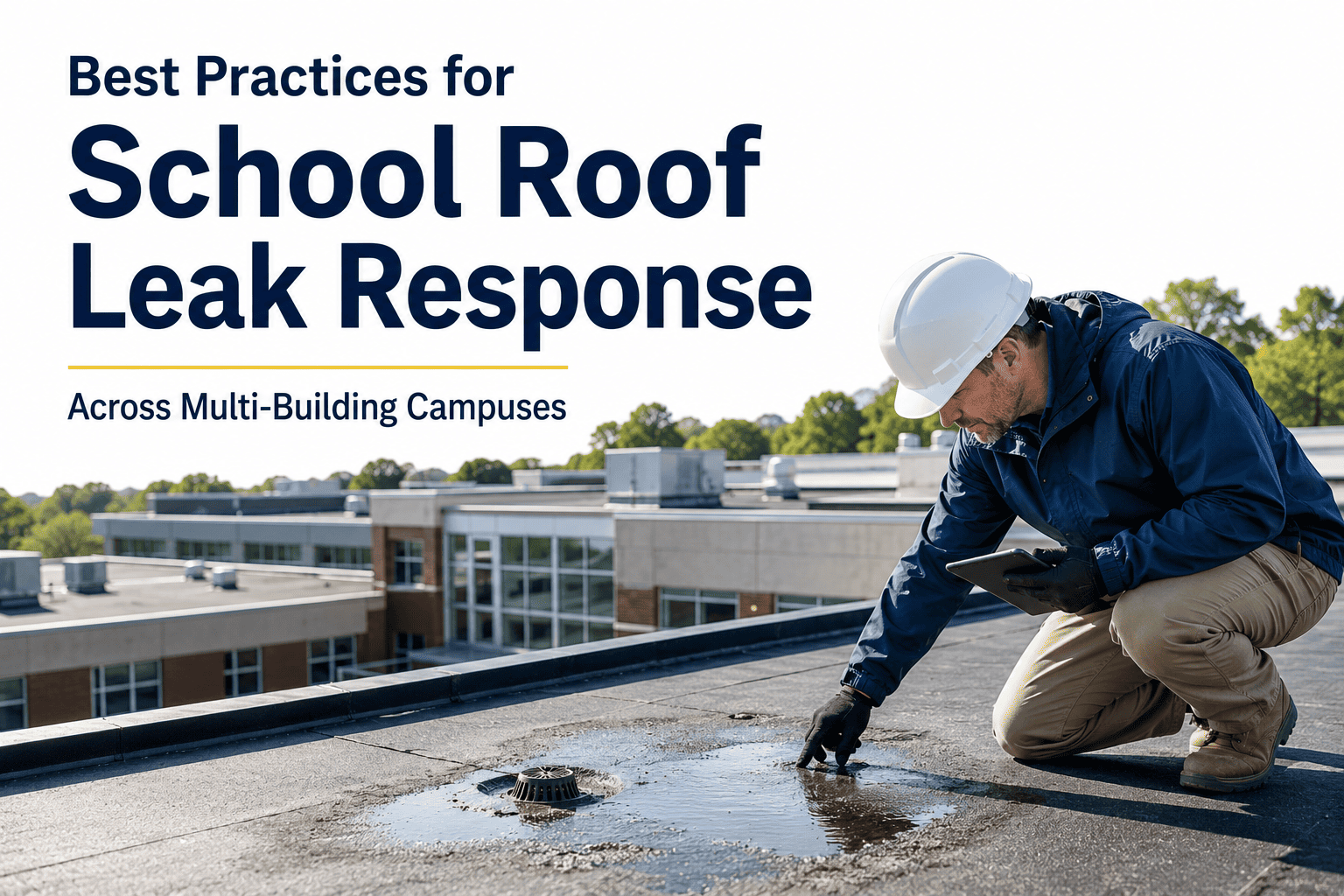
A facilities director at a mid-size university in Ohio discovered a failed parapet wall flashing on Building 14 during a student housing move-in week in August — water had been entering the wall cavity for at least two seasons, and the damage had progressed to structural insulation and interior drywall on two floors. The emergency remediation cost $186,000 and disrupted 34 student rooms for 11 days. The roof had last been manually inspected 22 months earlier by a technician who accessed it via a roof hatch, walked a partial perimeter, and logged a general condition as "fair." A drone survey of the same roofline conducted the following spring found 14 additional defects — membrane blisters, clogged scupper drains, split coping joints, and a failing HVAC curb seal — none of which had been visible from ground level or the partial hatch walk. Manual roof inspections on large campus buildings are incomplete by design: they cover what a person on foot can safely access, and they miss the defects at parapet edges, behind rooftop equipment, and in drainage channels that are the most expensive failures when they occur. OxMaint integrates drone inspection data directly into CMMS work orders — so every defect a drone identifies becomes a prioritized, assigned maintenance action in OxMaint within minutes of the flight completing.
Drone Survey → AI Defect Detection → CMMS Work Order — All Within 30 Minutes of Landing
Campus roofs, gutters, parapet walls, and drainage systems inspected from the air — every defect automatically becomes a prioritized OxMaint work order with photo, GPS location, and severity score
Ohio university parapet flashing failure — 22 months since last manual inspection, 2 seasons of water ingress undetected
14 defects
Found by drone on the same roof — zero detected during the previous manual hatch-access inspection 22 months earlier
8×
More roof defects detected per building via drone vs manual hatch-access inspection — US facilities management benchmark
Six Campus Roof and Drainage Defects That Drones Detect — and Manual Inspections Miss
Manual roof inspections are limited to what a technician can physically reach and see on foot. Drones equipped with thermal imaging, 4K optical cameras, and AI defect classification see the entire roof surface, including areas that are inaccessible, unsafe to walk, or obscured by rooftop equipment. OxMaint AI classifies all six defect categories from drone imagery and generates work orders with severity scores and GPS-tagged photo evidence.
Membrane Blisters & Delamination
Highest failure cost — leads to structural ingress
Membrane blisters are invisible from ground level and often missed in foot-access inspections because they develop in low-slope areas away from roof hatches. Thermal imaging drones detect subsurface moisture trapped beneath delaminated membrane by identifying the thermal differential at dusk — the wet area retains heat longer than dry membrane. AI classifies blister severity and area in square feet, generating an OxMaint work order with repair urgency scored by the rate of growth between surveys.
Clogged Scuppers & Blocked Drains
Ponding water — accelerates membrane failure
Blocked scuppers and roof drains cause ponding water that adds structural load and accelerates membrane aging at a rate 4× higher than drained areas. Drones identify ponding locations from standing water reflectance and debris accumulation at drain openings. OxMaint work orders generated from drain blockage events are prioritised by surface area of ponding and proximity to building penetrations.
Parapet Wall & Coping Joint Failures
Most expensive repair — water enters wall cavity
Parapet coping joints and flashing at roof-to-wall transitions are the most common water ingress points on institutional buildings. They are also the least accessible to foot-traffic inspections and the most expensive to remediate when water has been entering the wall cavity for multiple seasons. Drones photograph the full parapet perimeter at close range — AI identifies open joints, split flashings, and displaced coping sections with GPS coordinates for each defect.
HVAC Curb Seal Degradation
High frequency — every rooftop unit is a risk point
Every rooftop HVAC unit, exhaust fan, and equipment curb is a potential water ingress point if its base flashing or counter-flashing has failed. Large campus buildings may have 20–60 rooftop units, each requiring individual seal inspection. Drones photograph every curb in a single flight. AI flags failed or degrading seals with thermal imaging that identifies existing moisture at the curb base — invisible in optical imagery alone.
Gutter & Downspout Blockages
Overflow and fascia damage — detectable before failure
Blocked gutters overflow onto fascia boards, soffits, and foundation walls — damage paths that are significantly more expensive to repair than the gutter cleaning that prevents them. Drones survey full gutter runs and identify debris accumulation, sagging sections, and detached downspout connections from overhead at angles that ground-level inspection cannot achieve on multi-storey buildings.
Skylight Seal & Glazing Failures
Interior leak risk — often first noticed from below
Skylight perimeter seals, glazing compound failures, and frame joint separations cause water to enter directly into occupied spaces — typically first noticed by building occupants after significant water has already entered. Drones inspect skylight perimeters from directly above, identifying seal gaps and glazing failures before water reaches the interior. AI generates OxMaint work orders with a photo of each affected skylight and GPS-tagged location for technician routing.
OxMaint — Drone Inspection + CMMS Integration
Every Drone Defect Becomes a Work Order. Automatically. In 30 Minutes.
Membrane blisters, clogged drains, parapet failures, HVAC curbs, gutters, skylights — AI-classified, GPS-tagged, and in the OxMaint work order queue before the drone lands.
Manual Inspection vs Drone + CMMS — The Defect Detection Gap
Manual roof inspection on a large institutional building takes 2–4 hours, requires fall-arrest equipment, and covers an estimated 60–70% of the roof surface in typical hatch-access conditions. A drone survey covers 100% of the roof surface in 25–40 minutes without any technician on the roof. OxMaint's drone integration converts that coverage advantage into immediate maintenance action for every defect found.
Manual Inspection
Hatch-access, foot traffic, visual only
Roof surface coverage per inspection
60–70% accessible
Defects detected per 10,000 sq ft roof
1.8 avg
Thermal moisture detection
Not available
Work order creation after inspection
Manual — 1–3 days later
Drone Survey Only
Aerial imagery — no CMMS integration
Roof surface coverage per inspection
100% — full perimeter and field
Defects detected per 10,000 sq ft roof
14.4 avg
Thermal moisture detection
Available — IR payload
Work order creation after inspection
Manual — report review required
Drone + OxMaint CMMS
AI classification → instant work orders
Roof surface coverage per inspection
100% — all zones covered
Defects detected per 10,000 sq ft roof
14.4 — all actioned
Thermal moisture detection
IR + optical — both tracked
Work order creation after inspection
<30 min — automatic
Technology Stack: Drone → AI → OxMaint CMMS Pipeline
The value of drone inspection is only fully realised when the imagery becomes maintenance action without a human bottleneck between the flight and the work order. Four technology components make that pipeline work automatically. OxMaint connects to drone inspection platforms via API to automate every step from defect detection to technician dispatch.
AI Drone Vision — Defect Classification
DJI Enterprise, Skydio, and Parrot Anafi commercial drones equipped with 4K optical and thermal IR payloads feed footage to OxMaint AI. Computer vision models trained on 500,000+ roof defect images classify membrane blisters, coping failures, blocked drains, and HVAC seal failures with 89%+ accuracy — generating a defect map with GPS coordinates and severity scores for every identified issue within 20 minutes of flight completion.
Thermal Imaging — Subsurface Moisture
Thermal IR cameras on drone flights conducted at dusk — when retained heat differential is maximum — identify wet insulation beneath roofing membrane that is completely invisible in optical imagery. OxMaint stores both the optical and thermal image for each defect location, giving the repair contractor documentation of both the visible surface condition and the underlying moisture extent before they open the roof.
AI Digital Twin — Building Roof Asset Record
OxMaint builds a digital twin of every campus building's roof — accumulated from successive drone surveys, manual inspection records, and repair work orders. The twin tracks defect history per roof zone, membrane age, last repair date, and projected remaining service life. Facilities directors use the building roof digital twin to prioritise capital replacement budget against actual condition data — not assumptions based on age alone.
SAP & ERP Capital Planning Integration
OxMaint roof defect work orders sync with SAP Plant Maintenance and campus ERP systems — repair costs are captured against the building asset record automatically. Multi-year drone survey data feeds the capital replacement model: buildings with accumulating defect rates are flagged for full roof replacement budget inclusion before emergency remediation costs exceed the replacement cost of the system.
"We surveyed 18 campus buildings with a drone in 3 days. OxMaint had work orders generated for 67 defects by the time I got back to my desk. The previous manual inspection cycle took 8 weeks and found 9 defects across the same buildings. We found a failing parapet on the library that had moisture behind it — we caught it before the interior damage started."
— Director of Facilities, Mid-Size University · 18 buildings surveyed · Ohio, USA
Frequently Asked Questions
Q1How does drone inspection data get into OxMaint work orders — does someone review the imagery manually?▼
OxMaint integrates with drone inspection platforms via API — AI-classified defects transfer automatically with GPS coordinates, severity score, and photo evidence. A facilities manager reviews the generated work order queue to approve priorities before dispatch, but no manual imagery review is required. The bottleneck between flight and action is eliminated.
Q2Does OxMaint support thermal imaging data from drone surveys — not just optical photos?▼
Yes — OxMaint stores both optical and thermal IR imagery per defect location. Thermal images are linked to the building asset record and the specific work order — contractors see the thermal extent of subsurface moisture before opening the roof, enabling accurate repair scope estimation and reducing the risk of incomplete repairs that miss adjacent wet insulation.
Q3Which drone platforms and inspection software does OxMaint integrate with?▼
OxMaint integrates with DJI Terra, Skydio Cloud, Pix4D, and drone inspection platforms including Roofr and Loveland Technologies via API and structured data export. Any drone platform that generates a georeferenced defect report in JSON or CSV format can integrate with OxMaint's work order creation API within a standard integration project.
Q4Can OxMaint track defect changes between successive drone surveys to measure deterioration rate?▼
Yes — OxMaint's building roof digital twin compares defect maps between surveys and flags defects that have grown in area or severity since the last flight. Deterioration rate tracking is used to prioritise emergency repair vs planned maintenance scheduling and to forecast when a defect will exceed repair-viable condition and require section replacement.
Q5Does OxMaint require FAA Part 107 drone operator credentials to operate the inspection workflow?▼
OxMaint is the CMMS platform that receives and acts on drone inspection data — it does not operate the drone. Campus facilities teams can use their own Part 107-certified operators, contract a licensed drone inspection service, or partner with OxMaint's certified drone inspection network for scheduled campus surveys that feed directly into the OxMaint work order system.
OxMaint — Drone Inspection + CMMS
Find 8× More Defects. Act on All of Them. Automatically.