A tenured physics professor at a mid-Atlantic research university submitted a maintenance request for a persistent ceiling leak in her faculty apartment on September 3rd. The work order sat in a shared inbox for eleven days before anyone acknowledged it. By the time a technician arrived, water had migrated behind drywall across two rooms, saturating insulation, warping hardwood flooring, and fostering mold growth behind the bathroom vanity wall. Remediation cost: $41,000. The original repair — resealing a second-floor balcony membrane — would have cost $600 and taken two hours. The university settled the professor's relocation expenses for $8,200 and lost a faculty recruitment advantage it had spent years building: the promise that campus housing "takes care of everything so you can focus on your research." Three other faculty residents submitted transfer requests within the same semester. Faculty housing is not a dormitory operation. It is a strategic recruitment and retention asset that competes directly with private-market housing — and the maintenance experience is the single largest factor determining whether faculty choose to stay. Universities managing faculty housing with Sign Up for Oxmaint's work order management resolve maintenance requests 74% faster, reduce repeat calls by 60%, and maintain the resident satisfaction scores that keep housing occupancy above the 92% threshold where the program remains financially self-sustaining. Book a Demo to see how structured work order management transforms faculty housing maintenance from a liability into a competitive advantage.
Work Order Response Time
74%
Faster maintenance response with CMMS-managed work orders vs. email/phone-based requests
Repeat Service Calls
60%
Reduction in callbacks when first-visit resolution is tracked and root cause is documented
Occupancy Break-Even
92%
Minimum occupancy rate for faculty housing programs to remain financially self-sustaining
The Four Maintenance Failures That Drive Faculty Out of Campus Housing
Faculty residents are not traditional tenants. They are high-value professionals with market alternatives, low tolerance for service failures, and direct access to university leadership when dissatisfaction accumulates. The maintenance issues that drive faculty out of campus housing are rarely catastrophic — they are chronic: slow responses, incomplete repairs, lack of communication, and the perception that nobody is accountable for the condition of their home. Each failure mode is directly addressable through structured work order management.
1
Slow Response to Service Requests
11-day avg. response without CMMS
How It Happens Without Work Order Management:
• Requests arrive via email, phone calls, hallway conversations, and notes slipped under doors — no single intake point
• No automated triage — urgent plumbing emergencies sit alongside lightbulb replacements in the same inbox
• No accountability tracking — nobody knows which requests are open, overdue, or forgotten
• Residents receive no acknowledgment that their request was received, creating frustration and duplicate submissions
CMMS Fix: Oxmaint provides a resident-facing request portal with auto-acknowledgment, priority-based routing, SLA timers, and real-time status visibility — average response drops from 11 days to under 48 hours.
2
Incomplete Repairs and Repeat Callbacks
38% callback rate industry average
How It Happens Without Work Order Management:
• Technician arrives without complete information about the problem — diagnoses on the spot, lacks the right parts
• No repair history per unit — technician doesn't know this is the third leak from the same fitting in two years
• Symptoms are addressed but root cause is never documented or investigated
• No completion verification — work order closes when the technician leaves, not when the problem is confirmed resolved
CMMS Fix: Oxmaint attaches full unit maintenance history to every work order, requires photo documentation of completed repairs, and enables resident confirmation before work order closure — first-visit resolution rises to 82%+.
3
Deferred Preventive Maintenance
3–5x higher emergency repair costs
How It Happens Without Work Order Management:
• HVAC filter changes, water heater flushes, and appliance inspections are "scheduled" but never tracked to completion
• PM tasks are the first to be skipped when reactive work orders overwhelm the maintenance team
• No equipment lifecycle tracking — 15-year water heaters run until they flood a unit at year 18
• Capital replacement decisions are based on age estimates, not documented condition data
CMMS Fix: Oxmaint auto-schedules PM tasks per unit and asset, tracks completion rates, trends equipment condition data, and generates capital replacement recommendations based on actual maintenance history — not guesswork.
4
Poor Communication and Resident Experience
#1 factor in lease non-renewals
How It Happens Without Work Order Management:
• Residents never receive status updates — they don't know if their request was received, assigned, or in progress
• Scheduling requires phone tag between resident, housing office, and technician — often taking days to coordinate
• No post-completion follow-up to verify resident satisfaction or catch incomplete repairs
• Residents feel like an inconvenience rather than the customer the housing program exists to serve
CMMS Fix: Oxmaint sends automated status notifications at every stage (received, assigned, scheduled, in-progress, completed), enables resident scheduling preferences, and captures satisfaction ratings that feed continuous improvement.
Faculty Housing Is a Recruitment Asset. Maintenance Determines Whether It Stays One.
Oxmaint's work order management gives faculty housing teams a single platform to receive requests, assign technicians, track SLAs, document repairs, schedule preventive maintenance, and communicate with residents — so every maintenance interaction reinforces the value of living on campus.
The Service Gap: Unmanaged vs. CMMS-Managed Faculty Housing Maintenance
Most university housing offices know their maintenance operation needs improvement. The challenge is quantifying how much reactive, untracked maintenance actually costs — in direct repair expenses, in resident turnover, and in the reputational damage that accumulates when faculty compare their on-campus experience to what a private landlord would provide. The gap between unmanaged and CMMS-managed operations is not incremental — it is transformational.
Unmanaged vs. CMMS-Managed Faculty Housing Maintenance
200-unit faculty housing complex • 14 buildings • Mixed apartments and townhomes
Avg. work order response time
11 days → 36 hrs
74% faster with CMMS routing + SLAs
First-visit resolution rate
54% → 82%
History + parts staging eliminates callbacks
PM task completion rate
35% → 94%
Auto-scheduled, tracked, verified per unit
Emergency-to-planned maintenance ratio
65:35 → 25:75
Proactive program reduces emergencies 62%
Annual maintenance cost per unit
$4,800 → $3,100
$340K/yr saved across 200 units
Unit-Level Preventive Maintenance: The Program That Prevents Emergencies
Every faculty housing unit contains 15–25 maintainable assets — HVAC system, water heater, appliances, plumbing fixtures, electrical panel, smoke detectors, CO detectors, windows, doors, and exterior components. Each requires periodic inspection and servicing at different intervals. A 200-unit complex generates 3,000–5,000 individual PM tasks per year. Without automated scheduling and tracking, the majority of these tasks simply do not get done — and the result is the emergency repair cycle that costs 3–5x more and drives residents away. Sign Up to start building unit-level PM schedules for your faculty housing portfolio.
HVAC Systems (Furnace, AC, Heat Pump)
The #1 comfort complaint and the #1 preventable emergency in faculty housing
✓ Monthly: Check air filter condition — replace every 60–90 days (high-allergen units may require 30-day cycles)
✓ Semiannual: Pre-season startup — cooling inspection in spring, heating inspection in fall (combustion analysis for gas furnaces)
✓ Annual: Full system inspection — refrigerant check, coil cleaning, blower motor lubrication, thermostat calibration, duct inspection
Without PM: avg. HVAC emergency costs $1,800/unit. With PM: $180/unit/year in scheduled maintenance. ROI: 10:1.
Water Heaters (Tank and Tankless)
50-gallon tank water heaters are the #1 source of interior flooding in residential facilities
✓ Annual: Flush sediment, inspect anode rod (replace at 50%+ depletion), test T&P relief valve, check for corrosion
✓ Every 3–5 years: Replace anode rod proactively — $45 part prevents $1,200 tank failure and $15,000–$40,000 flood damage
✓ Year 10–12: Schedule proactive replacement — tank water heaters have a 12–15 year lifespan; failures after year 12 cause flooding
CMMS tracks installation date, flush history, anode rod condition, and auto-generates replacement WO at manufacturer end-of-life.
Kitchen and Laundry Appliances
Refrigerators, ranges, dishwashers, washers, and dryers — 5 assets per unit with overlapping lifecycles
✓ Quarterly: Clean refrigerator condenser coils, inspect dishwasher drain and door gasket, clean dryer vent and lint trap housing
✓ Annual: Inspect range gas connections and igniter (gas) or element condition (electric), check washer hoses for bulging/cracking
✓ Lifecycle: Track each appliance by model, installation date, and repair history — replace proactively at manufacturer EOL
Appliance failures generate 35% of faculty housing work orders. Proactive replacement before EOL eliminates the worst resident experiences.
Life Safety Systems (Smoke, CO, Fire Suppression)
NFPA 72 and local fire code compliance — non-negotiable, non-deferrable
✓ Monthly: Test all smoke and CO detectors, verify audible alarm function, document results per unit
✓ Annual: Replace smoke detector batteries (or verify sealed 10-year units), test fire extinguishers, inspect sprinkler heads
✓ Every 10 years: Replace smoke detectors per NFPA 72 — regardless of function, photoelectric sensors degrade over time
CMMS generates unit-by-unit compliance reports for fire marshal inspections with device-level test history and replacement dates.
3,000–5,000 PM Tasks Per Year. Zero Missed with Oxmaint.
Oxmaint auto-schedules every filter change, water heater flush, appliance inspection, and smoke detector test across every unit in your portfolio — with technician assignment, completion tracking, photo documentation, and compliance reporting built into every work order.
Work Order Lifecycle: From Resident Request to Verified Resolution
The difference between faculty housing maintenance that retains residents and maintenance that drives them away is not the quality of the repair — it is the quality of the process surrounding the repair. Residents experience the entire work order lifecycle: how they submit requests, how quickly they are acknowledged, whether they receive updates, whether the technician arrives informed and prepared, and whether anyone follows up to confirm the problem is resolved. Each stage is a touchpoint that either builds or erodes trust. Book a Demo to see how Oxmaint manages every stage of this lifecycle.
Stage 1: Resident Submits Request
Mobile-friendly portal with photo upload, category selection, and urgency indication
✓ Resident submits request via web portal or mobile app — describes issue, selects category, attaches photos
✓ System auto-acknowledges within seconds: "Your request has been received. Reference #WO-2847. We'll update you within 24 hours."
✓ Request auto-categorized by type (plumbing, HVAC, electrical, appliance, structural) and priority (emergency, urgent, routine)
Resident experience: Immediate confirmation that their request entered a tracked system — not a black hole inbox.
Stage 2: Triage, Assignment, and Scheduling
Right technician, right parts, right time — before anyone arrives at the unit
✓ Housing coordinator reviews request with unit maintenance history attached — sees this is the third plumbing call in 18 months
✓ Work order assigned to technician with matching skill set and parts staged based on likely diagnosis
✓ Resident receives notification: "Technician Maria S. is scheduled for Thursday 10:00 AM–12:00 PM. Does this work for you?"
Resident experience: They know who is coming, when, and that the technician already understands the history.
Stage 3: On-Site Repair and Documentation
Technician arrives informed, completes repair, documents everything
✓ Technician reviews unit history on mobile device before entering — knows the supply line under the kitchen sink failed twice before
✓ Completes repair, takes before/after photos, logs parts used, documents root cause and any additional issues observed
✓ If follow-up work is needed (parts on order, specialist required), a linked follow-up work order is created immediately
Resident experience: A prepared technician who fixes the problem right the first time and explains what was done.
Stage 4: Verification and Resident Satisfaction
Closed-loop confirmation that the resident considers the issue resolved
✓ Resident receives completion notification with summary of work performed and any upcoming follow-up scheduled
✓ Satisfaction survey captures resident rating (1–5) and optional comments — flags any score below 4 for coordinator review
✓ Work order closes only after resident confirmation or 72-hour auto-close with documented attempt to verify
Resident experience: Someone actually checked that the problem was solved — and their feedback matters.
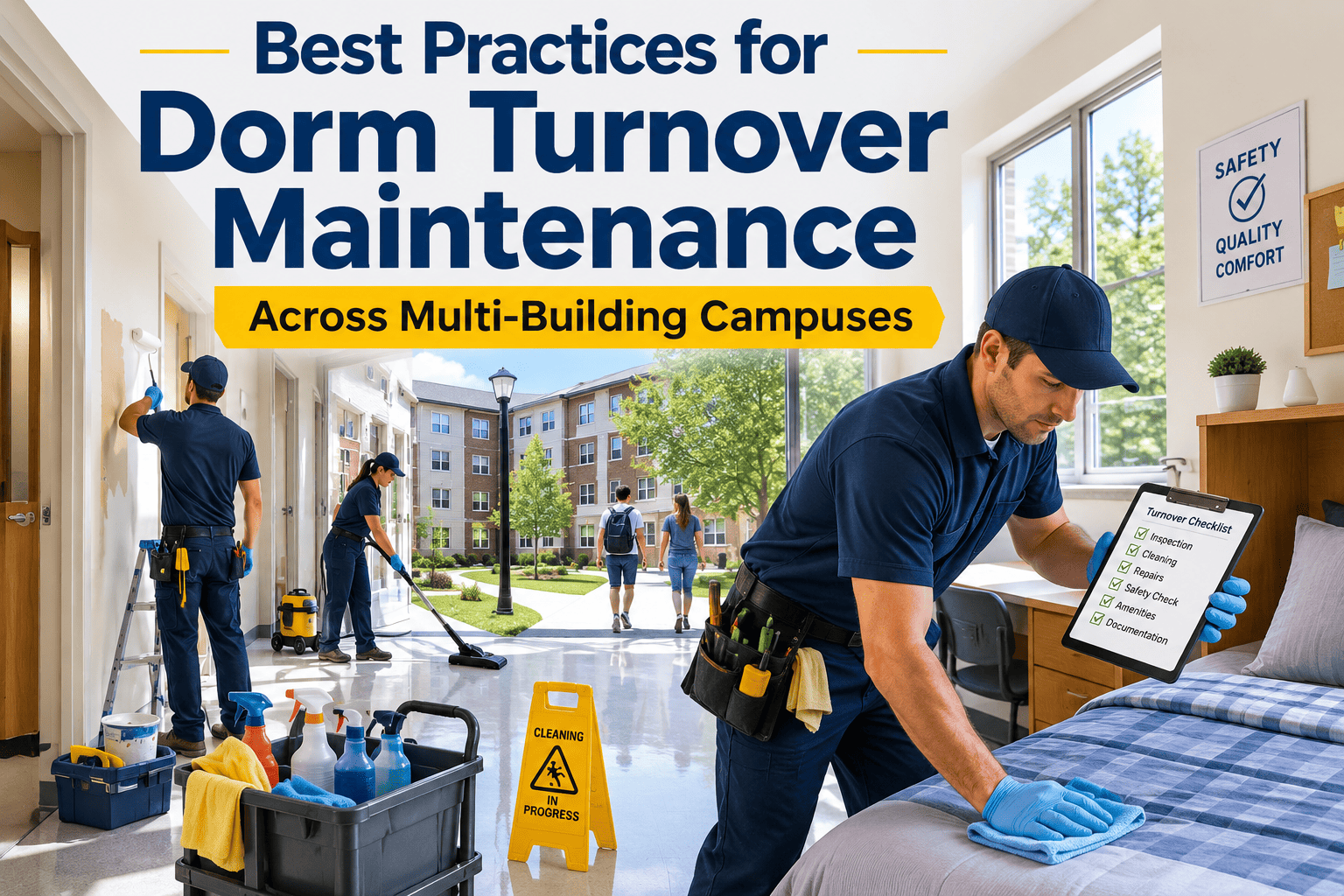
Unit Turnover Maintenance: The 14-Day Window That Determines Occupancy
When a faculty resident moves out, the housing team has a narrow window — typically 14–21 days — to inspect, repair, deep clean, and prepare the unit for the next resident. Miss the window and the unit sits vacant, costing $2,000–$4,000 per month in lost revenue. Turnover maintenance requires a structured, multi-trade work order sequence that moves through the unit systematically. Without a CMMS coordinating the sequence, trades overlap, items are missed, and the unit fails move-in inspection.
Unit Turnover Work Order Sequence
14-day turnover window • Multi-trade coordination • Move-in inspection standard
Day 1–2: Move-out inspection and punch list
40+ items
Generates all downstream work orders
Day 2–5: Structural and systems repairs
Plumbing, HVAC, electrical
Must complete before cosmetic work begins
Day 5–8: Cosmetic restoration
Paint, flooring, hardware
Sequenced after systems — no rework
Day 8–10: Appliance service and replacement
Test, clean, or swap
Based on lifecycle data in CMMS
Day 10–14: Deep clean, final inspection, move-in ready
100% checklist
Failed items generate immediate rework WOs
Implementation Roadmap: From Reactive to Resident-Centered Maintenance
Faculty housing maintenance teams can deploy CMMS-managed work order processes within 6–8 weeks, covering reactive request management, preventive maintenance scheduling, and resident communication in a phased rollout that builds adoption incrementally. Book a Demo and our residential facilities team will map this roadmap to your housing portfolio.
Phase 1: Weeks 1–2
Unit Inventory and Asset Registration
✓ Register every housing unit in Oxmaint with building, floor, unit number, square footage, and bedroom/bathroom count
✓ Register major assets per unit — HVAC system, water heater, appliances — with manufacturer, model, installation date
✓ Import existing maintenance history (if available) to establish repair patterns and identify high-maintenance units
Deliverable: Complete housing portfolio in CMMS with asset-level visibility into every maintainable component per unit.
Phase 2: Weeks 2–4
Work Order Workflow and Resident Portal Configuration
✓ Configure resident request portal with category selection, photo upload, urgency indicators, and auto-acknowledgment
✓ Set up SLA timers: emergency (4-hour response), urgent (24-hour), routine (48-hour), cosmetic (5-day)
✓ Build technician routing rules by trade specialization and building assignment
Deliverable: Live work order intake system with automated triage, assignment, and resident notification at every stage.
Phase 3: Weeks 4–6
Preventive Maintenance Schedule Activation
✓ Activate PM schedules for all registered assets — HVAC filters, water heater flushes, appliance inspections, smoke detector tests
✓ Build turnover maintenance checklist template with sequenced multi-trade work order generation
✓ Configure seasonal PM calendars — pre-winter heating inspection, pre-summer cooling startup, spring exterior assessment
Deliverable: Automated PM program generating 3,000–5,000 work orders/year across the full portfolio — no manual scheduling.
Phase 4: Weeks 6–8+
Reporting, Resident Satisfaction, and Continuous Improvement
✓ Launch resident satisfaction tracking — post-completion surveys feeding into unit-level and technician-level quality metrics
✓ Build management dashboards: SLA adherence, PM completion rates, cost per unit, callback rates, satisfaction trends
✓ Generate capital planning reports from accumulated maintenance data — identify units approaching major system replacements
Deliverable: Data-driven housing maintenance operation with resident satisfaction scores, cost transparency, and capital forecasting.
Your Faculty Chose Campus Housing Because They Were Promised It Would Be Easy. Make It Easy.
Oxmaint gives your housing maintenance team the work order management system that turns every service request into a tracked, timed, documented, and verified resolution — protecting the resident experience that keeps occupancy rates above 92% and faculty recruitment competitive. The professor whose ceiling leaked for 11 days cost the university $49,200. Oxmaint costs less than one remediation.
Frequently Asked Questions
How many maintenance work orders does a typical faculty housing complex generate per year?
A 200-unit faculty housing complex typically generates 800–1,200 reactive work orders per year from resident requests (4–6 per unit annually), plus 3,000–5,000 preventive maintenance work orders for scheduled asset servicing (HVAC filters, water heater flushes, smoke detector tests, appliance inspections). Total work order volume runs 4,000–6,000 per year. Without a CMMS, most housing operations only track the reactive requests — and even those incompletely. The PM work orders simply do not exist without automated scheduling.
Sign Up to start generating both reactive and preventive work orders from a single platform.
What SLA response times should faculty housing target for maintenance requests?
Best-practice SLAs for faculty housing are: Emergency (water leak, no heat/AC, gas smell, security issue) — 4-hour response, same-day resolution. Urgent (HVAC not cooling/heating adequately, appliance failure, plumbing fixture malfunction) — 24-hour response, 48-hour resolution. Routine (minor plumbing, electrical outlet, door/window adjustment) — 48-hour response, 5-day resolution. Cosmetic (paint, hardware, non-functional damage) — 5-day response, 14-day resolution. These SLAs should be published to residents so expectations are set and accountability is transparent.
Book a Demo to configure SLA timers in Oxmaint.
How does a CMMS improve unit turnover time between faculty residents?
The CMMS generates a sequenced, multi-trade turnover work order package the moment a move-out date is confirmed. The move-out inspection checklist (40+ items) auto-generates repair work orders for each deficiency, sequenced in the correct trade order: structural and systems repairs first (plumbing, HVAC, electrical), cosmetic restoration second (paint, flooring, hardware), appliance service third, and deep clean last. Each trade's work orders are assigned with dependency rules so painters don't start before plumbers finish. The final inspection checklist verifies every item before the unit is released for move-in. Average turnover time drops from 21–28 days to 12–16 days.
What does it cost to implement CMMS for faculty housing maintenance?
Oxmaint's platform cost for a 200-unit faculty housing operation is a fraction of the savings it generates. Most housing programs recover the annual subscription cost within the first quarter through reduced emergency repair spending (emergency repairs cost 3–5x planned maintenance), fewer callback visits (60% reduction), and shorter vacancy periods during turnovers. The $41,000 ceiling leak remediation in our opening example would fund years of CMMS service. The real ROI is in occupancy retention — each unit vacancy costs $2,000–$4,000 per month in lost revenue, and maintenance quality is the #1 driver of lease renewal decisions.
Can faculty residents submit maintenance requests through the system?
Yes — resident-facing request submission is a core function. Residents access a web portal or mobile interface to describe their issue, select a category (plumbing, HVAC, electrical, appliance, structural, pest, other), indicate urgency, attach photos, and specify scheduling preferences. The system auto-acknowledges receipt within seconds and sends status notifications at every stage: assigned, scheduled, in-progress, completed. Residents can view the status of all their open requests at any time. Post-completion, the system requests a satisfaction rating. This transparency is the single most impactful change for resident experience — they know their request is in a system, not lost in someone's inbox.