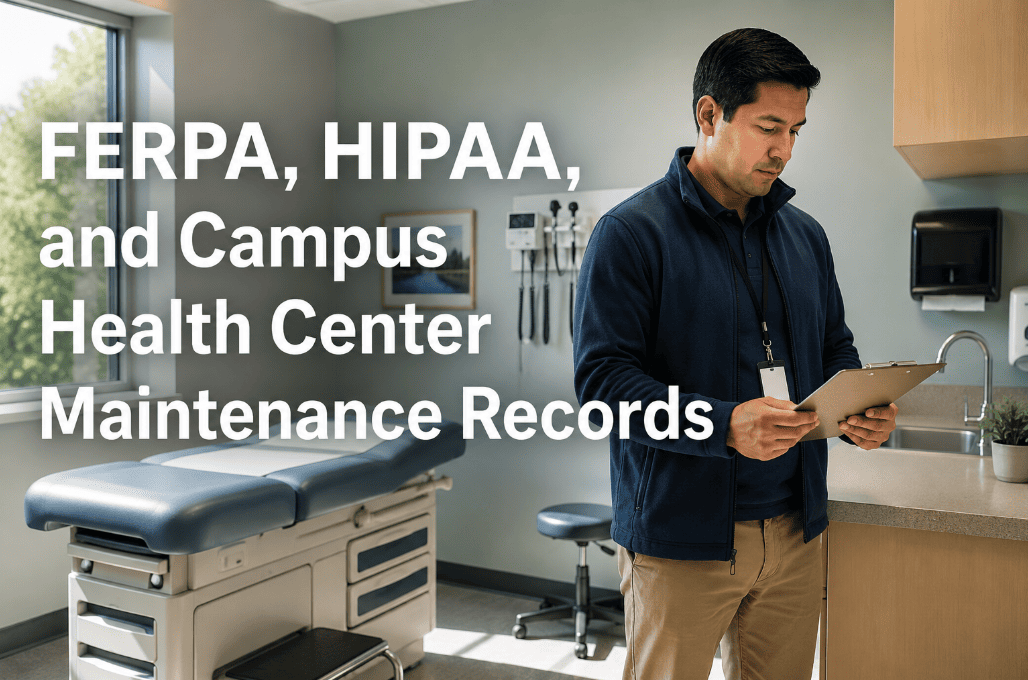
Campus student health centers occupy a uniquely complicated compliance position: they are simultaneously subject to FERPA as institutional records holders, HIPAA as covered healthcare entities or business associates, state licensing requirements as clinical facilities, and standard facility maintenance obligations as campus buildings. When a facilities technician repairs an HVAC unit in a clinical examination room, the work order that documents that repair sits at the intersection of all four compliance frameworks. Getting the boundary between clinical protected health information and legitimate facility maintenance records wrong costs institutions in both federal audits and patient trust. If your facilities CMMS does not have a documented approach to campus health center record separation, start a free trial or book a demo to see how Oxmaint structures health center facility documentation for dual-framework compliance.
FERPA, HIPAA, and Campus Health Center Maintenance Records
Campus student health centers are simultaneously subject to FERPA and HIPAA. Facility maintenance records must be structured to support clinical privacy obligations, audit trail requirements, and operational compliance — without creating PHI exposure inside your CMMS work orders.
The Line Between a Facility Record and a PHI Record Is Not Always Obvious — And Getting It Wrong Has Consequences
A work order that notes "repaired broken lock on patient record storage room" is a facility record. A work order that notes "repaired lock on Room 114 after patient Smith's appointment" has crossed into PHI territory by associating a named individual with a clinical space at a specific time. Facilities teams managing campus health centers must train their technicians and structure their CMMS to keep work order language on the right side of that line. Oxmaint helps facilities teams document health center maintenance with the right level of clinical-facility separation — start a free trial or book a demo to configure your health center asset structure.
FERPA, HIPAA, and Campus Health: The Dual-Framework Reality
Most campus health centers operate under both FERPA and HIPAA simultaneously, though the regulatory interplay is nuanced. Understanding which framework governs which records — and where facility maintenance records fit — is the starting point for compliant health center operations.
Governs education records maintained by institutions receiving federal funding. Student health records created by a student health center that functions as a school health clinic — not a covered healthcare entity — may be classified as education records under FERPA rather than medical records under HIPAA. The treatment records exemption in FERPA applies specifically to records made by healthcare professionals in the context of treatment and not accessible to anyone other than those providing treatment.
Applies to covered healthcare entities and their business associates. Campus health centers that bill health insurance carriers are typically HIPAA-covered entities and must comply with the Privacy Rule, Security Rule, and Breach Notification Rule. Facilities staff who access PHI while performing maintenance in clinical spaces — even incidentally — trigger HIPAA workforce training and access control obligations.
Any vendor or contractor who may access PHI while performing services for a covered entity must sign a Business Associate Agreement. Facilities management software vendors — including CMMS platforms — may require BAA review if work order notes or inspection records could include PHI. Keeping PHI out of the CMMS is the cleaner compliance strategy than attempting to make a facilities platform a HIPAA-compliant system.
Campus health centers holding state clinic licenses, laboratory certifications, or pharmacy permits face facility maintenance requirements tied to those licenses — equipment calibration records, refrigerator temperature logs, eyewash station tests, and autoclave cycle logs. These records are facility records, not PHI, and must be maintained in a CMMS or documented system that supports license renewal and inspection.
Facility Records vs. Clinical Records: The Separation That Protects Compliance
The critical compliance task for campus health center facilities teams is maintaining a clean boundary between legitimate facility maintenance records and clinical records that contain or imply PHI. The table below illustrates the correct categorization of common health center documentation scenarios.
| Record Type | Example | Category | Appropriate System | PHI Risk |
|---|---|---|---|---|
| HVAC maintenance | Annual air handler PM in exam wing | Facility Record | CMMS | None if no patient detail in notes |
| Exam table repair | Replaced torn upholstery on Table 3 | Facility Record | CMMS | None — asset-level, no patient link |
| Medical refrigerator log | Daily temperature log for vaccine storage unit | Facility/Compliance Record | CMMS or dedicated log | None — equipment record, no PHI |
| Patient record room access | "Fixed lock on Room 114 after patient left" | PHI Risk — Facility Record | CMMS — revised note required | High — patient implied in notes |
| Autoclave cycle log | Weekly sterilization cycle records for instruments | Facility/Clinical Record | CMMS or sterile processing log | None — process record, no patient |
| Electronic medical records system | IT ticket for EMR server maintenance | PHI Risk — IT Record | IT system — not CMMS | High — server contains PHI |
| Eyewash station test | Monthly eyewash operability inspection | Facility Record | CMMS | None — safety inspection record |
| Plumbing repair in restroom | Replaced toilet flapper in patient restroom | Facility Record | CMMS | None — building maintenance record |
Four Compliance Failures in Campus Health Center Facility Management
Technicians who enter notes like "fixed AC unit after patient Nguyen complained about heat" have created a PHI record inside the CMMS — linking a named patient to a clinical appointment time and location. Without specific technician training and note-writing guidelines for health center work orders, this happens constantly and creates HIPAA exposure in a system not designed to be HIPAA-compliant.
Vaccine refrigerator temperature monitoring, autoclave cycle documentation, and laboratory equipment calibration records are clinical facility requirements — not optional. Campus health centers that fail state health department inspections frequently cite missing or unorganized equipment maintenance logs. These are facility records that belong in a CMMS with scheduled PM reminders, not in a clinician's personal notebook.
HIPAA requires covered entities to implement physical safeguards to restrict access to PHI. Facilities staff who access examination rooms, medical record storage areas, or pharmacy spaces without a documented access control protocol — and without escort or supervision — are creating a HIPAA physical safeguard gap that auditors will find. Access control work orders and key issuance records must reflect that clinical spaces have controlled entry.
If PHI has ever entered the CMMS — through technician notes, photo attachments, or patient-linked work request submissions — and the CMMS vendor has not signed a Business Associate Agreement, the institution is in HIPAA breach exposure. Most facilities software vendors are not HIPAA-compliant platforms and do not offer BAAs. The correct response is to keep PHI out of the CMMS entirely, not to attempt to make the CMMS HIPAA-compliant.
How Oxmaint Supports Campus Health Center Facility Compliance
Oxmaint is a facility asset management platform — not a clinical records system. The correct approach to campus health center compliance is keeping PHI entirely out of the CMMS through structured work order protocols, asset-level tracking, and technician documentation guidelines. Oxmaint provides the structure, scheduling, and audit trail that supports this separation. Facilities teams managing student health centers can start a free trial or book a demo to configure health center asset tracking correctly from day one.
Work orders in Oxmaint are tied to named assets — "Exam Table 3," "Vaccine Refrigerator Unit A," "Air Handler AH-12." Notes describe what was done to the asset, not why a patient needed the space serviced — keeping all facility records clean of PHI by design.
Monthly eyewash station tests, weekly autoclave cycle documentation triggers, quarterly refrigerator calibration PMs, and annual fire extinguisher inspections generate automatically — with completion records that satisfy state licensing and OSHA requirements without manual tracking.
Work orders for clinical space maintenance include required fields for escort protocol compliance — whether health center staff was present, which spaces were accessed, and access duration. This creates the documented physical safeguard record that HIPAA requires for workforce access to PHI-containing areas.
Health center-specific work order templates in Oxmaint include prompts reminding technicians to use asset-level language, avoid patient references, and flag any inadvertent PHI exposure for facilities supervisor review — preventing PHI contamination before it enters the system.
Every inspection record — eyewash tests, fire extinguisher checks, refrigerator temperature logs, and air quality measurements — is retained with technician identity, date, pass/fail outcome, and corrective action if required. State health department inspections and AAAHC accreditation reviews find organized, accessible documentation.
Clinical facility assets — exam tables, sterilization equipment, specialized HVAC, and medical gas systems — are tracked within a health center asset hierarchy with their own condition scores, remaining useful life estimates, and CapEx replacement forecasts for budget planning separate from general campus infrastructure.
Unstructured Health Center Records vs. Oxmaint Compliance-Ready Documentation
Compliance Outcomes from Structured Health Center Facility Documentation
Asset-level work order structure and technician note guidelines eliminate the PHI contamination that creates HIPAA breach exposure in facility management systems
Automated PM scheduling for vaccine refrigerators, eyewash stations, autoclaves, and fire extinguishers eliminates the missed inspections that trigger state licensing deficiencies
Full work order and inspection history retained and accessible — satisfying both HIPAA's six-year documentation standard and FERPA's record access obligations without separate archiving
Filtered CMMS exports of equipment inspection records, PM completion history, and corrective maintenance logs compiled in hours — not days of manual document gathering
Frequently Asked Questions
Does HIPAA apply to all campus student health centers?+
What maintenance records are required for campus health center state licensing?+
Does a CMMS vendor need to sign a HIPAA Business Associate Agreement?+
How should facilities technicians be trained for health center work?+
Campus Health Center Compliance Starts With Clean Facility Records
FERPA, HIPAA, and state licensing create a compliance environment where facility documentation must be both thorough and carefully bounded. Oxmaint gives campus health center facilities teams the asset-level structure, scheduled PM automation, and audit trail documentation to satisfy every compliance framework — without ever bringing PHI into the facility management system. Your health center patients and your institution both deserve records that protect privacy and prove compliance.