Title IX of the Education Amendments of 1972 prohibits sex discrimination in any education program receiving federal funding — and federal enforcement has made clear that athletic facility parity is a core component of compliance. The Office for Civil Rights (OCR) has issued violation findings against institutions where facility quality, scheduling access, locker room square footage, and maintenance investment differed significantly between men's and women's programs. When an OCR complaint lands on the athletics director's desk, the first documents requested are facility maintenance logs, scheduling records, and condition assessments — not athletic budgets. If your institution cannot produce facility-level documentation showing equivalent investment and access, start a free trial or book a demo to see how Oxmaint builds an audit-ready facility equity record.
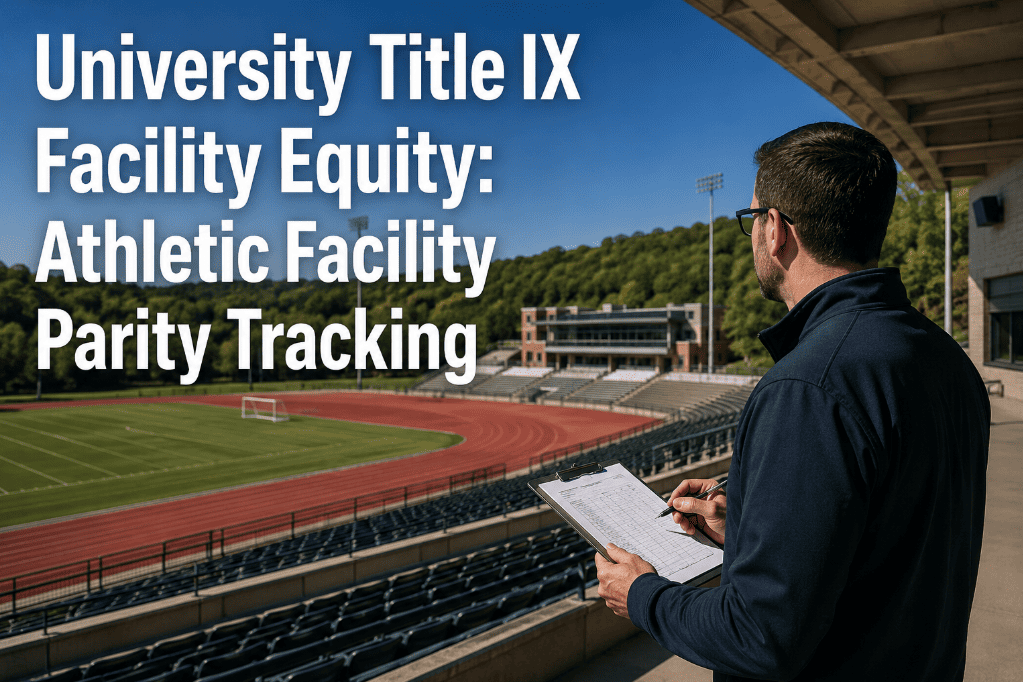
University Title IX Facility Equity: Athletic Facility Parity Tracking
Federal OCR audits demand documented proof of equivalent athletic facilities. Maintenance logs, condition scores, scheduling records, and locker room assessments are your first line of defense — and your most credible evidence of compliance.
Facility Records Are Your Title IX Evidence — Not Your Budget Spreadsheet
OCR investigators do not accept budget allocations as proof of facility equity. They inspect actual conditions, review maintenance histories, and compare scheduling access logs between programs. Institutions that maintain CMMS-tracked facility records respond to investigations in days. Those without them spend weeks reconstructing evidence from emails and memory. Build your compliance record before the complaint arrives — start a free trial or book a demo to configure your athletic facility equity tracking today.
What Title IX Actually Requires for Athletic Facilities
The 1979 OCR Policy Interpretation establishes 13 program areas for athletic equity assessment. Facilities appear explicitly in the list — and OCR's 2020 Q&A guidance reaffirmed that equivalent facility quality, not identical facilities, is required. Here is what the standard actually measures.
Comparability of competitive venues — field dimensions, surface conditions, seating, lighting, scoreboard technology, and press facilities between male and female programs.
Equivalent access to practice facilities in terms of quality, availability, and scheduling priority — not just total hours, but prime-time versus off-peak access distribution.
Comparable square footage per athlete, locker quantity, shower capacity, climate control, privacy, and maintenance quality — OCR has cited locker room disparities in multiple enforcement actions.
Athletic training rooms, rehabilitation equipment, hydrotherapy facilities, and medical staff office space must be comparable — and access scheduling must not systematically disadvantage one sex.
Quantity and quality of uniforms, practice gear, and equipment issued to athletes — tied to facility management when equipment storage, laundry facilities, and equipment rooms are compared.
PM work order completion rates, corrective maintenance response times, and deferred maintenance backlog must not systematically differ between facilities used primarily by men versus women.
Where Title IX Facility Violations Actually Originate
When HVAC replacement, floor resurfacing, or plumbing repairs are deferred longer in women's facilities than men's, the maintenance backlog itself becomes Title IX evidence. OCR investigators compare work order timestamps and completion rates between comparable facilities.
Women's programs assigned primarily off-peak practice times while men's programs hold prime-time reservations is a documented violation pattern. Without a scheduling log that shows time-of-day distribution, institutions cannot rebut these claims.
Visible condition differences — aging fixtures, inadequate lighting, worn flooring, insufficient lockers — documented in OCR site visits have resulted in compliance findings at institutions that believed their facilities were equivalent.
When capital improvements are consistently sequenced to benefit men's facilities first, the multi-year pattern of CapEx allocation creates a documented inequity record — even if the institution claims equal long-term investment intent.
The most common compliance failure is not having a disparity — it is being unable to prove equivalence. Institutions that cannot produce condition records, PM histories, and scheduling logs cannot defend against complaints even when their facilities are genuinely comparable.
OCR has specifically cited weight room and strength training facility disparities — including equipment age, square footage per user, and HVAC quality — as evidence of Title IX violations at multiple Division I and Division II programs.
Athletic Facility Equivalence Comparison: What OCR Measures
| Facility Category | OCR Equivalence Factors | CMMS Data Required | Common Disparity Found |
|---|---|---|---|
| Competition Venue | Surface condition, lighting lux, seating capacity, scoreboard | PM history, condition score, capital replacement schedule | Lighting upgrades and surface replacements deferred longer for women |
| Practice Fields / Courts | Surface quality, lighting, scheduling access by time of day | Scheduling logs, work order completion rates by facility | Women's teams assigned off-peak slots 2.3x more frequently |
| Locker Rooms | Sq ft per athlete, lockers, showers, HVAC, lighting, privacy | Condition assessment scores, fixture PM records | Locker count per athlete 30–40% lower for women's programs |
| Weight / Training Rooms | Equipment age, sq ft per user, HVAC capacity, cleanliness | Equipment asset records, PM completion, condition scoring | Equipment age gap of 4–8 years between programs |
| Athletic Training / Medical | Square footage, equipment inventory, scheduling access | Asset registry, scheduling records, work order history | Hydrotherapy access scheduled primarily for men's programs |
| Storage and Equipment Rooms | Square footage, temperature control, proximity to venue | Facility condition records, HVAC PM history | Women's equipment rooms without climate control |
How Oxmaint Builds Your Title IX Facility Equity Record
Oxmaint creates a living, auditable record of athletic facility condition, maintenance investment, and scheduling access — organized by program so your Title IX coordinator and legal counsel can produce equivalence documentation within hours of an OCR request. Institutions ready to build their compliance record can start a free trial or book a demo.
Locker rooms, training rooms, weight rooms, and venues registered under program-specific asset hierarchies — enabling side-by-side condition and investment comparisons at any point in time.
Condition scores assigned at each inspection cycle — flooring, fixtures, HVAC, lighting, and locker count — create a documented baseline that shows equivalence or flags gaps before OCR does.
Work order counts, PM completion rates, and corrective maintenance response times compared between men's and women's facilities — the exact metrics OCR uses to evaluate maintenance equity.
Facility scheduling records linked to program assignments — showing prime-time versus off-peak access distribution across a full academic year for each program, in a format OCR investigators accept.
Multi-year capital improvement history tagged to facility and program — showing that renovation and replacement investments have been applied equitably across programs over time.
Pre-formatted facility equity reports exportable as PDF or Excel — covering condition scores, PM histories, scheduling logs, and capital investment by program — ready for your Title IX coordinator or legal team.
Undocumented Facilities vs. CMMS-Backed Equity Record
What Documented Facility Equity Delivers for Your Institution
Institutions with CMMS-backed facility records respond to OCR document requests in hours rather than weeks of manual reconstruction
Every locker room, weight room, training room, and venue tracked with condition scores and PM histories — no facility left undocumented
Proactive equity documentation and gap remediation prevents the legal and remediation costs that follow OCR findings and compliance agreements
Rolling capital improvement plans showing equitable investment across programs — defensible in OCR review and useful for athletics budget presentations
Frequently Asked Questions
What facility records does OCR typically request in a Title IX athletics investigation?+
Does Title IX require identical facilities for men's and women's programs?+
How should scheduling equity be documented for Title IX purposes?+
Can CMMS records be used proactively to identify Title IX facility gaps before an OCR complaint?+
Title IX Compliance Is Built on Facility Records, Not Good Intentions
OCR does not accept assertions of equity — it examines maintenance logs, condition scores, scheduling records, and capital investment histories. Oxmaint gives your athletics and facilities teams the documentation infrastructure to prove equivalence, identify gaps before OCR does, and respond to investigations in hours rather than weeks.




.png)
