University facilities teams are rarely trained as compliance officers — yet when a Clery Act audit lands, the first documents requested are often maintenance logs, access control records, lighting work orders, and emergency phone inspection reports. The Jeanne Clery Disclosure of Campus Security Policy and Campus Crime Statistics Act requires every Title IV-eligible institution to maintain, disclose, and report crime statistics and security policy information tied directly to campus geography — and the physical state of that geography is a facilities responsibility, not just a public safety one. Institutions that fail Clery audits rarely fail because their police logs were incomplete. They fail because their facilities records cannot prove that lighting was operational, access points were functional, and emergency equipment was tested. If your facilities CMMS is not structured to support Annual Security Report production, start a free trial or book a demo to see how Oxmaint structures campus facility records for compliance.
University Clery Act Facility Records: Maintenance Logs in Crime Reporting
Clery Act audits request facility maintenance logs, lighting work orders, access records, and emergency equipment inspection history. Without structured CMMS documentation, institutions face findings, fines up to $69,733 per violation, and failed Annual Security Reports.
Clery Compliance Is a Facilities Problem, Not Just a Public Safety Problem
The physical condition of your campus — lighting levels in parking lots, access control functionality at residence hall entries, emergency blue-light phone operability, and fire alarm test records — is documented evidence in a Clery Act program review. Institutions that treat Clery as a police department responsibility and leave facilities records unstructured for compliance are leaving their institution exposed to the highest-stakes federal audit in higher education. Oxmaint structures work orders, PM records, and inspection logs so they can be produced on demand — start a free trial or book a demo to configure your campus for ASR-ready documentation.
The Clery Act and Its Facility Dimensions
The Clery Act requires institutions to disclose campus crime statistics, publish an Annual Security Report, maintain a public crime log, issue timely warnings, and adhere to emergency notification procedures. The geographic scope — Clery geography — includes all campus property, public property adjacent to campus, and non-campus buildings used for institutional purposes. Every inch of that geography has a facilities manager responsible for its physical condition, and that condition is auditable.
Published by October 1 each year. Must include crime statistics for the previous three calendar years, security policies, emergency procedures, and campus safety program descriptions. Facility maintenance status informs the credibility of security policy claims.
Includes on-campus property, on-campus residential facilities, non-campus buildings, and public property adjacent to campus. All facility assets within Clery geography — lights, locks, alarms, cameras — require documented maintenance records.
CSAs include public safety, student affairs, residence life, and — in some interpretations — facilities personnel who receive crime reports or manage access-controlled spaces. Facilities directors may carry CSA obligations they are unaware of.
When a Clery crime creates an ongoing threat, the institution must issue a timely warning. Emergency notification systems — mass notification panels, blue-light phones, PA systems — must be maintained, tested, and documented to prove operability at the time of any incident.
Eight Facility Record Types That Appear in Clery Audits
A Department of Education program review examiner will request documentation from multiple departments simultaneously. Facilities is expected to produce organized, date-stamped, location-tagged records within days — not weeks. These are the eight categories that appear most frequently.
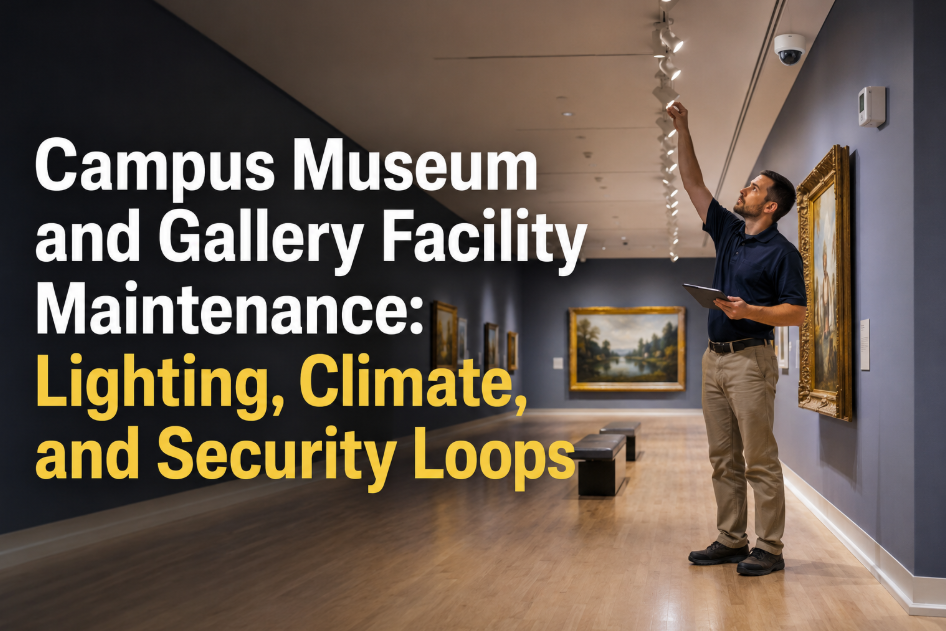
Every reported-out exterior light, parking lot fixture, pathway lamp, and building perimeter luminaire must have a corresponding work order with date reported, date repaired, and location. Unresolved lighting complaints in high-crime areas are audit red flags.
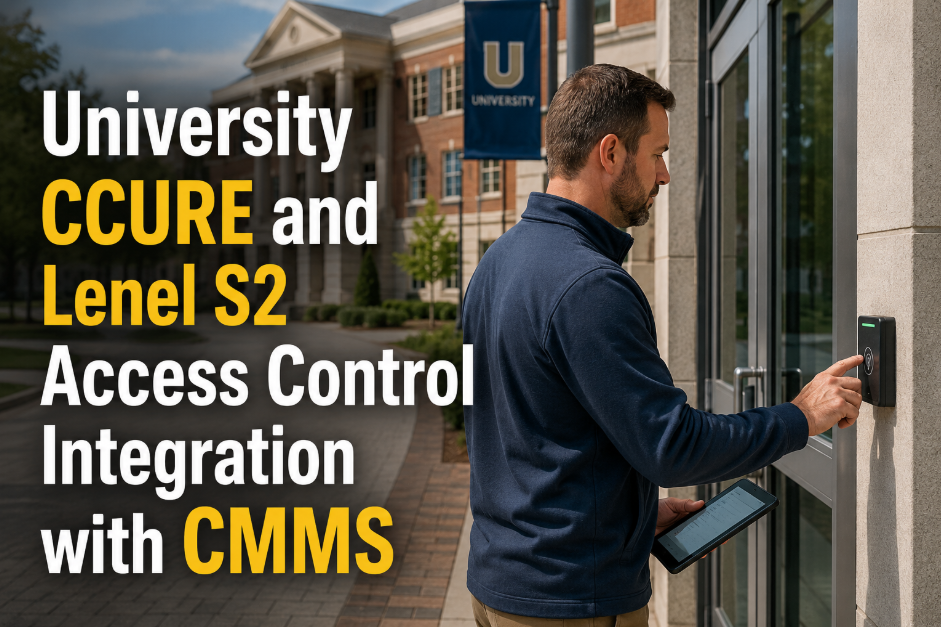
Residence hall door hardware, electronic access readers, and perimeter gate systems must have PM records and corrective work order histories. A door that was reported broken and not repaired for 30 days before an assault becomes an institutional liability in a Clery review.
Blue-light emergency phones require periodic testing and documented operability. Most institutions test monthly or quarterly. The test record must show date, location, tester identity, and pass/fail outcome — not just that "phones were tested."
NFPA 72 annual inspection records for fire alarm systems in campus buildings are Clery-relevant when fires are classified reportable crimes (arson). Inspectors verify that alarm systems were functional and tested per code during reporting periods.
Camera operability at the time of a reported crime is verified during investigations and audits. Cameras that were non-functional, covered, or in a work order backlog at the time of an incident become evidence of systemic neglect if no documented repair effort exists.
Scheduled PM for door closers, latch hardware, strike plates, and panic hardware in residential facilities creates a documented baseline of proactive maintenance. Without scheduled PM, every broken door appears reactive and negligent in the audit record.
Outdoor warning sirens, indoor PA panels, and emergency mass notification systems must be tested on a documented schedule. Test records prove the system was functional for timely warning and emergency notification obligations throughout the reporting period.
Re-key records, master key issuance logs, and lock change work orders are Clery-relevant when unauthorized access to restricted spaces is involved in a reported crime. Key control documentation must be retained for the full three-year Clery reporting window.
Four Facility Documentation Failures That Damage Clery Compliance
Work orders entered as "parking lot lighting" with no building number, lot identifier, or GPS coordinate cannot be mapped to Clery geography during an audit. Examiners need to verify that the specific location relevant to a crime report had documented, maintained safety infrastructure — and generic location labels make that impossible.
Blue-light phone test results in paper binders, fire alarm records in a contractor's PDF folder, and camera maintenance logs in a spreadsheet cannot be produced quickly during a program review. Examiners work on tight timelines and treat disorganized records as missing records in their findings language.
Knowing that a broken exterior light was reported is not enough — the record must show how many days elapsed between report and repair. A 90-day open work order for a broken pathway light adjacent to a residence hall during a reporting period with a reported assault is the kind of gap that produces a Clery finding and institutional liability.
Clery requires institutions to retain security-related records for three calendar years. Facilities teams that purge work orders annually, archive to offline systems, or use platforms without audit-trail retention delete the very records that prove compliance during the window that matters most to federal reviewers.
How Oxmaint Structures Facility Records for Clery Act Compliance
Oxmaint organizes every campus asset within a hierarchy that maps directly to Clery geography. Work orders, PM completions, inspection records, and corrective maintenance histories are date-stamped, location-tagged, and searchable by building, zone, or asset type — producing the audit package a Clery reviewer needs within minutes, not days. To see campus Clery-ready record structure in action, start a free trial or book a demo.
Every blue-light phone, exterior light fixture, access reader, and camera is registered as a named asset with building, zone, and Clery geography classification — so records can be filtered by location in seconds during an audit pull.
Monthly blue-light phone tests, quarterly access control PM, annual fire alarm inspections, and annual camera operability checks generate automatically on schedule — with completion records that include technician ID, date, location, and pass/fail outcome.
Every corrective work order records when it was opened, when it was assigned, and when it was closed — with technician notes and resolution description. Response time from report to repair is instantly reportable for any asset, building, or date range.
Oxmaint retains full work order and PM completion history indefinitely. Three-year Clery reporting windows are always accessible — no offline archiving, no data purges, no missing records from years that fell off a local system's retention cycle.
Blue-light phone tests, exterior lighting audits, and access hardware inspections use digital checklists with location-tagged completion. Each completed checklist is a time-stamped, signer-identified record — not a paper binder entry that can be questioned for authenticity.
When a program review examiner requests documentation, Oxmaint generates filtered exports of all work orders, PM completions, and inspection records for any calendar year, building, or asset category — formatted for straightforward submission.
Reactive Record-Keeping vs. Clery-Structured CMMS Documentation
What Structured Facility Documentation Delivers in Clery Compliance
Every corrective and PM record tied to a named asset within Clery geography — no generic entries that fail to satisfy an examiner's location verification request
Full three-year Clery window always online — no data purges, no offline retrieval delays, no missing records when a program review arrives without warning
Facilities data for Annual Security Report compiled in hours from filtered CMMS exports — versus weeks of cross-departmental email chains under reactive documentation
Scheduled PM auto-generates inspection work orders — if a blue-light phone test was not completed, the overdue record is visible, not invisible, before an audit surfaces it
Frequently Asked Questions
What facility records are most commonly requested during a Clery Act program review?+
How long must universities retain facility maintenance records for Clery Act compliance?
Are facilities personnel considered Campus Security Authorities under the Clery Act?+
Can Oxmaint produce a Clery-period facility record export for a program review examiner?+
Your Facilities Records Are Clery Evidence — Treat Them That Way
Every unresolved lighting work order, every untested blue-light phone, and every undocumented access control repair is a gap in your Clery compliance posture. Oxmaint structures campus facility records so that when a program review arrives, your documentation is organized, accessible, and complete — not scattered across binders, spreadsheets, and archived folders. Give your institution the documentation foundation its Clery compliance deserves.