University dining services operate some of the most demanding commercial kitchen environments in any industry — serving thousands of meals per day across multiple residential and retail dining facilities, with equipment that runs at full duty cycle during service periods and cannot afford unplanned downtime without immediate impact on student meals and health code compliance. A walk-in refrigerator that loses temperature at 6 PM during a Thursday dinner service is not just an equipment failure — it is a potential $15,000 food loss event, a health department notification trigger, and a student safety incident. A hood suppression system with an expired service tag that the fire marshal finds during an inspection is a facility shutdown. Dining facilities managers who rely on reactive maintenance are managing risk that compounds daily across dozens of high-duty-cycle assets. If your campus dining operation does not have scheduled PM for every piece of commercial kitchen equipment, start a free trial or book a demo to see how Oxmaint manages commercial kitchen asset PM at scale.
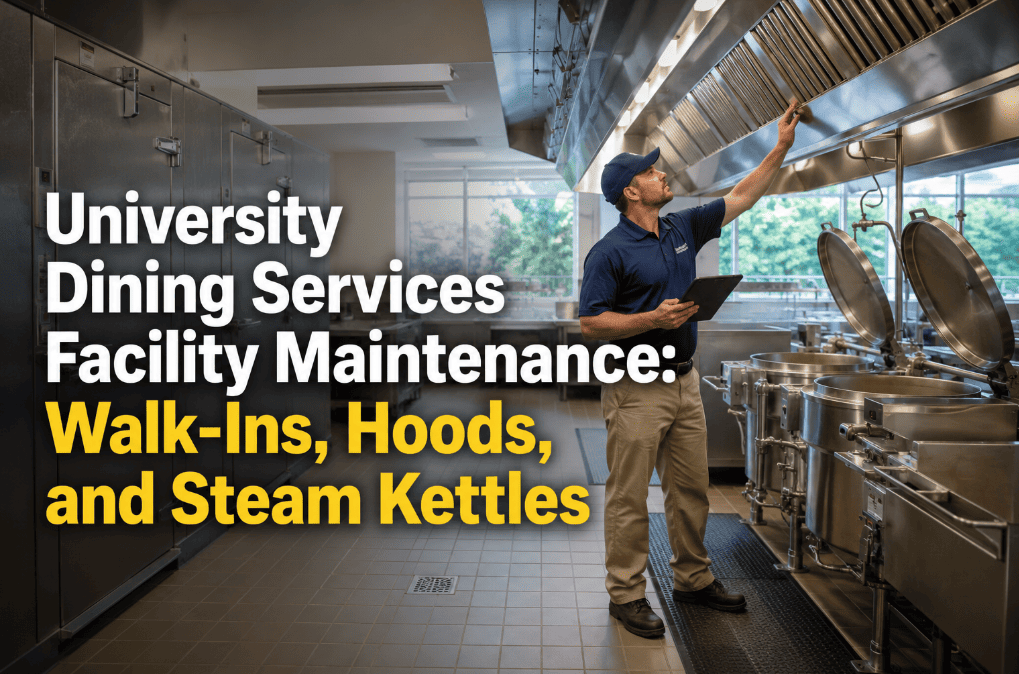
University Dining Services Facility Maintenance: Walk-Ins, Hoods, and Steam Kettles
University dining halls run equipment at duty cycles that commercial restaurants rarely match — and with fewer technicians per piece of equipment. Walk-in refrigeration, hood suppression, steam kettles, and grease traps require structured PM programs and CMMS-tracked health code documentation to keep meals safe and inspections passing.
University Dining Equipment Is Commercial-Grade — It Requires Commercial-Grade PM
A 600-gallon steam kettle running two shifts per day experiences more thermal cycle stress in a semester than a restaurant kettle experiences in two years. A walk-in unit holding product for 5,000 daily meals cannot have a deferred condenser coil cleaning on its maintenance record. University dining facilities run equipment harder, longer, and with tighter health code accountability than most food service operations — yet many campus dining facilities still rely on verbal PM agreements with vendors and paper logs for health department inspections. Oxmaint puts every dining asset on a documented PM schedule with CMMS-tracked compliance records — start a free trial or book a demo to configure your dining facility asset program.
The Eight Critical Asset Categories in University Dining Facilities
University dining operations manage asset portfolios that span refrigeration, cooking, fire suppression, ventilation, sanitation, and utility systems — all within a single high-pressure service environment. Each category has distinct PM requirements, failure consequences, and compliance documentation needs.
The highest-consequence asset in dining operations. Condenser coil cleaning every 90 days, evaporator fan inspection, door gasket and strip curtain PM, and temperature data logger calibration are minimum scheduled items. A single compressor failure during active service can trigger a full food discard event exceeding $15,000 in product loss alone.
NFPA 96 requires hood suppression systems to be inspected and serviced by a licensed contractor every six months minimum. High-volume fry stations may require quarterly service. The inspection record must document fusible link replacement, suppression agent quantity check, nozzle inspection, and manual pull station test — and must be posted at the system. An expired inspection tag discovered by a fire marshal is an immediate shutdown condition.
Steam kettle PM includes steam trap inspection, pressure relief valve testing, gasket and seal replacement, and internal descaling on a cycle appropriate to local water hardness. Combi oven PM requires boiler element inspection, door seal replacement, and descaling at frequency determined by water quality. Scale buildup in a combi oven reduces cooking efficiency by up to 30% and shortens element life by 40%.
University dining operations generate grease trap loading that typically requires 30–90 day pump-out cycles during active semesters. Local authority requirements vary, but most jurisdictions require documented pump-out records with manifests from licensed haulers. A grease trap that overflows into the municipal sewer system triggers an environmental violation, emergency repair costs, and potential service disruption.
High-temperature or chemical sanitizing commercial dishwashers require daily temperature verification, weekly chemical concentration testing, and quarterly service for pump seals, door gaskets, and spray arm inspection. Health departments verify sanitizing efficacy during inspections — failing sanitizer concentration is a critical violation that closes the dishwashing operation.
Kitchen ventilation systems balance positive and negative pressure to ensure proper hood capture of cooking exhaust. Belt and bearing PM on exhaust fans, makeup air unit filter changes, and seasonal coil cleaning are required to maintain ventilation efficiency. Imbalanced kitchen pressure allows grease-laden air to bypass the hood — accelerating fire risk and grease accumulation in the plenum above the cooking line.
Commercial fryer PM includes heating element inspection, high-limit thermostat testing, drain valve inspection, and basket hook PM. Oil filtration systems require filter media replacement on a frequency tied to fry volume — typically every 1–2 days in high-volume operations. Fryers with failed high-limit thermostats are a fire risk; fryers with degraded oil are a food quality and health code issue simultaneously.
Ice machines require cleaning and sanitizing every six months per NSF/ANSI 12 — more frequently in humid environments or where water quality is poor. Condenser coil cleaning, water filter replacement, and bin liner sanitizing are scheduled PM items. Ice machines are among the most frequently cited pieces of equipment in health department inspections due to biofilm and mold accumulation when PM is deferred.
University Dining Facility PM Schedule and Compliance Intervals
| Equipment | Service Action | Interval | Regulatory Reference | CMMS Trigger |
|---|---|---|---|---|
| Walk-in refrigerator | Condenser coil cleaning | 90 days | FDA Food Code 4-204 | Calendar PM |
| Walk-in refrigerator | Temperature logger calibration | Annually | FDA Food Code 4-203 | Annual PM |
| Hood suppression system | Full suppression system service | Every 6 months | NFPA 96 Section 11.4 | Calendar PM |
| Exhaust hood plenum | Grease deposit cleaning | Quarterly | NFPA 96 Section 11.6 | Calendar PM |
| Steam kettle | Descaling and steam trap inspection | Quarterly | Manufacturer + ASME | Calendar PM |
| Grease trap | Pump-out with licensed hauler manifest | 30–90 days | Local authority / EPA | Calendar PM |
| Commercial dishwasher | Temperature and sanitizer concentration log | Daily | FDA Food Code 4-501 | Daily checklist |
| Ice machine | Cleaning, sanitizing, and biofilm inspection | Every 6 months | NSF/ANSI 12 | Calendar PM |
Four Dining Facility Maintenance Failures With High Operational Consequence
Dirty condenser coils force the compressor to work harder to achieve the same cooling — raising head pressure, increasing current draw, and accelerating compressor wear. A condenser that has not been cleaned for 18 months on a unit running 24/7 has typically reduced the compressor's remaining useful life by 30–40%. When the compressor fails on a Friday afternoon before a busy weekend, the cost is not just the $2,800 compressor replacement — it is the $15,000 food discard, the emergency service call at double hourly rate, and the missed weekend meal service.
NFPA 96 requires the suppression system inspection record and current certification to be posted at the system. A fire marshal who finds an expired tag — even by one week — has the authority to issue an immediate notice of violation requiring the operation to cease until the system is serviced and re-certified. For a university dining hall serving 3,000+ meals per day, a single-day shutdown can cost $40,000–$80,000 in lost meal plan equivalency and emergency food service alternatives.
A grease trap that has not been pumped on schedule fills to capacity and begins allowing grease-laden water to pass directly into the municipal sewer — an environmental violation in virtually every jurisdiction. Municipal utility authorities issue fines ($500–$5,000 per incident in most jurisdictions) and require documented corrective action plans. Universities with multiple dining facilities have faced consent orders requiring grease trap monitoring programs after multiple overflow events tied to missed pump-out cycles.
Ice machine biofilm and mold contamination is among the most frequently cited critical violations in food service health inspections — and it is entirely preventable with scheduled six-month cleaning and sanitizing cycles. A critical violation on an ice machine results in immediate machine closure until cleaning and sanitizing is documented, a re-inspection fee, and a public inspection record that carries reputational consequences beyond the inspection event itself.
How Oxmaint Manages University Dining Facility PM and Compliance Records
Oxmaint registers every dining facility asset — from the largest walk-in refrigeration system to the smallest ice machine — within a building and zone hierarchy that maps to your campus dining operations. Every PM schedule triggers automatically. Every completed inspection is a timestamped, signer-identified compliance record. Every contractor service visit is documented with service detail and the next service date pre-loaded into the system. Dining facilities teams ready to eliminate reactive kitchen maintenance can start a free trial or book a demo.
Every walk-in unit registered with its condenser cleaning cycle, evaporator fan inspection interval, and door gasket PM schedule — auto-triggered by calendar with technician assignment and completion documentation that proves proactive maintenance during health department review.
Hood suppression service intervals loaded for every system in every dining facility. Contractor service visit documented with technician name, certification number, service date, and next service due — so the inspection record in Oxmaint matches the posted certificate at the system and the fire marshal finds both current.
Digital daily checklists for dishwasher temperature verification, sanitizer concentration logging, and walk-in temperature spot checks — completed by dining staff on mobile, retained in CMMS, and exportable as a date-range report for health department inspectors who request ongoing temperature documentation.
Each grease trap registered with its pump-out interval and hauler documentation requirements. Work orders closed with hauler manifest number, pump-out volume, and next service date — creating the environmental compliance record that satisfies municipal utility audit requests and prevents repeat overflow violations.
Steam kettle descaling cycles, pressure relief valve testing schedules, combi oven boiler element PM, and fryer high-limit thermostat inspection intervals — all auto-triggered on schedule with completion records that document water hardness readings, scale condition, and corrective actions taken.
Directors overseeing multiple dining halls, residential facilities, and retail food service locations see overdue PMs, upcoming service deadlines, and open corrective work orders across all facilities in a single dashboard — with drill-down to individual assets and service history when a health department inspection or equipment failure requires rapid documentation retrieval.
Reactive Kitchen Maintenance vs. Oxmaint Scheduled Dining Facility PM
What Scheduled Dining Facility PM Delivers in Operations and Compliance
Condenser PM at $180 per service prevents compressor failures that trigger food discard events averaging $15,000 in product loss plus emergency repair and service disruption costs
NFPA 96 service auto-triggered before expiration across all dining facilities — fire marshal inspections find current certifications posted at every system
Descaled steam kettles, clean combi oven boilers, and properly maintained fryer elements operate at manufacturer efficiency ratings — recovering the 25–35% energy waste that scale buildup creates in neglected commercial cooking equipment
Every temperature log, sanitizer record, hood service date, and equipment PM completion available for inspector review in a single CMMS export — no missing records, no scrambled paper binders during surprise inspections
Frequently Asked Questions
How often must hood suppression systems be serviced in a university dining hall?+
What is the correct PM interval for a university dining walk-in refrigerator?+
How frequently do university dining grease traps need to be pumped?+
Can Oxmaint produce health department inspection documentation for a dining facility on short notice?+
Your Dining Facility Runs Commercial-Grade Equipment — Give It Commercial-Grade PM
Walk-in failures, expired hood suppression tags, overflowed grease traps, and ice machine biofilm are all preventable with scheduled PM and documented compliance records. Oxmaint puts every piece of dining equipment on an automatic schedule, captures every inspection as a timestamped compliance record, and gives your team the documentation to pass every health department inspection with confidence. First dining facility PMs are live within days of setup — not weeks.