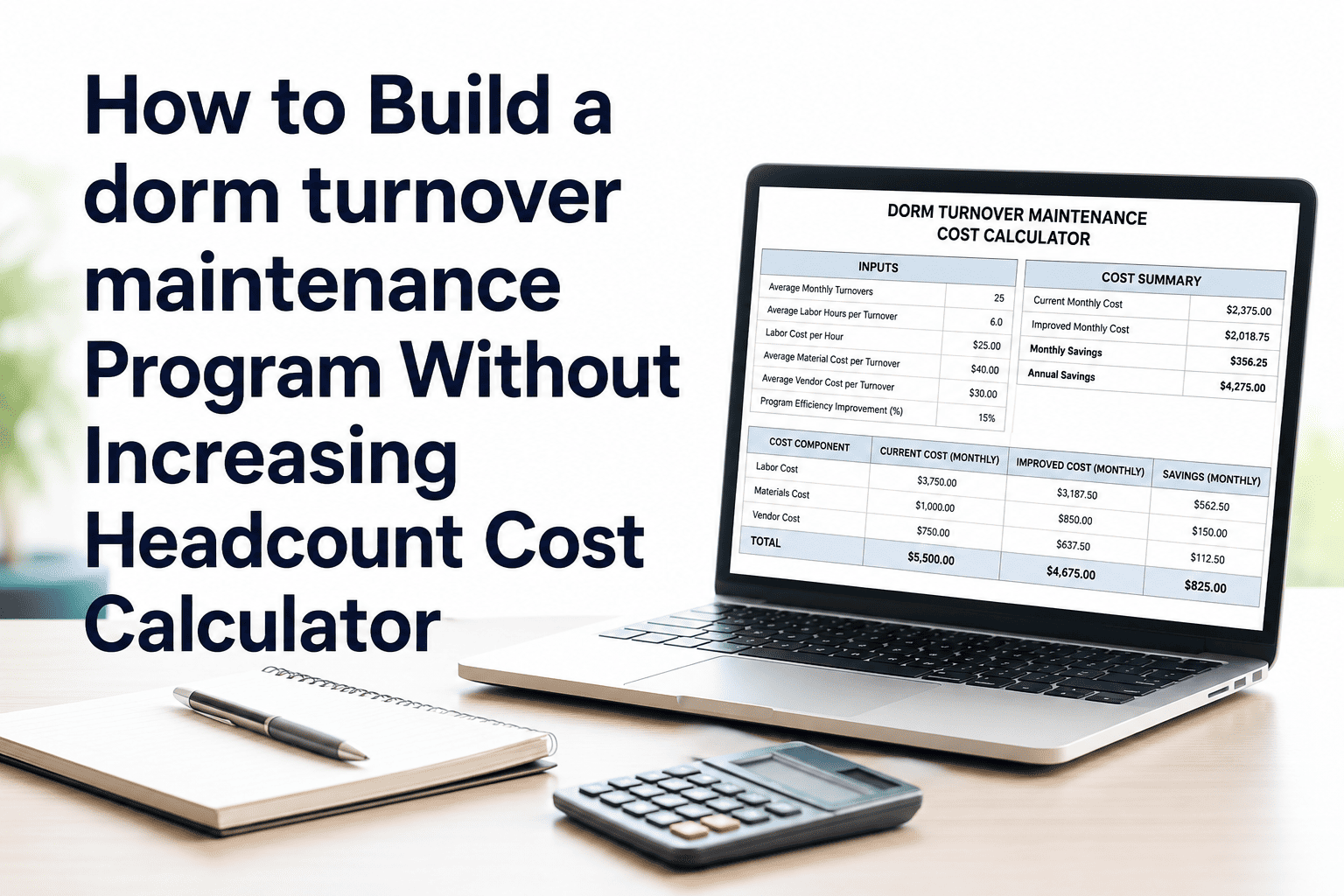
Every August, university housing departments face the same impossible math: hundreds of rooms to turn over in two to three weeks, the same maintenance headcount as the prior year, and a long list of deferred items from the spring semester. Most institutions respond by throwing overtime at the problem — adding 20 to 40 percent to labor costs for a window they could have predicted and planned for all year. A structured dorm turnover maintenance program doesn't require more people; it requires a system that converts unplanned emergency responses during the year into completed preventive maintenance before move-out, and routes work intelligently during the turnover window itself. The calculator on this page shows what a properly structured program saves your institution compared to your current approach. OxMaint gives housing maintenance teams the CMMS infrastructure to run this program at scale — start a free trial or book a demo to configure your turnover program.
How to Build a Dorm Turnover Maintenance Program Without Increasing Headcount
A cost calculator and program framework that shows exactly where your current turnover process is burning budget — and how to fix it with the same team you already have.
What Is Your Current Turnover Program Actually Costing?
Use the benchmarks below to estimate your current annual turnover cost and compare it against a structured CMMS-managed program. These figures are based on industry averages across university housing facilities with 500 to 3,000 beds.
The Four-Phase Dorm Turnover Maintenance Program
The single most impactful change a housing maintenance team can make is moving recurring maintenance from the turnover window into the academic year. HVAC filter changes, plumbing inspections, and appliance checks completed during the year eliminate them from the summer backlog. Each room gets a digital maintenance history that technicians can reference at turnover — no more starting from scratch every August.
Eight to ten weeks before move-out, the facilities team pulls the maintenance history for every room and building. Work orders from the academic year identify recurring issues, rooms that need intensive attention, and buildings where contractor scheduling is needed. Contractors are booked in advance at standard rates — not emergency rates. Material orders are placed. Crew assignments are made before the window opens.
The three-week execution window runs against a pre-built work order queue — not a blank slate. Each room has a standardized turnover checklist that technicians complete with photo documentation. Room condition is recorded at move-out and move-in, creating a defensible damage record. Supervisors track completion progress daily against the schedule, not by walking the floor and hoping.
Within two weeks of move-in, the facilities director reviews the turnover data: which rooms took longest, which contractors underperformed, which buildings had the highest repair counts, and what the total cost per bed was. This analysis directly informs the year-round PM schedule and the budget request for the following cycle — creating a continuous improvement loop instead of repeating the same problems next year.
Where the Savings Come From Without Adding Staff
Year-round PM catches the plumbing drips, broken fixtures, and HVAC issues before they become move-out surprises. Emergency repairs command premium labor rates — planned repairs don't.
When crews work from a pre-built queue instead of triaging on the fly, they cover 30 to 40 percent more rooms per shift. Same headcount, better scheduling, significantly lower overtime.
Contractors booked eight weeks in advance cost 25 to 40 percent less than contractors booked two weeks before the window opens. Pre-planning turns the most expensive line item into the most controllable one.
Photo-documented room condition at move-out and move-in creates a defensible record for damage charges. Disputes resolved with documentation cost nothing. Disputes without documentation often result in waivers.
What You Need to Run This Program in OxMaint
Each dorm room becomes an asset with its building, floor, room number, and unit type. Maintenance history attaches to the room — not the resident. When a new resident moves in, the room's full history is already there.
A room turnover checklist covers plumbing, electrical, HVAC, appliances, doors, windows, flooring, and paint condition — with mandatory photo fields. This template applies to every room; technicians cannot skip items or close without documentation.
Annual PM schedule for HVAC, plumbing inspections, appliance checks, and fire life safety items — distributed across the academic year. OxMaint auto-generates PM work orders on schedule so nothing falls off the list.
Six weeks before turnover, OxMaint generates a pre-built work order queue based on the prior year's maintenance history for each room. Rooms with known issues get priority scheduling. Rooms with clean histories get lighter checklists. Workload is distributed before the window opens.
A real-time view of rooms completed, rooms in progress, and rooms not yet started — sorted by building and crew. Supervisors spend their time on the floor fixing problems, not manually tracking completion against a spreadsheet.
Your Turnover Savings Are Waiting — No New Hires Required
Housing maintenance programs that move from reactive turnover to CMMS-managed preventive maintenance consistently achieve $200 to $300 per bed in annual cost reduction. For a 1,000-bed facility, that's $200,000 to $300,000 per year — with the same team, working smarter rather than harder.
Frequently Asked Questions
How long does it take to set up a dorm turnover program in OxMaint? +
Can OxMaint track damage documentation for resident charge disputes? +
How does OxMaint help prioritize which rooms to address first during turnover? +
What preventive maintenance should be scheduled during the academic year to reduce turnover work? +
Can student or resident requests be tracked through OxMaint during the academic year? +
Build the Turnover Program That Finally Works — This Cycle
The savings shown in this calculator are achievable within one full program cycle. OxMaint gives your housing maintenance team the system to stop repeating the same expensive turnover every year — starting with the setup that takes less than two weeks.