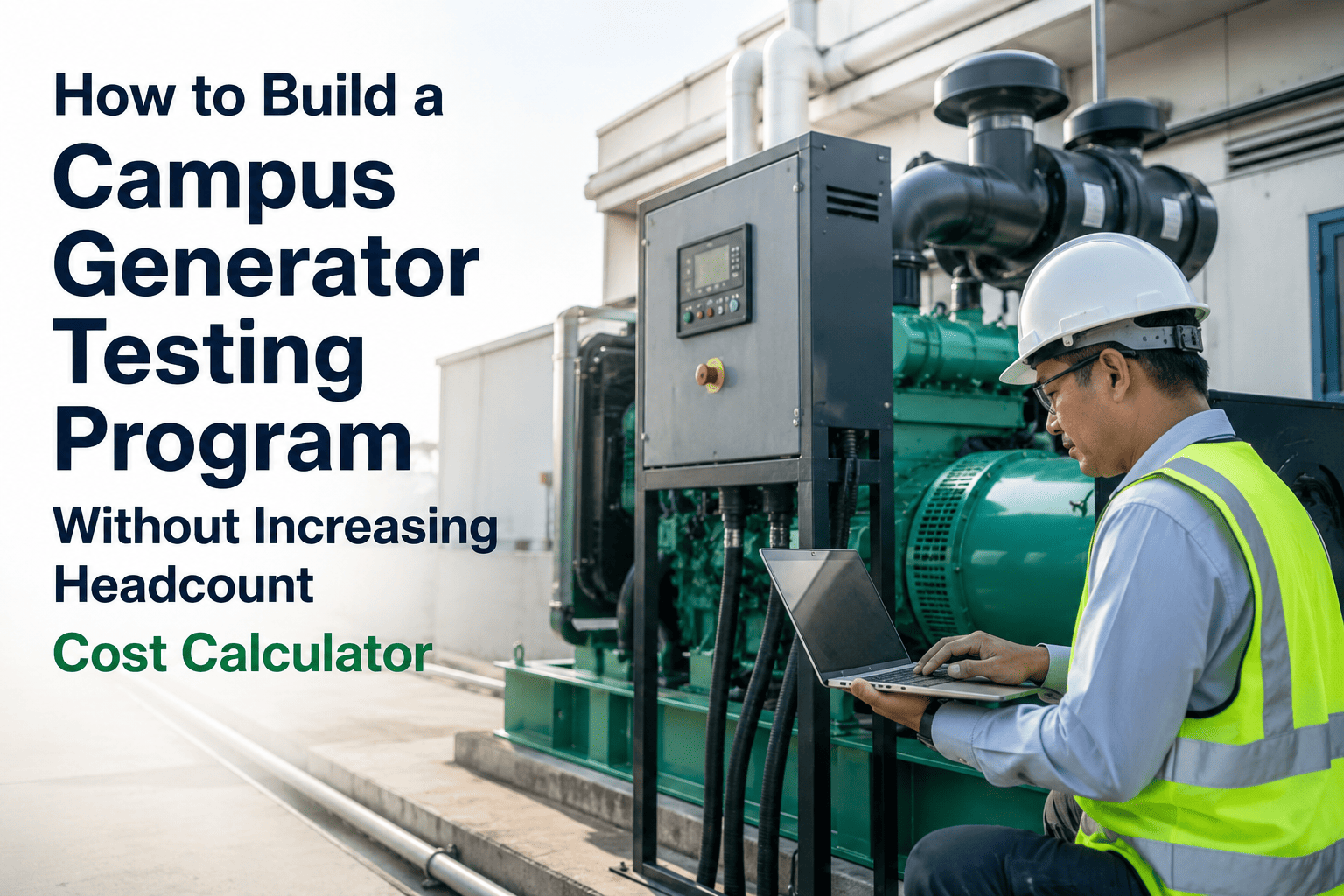
The math that stops most campus generator programs is not the equipment budget — it is the headcount. NFPA 110 expects every emergency generator exercised under load monthly, a longer load bank test annually, and on Level 1 systems a full-capacity run every three years, all documented and ready for the authority having jurisdiction. Multiply that cadence across ten or twenty generators serving dormitories, labs, and data closets, and a facilities lead reasonably concludes they need another full-time person just to keep the paperwork straight. They usually do not — what they need is to stop spending technician hours on scheduling, chasing forms, and assembling audit packets by hand. That recovered time is the headcount you already have, and OxMaint's asset management for standby power is how you free it.
Build a Campus Generator Testing Program Without Adding Headcount
Where the hours actually go in an NFPA 110 testing program — and how much of that time is scheduling and paperwork you can automate instead of hiring for.
Monthly
load exercise required per generator — 30 minutes minimum at 30% of nameplate rating
Annual
load bank test on Level 1 systems when monthly runs do not load the engine enough
3 yrs
full-capacity run required on Level 1 generators, all documented for the AHJ
The Time Audit
Where the Hours Go in a Manual Program
Run the breakdown for a single generator's monthly cycle. The hands-on testing is the small part — the overhead around it is what eats the week and drives the "we need to hire" conversation.
Scheduling & remindersRecoverable
Tracking which generator is due, on what cadence, and nudging the tech.
Paper forms & transcriptionRecoverable
Filling load-test sheets, then re-keying them into a spreadsheet later.
Audit packet assemblyRecoverable
Hunting down twelve months of logs when the AHJ asks for them.
Actual hands-on testingKeep
The 30-minute load run and inspection that genuinely needs a technician.
Automatable overhead
True technician work
The Reframe
Hire a Person, or Recover the Hours You Already Pay For
Add Headcount
A new salary plus benefits, recruited and onboarded
Still relies on manual reminders and paper forms
Audit prep is still a multi-day scramble
Knowledge walks out if that person leaves
Automate the Overhead
Test schedules generate themselves per generator
Results logged on a phone at the generator, no re-keying
Audit packet exports as a signed PDF on demand
Full history stays on the asset, not in someone's head
Give your existing team back their week
OxMaint auto-generates every monthly exercise, annual load bank, and triennial test per generator, captures results in the field, and keeps the full record audit-ready — so the program scales without a new hire.
The Cadence
One Schedule That Runs Itself
Weekly
Visual inspection — fluid levels, leaks, battery and ventilation checks logged per unit.
Monthly
30-minute load exercise at 30% nameplate, auto-scheduled and result-stamped.
Annual
Load bank test where monthly runs underload the engine, with documentation retained.
Triennial
Full-capacity run on Level 1 systems, scheduled three years out the moment the last one closes.
Expert Review
A generator that only ever runs its brief monthly no-load exercise has not really been tested — and a program that only ever survives on one person's memory has not really been built. The campuses that pass AHJ review without drama are not the ones with the most staff; they are the ones where the schedule, the results, and the records run on the system instead of the individual. That is what lets a flat team cover a growing fleet.
Reviewed by OxMaint's Asset Reliability Advisory Team
FAQ
Frequently Asked Questions
How often does NFPA 110 actually require generator testing?
A monthly load exercise of at least 30 minutes at 30% of nameplate rating, an annual load bank test where monthly runs underload the engine, and a triennial full-capacity run on Level 1 systems.
Can we really cover more generators without hiring?
Yes. Most of the per-generator effort is scheduling, transcription, and audit prep, not hands-on testing. Automating that overhead is what lets a flat team absorb a growing fleet.
Start free to map your generators.
Does OxMaint keep records the AHJ will accept?
Every test result is stored against the generator with date, technician, and readings, then exportable as a signed report — the documented history NFPA 110 requires be available to the AHJ on request.
How do technicians log a test in the field?
They open the auto-generated work order on a phone at the generator, enter readings and result fields, and sign off on the spot — no paper form and no later re-keying into a spreadsheet.
What happens to history when a team member leaves?
Nothing is lost. The full test and inspection history lives on each generator's asset record, so the program continues seamlessly regardless of staff turnover.
Book a demo to see it.
Scale the program, not the payroll
OxMaint turns NFPA 110 testing into a schedule that runs itself and records that export in minutes — so every added generator is a few more work orders, not another full-time hire.