Gym floors are the most visible — and most expensive — assets in school and university athletic facilities. A maple sports floor can last 50 years with the right maintenance program, but only if daily, weekly, monthly, and annual tasks are executed without fail. The pressure is real: school athletic departments are asked to expand programming, host more events, and protect a six-figure flooring asset without hiring more staff. The answer isn't more people — it's a structured maintenance template that turns existing staff into a disciplined PM crew. To deploy a turnkey gym floor template across your facilities, start a free trial or book a demo.
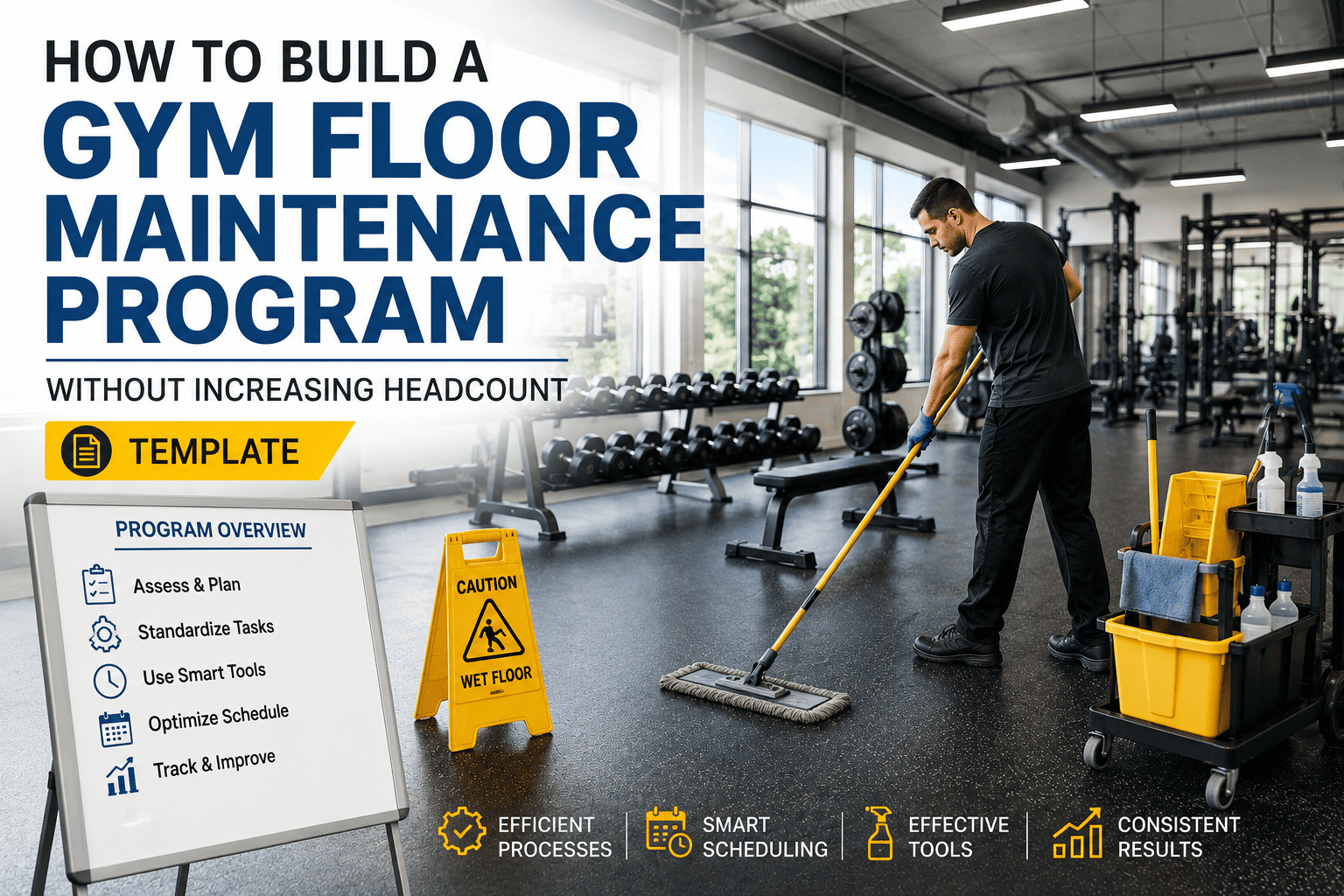
How to Build a Gym Floor Maintenance Program Without Increasing Headcount
A complete daily-weekly-monthly-annual maintenance template for maple hardwood sports floors. Built around MFMA guidelines, executable by existing custodial staff, and structured to extend floor life beyond 50 years — without a single new hire.
The Full Maintenance Template, Cadence by Cadence
The template below is structured around MFMA position statements and the maintenance cycles published by Connor Sports, Robbins, and other MFMA-accredited manufacturers. Every task is something existing custodial staff can execute — provided the cadence is scheduled, the supplies are stocked, and the records are captured.
How to Execute This Template Without Adding a Single FTE
The math is straightforward: daily dust-mopping a single competition court takes 15 minutes; weekly auto-scrub takes 45; monthly burnish takes 90; annual recoat is contracted out. The total cycle — on a single court, executed correctly — consumes less than 4 percent of one custodian's weekly hours. Every additional court adds incrementally, never proportionally, when supplies are pre-staged and tasks are auto-scheduled.
Treated dust mops, MFMA-approved cleaner, microfiber pads, and absorbent towels stored adjacent to the court — not in a basement closet 200 yards away. Five minutes saved per daily task equals 25 hours per court per year.
Daily PMs auto-create at 6:00 a.m., weekly PMs at end-of-week, monthly PMs at month-end. Tasks appear in the assigned custodian's mobile queue — no clipboard, no missed dates, no end-of-month scramble.
Each PM completion includes a quick photo of the finished surface and a digital sign-off. Photos build a longitudinal record of floor condition and prove tasks were executed for insurance, capital planning, and parent inquiries.
Daily, weekly, and monthly tasks stay in-house. Annual screen and recoat — and the every-8-to-10-year resand — go to an MFMA-accredited contractor. In-house staff never attempts sanding, period.
How Oxmaint Deploys the Template Across One Court or Twenty
Oxmaint loads the gym floor PM template as a pre-built asset class with daily, weekly, monthly, and annual schedules ready to assign — not as something a facility director needs to design from scratch. The template scales from a single high school gym to a multi-campus athletic facility portfolio with the same configuration effort. To deploy this template for your facilities, start a free trial or book a demo.
Add your gym as an asset, select "hardwood sports floor," and every daily, weekly, monthly, and annual PM is auto-loaded with MFMA-aligned task descriptions and frequency. No template design required.
Custodians see the day's gym floor tasks on their phone or tablet with checklist steps, supply lists, and a photo-and-sign completion field. No paper logs, no missing entries.
Temperature and humidity entry built into the daily PM task — not a separate log book. Excursions outside the 35 to 50 percent RH band auto-trigger an alert to facilities leadership.
Annual screen-and-recoat reminder fires 6 months ahead. Resand cycle reminder fires 18 months ahead. Vendor RFQs and athletic-calendar coordination begin before the season ends, not after.
Every monthly inspection photo stored against the asset record. Year-over-year visual comparison reveals when finish degradation is accelerating — in time to act, not after the floor is bare wood.
For districts and universities with multiple gyms, a single dashboard rolls PM completion, RH compliance, and recoat-cycle status across every court — visible to operations and athletic leadership.
What This Template Delivers in the First Twelve Months
MFMA documents floors well past 50 years when daily, monthly, and annual cycles are executed consistently — versus 15 to 20 years on a neglected reactive program
Template executes inside existing custodial hours when scheduled and supplied correctly — no FTE addition required, no overtime escalation
Every daily, weekly, monthly task captured with photo and timestamp — insurance, athletic, and capital planning records always current
Annual recoat closes the floor for three days; skipping recoats and waiting for resand closes it for 4 to 6 weeks — planned downtime is one-fifteenth the disruption
Frequently Asked Questions
Can existing custodial staff actually execute a full MFMA-aligned gym floor template?+
What humidity range must be maintained for hardwood gym floors?+
How often does a hardwood gym floor actually need to be recoated?+
How does Oxmaint handle multi-court districts and university athletic facilities?+
What records does this template produce for insurance, ASTM F2772, and capital planning?+
Build the Template Once. Let the Schedule Do the Work Every Day After.
The campuses that protect their gym floors aren't the ones with bigger budgets — they're the ones with a written template, an automated schedule, and a CMMS that holds the cadence so staff doesn't have to remember it. A 50-year floor is a discipline outcome, not a labor outcome. Deploy the template and let the system carry the cycle.