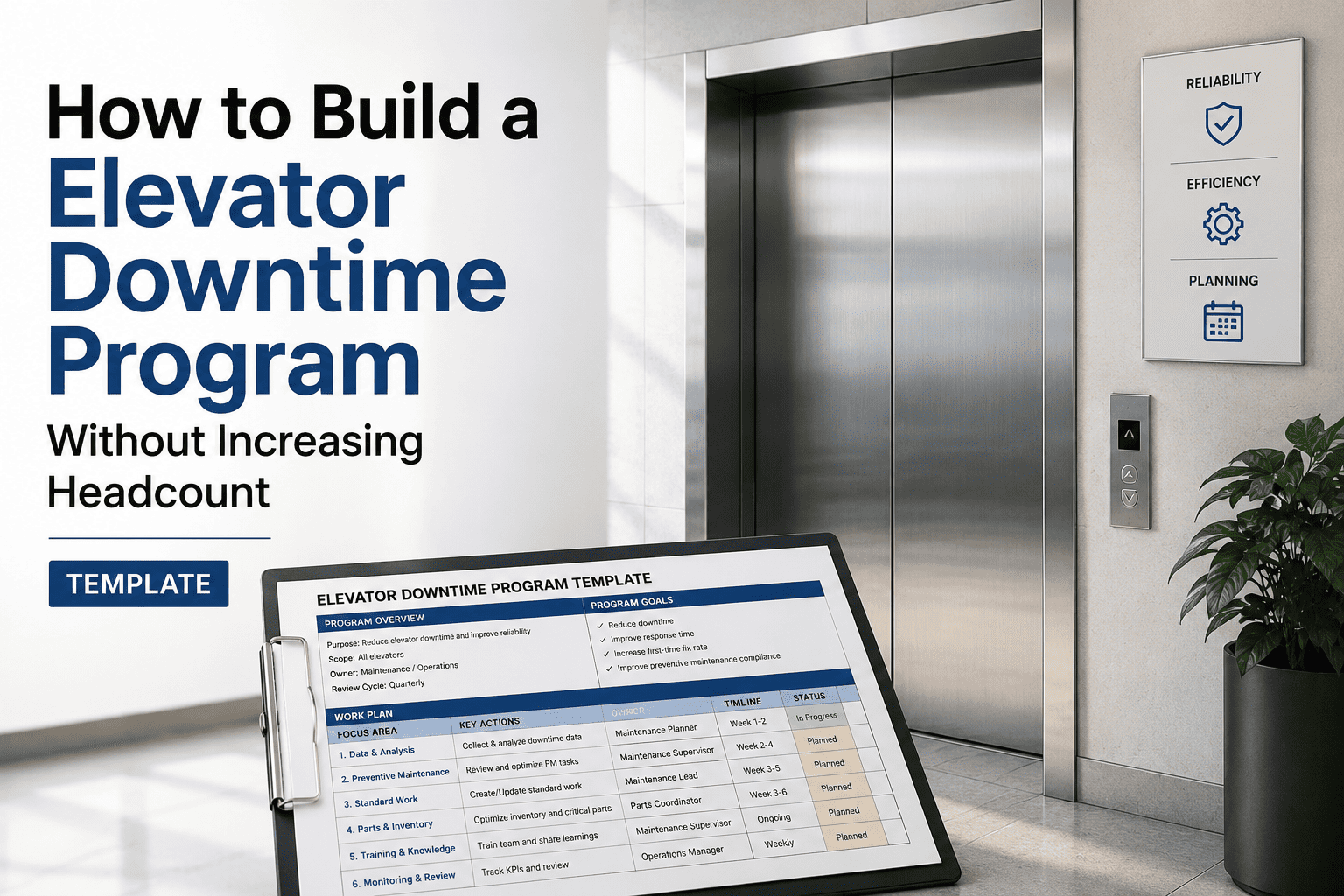
Elevator downtime in commercial and residential buildings costs facility teams an average of $4,800 per incident in emergency repair fees, contractor overtime, and tenant disruption — yet 73% of building operators still rely on reactive maintenance, waiting for failure before acting. A structured elevator downtime reduction program changes that equation entirely: buildings using CMMS-driven preventive maintenance cut unplanned outages by up to 38%, extend equipment life by 12 to 15 years, and reduce annual maintenance spend by $1,200 to $3,400 per elevator. The key is not more headcount — it is smarter scheduling, real-time inspection tracking, and automated compliance documentation. OxMaint gives your maintenance team the tools to run a full elevator PM program across every building in your portfolio, without adding a single technician. Explore the template below or start a free trial to deploy it today.
Build an Elevator Downtime Program Without Increasing Headcount
A complete operational template for facility managers who need to cut elevator failures, automate compliance, and protect tenant experience — using existing staff and OxMaint's AI-driven CMMS.
Why Elevators Keep Breaking Down Despite Existing Staff
The problem is rarely a shortage of technicians. It is a shortage of visibility. When maintenance teams cannot see what was last inspected, what parts are aging, or which units are overdue for service, every elevator becomes a ticking clock.
Technicians work from paper logs or memory. Without a digital record, repeat issues go undiagnosed and inspectors cannot see failure patterns across multiple units.
Spreadsheet-based PM calendars break down at scale. When a crew has 40 elevators across 12 buildings, manual tracking means inspections slip — often going months overdue.
Annual state inspections and AHJ certificate renewals require documented service history. Teams that keep paper records spend 8 to 14 hours per audit assembling proof.
When emergencies dominate the queue, PMs get pushed. The cycle accelerates: fewer PMs lead to more failures, which lead to even fewer PMs. Without automation, teams cannot escape it.
The OxMaint Elevator Downtime Program Template
This template is built around five operational pillars. Each one maps directly to a CMMS feature in OxMaint and can be activated without hiring additional staff.
Log every elevator with its manufacturer, install date, last major overhaul, door type, drive system, and capacity. OxMaint links all work orders and inspection records to each unit permanently.
Set monthly, quarterly, semi-annual, and annual PM triggers per unit. OxMaint auto-assigns work orders to technicians based on zone and availability — no manual calendar management.
Technicians complete standardized inspection forms on their phone — door operation, cab leveling, safety devices, oil levels, cab lighting. Data syncs instantly with no paper transcription.
Upload state inspection certificates, AHJ permits, and contractor licenses per unit. OxMaint sends renewal alerts 60, 30, and 7 days before expiry — eliminating last-minute scrambles.
Track MTBF (mean time between failures) and MTTR (mean time to repair) per elevator unit over rolling 90-day windows. Identify which units need capital replacement before they cause tenant escalations.
What This Program Delivers in 90 Days
Results are based on OxMaint deployments across multi-building commercial and residential portfolios using this exact template structure.
All elevator units logged, PM schedules activated, and mobile checklists deployed to field technicians. No manual tracking from this point forward.
OxMaint auto-compiles service history, certificate status, and inspection records per unit. What took 14 hours of manual assembly now takes 12 minutes.
Automated work order assignment closes the scheduling gap. Emergency callouts begin declining as PMs catch wear issues before failure.
MTBF and MTTR per unit visible in the dashboard. Capital replacement decisions are now backed by 90 days of real performance data, not guesswork.
Ready to Deploy This Template in Your Building Portfolio?
OxMaint sets up elevator PM schedules, mobile checklists, and compliance tracking in under two weeks — for teams managing 5 elevators or 500.
Reactive vs. Preventive: The Numbers Side by Side
This comparison uses industry averages for a portfolio of 20 elevators across 4 buildings — a common scale for mid-market commercial operators.
| Metric | Reactive-Only Model | OxMaint PM Program |
|---|---|---|
| Annual emergency callouts (20 units) | 18 to 24 per year | 6 to 9 per year |
| Average cost per emergency callout | $4,800 | $4,800 (rare) |
| Annual emergency repair spend | $86,400 to $115,200 | $28,800 to $43,200 |
| PM compliance rate | 22 to 40% | 88 to 96% |
| Audit documentation prep time | 12 to 14 hours per audit | Under 90 minutes |
| Equipment replacement cycle | 15 to 18 years | 25 to 30 years |
| Headcount required for program | Reactive: no change | Same team, automated scheduling |
Frequently Asked Questions
Can OxMaint manage elevators alongside other building systems like HVAC and electrical?
Yes. OxMaint is a full CMMS — elevators are one asset category within a broader building or campus hierarchy. Teams managing HVAC, electrical, plumbing, and elevators under one platform get unified scheduling, reporting, and compliance tracking across all systems. Start a free trial to see the full asset hierarchy.
Does this template work for both traction and hydraulic elevator types?
The PM checklist templates in OxMaint can be customized by elevator drive type. Hydraulic units have different fluid and cylinder inspection requirements than traction units, and the system supports separate checklist templates per asset category. Both types are fully supported.
How does OxMaint handle third-party elevator service contractor work orders?
Contractors can be assigned work orders directly through OxMaint with email notification. They can complete and close work orders via a mobile link — no login required on their end. All contractor work is logged in the asset's service history for compliance documentation. Book a demo to see the contractor workflow.
What happens if my team has no prior CMMS experience?
OxMaint is designed for field technicians, not software engineers. The mobile app requires no training beyond a 30-minute walkthrough, and the admin setup for a 20-elevator portfolio takes under 4 hours. Most teams are fully operational within one week of signing up.
Can OxMaint generate the documentation required for state elevator inspection filings?
OxMaint auto-generates service history reports per elevator unit that include all completed work orders, inspection dates, technician names, and part replacements. These reports are accepted by most state AHJ inspectors as supporting documentation. Requirements vary by state, so we recommend confirming with your local authority. Explore compliance features here.
Your Elevators Should Not Be Your Biggest Liability
With OxMaint, your existing maintenance team can run a world-class elevator PM program — automated scheduling, mobile inspections, compliance tracking, and real-time downtime analytics — all without adding headcount or complex integrations.