Most university asset managers know approximately how old their major equipment is. Very few know the full lifecycle cost of that equipment — what it cost to purchase, what it has cost to maintain, what it will cost to replace, and how much useful life remains before replacement becomes necessary. That gap between knowing what you own and understanding its full lifecycle position is what turns capital planning from a data-driven process into an educated guessing game. When a VP of Operations asks which HVAC units across the portfolio are approaching end-of-life and what the replacement cost exposure looks like over the next 5 years, the answer should come from a system — not from a spreadsheet assembled by hand over several weeks, and not from an asset manager's personal familiarity with individual buildings built over years of institutional memory. Campus asset lifecycle tracking creates the institutional visibility that makes capital decisions defensible, replacement prioritization evidence-based, and deferred maintenance tracking systematic rather than anecdotal. Start a free trial for 30 days to see how Oxmaint tracks campus asset lifecycles from installation to disposal, or book a demo with a higher education asset management specialist.
Campus Asset Management · Lifecycle Tracking · Complete How-to Guide
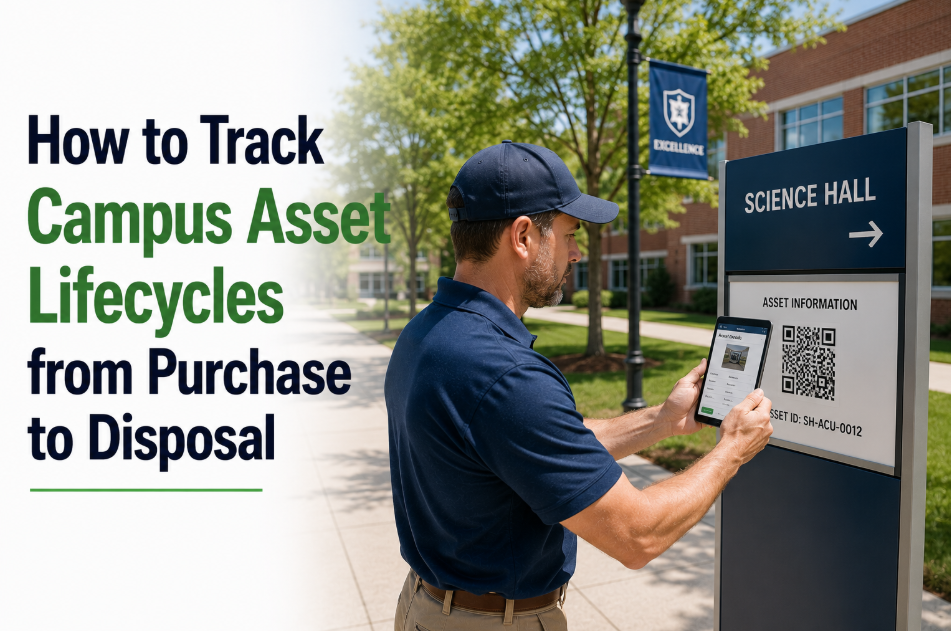
How to Track Campus Asset Lifecycles from Purchase to Disposal
A complete framework for campus asset lifecycle tracking — initial acquisition through condition scoring, maintenance history accumulation, remaining useful life calculation, and planned replacement or disposal documentation
Replace Spreadsheet Asset Lists with Live Lifecycle Intelligence
Oxmaint tracks every campus asset through its complete lifecycle — from purchase record and installation date through condition scoring from every inspection, maintenance cost accumulation from every work order, and capital replacement forecasting tied to condition trends. Asset managers move from knowing what they own to knowing where every asset sits in its lifecycle. Start a free trial or book a demo to walk through the lifecycle tracking framework.
$100B+
Deferred campus maintenance in US universities — the result of replacing assets reactively instead of tracking lifecycle position
34%
Average reduction in capital expenditure when condition-based lifecycle planning replaces age-based replacement schedules
18 mo
Average advance warning before end-of-life when condition trend analysis drives replacement forecasting
4.8x
Higher total lifecycle cost per asset when maintenance history is not tracked and replacement timing is reactive
The 6 Lifecycle Stages Every Campus Asset Passes Through
Understanding the six lifecycle stages is the foundation of structured campus asset management. Each stage generates data that informs the next — creating a continuous intelligence loop from acquisition to disposal.
01
Acquisition
Purchase order, vendor, cost, warranty terms, expected service life
→
02
Installation
Commission date, location, initial condition score, installation contractor
→
03
Operation
Runtime hours, operating conditions, OEM maintenance compliance
→
04
Maintenance
PM history, repair events, parts consumed, cumulative maintenance cost
→
05
Decline
Condition score deterioration, repair frequency increase, end-of-life forecasting
→
06
Disposal
Replacement decision, total lifecycle cost, disposal record, successor asset link
What to Capture at Each Lifecycle Stage
The quality of lifecycle intelligence depends entirely on what data is captured and when. These are the specific data points that make campus asset lifecycle tracking actionable — not just a record-keeping exercise. Start a free trial to build your asset registry in Oxmaint, or book a demo to see the full lifecycle data model.
Asset name, category, and manufacturer model number
Purchase date and purchase order reference
Acquisition cost (hardware only — separate from installation)
Vendor and warranty terms — duration and coverage scope
OEM-stated expected service life in years
Depreciation schedule linked to financial records
Commission date — the start of the lifecycle clock
Building, floor, and precise location within the asset hierarchy
Installation contractor and labor cost
Initial condition score from commissioning inspection
As-installed photos stored in the asset record
First PM schedule set based on OEM documentation
Every PM completion — date, technician, findings, parts used
Every corrective work order — failure mode, repair, labor, parts cost
Cumulative maintenance cost updated with every work order close
Condition score updated from inspection findings at each PM
Runtime hours or operational cycles where applicable
Repair frequency trend — how often corrective work orders are opening
Condition trajectory — rate of condition score decline over time
Projected end-of-life date based on condition trend extrapolation
Total lifecycle cost — acquisition + installation + cumulative maintenance
Replacement decision record — rationale, approval, timing
Disposal method and disposal date
Successor asset link — replacement asset ID connected to this record
How Condition Scoring Drives Lifecycle Decisions
Condition scores are the engine of data-driven lifecycle management. When condition scores update continuously from inspection data rather than annually from point-in-time assessments, they generate reliable replacement forecasts — not educated guesses.
90–100
Excellent Condition
Maintain current PM schedule. No capital action required. Estimated remaining life: 70–100% of design life remaining.
70–89
Good Condition
Monitor condition trend rate. Flag for capital forecast inclusion if deteriorating faster than 5 points per year. Estimated remaining life: 40–70% of design life.
50–69
Fair Condition
Include in 3–5 year capital plan. Review maintenance cost trends — if annual maintenance cost exceeds 15% of replacement value, accelerate replacement timeline.
30–49
Poor Condition
Priority capital planning — include in 1–2 year replacement window. Begin procurement process. Document condition evidence for budget justification.
0–29
Critical / End of Life
Immediate replacement planning. Failure risk is high. Emergency procurement if planned replacement has not been initiated. Document condition for insurance and liability purposes.
Trend
Rate of Decline Matters More Than Score
An asset at 70 declining 10 points per year reaches critical condition in 4 years. An asset at 55 declining 2 points per year remains serviceable for 12 years. Track the rate — not just the number.
How Oxmaint Tracks Campus Asset Lifecycles
Asset Registry
Five-Level Hierarchy From Portfolio to Component
Every campus asset is registered within a structured hierarchy — Portfolio, Property, System, Asset, Component. Acquisition data, installation details, and lifecycle parameters are captured at onboarding. The structure enables condition data to aggregate from component level up to portfolio-level capital planning models automatically.
Condition Tracking
Inspection-Updated Condition Scores — Always Current
Condition scores update automatically with every inspection and PM completion. When a technician notes early corrosion on a chiller's heat exchanger, the asset's condition score adjusts and the condition trend flags for facilities review. No annual re-assessment cycle needed — condition intelligence is live.
Cost Accumulation
Cumulative Lifecycle Cost Updated per Work Order
Every work order closed against an asset — PM or corrective — updates the asset's cumulative maintenance cost counter. Asset managers can see the total lifecycle cost at any point: acquisition cost plus installation cost plus every dollar spent on maintenance. When annual maintenance cost approaches 15% of replacement value, the system flags the asset for accelerated replacement consideration.
Lifecycle Forecasting
Remaining Useful Life Projected from Condition Trends
Oxmaint extrapolates condition trend data forward to project when each asset will reach defined replacement thresholds. The result is a rolling 5–10 year CapEx forecast that shows probable replacement costs by year, by building, and by system category — generated automatically, not assembled manually before each budget cycle.
Disposal Records
Full Lifecycle Closure with Successor Asset Linking
When an asset is replaced, Oxmaint closes the lifecycle record — capturing total lifecycle cost, disposal method, final condition score, and the replacement decision rationale. The successor asset is linked to the replaced asset's record, giving future asset managers context about what replaced what and why — building institutional knowledge that survives personnel changes.
Portfolio Reporting
Condition Distribution Across All Campus Buildings
Portfolio dashboard shows the condition distribution of all registered assets across all campus buildings — what percentage are in excellent, good, fair, poor, and critical condition. Facilities leadership can see total deferred maintenance liability and projected CapEx requirements by year at a glance, in a format ready for board presentation without manual data assembly.
Spreadsheet Asset Lists vs Oxmaint Lifecycle Tracking
34%
CapEx Reduction
average capital spend reduction when condition-based lifecycle planning replaces age-based replacement
18 mo
Earlier Replacement Warning
condition trend analysis projects end-of-life 12–18 months ahead — enabling planned procurement
100%
Lifecycle Cost Visibility
every maintenance dollar spent tracked against the asset — total lifecycle cost visible at any point
Hours
vs Weeks for CapEx Reports
time to generate board-ready 5-year capital forecast when asset lifecycle data is live and structured
Frequently Asked Questions
What is the difference between asset tracking and asset lifecycle management?
Asset tracking records what you own and where it is — a registry. Asset lifecycle management goes further: it tracks the asset's condition over time, accumulates its maintenance cost history, projects its remaining useful life based on condition trends, and generates replacement timing recommendations for capital planning. A spreadsheet can do asset tracking. Asset lifecycle management requires a system where maintenance activity, inspection findings, and condition scoring are connected — so that the asset record reflects the asset's current state, not just its initial installation details. The distinction matters most at capital planning time: asset tracking tells you what you have, lifecycle management tells you what decisions you need to make about it.
When should a campus begin asset lifecycle tracking — at installation or retrospectively?
Ideally both. For new assets, lifecycle tracking begins at purchase order — capturing acquisition cost, warranty terms, expected service life, and commission date. For existing assets, retrospective registration builds the registry from current condition forward, using initial condition assessment to establish the baseline score and PM schedule. You do not need complete historical data for existing assets to generate value — Oxmaint builds asset history progressively from the date of registration forward. The most important data points for existing assets are current condition score, installation year, OEM service life, and any known major repair events. Even partial historical data significantly improves lifecycle forecast quality compared to age-only estimates.
How does Oxmaint calculate remaining useful life for campus assets?
Oxmaint uses three inputs to calculate remaining useful life: the asset's current condition score, the rate at which that score has been declining over the tracking period, and a configurable replacement threshold score (typically 30–40, representing poor condition). By extrapolating the current condition trend forward, the system projects when the asset will reach the replacement threshold — producing a date range rather than a single estimate, to reflect uncertainty in the projection. For assets with less than 12 months of condition history, Oxmaint supplements trend data with asset type benchmarks and OEM expected service life to produce a probability-weighted remaining life estimate. Forecast accuracy improves significantly at 12–18 months of condition data accumulation.
How does campus asset lifecycle data support capital planning and board presentations?
Oxmaint's lifecycle data feeds directly into the CapEx forecasting module, which generates rolling 5–10 year capital expenditure projections by year, by building, and by system category. These projections are based on projected replacement costs for assets whose condition trends indicate end-of-life within the forecast window — not on age estimates or generalized benchmarks. Board presentations can be generated from the system showing: total asset portfolio condition distribution, cumulative deferred maintenance liability, projected CapEx by year and category, and the condition evidence basis for each major replacement project included in the plan. This replaces the weeks-long manual assembly process that typically precedes capital planning submissions with a report that can be generated in hours from live data.
Campus Asset Lifecycle Tracking · Oxmaint Platform
Know Where Every Campus Asset Sits in Its Lifecycle — Not Just What You Own
Oxmaint tracks every campus asset from acquisition through disposal — condition scoring that updates from every inspection, maintenance cost accumulation from every work order, remaining useful life projection from condition trends, and board-ready CapEx forecasting generated automatically. Asset managers gain the lifecycle intelligence needed to make capital decisions based on data, not institutional memory.