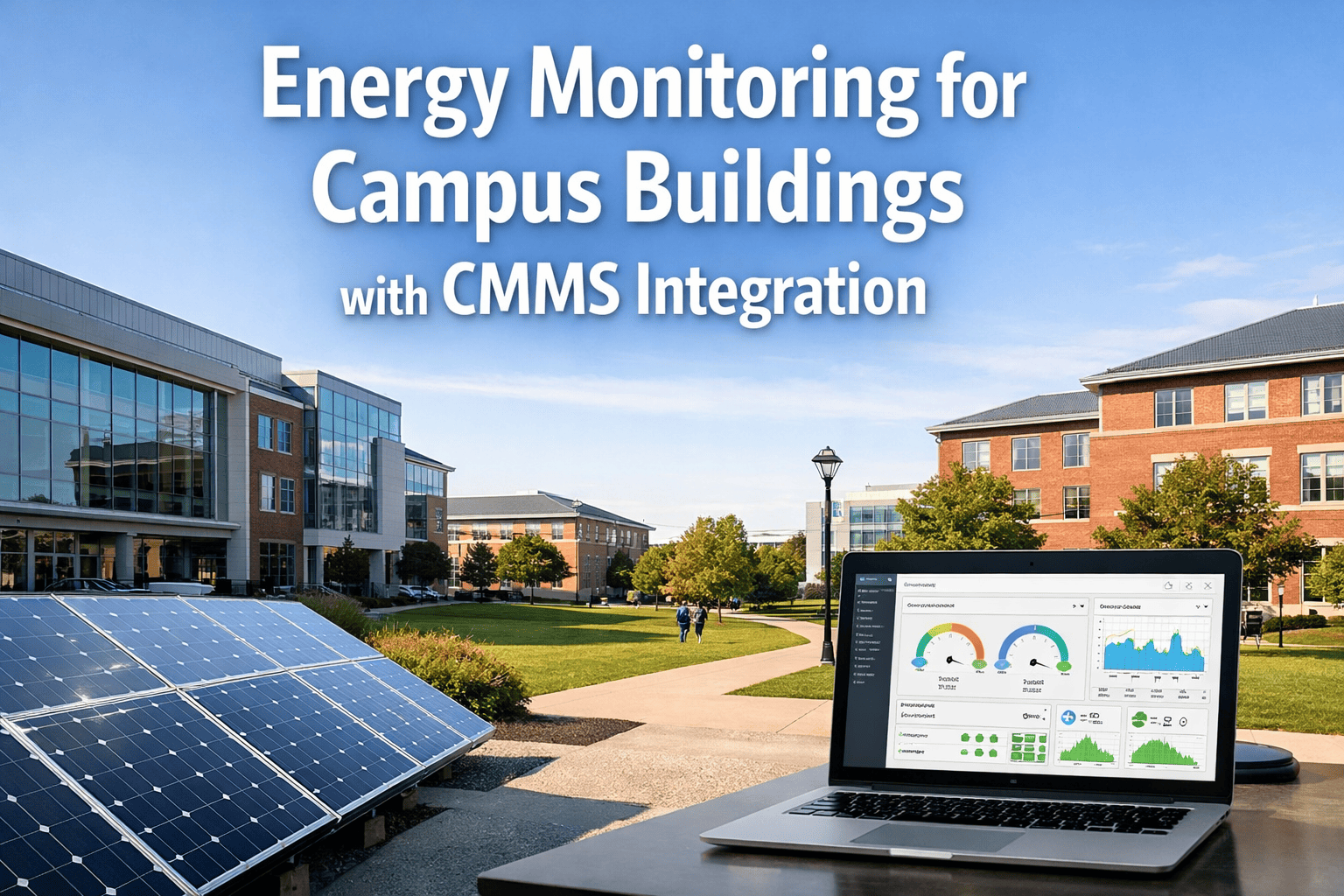
A campus HVAC system that begins drawing 18% more current than its baseline does not announce itself — it continues operating, consuming electricity at an accelerating rate, until a component fails and a building goes offline during finals week. A chiller that develops a refrigerant leak does not send an email — it cycles longer and longer to maintain setpoints, running up energy costs for weeks before a service call is triggered by a room temperature complaint. The gap between when a campus asset begins failing and when a facilities team discovers it is almost always measured in weeks, and it is almost always closed by a student, faculty member, or building occupant rather than by a maintenance system. IoT vibration, temperature, humidity, and power sensors integrated with Oxmaint change this by giving campus facilities teams a live asset health dashboard — with automatic work order generation the moment any sensor reading crosses a threshold that indicates a problem developing, not one that has already occurred. See Oxmaint's IoT campus monitoring configured for your facility — start free.
IoT Sensors for Campus Maintenance: Real-Time Monitoring Guide
Vibration, temperature, humidity, pressure, and power sensors integrated with Oxmaint give campus facilities teams live asset health dashboards and auto-generate work orders the moment any sensor reading crosses a threshold — catching failures 3 to 6 weeks before they stop building operations.
Oxmaint integrates with vibration, temperature, humidity, current, pressure, and CO2 sensors across campus buildings — creating a live asset health dashboard that surfaces developing problems automatically and generates a prioritized work order to the nearest qualified technician without dispatcher intervention.
Why Scheduled Inspection Alone Cannot Protect Campus Assets
A typical campus PM schedule inspects an air handler unit every 90 days. But bearing degradation, refrigerant loss, and belt wear do not observe a 90-day schedule — they develop continuously between inspection visits, with failure curves that can move from early-stage detectable degradation to operational failure in 2 to 4 weeks under heavy seasonal load. A vibration sensor mounted on a motor bearing reads every 15 minutes and catches a bearing defect frequency pattern developing at week 3 of the 90-day inspection cycle, when targeted lubrication or a bearing replacement costs $200 and takes 2 hours. The same defect discovered at the PM visit at day 90 — if the bearing has not already failed — still costs $200. Discovered after failure during peak cooling season, the same bearing failure costs $8,000 to $18,000 in emergency repair, temporary cooling equipment, and academic program disruption.
Oxmaint's IoT integration does not replace PM schedules — it fills the gaps between them with continuous monitoring that extends the effective inspection frequency from quarterly to continuous, at a fraction of the labor cost of more frequent manual rounds. Start free to see IoT sensor integration for your campus assets.
IoT Sensor Types — Campus Asset Coverage by Oxmaint
Oxmaint integrates with six sensor categories that cover the highest-failure-risk campus assets — from HVAC mechanical systems to building envelope monitoring. Each sensor type generates threshold-based alerts that automatically create prioritized work orders in Oxmaint. See sensor integration configured for your building types.
| Sensor Type | Campus Assets Monitored | Failure Detected | Avg Detection Lead |
|---|---|---|---|
| Vibration | Motors, pumps, fans, compressors, chillers | Bearing wear, imbalance, misalignment | 3–6 weeks early |
| Temperature | HVAC, boilers, electrical panels, freezers | Overheating, cooling loss, insulation failure | 2–4 weeks early |
| Humidity | Labs, archives, server rooms, museums | Condensation risk, mold conditions, equipment damage | Real-time alert |
| Current / Power | Motors, HVAC, lab equipment, elevators | Efficiency loss, impending motor failure | 4–8 weeks early |
| Pressure | Boilers, steam systems, compressed air, water | Leak detection, seal failure, system imbalance | 1–3 weeks early |
| CO2 / Air Quality | Classrooms, labs, residential halls, libraries | Ventilation failure, filter degradation, IAQ non-compliance | Real-time alert |
IoT Monitoring Results — Campus Deployments
Measured outcomes at university campuses using Oxmaint IoT sensor integration — 12-month post-deployment data on downtime, energy cost, and maintenance labor efficiency.
IoT Integration Workflow — Sensor to Work Order
Oxmaint's IoT integration connects sensor data to maintenance action in five steps — from sensor reading through threshold analysis to prioritized work order dispatch — without requiring dispatcher review for routine threshold events.
Our vibration sensors caught a chiller motor bearing at 67% degradation in October — during our busiest enrollment period. We replaced the bearing over a weekend for $340. The same failure in December would have been a $22,000 emergency repair and 4 days without cooling in our main academic building. IoT paid for itself on that one event.
Frequently Asked Questions
-52% Downtime. -31% Energy Cost. 15-Second Threshold-to-Work-Order.
IoT campus monitoring integrated with Oxmaint — live on your highest-risk assets within 2 weeks.