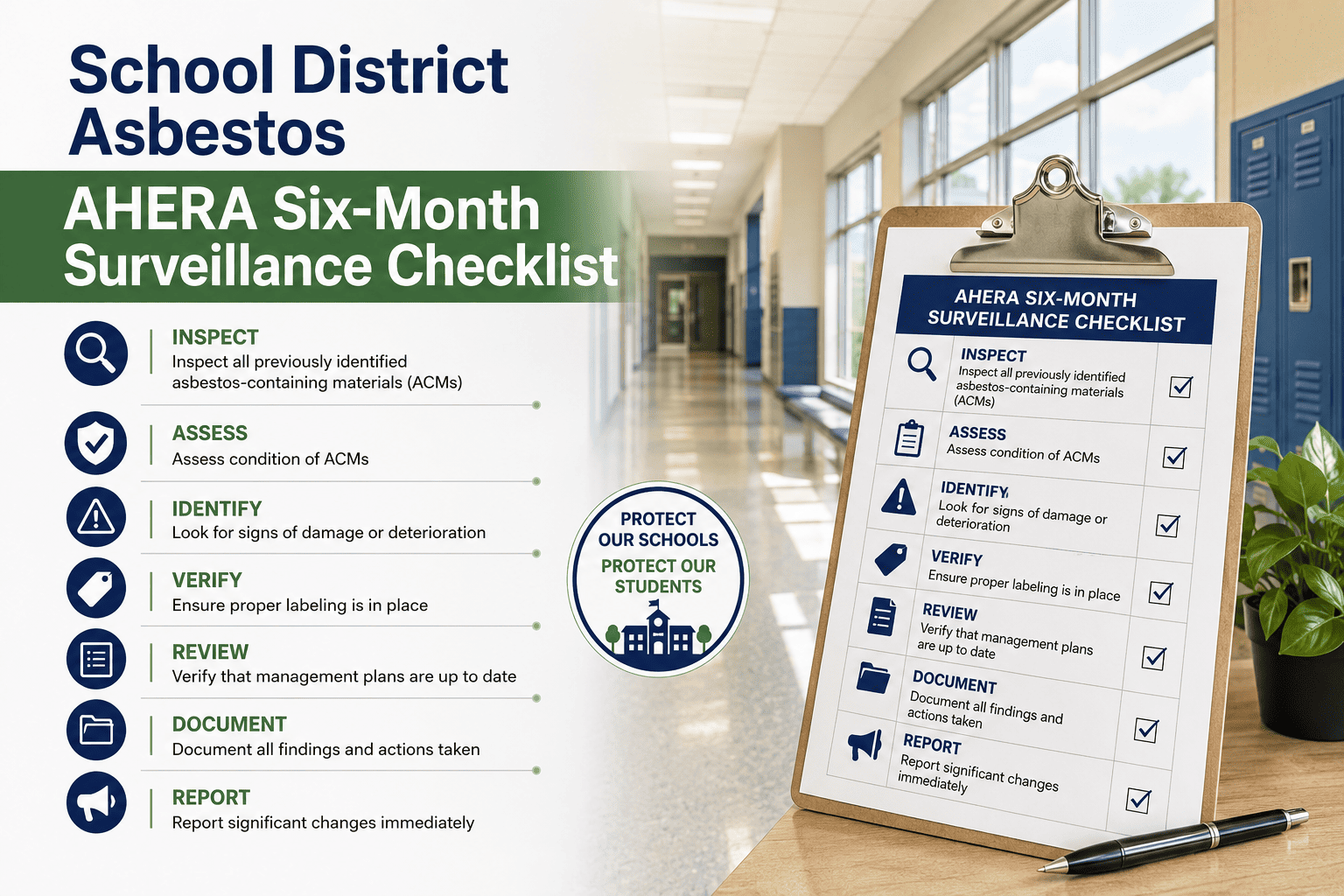
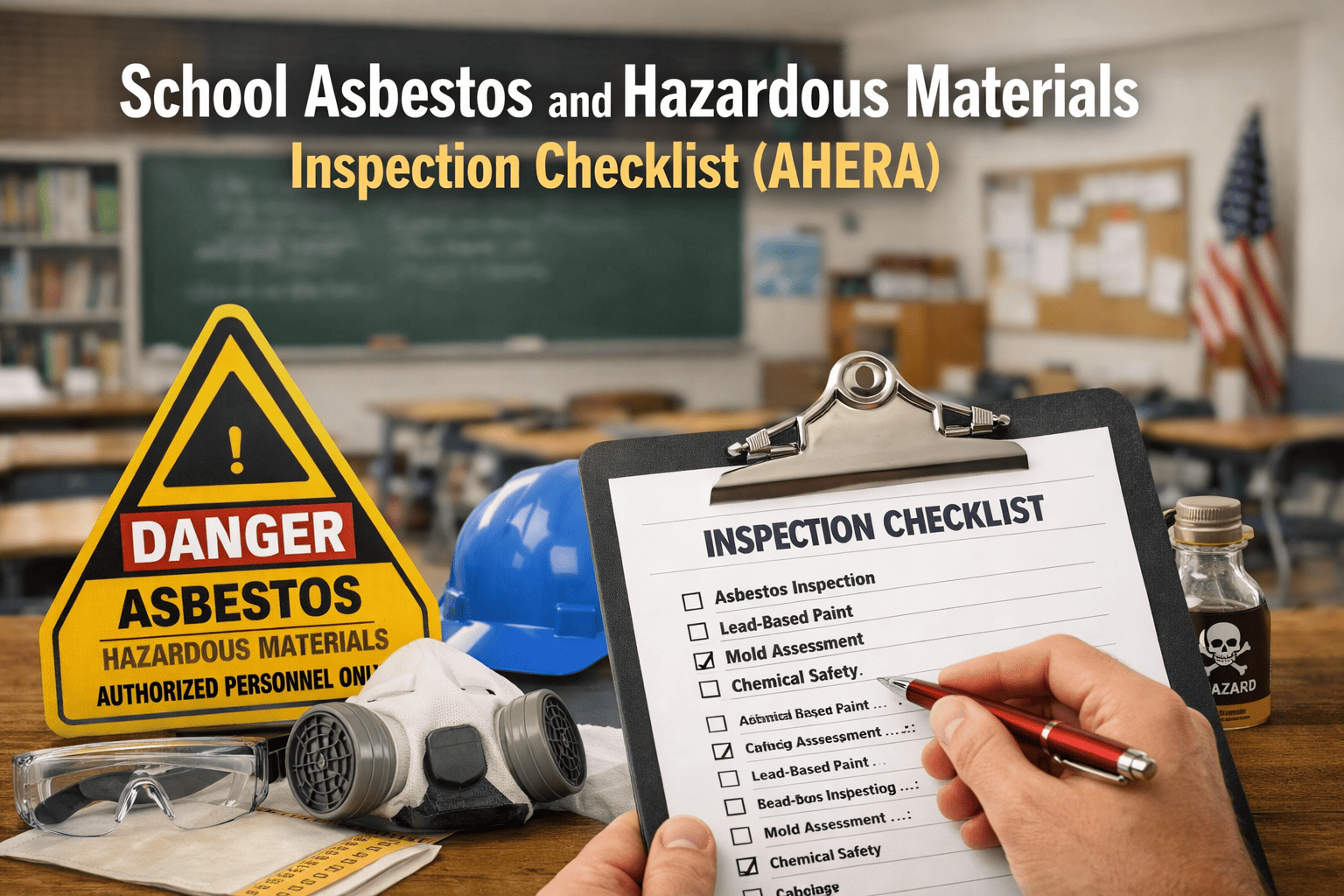
School District Asbestos AHERA Six-Month Surveillance Checklist
By Stephen King on June 8, 2026
School districts are required under the Asbestos Hazard Emergency Response Act (AHERA) to conduct six-month periodic surveillance of all identified asbestos-containing materials (ACM) in K-12 school buildings. These inspections must be performed by trained staff, documented in the building's AHERA Management Plan, and retained for at least three years. A missed or incomplete six-month surveillance cycle puts districts at risk of EPA enforcement, fines up to $25,000 per day, and — far more critically — undetected ACM deterioration that exposes students and staff. This checklist covers every element of a compliant AHERA six-month surveillance: friable and non-friable ACM condition assessment, response action review, designated person obligations, and recordkeeping — structured for deployment in OxMaint as a building-by-building compliance work order. Book a Demo to see how districts track AHERA compliance across every facility in real time.
AHERA Compliance — OxMaint CMMS
School District Asbestos AHERA Six-Month Surveillance Checklist
Friable ACM condition assessment, response action tracking, designated person obligations, and EPA-compliant recordkeeping — every item required for a defensible AHERA six-month surveillance, structured for CMMS deployment across all school buildings.
Complete per building at six-month intervals — typically once in fall (October–November) and once in spring (April–May). Items marked Escalate require designated person review and possible accredited inspector involvement before the surveillance record is closed. Items marked Document must be recorded in the AHERA Management Plan with date, location, and observer name. All completed surveillances must be signed by the designated person.
AHERA Surveillance Tracked Per Building in OxMaint
Every school building is an individual asset in OxMaint. Six-month surveillance work orders are generated automatically on schedule, assigned to trained designated person staff, and completed room-by-room. All ACM location records, condition assessments, and response action statuses are stored against each building — exportable for any EPA or state agency audit. Sign Up Free and deploy your first AHERA surveillance programme today.
AHERA requires each school district to identify a Designated Person (DP) — an individual responsible for ensuring all inspection, surveillance, and recordkeeping requirements are met. The DP must complete an EPA-approved awareness course. Before each six-month surveillance begins, the DP must confirm that the correct trained observer is assigned, that the current Management Plan is available, and that all prior response actions are reviewed for ongoing compliance. Failure to maintain a properly trained and documented DP is one of the most common AHERA citation triggers in EPA enforcement actions. Sign Up Free to track DP training records and surveillance assignments in OxMaint.
Pre-SurveillanceDesignated Person Pre-Surveillance Review
EscalateIf the Designated Person position is vacant or DP training has lapsed — surveillance may not commence; district must assign and train a new DP before the six-month requirement deadline
2. Friable ACM Condition Assessment
Friable ACM — material that can be crumbled by hand pressure and releases fibres — represents the highest-priority category in AHERA surveillance. Common friable ACM in school buildings includes sprayed-on fireproofing, pipe insulation, boiler lagging, and certain ceiling tiles. The six-month surveillance must assess the current condition of all previously identified friable ACM against the condition recorded in the prior inspection or surveillance, and note any changes in deterioration, damage, or disturbance. Book a Demo to see how OxMaint tracks ACM condition changes across building assets over time.
Every ACM LocationFriable ACM Visual Assessment
EscalateAny friable ACM that has deteriorated significantly, been physically damaged, or shows new debris on surfaces below — do not disturb; immediately notify Designated Person; may require accredited inspector re-assessment and response action initiation
Damage AssessmentPhysical Damage and Disturbance Indicators
ACM Condition History Tracked Per Location in OxMaint
Every identified ACM location is registered as a unique asset in OxMaint — tied to its building, room, and AHERA location code. Each six-month surveillance records a condition rating against the prior record. Condition trend data (stable, deteriorating, improving after response action) is visible across all buildings in the district compliance dashboard. Sign Up Free to manage your district's ACM inventory in one platform.
Non-friable ACM — material that cannot be crumbled by hand pressure under normal conditions — includes floor tiles, floor tile mastic, roofing materials, caulking, and certain ceiling systems. While lower priority than friable ACM, non-friable materials can become friable through damage, cutting, drilling, or water exposure. AHERA requires that non-friable ACM be assessed for any change in condition that could indicate the material is becoming friable or has been disturbed. Book a Demo to see non-friable ACM condition tracking in OxMaint.
Every ACM LocationNon-Friable ACM Visual Assessment
DocumentAny non-friable ACM showing cracking, breakage, cutting, or drilling damage must be recorded with location, extent of damage, and likely cause — and assessed by Designated Person for response action requirement
4. Response Action Status Review
Each prior AHERA inspection or surveillance may have initiated a response action — operations and maintenance (O&M), repair, encapsulation, enclosure, or removal. The six-month surveillance must confirm that all ongoing response actions are being implemented as required, that O&M programme documentation is current, and that no areas with active response actions have been disturbed. Response action failures — particularly O&M programme lapses — are the second most common category of AHERA enforcement action in school districts. Sign Up Free to track response action status and O&M programme compliance in OxMaint.
Every Active Response ActionO&M Programme and Response Action Review
EscalateAny O&M programme lapse, encapsulant failure, or evidence of work in ACM areas without O&M compliance — notify Designated Person immediately; may require accredited inspector involvement and EPA notification depending on the extent of disturbance
Abatement ProjectsAbatement and Removal Activity Since Last Surveillance
5. Special Function Areas
Certain areas of school buildings carry elevated AHERA surveillance requirements due to higher maintenance activity, more frequent occupancy changes, or construction near ACM. Mechanical rooms, boiler rooms, roof spaces, gymnasiums with sprayed fireproofing, and areas undergoing renovation require dedicated assessment during each six-month surveillance. These areas are also the most likely locations for unreported ACM disturbance by maintenance staff unfamiliar with the O&M programme.
High-Priority AreasMechanical Rooms, Boiler Rooms, and Roof Spaces
Corridors and ClassroomsOccupied Space ACM Assessment
6. Recordkeeping Requirements
AHERA requires that every six-month surveillance be recorded in writing, signed by the trained observer and the Designated Person, and retained in the building's Management Plan for a minimum of three years. The record must include the date of surveillance, the name and signature of the observer, the specific areas inspected, and the condition of all ACM assessed. Incomplete or missing surveillance records are one of the primary triggers for EPA Notice of Violation in school districts — and cannot be reconstructed after the fact. Book a Demo to see how OxMaint generates and archives compliant AHERA surveillance records automatically.
Every SurveillanceRequired Surveillance Documentation
DocumentAHERA Management Plans must be available for inspection by any parent, teacher, or employee on request within five working days — the plan must include all surveillance records for the past three years
District RecordsDistrict-Level AHERA Recordkeeping
7. Management Plan Update and Next Cycle Planning
After each six-month surveillance is completed and signed, the Management Plan must be updated to reflect any condition changes, response action initiations, or ACM inventory changes identified during the cycle. The Designated Person must also confirm the schedule for the next surveillance cycle — AHERA requires that the six-month interval is maintained, and districts that allow the interval to extend beyond six months face increased enforcement risk. Sign Up Free to automate next-cycle scheduling and Management Plan updates in OxMaint.
Post-SurveillanceManagement Plan Update
Next CycleNext Surveillance Cycle Planning
EscalateIf the six-month interval cannot be met due to staffing, building access, or other constraints — notify district administration immediately; failure to conduct surveillance within the six-month window is a direct AHERA violation
Frequently Asked Questions
Under 40 CFR Part 763, school districts must conduct a six-month periodic surveillance of all identified asbestos-containing materials (ACM) in K-12 school buildings twice per year. The surveillance must be performed by a trained observer, documented in the AHERA Management Plan, and signed by the Designated Person. Records must be retained for at least three years. OxMaint automates the surveillance schedule, assignment, and recordkeeping for every building in the district.
The six-month periodic surveillance must be conducted by a trained observer — a school employee who has completed a two-hour AHERA awareness course. This is distinct from the three-year periodic re-inspection, which must be performed by an EPA-accredited building inspector. The Designated Person (who must complete an EPA-approved awareness course) is responsible for overseeing the surveillance programme and signing off on completed records. Training dates and providers must be recorded in the Management Plan.
Failure to conduct a required six-month surveillance is a direct AHERA violation subject to EPA enforcement. Civil penalties can reach $25,000 per day per violation. Missing surveillance records cannot be reconstructed after the fact, meaning any subsequent EPA audit will identify the gap. Districts with OxMaint track surveillance completion in real time across all buildings — automated scheduling ensures the six-month interval is never missed and every completed record is archived and audit-ready.
Yes — the six-month surveillance must cover all AHERA-identified ACM in the building, including both friable and non-friable materials. Non-friable ACM such as floor tiles, roofing, and caulking must be assessed for any condition change that indicates the material is becoming friable or has been disturbed. Any non-friable ACM found to be damaged, abraded, or cut must be documented and reviewed by the Designated Person for potential response action.
Yes — every school building in the district is an individual asset in OxMaint. Each building has its own AHERA Management Plan data, ACM location records, response action status, and six-month surveillance history. The district compliance dashboard shows surveillance completion percentage, overdue items, and response action flags across all buildings simultaneously. All records are exportable for EPA, state agency, or parent/teacher/employee requests. Sign Up Free to deploy your district's AHERA programme today.
School District AHERA — OxMaint CMMS
Every Building Compliant. Every Surveillance on Record.
Per building
ACM records tracked
Auto-scheduled
six-month cycles
3-year
record retention
Free
to start today
✓Six-month surveillance work orders auto-generated per building on schedule
✓ACM condition trend tracked per location — stable, deteriorating, or improved after response action
✓Designated Person training records, surveillance sign-offs, and O&M programme compliance all in one platform
✓All records exportable for EPA audit, state agency review, or parent/teacher/employee requests