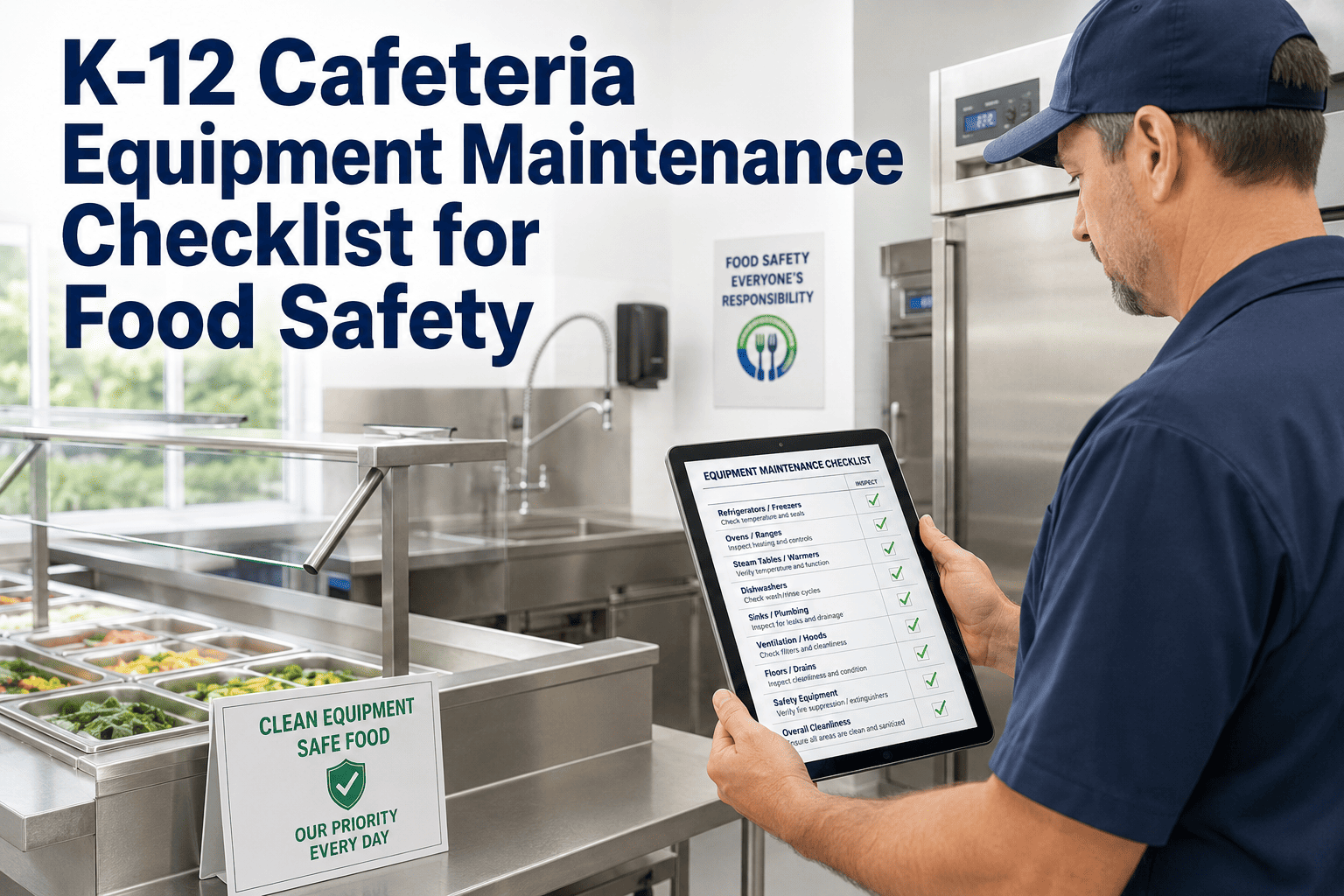
A school kitchen that skips daily cleaning and inspection rounds is not a safe food service environment — it is a liability waiting for a health department citation, a student illness outbreak, or a failed unannounced inspection. K-12 cafeteria kitchens operate under USDA Child Nutrition Program requirements, state health codes, and local district food safety policies that together demand documented daily sanitation checks, refrigeration temperature logs, hood system inspections, and handwash station compliance. Whether your school district uses paper binders or a digital CMMS like Oxmaint to track kitchen compliance, every food service supervisor needs a structured daily framework that leaves nothing to memory. Sign Up Free to digitize your kitchen inspection records and give your district health code audit trail it needs. This checklist covers every critical system — from cold storage and cooking equipment to personal hygiene stations and pest control — structured so every check is timestamped, traceable, and ready for your next Book a Demo with your district's food service compliance team. School cafeteria managers who Sign Up Free with Oxmaint replace paper logs with mobile inspection workflows that automatically flag out-of-range temperatures and missed sanitation tasks before the next shift begins.
K-12 · Food Service · Daily Compliance
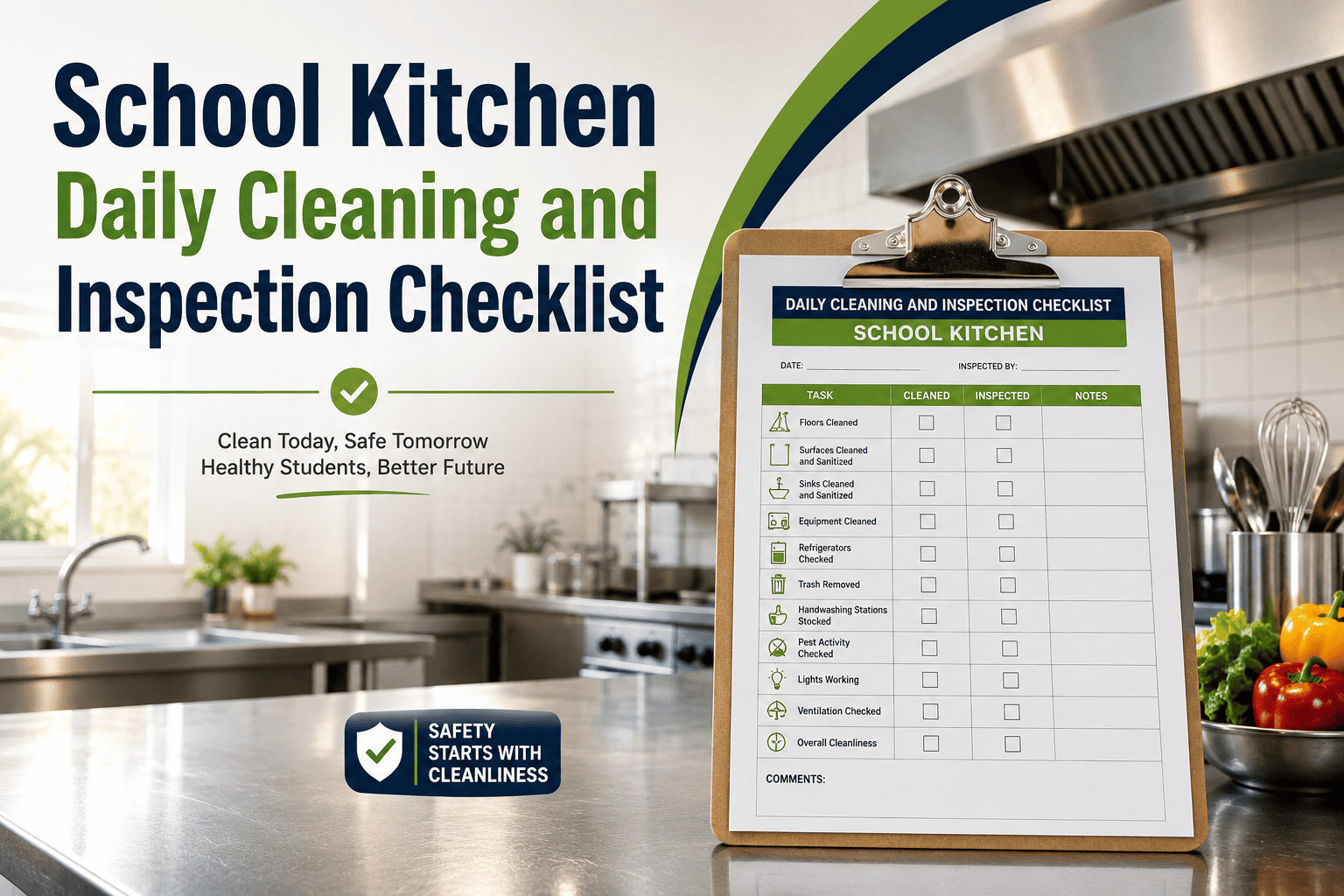
School Kitchen Daily Cleaning and Inspection Checklist
A system-by-system daily inspection framework for school cafeteria kitchens covering sanitation, refrigeration logs, hood checks, handwash stations, and CMMS-tracked health code records — built for K-12 food service teams where a missed check becomes a health code violation or a failed district audit.
7System Categories
45+Check Points
100%Compliance Target
P1Food Safety Priority
High-Risk Zones in a School Cafeteria Kitchen
Cold Storage UnitsTemperature drift, door seal failure, cross-contamination
Cooking EquipmentCalibration failure, grease buildup, internal temp compliance
Hood & VentilationGrease accumulation, filter blockage, fire suppression gap
Handwash StationsNo soap, blocked access, non-compliant water temperature
Food Contact SurfacesSanitizer concentration failure, residue buildup, scratch contamination
Dry Storage & ReceivingPest entry, FIFO failure, expired product on shelf
DDaily
WWeekly
MMonthly
QQuarterly
AAnnual
System 01
Refrigeration & Cold Storage Temperature Logs
Cold holding failures are the single most cited health code violation in K-12 school kitchens. Walk-in coolers, reach-in refrigerators, and milk coolers must be verified at the start of every service period — not assumed compliant because they ran through the night without an alarm.
Walk-in cooler internal temperature logged — unit must hold 41°F (5°C) or below; temperature recorded from calibrated thermometer or digital display; any reading above 41°F triggers immediate food safety assessment and product holdDFood Service Supervisor · Temperature log
Reach-in refrigerators and prep coolers verified — each unit checked individually; door seals inspected for tears or gaps; condensation inside the unit that is excessive or unusual requires maintenance work orderDKitchen Staff · Unit-by-unit temp log
Freezer temperature confirmed at 0°F (−18°C) or below — frost buildup pattern inspected; any rapid temperature variance from the previous shift reading requires investigation before product is usedDKitchen Staff · Freezer log
Milk cooler and serving line cold holding units checked — serving line cold wells verified at 41°F or below before service begins; ice levels in ice-bath units confirmed adequate for the service periodDFood Service Supervisor · Serving line temp log
Thermometer calibration confirmed — probe thermometers used for product checks calibrated in ice water at 32°F (0°C) before service; uncalibrated thermometers removed from service and tagged for recalibrationWFood Service Supervisor · Calibration log
System 02
Cooking Equipment & Hot Holding Compliance
Undercooking and improper hot holding are direct food safety hazards in school cafeterias serving hundreds of students per meal period. Every cooking unit and hot holding cabinet must be verified to reach and maintain required internal temperatures before service begins.
Oven and steam kettle preheat temperatures confirmed — equipment reaches operating temperature before food is loaded; cooking temperatures logged against menu item minimum internal temperature requirements (poultry 165°F, ground meat 155°F)DCook · Equipment preheat log
Hot holding cabinet temperatures verified at 135°F (57°C) or above — all hot holding units checked before product is transferred from cooking equipment; units not reaching 135°F taken out of service until repairedDFood Service Supervisor · Hot holding temp log
Serving line hot well temperatures confirmed — steam table wells at temperature before food pans are placed; water level in steam table wells maintained throughout service to prevent hot holding failureDKitchen Staff · Steam table log
Cooking equipment exterior and heating elements inspected for grease accumulation — visible grease on burner grates, oven interiors, or steamer compartments logged as a maintenance and fire hazard requiring scheduled cleaningDKitchen Staff · Equipment cleaning log
System 03
Hood System & Ventilation Inspection
A grease-laden exhaust hood that has not been cleaned or inspected is not a ventilation asset — it is a fire waiting for an ignition source. School kitchen hood systems must be checked daily for grease accumulation and monthly for filter condition, with documented quarterly deep cleanings by certified contractors.
Hood filters visually inspected for grease loading — heavily saturated filters that drip or show pooling grease removed immediately and replaced; filter condition logged and compared to previous shift observationDKitchen Staff · Hood inspection log
Exhaust fan operation confirmed — hood fan audible and pulling smoke or steam effectively during cooking; reduced airflow that allows smoke to roll into the kitchen requires immediate maintenance work orderDFood Service Supervisor · Ventilation check log
Fire suppression system nozzle covers intact — plastic nozzle caps on the hood suppression system present and undamaged; missing nozzle caps expose suppression agent ports to grease contaminationWFood Service Supervisor · Fire suppression visual log
Hood contractor deep clean scheduled and current — last certified hood cleaning date tracked in CMMS; cleaning certificate posted in kitchen; hood cleaning overdue by more than 30 days triggers priority maintenance work orderQFacilities Manager · CMMS contractor schedule
System 04
Handwash Stations & Personal Hygiene Compliance
A handwash sink that runs out of soap, has no paper towels, or is blocked by equipment stored in front of it is a health code violation in every state food code. Handwash station compliance is checked by health inspectors first — and the corrective action is always immediate.
All handwash sinks stocked and accessible — soap dispenser full and dispensing correctly; single-use paper towels or functional hand dryer present; no equipment, boxes, or supplies blocking access to any handwash sinkDKitchen Staff · Handwash station log
Handwash sink water temperature verified — hot water reaching handwash sinks at a minimum of 100°F (38°C); cold water present; any sink with no hot water tagged out of service and maintenance notified immediatelyDFood Service Supervisor · Water temp log
Handwash sink drain flow confirmed unobstructed — sinks draining freely with no standing water; slow or backed-up drain reported to facilities as a plumbing work order before service beginsDKitchen Staff · Sink condition log
System 05
Food Contact Surface Sanitation & Sanitizer Verification
Sanitizer that is too dilute provides no pathogen reduction. Sanitizer that is too concentrated is a chemical contamination hazard. Every food contact surface cleaning cycle in a school kitchen requires a sanitizer concentration test — not an assumption that the correct amount was measured.
Sanitizer solution concentration tested with test strips — chlorine sanitizer at 50–100 ppm or quaternary ammonium at 200–400 ppm depending on product label; out-of-range concentration requires immediate remix and retest before food contact surface useDKitchen Staff · Sanitizer concentration log
Food prep surfaces wiped, rinsed, and sanitized in correct sequence — clean, rinse, sanitize order confirmed; sanitizer left on surface for required contact time before food contact; cross-contamination between raw meat and ready-to-eat prep areas prevented by separate designated surfacesDKitchen Staff · Surface sanitation log
Cutting boards inspected for deep scoring and discoloration — boards with deep knife grooves or staining that cannot be sanitized effectively removed from service and replaced; color-coded cutting board system verified in use for raw vs ready-to-eat foodsWFood Service Supervisor · Equipment condition log
Dish machine final rinse temperature confirmed — high-temp sanitizing dishwasher achieving 180°F (82°C) at the manifold or 165°F on the dish surface; chemical sanitizing machine achieving correct sanitizer concentration in final rinse; temperature log completed after first rack of the dayDKitchen Staff · Dishwasher temp/sanitizer log
System 06
Dry Storage, Receiving & FIFO Compliance
Dry storage and receiving areas that skip daily inspection accumulate expired product, pest harborage, and FIFO failures that contaminate subsequent meal service. Every receiving event requires a temperature and condition check — and every dry storage area requires a daily visual sweep before ordering or issuing product.
Received food products inspected at delivery — temperature of refrigerated and frozen deliveries verified on receipt; damaged, swollen, or leaking packages rejected and documented; all product date-labeled before being placed in storageDFood Service Supervisor · Receiving log
FIFO rotation confirmed in dry, refrigerated, and frozen storage — oldest product placed in front and issued first; expired or past-use-by-date product removed, logged, and discarded; no undated product on any shelfDKitchen Staff · FIFO check log
Dry storage area pest evidence sweep — floor perimeter and shelf edges checked for droppings, gnaw marks, or live pest activity; any evidence triggers immediate pest control work order and district facilities notificationDKitchen Staff · Pest control log
Dry storage product stored 6 inches off floor — all product on shelving units, not on floor; no product stored under plumbing lines or in areas prone to condensation or leaksDKitchen Staff · Storage compliance log
System 07
End-of-Service Cleaning & Compliance Documentation
End-of-service cleaning documentation is the record that a health inspector reviews when your school kitchen is the subject of a complaint investigation. Signed cleaning logs, sanitizer test records, and temperature logs from every service period form the paper trail that demonstrates active food safety management — not just crisis response.
Floor cleaning completed and logged — kitchen floor swept, mopped with sanitizer solution, and left dry; floor drain cleaned and free of food debris; wet floor signage posted during moppingDKitchen Staff · End-of-service cleaning log
Grease traps and floor drains inspected — no pooling water or backup around floor drains; grease trap condition noted; slow drain requiring jetting or grease trap service generates work order in CMMS before the next service dayWFood Service Supervisor · Drain condition log
All daily temperature logs signed by food service supervisor — refrigeration, hot holding, cooking, and receiving temperature records completed, accurate, and signed before supervisor departs; unsigned logs treated as missing records during health department auditsDFood Service Supervisor · Daily log sign-off
Health permit and food manager certification posted and current — health department permit displayed in kitchen; certified food manager certificate within validity period; expiry within 60 days triggers renewal action in CMMS compliance calendarMFacilities Manager · Compliance calendar tracker
Compliance KPIs
Six Metrics That Prove Your School Kitchen Passes Every Health Inspection
| Metric | How to Measure | Target | Frequency |
|---|
| Cold Holding Compliance Rate | Readings at or below 41°F / Total readings | 100% | Daily |
| Hot Holding Compliance Rate | Readings at or above 135°F / Total readings | 100% | Daily |
| Sanitizer Concentration Pass Rate | In-range test strip results / Total tests | 100% | Daily |
| Handwash Station Compliance | Compliant sinks / Total sinks inspected | 100% | Daily |
| Daily Log Completion Rate | Signed completed logs / Scheduled service days | 100% | Weekly |
| Health Permit Validity Buffer | Days remaining to permit expiration | Minimum 60 days | Monthly |
Health department inspectors arrive without notice. Oxmaint timestamps every kitchen inspection round, captures temperature readings as structured compliance data, and alerts supervisors to missed cleaning tasks before the next service period — giving your school district an audit-ready food safety record on demand.
FAQs
Frequently Asked Questions
What temperature logs are required daily in a school cafeteria kitchen?
K-12 school kitchens are required to maintain daily temperature logs for cold holding (41°F or below), hot holding (135°F or above), cooking (per menu item minimums), and receiving. Most state health codes and USDA Child Nutrition Program guidelines require these records to be signed by a certified food manager and retained for a minimum of 90 days. Oxmaint automates temperature log capture and retention.
How often should a school kitchen hood system be cleaned?
NFPA 96 requires cooking exhaust hoods used for high-volume cooking — such as school cafeteria kitchens — to be professionally cleaned quarterly. Filters should be checked daily and replaced when grease-saturated. Daily visual inspections and quarterly contractor records must be maintained for fire safety compliance. Book a Demo to see how Oxmaint tracks contractor cleaning schedules.
What sanitizer concentration is required for school kitchen food contact surfaces?
Chlorine sanitizer must be maintained at 50–100 ppm; quaternary ammonium sanitizer at 200–400 ppm depending on product label. Concentration must be verified with test strips at the start of each service period and any time sanitizer solution is remixed. Results must be logged.
Can Oxmaint replace paper-based school kitchen inspection logs?
Yes. Oxmaint digitizes every daily kitchen inspection task — temperature readings, sanitation checks, LWCO-style safety checks, and compliance sign-offs — into timestamped mobile workflows. Records are stored centrally, accessible for health department review, and automatically flagged when tasks are missed or readings fall out of range.
How does FIFO apply to a school cafeteria kitchen?
First In, First Out means product received earlier is always placed in front and used before newer stock. In a school kitchen, FIFO applies to refrigerated, frozen, and dry storage areas. Every item must be date-labeled, and expired or past-use-by product must be removed daily. Oxmaint work order checklists can include FIFO sweep tasks as part of daily kitchen rounds.
Digitize School Kitchen Compliance
Every Temperature Logged. Every Sanitation Check Documented. Every Health Inspection Ready.
Oxmaint converts your school cafeteria's daily kitchen inspection rounds into mobile compliance workflows with structured data entry, automatic temperature alerts, and one-click health code audit reports — so your next health department visit is a formality, not a risk.