A university vivarium animal holding room that operates without a documented daily inspection cycle is not a compliant animal care facility — it is a regulatory liability waiting for an AAALAC site visit or an IACUC audit to expose. Campus Division of Laboratory Animal Resources (DLAR) facilities serving research, teaching, and biomedical programs must meet USDA Animal Welfare Act standards, PHS Policy requirements, and Guide for the Care and Use of Laboratory Animals benchmarks, with every environmental parameter, cage condition, food and water status, and health observation logged by a trained animal care technician at every shift. This checklist gives your vivarium operations, animal care, and environmental health and safety teams a complete daily inspection framework covering temperature, humidity, light cycle, water, food delivery, cage sanitation, and welfare observation — structured so every check is traceable in your OxMaint CMMS compliance tracking platform with timestamped records that prove your holding rooms are actively managed, not just periodically visited. Sign Up Free to digitize your animal facility records today, or Book a Demo to see how OxMaint maps to AAALAC accreditation documentation requirements.
University · Vivarium · Animal Welfare Compliance
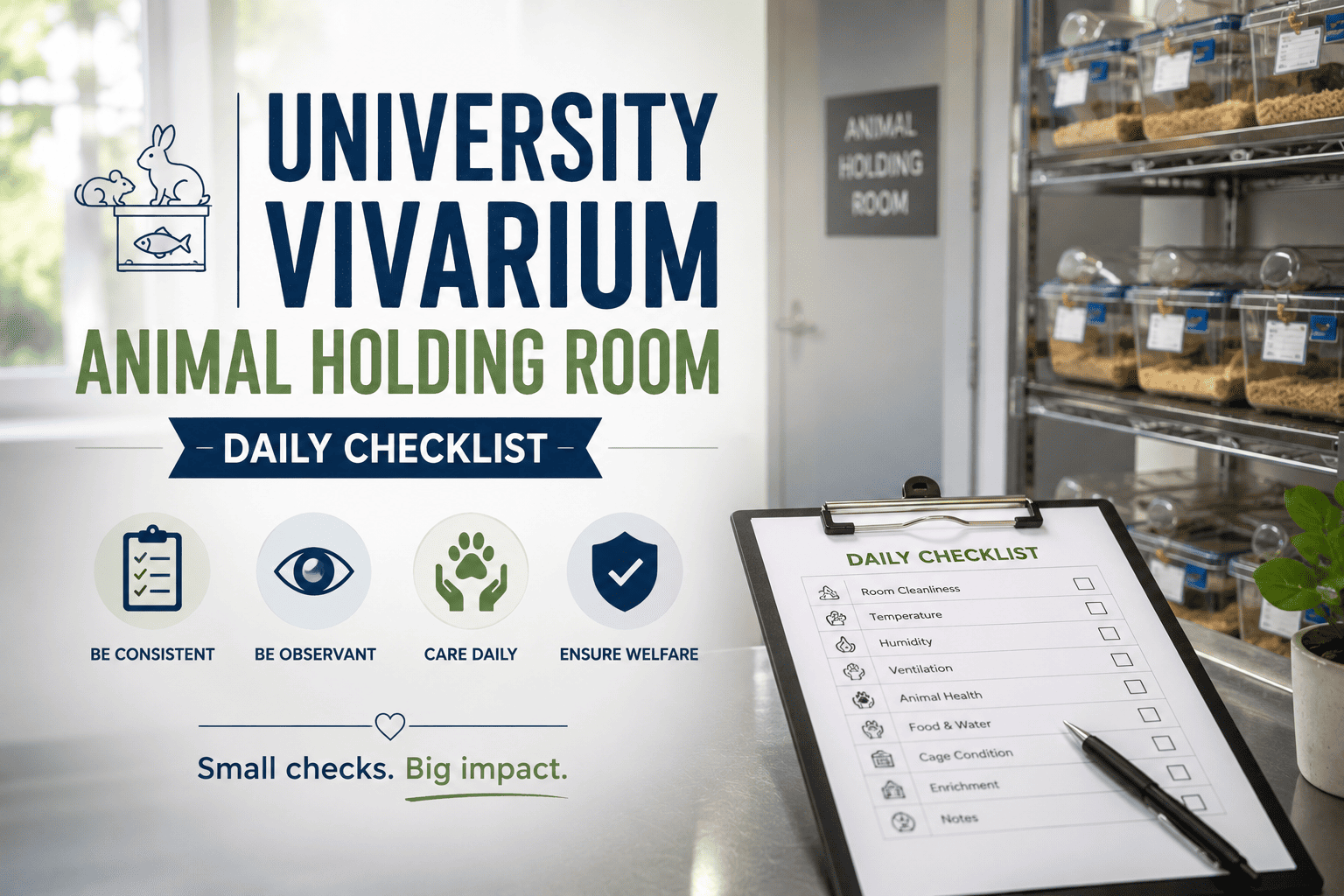
University Vivarium Animal Holding Room Daily Checklist (AAALAC / USDA Aligned)
A system-by-system daily animal holding room inspection framework covering environmental controls, water and feed delivery, cage condition, health observation, sanitation, and welfare documentation — built for university DLAR facilities where a missed check becomes an IACUC finding or an AAALAC accreditation gap.
7System Categories
40+Check Points
100%Compliance Target
P1Welfare Priority
High-Risk Areas in a University Vivarium Holding Room
Environmental ControlsTemperature and humidity excursions, HVAC failure, pressure differential loss
Water Delivery SystemLixit valve failure, acidified water pH drift, auto-watering line blockage
Feed and BeddingMolded feed, contaminated bedding, hopper blockage, incorrect diet delivery
Cage SanitationSoiled cage overfill, filter top blockage, IVC rack seal failure
Animal Health ObservationMorbidity missed, fight wounds undetected, moribund animals unidentified
Light Cycle ControlTimer failure, room light leaks disrupting photoperiod, override not reset
DDaily
WWeekly
MMonthly
QQuarterly
AAnnual
System 01
Environmental Controls — Temperature, Humidity & Pressure
The Guide for the Care and Use of Laboratory Animals specifies dry-bulb temperature ranges for each species and recommends relative humidity control between 30% and 70%. A holding room operating outside these parameters — even for a single shift — creates a physiological stressor that confounds research data and triggers a welfare finding during AAALAC program reviews. Pressure differential between the corridor and the holding room must be verified daily on rooms housing immunocompromised animals or infectious agent studies.
Room temperature read from calibrated digital thermometer or BMS display and logged — temperature must be within the species-appropriate range specified in the facility SOP; any reading outside range triggers HVAC service request in OxMaint before the next animal care round
DAnimal Care Technician · Room environmental log
Relative humidity read and logged — humidity must be within 30–70% or the species-specific range in the facility SOP; low humidity below 30% increases respiratory disease susceptibility in rodents; high humidity above 70% promotes microbial growth in bedding
DAnimal Care Technician · Room environmental log
Room air pressure differential verified — rooms housing immunocompromised, gnotobiotic, or infectious agent animals must maintain the correct positive or negative pressure relative to corridor; pressure gauge reading logged and any loss of differential reported to facilities immediately
DAnimal Care Technician · Pressure differential log
HVAC air change rate confirmed — facility maintenance record reviewed to confirm the holding room is receiving the minimum 10–15 air changes per hour recommended by the Guide; any supply or exhaust diffuser obstruction reported as a work order
WVivarium Supervisor · HVAC air change log
System 02
Light Cycle Control & Photoperiod Verification
Circadian rhythm disruption caused by light cycle timer failure or unauthorized room entry during the dark phase is a confounding variable in behavioral, endocrine, and reproductive studies that can invalidate months of research data. Light cycle integrity is a welfare and scientific validity issue that must be verified at each shift start without entering the room during the dark phase.
Light cycle timer status confirmed — corridor light cycle controller or BMS display checked to confirm the room is in the correct light or dark phase; any timer showing incorrect phase requires immediate DLAR facilities notification and log entry
DAnimal Care Technician · Light cycle log
Room light level verified at phase transition — light meter reading at cage level taken at the start of the light phase; illuminance must be within the species-appropriate range (typically 130–325 lux for rodents at cage level); excessive light causes retinal degeneration in albino strains
WAnimal Care Technician · Light level log
Red safety light confirmed operational for dark-phase entry — rooms requiring access during the dark phase must have functional red-light illumination installed; red light entry must be logged with technician ID and duration to document photoperiod interruption events
DAnimal Care Technician · Dark-phase entry log
System 03
Water Delivery — Lixit Valves, Bottles & Acidified Water Systems
Dehydration in small research rodents can occur within hours of a failed water source. Lixit valve blockage, empty water bottles, and acidified water pH outside the bacteriostatic range are daily failure modes that cannot be detected without a physical inspection of every cage position. Auto-watering systems require daily function checks at manifold test points; they do not self-report valve failures at the cage level.
Water bottle fill level and valve function checked at every cage — each bottle inspected for adequate volume; lixit valve depressed to confirm flow; bottles found empty or valves found blocked replaced immediately and deficiency logged in OxMaint with cage ID
DAnimal Care Technician · Water delivery log
Acidified water pH tested at manifold test point — pH must be within facility SOP target (typically 2.5–3.0) to maintain bacteriostatic properties; pH outside range requires immediate system flush and notification to the DLAR veterinary team
DAnimal Care Technician · Acidified water pH log
Auto-watering system line pressure confirmed at manifold gauge — pressure within the range specified by the system manufacturer; low pressure indicates a failed pressure regulator or a line break requiring immediate facilities work order through OxMaint
DAnimal Care Technician · Auto-watering system log
Water system flush and culture sample collected — auto-watering system flushed per facility schedule and culture sample submitted to the diagnostic lab; positive culture results for Pseudomonas or coliforms require immediate system disinfection and IACUC notification
MVivarium Supervisor · Water culture log
AAALAC site visitors and USDA inspectors review daily holding room logs as their first compliance evidence request. OxMaint timestamps every animal care round, captures environmental readings as structured data, and flags missed welfare checks before the next shift handover — giving your DLAR team audit-ready vivarium records on demand.
System 04
Feed Delivery, Hopper Condition & Diet Integrity
Irradiated or autoclave-sterilized rodent diet has a defined post-sterilization shelf life, and a hopper that has not been changed on schedule may be delivering feed that has exceeded the manufacturer's post-sterilization use period — a welfare and research integrity issue that IACUC protocols must address. Feed hopper blockage in individually ventilated cages is a daily failure mode that cannot be assumed functional without physical inspection.
Feed hopper fill level and delivery confirmed at every cage — hopper inspected for adequate volume and food delivery confirmed by pressing feed down from the hopper; blocked hoppers cleared or replaced immediately and deficiency logged with cage ID
DAnimal Care Technician · Feed delivery log
Feed lot number and post-sterilization expiry verified at cage change — irradiated or autoclaved feed lot number and expiry date recorded at each cage change; feed exceeding post-sterilization use period removed and discarded; lot information retained in OxMaint for traceability
DAnimal Care Technician · Feed lot traceability log
Special diet delivery confirmed for protocol-specific animals — animals on purified, high-fat, restricted, or medicated diets confirmed to be receiving the correct diet formulation; any cage receiving the wrong diet flagged immediately to the attending veterinarian and principal investigator
DAnimal Care Technician · Special diet delivery log
System 05
Cage Condition, Bedding & IVC Rack Integrity
Ammonia accumulation in an overfilled soiled cage exceeds 25 ppm within 72 hours at standard stocking densities, causing respiratory mucosal irritation that alters pulmonary immune response models and creates a direct welfare harm. IVC rack exhaust plenum pressure and filter top seal integrity are technical checks that prevent cross-contamination between immunocompromised and immunocompetent colonies sharing the same rack.
Soiled cage bedding level assessed at every cage position — bedding fill level and soiling degree assessed; cages meeting the change trigger threshold (per facility SOP or protocol) flagged for change; over-threshold cages changed the same shift they are identified
DAnimal Care Technician · Cage change log
IVC rack supply and exhaust plenum pressure confirmed — plenum pressure gauge within the range specified by the rack manufacturer; loss of plenum pressure indicates a blower failure or duct disconnection requiring immediate facilities work order before the next cage change event
DAnimal Care Technician · IVC rack pressure log
Filter top and cage body seal inspected for damage — each filter top checked for tears, compression failures, or missing gaskets during cage change; a compromised filter top on an immunocompromised animal cage is an immediate health risk requiring cage change outside the normal schedule
DAnimal Care Technician · Cage equipment integrity log
Cage card and identification verified against animal census — cage card species, strain, sex, protocol number, and principal investigator confirmed against the room census sheet; any discrepancy reported to the vivarium supervisor before end of shift
DAnimal Care Technician · Animal census verification log
System 06
Animal Health Observation & Welfare Assessment
The single most consequential daily task in a university vivarium is the health observation round. An undetected moribund animal, an untreated fight wound, or a missed clinical sign of infectious disease represents both an animal welfare failure and a potential research data integrity loss. The Guide requires that animals be observed for signs of illness, injury, or abnormal behavior daily, and that an attending veterinarian be notified of any health concern on the same day it is identified.
Animal census completed — all animals in each cage counted and total confirmed against cage card census; unexplained census discrepancy triggers immediate investigation and attending veterinarian notification; dead animals removed, weighed, and submitted for necropsy per facility SOP
DAnimal Care Technician · Animal census and mortality log
Clinical health observation completed for every cage — each cage observed for animals showing posture abnormalities, piloerection, ocular discharge, respiratory distress, weight loss, fight wounds, or abnormal behavior; any health concern logged with cage ID and reported to the attending veterinarian the same shift
DAnimal Care Technician · Health observation log
Humane endpoint assessment completed for animals on study — animals enrolled in protocols with defined humane endpoints assessed against endpoint criteria; animals meeting or approaching endpoint criteria removed from study immediately per IACUC-approved protocol and veterinarian notified
DAnimal Care Technician · Humane endpoint assessment log
Post-procedural animal monitoring completed — animals recovering from surgery or invasive procedures assessed per the post-procedural monitoring schedule in the IACUC protocol; pain score, food and water intake, and body weight recorded; analgesic administration logged with drug, dose, route, and technician ID
DAnimal Care Technician · Post-procedural monitoring log
System 07
Sanitation, Biosecurity & Compliance Documentation
A vivarium room that does not have a documented sanitation cycle, a sentinel health monitoring program, and a current IACUC protocol for every animal housed in it is not a compliant animal care facility under AAALAC standards. Biosecurity failures — introduced by a dirty cart, an unquarantined animal, or a vendor shipment received without health screening — can cause an epizootic that eliminates an entire research colony and triggers a reportable animal welfare incident under PHS Policy.
Room sanitation schedule confirmed current — floor, bench, and rack surface sanitation completed per the facility sanitation master schedule; disinfectant product, dilution, and contact time logged; any surface sanitation deficiency documented as a corrective action in OxMaint
DAnimal Care Technician · Sanitation completion log
Sentinel cage health monitoring status confirmed — sentinel animals inspected for clinical signs; dirty bedding sentinels receiving pooled soiled bedding confirmed to be receiving bedding from the correct source cages; sentinel serology submission date tracked in OxMaint against the scheduled submission interval
WVivarium Supervisor · Sentinel monitoring log
IACUC protocol validity confirmed for all animals in room — every animal in the holding room confirmed to be covered by an active, unexpired IACUC protocol; animals found without a valid protocol require immediate quarantine and IACUC office notification; protocol expiry tracked in OxMaint with 60-day advance alert
MVivarium Supervisor · IACUC protocol validity log
Daily shift log completed and signed — all environmental readings, health observations, water and feed checks, cage change records, and mortality entries completed before shift handover; unsigned or incomplete logs are treated as missed inspections during USDA and AAALAC reviews
DAnimal Care Technician · Signed shift log
Compliance KPIs
Six Metrics That Prove Your University Vivarium Is Compliantly Operated
| Metric |
How to Measure |
Target |
Frequency |
| Environmental Parameter Compliance |
Readings within range / Total shift readings |
100% of readings |
Daily |
| Animal Health Observation Rate |
Cages observed / Total cages in room |
100% |
Daily |
| Water Delivery Deficiency Rate |
Failed lixit or empty bottles found / Total cage positions |
< 0.5% |
Daily |
| Cage Change Compliance Rate |
On-schedule cage changes / Due cage changes |
100% |
Daily |
| IACUC Protocol Validity |
Active protocols / Total protocols in room |
100% — 60-day buffer |
Monthly |
| Shift Log Completion Rate |
Signed logs / Scheduled shifts |
100% |
Weekly |
FAQs
Frequently Asked Questions
What standards govern daily animal holding room inspections at a university vivarium?
University vivarium operations are governed by the Guide for the Care and Use of Laboratory Animals (8th edition), USDA Animal Welfare Act regulations (9 CFR Parts 1–3), PHS Policy on Humane Care and Use of Laboratory Animals, and AAALAC International accreditation standards. State veterinary practice acts and institutional IACUC policies add additional requirements. Sign Up Free to track all compliance obligations in a single CMMS platform.
How often must animal holding rooms be inspected in a university DLAR facility?
The Guide requires animals to be observed for signs of illness, injury, or abnormal behavior at least daily, and more frequently for animals on study or recovering from procedures. Environmental parameters must be monitored and logged every shift. IACUC semi-annual program reviews include inspection of holding rooms, and any deficiencies must be corrected within defined timeframes. Book a Demo to see OxMaint's vivarium inspection scheduling tools.
What environmental parameters must be controlled in a university rodent holding room?
The Guide specifies dry-bulb temperature ranges by species (typically 18–26°C for mice and rats), relative humidity between 30–70%, minimum 10–15 air changes per hour, and a controlled light cycle (typically 12:12 or 14:10 light-dark). Illuminance at cage level must not exceed 325 lux for albino rodent strains to prevent retinal degeneration. All parameters must be logged daily.
What documentation does AAALAC review during a university vivarium site visit?
AAALAC site visitors review daily animal care and health observation logs, environmental monitoring records, cage change and sanitation schedules, sentinel health monitoring results, IACUC protocol files, veterinary care records, and personnel training documentation. Gaps in daily records are among the most common program descriptions cited during site visits. Sign Up Free to generate AAALAC-ready compliance reports from OxMaint.
How does a CMMS help with university vivarium compliance documentation?
A CMMS like OxMaint converts paper shift logs into structured digital records with GPS and timestamp verification, schedules and tracks cage change cycles and sentinel submission dates, generates one-click compliance reports for USDA inspections and AAALAC site visits, and alerts supervisors when daily checks are missed before the next shift begins. Book a Demo to see a live demonstration of OxMaint in a university animal care context.
Digitize Vivarium Animal Care Compliance
Every Health Observation Logged. Every Environmental Reading Documented. Every Shift Record Ready for AAALAC.
OxMaint converts your daily holding room rounds into a mobile inspection workflow with structured data entry, automatic shift handover summaries, IACUC protocol expiry alerts, and one-click compliance reports — so the next USDA inspection or AAALAC site visit is a formality, not a risk.