School Emergency Preparedness: Maintaining Critical Systems for Crisis Response
By Jamie lanister on March 30, 2026
School emergency preparedness systems — backup generators, mass notification platforms, panic buttons, lockdown hardware, and storm shelters — matter most precisely when they are least expected to be tested. A generator that fails to transfer load during a winter ice storm, a mass notification system with a dead outdoor speaker zone, a panic button with an expired battery: these are not hypothetical failures. They are documented patterns in districts that treat emergency infrastructure as set-and-forget equipment. OxMaint automates the full testing and inspection schedule for every emergency system — generating signed maintenance records per test event and alerting facilities managers to overdue checks before the next crisis drill review.
OxMaint · Article · School Emergency Preparedness · Critical System Maintenance
School Emergency Preparedness: Maintaining Critical Systems for Crisis Response
Backup generators · emergency communications · mass notification · panic buttons · lockdown hardware · storm shelters · CMMS-automated emergency PM for K–12 and higher education facilities.
of school districts report at least one emergency system failure during an actual crisis — REMS national survey
$280K
average cost of a school generator failure — emergency fuel, reactive repair, and operational disruption
78%
of emergency system failures trace to missed PM — dead batteries, expired fuel, corroded contacts
30 min
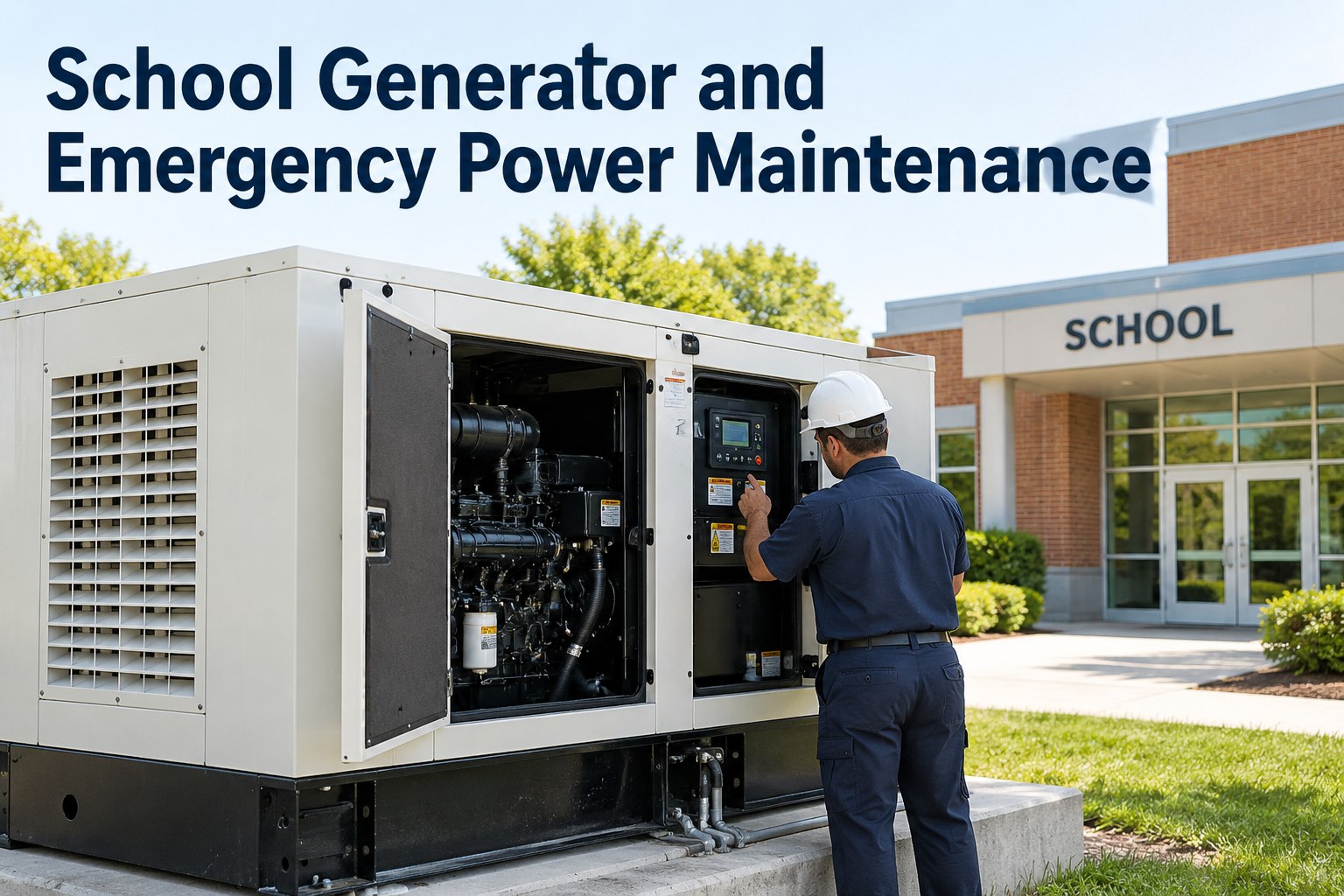
NFPA 110 monthly generator test requirement — under load, with signed technician documentation
Emergency System Test Schedule
Every school emergency system has a prescribed test frequency — mandated by NFPA, FEMA guidance, or state emergency management code. Unlike fire safety, emergency preparedness tests are rarely enforced by external inspectors on a routine cycle — making them among the most commonly missed PM events in any district. OxMaint schedules and tracks every emergency system test automatically, generating work orders before due dates with no manual calendar management required.
Emergency System
Monthly
Quarterly
Annual
Standard
Backup Generator NFPA 110
30-min load test
—
Full load bank
NFPA 110 / IEEE 446
Mass Notification FEMA K-12
System check
Full outdoor test
Zone coverage audit
FEMA K-12 / NFPA 72
Panic Buttons State Code
—
Function test
Battery + comms
State School Safety Code
Lockdown Hardware CISA / State
—
Function test all
Full hardware audit
CISA K-12 School Safety
Storm Shelter FEMA P-361
—
—
Structural + door
FEMA P-361 / ICC 500
Two-Way Radios FCC / Local
—
Battery + range
Frequency + coverage
FCC Part 90 / Local EMA
AED Devices AHA / State
Indicator check
—
Battery + pad replace
AHA / State EMS Code
What Fails First in a Real Crisis
Analysis of documented school emergency incidents reveals consistent failure patterns — almost never equipment design failures, always maintenance failures. Expired batteries, degraded diesel, untested communication zones, and jammed lockdown hardware account for over 80% of documented emergency system failures. The four cards below show where the breakdowns concentrate.
Battery Failure
34%
of emergency system failures
UPS batteries in generators and communication systems have a 3–5 year lifespan. Without CMMS-tracked replacement cycles they degrade silently until the moment the grid fails.
Diesel Degradation
22%
of generator failures
Diesel fuel has an 18–24 month useful life in storage. A generator refuelled 3 years ago may start but fail under load — discovered only during an actual outage.
Comms Zone Gap
19%
of notification failures
Mass notification systems are tested in one or two zones — never all. Outdoor arrays and remote athletic facilities are the most common uncovered zones found during actual events.
Lockdown Hardware Jam
15%
of lockdown-related failures
Classroom lockdown devices are the least frequently tested items in most PM programmes. Hardware jams, seized bolts, and dead electronic locks are found only when needed.
Technology: AI, PLC & SAP for Emergency System Reliability
IoT-connected generator controllers, smart UPS monitoring, and AI-powered anomaly detection have made emergency system reliability far more proactive. OxMaint integrates with emergency system monitoring platforms — receiving live status signals from generators, communication controllers, and UPS systems, and generating maintenance alerts before pre-failure indicators become actual failures.
PLC / Generator Controller
99%
Transfer failure detection
Generator ATS status feeds OxMaint directly — triggering immediate work orders for failed transfer tests, low coolant, and battery voltage anomalies in real time.
AI Digital Twin
87%
Emergency route gap detection
Virtual campus model maps evacuation routes, shelter zones, and notification coverage — identifying gaps before a real event reveals them.
AI Camera Vision
92%
Emergency access monitoring
AI cameras monitor exit routes, AED cabinet access, and generator room obstructions overnight — flagging issues before the building opens each day.
SAP Integration
4.6 hrs
Emergency parts lead time cut
Generator PM work orders pre-order fuel treatment, UPS batteries, and AED pads through SAP — arriving before the service window, never after a failure escalates.
Mobile Test Documentation
100%
Field documentation at test
Emergency system technicians complete test checklists on mobile with timestamped results — creating NFPA-compliant records at the point of test with no paper transcription.
IoT / OBD Sensors
24/7
Live system status monitoring
IoT sensors on generator ATS, UPS units, and AED cabinets monitor real-time operational status — alerting OxMaint the moment any emergency-critical asset goes offline.
Documentation: What Insurance Carriers and Inspectors Require
After any school emergency incident, the first document requests from legal counsel, the state emergency management agency, and the insurer are the maintenance histories for every system involved. Districts that cannot produce those records face both liability exposure and insurance coverage disputes on top of the incident itself. OxMaint stores every test record, failure event, and repair history per asset, per building.
Without CMMS — Post-Incident Discovery
Generator test log — paper binder, last 2 entries only
Mass notification test records — no documented history
Storm shelter inspection — last done at original installation
AED pads — expiry date unknown, discovered post-incident
Insurance carrier disputes coverage — insufficient maintenance record
With OxMaint — Full History Available
Generator — 3 years of monthly test records, technician signed, per unit
Mass notification — quarterly zone test records with coverage maps
Panic button — quarterly log with battery voltage per device
Storm shelter — annual structural inspection, door hardware, signed
AED — monthly status check, pad and battery replacement history per unit
Full export in 3 minutes — legal, insurance, and state agency ready
❝
During a severe ice storm our generator ATS failed to transfer — first time in eleven years. Because OxMaint had every monthly test record and the annual load bank history, our insurance claim was processed without dispute and our state emergency review closed in three weeks. Without that documentation we would have been in a very different position.
Director of Operations — K–12 district · 12 buildings · 4 generators · OxMaint user since 2020
Frequently Asked Questions
NFPA 110 requires a minimum 30-minute load test monthly and an annual full load bank test. Both require signed documentation showing transfer time, load applied, and any anomalies detected during the test.
Monthly system connectivity checks, quarterly full outdoor zone tests, and annual coverage audits across all campus zones including athletic facilities. All tests must be documented with zone-by-zone results.
Panic buttons require quarterly function and battery tests per device. Lockdown hardware requires quarterly function tests of all mechanisms plus an annual hardware audit checking for corrosion, jamming, and electronic lock battery status.
Diesel fuel has an 18–24 month useful storage life without treatment. Annual fuel testing and treatment — or full replacement — is required to ensure the generator can sustain load during an extended outage. This is among the most commonly missed PM items.
OxMaint schedules every emergency system test automatically per asset and building — with pre-populated work orders, response timers for failures, and signed documentation stored per test event, creating the compliance record that protects the district in any post-incident review.
Three to five years of maintenance records for the failed system — test logs, repair history, battery replacement dates, and fuel treatment records. Insurers use this to assess coverage; districts without records face disputes on top of the repair cost.
43% of Districts Have an Emergency System Fail in a Real Crisis. OxMaint Prevents It.
Automated generator PM · mass notification test tracking · panic button schedules · lockdown hardware audits · full post-incident documentation export. Free to start.