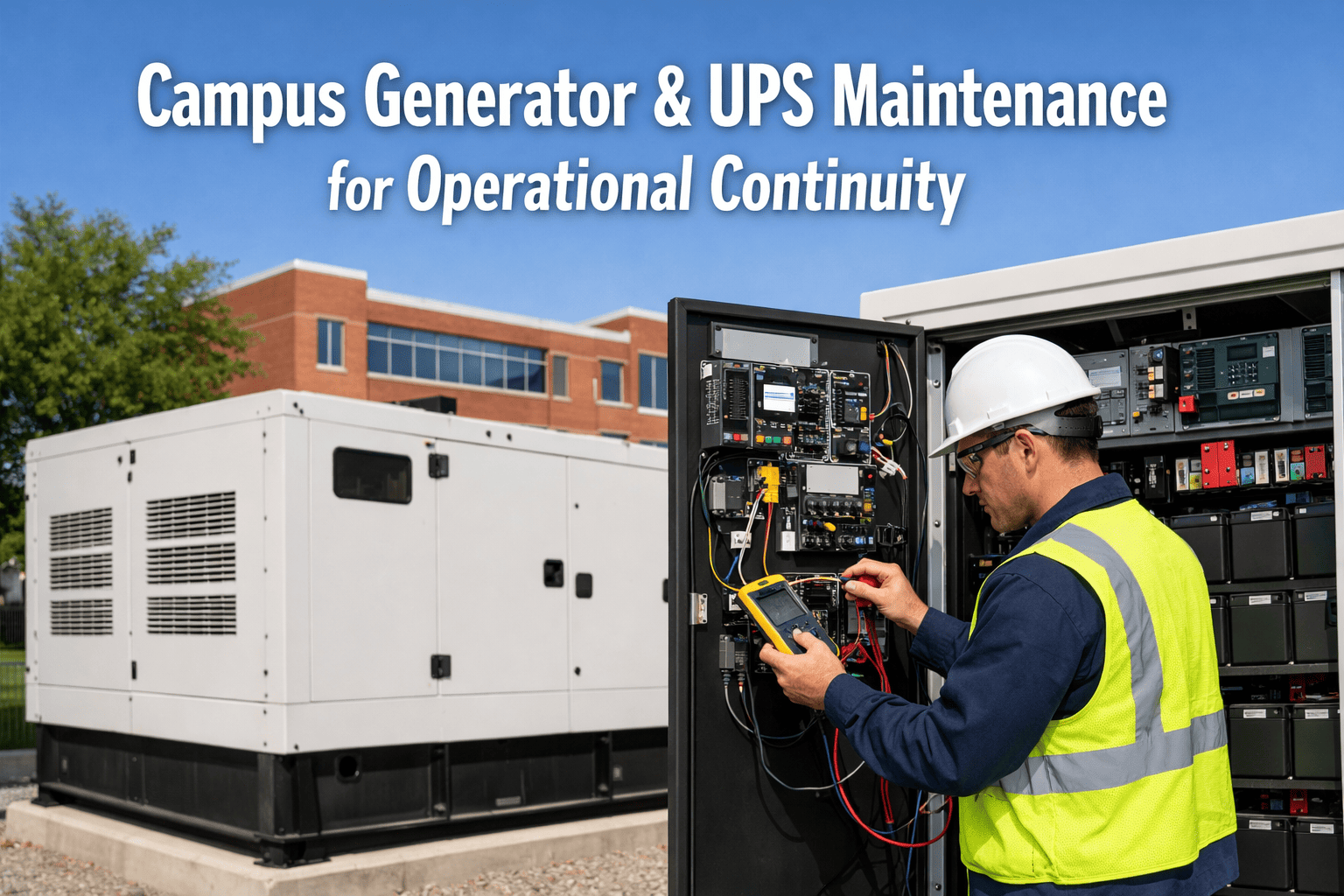
A backup generator that fails during an emergency is worse than no generator at all — because the whole building was counting on it. School emergency power is the equipment nobody thinks about until the grid drops, and then it's the equipment everything depends on: egress lighting, fire alarm, life-safety systems, and the ability to keep a campus safe until utility power returns. This guide covers school generator and emergency power maintenance end to end: NFPA 110 testing cadence, the 30% load rule and load bank testing, fuel management, transfer switch service, and the discipline that keeps standby power actually available when it matters. Start free on OxMaint to schedule every test and log every record, or book a demo.
School Generator & Emergency Power Maintenance
The one machine that only gets graded on the day it's needed most.
10 sec
the transfer-time criterion a Level 1 system must meet — from grid loss to generator carrying the load
30%
minimum nameplate load every monthly exercise must reach to prevent wet stacking in a diesel set
#1 cause
contaminated fuel is the leading cause of injector failure — and it builds up silently in storage
36 mo
interval for the Level 1 four-hour continuous load test that proves extended-outage capability
The Promise a Generator Makes
An emergency generator sits idle for months, sometimes years, waiting for a power outage that may never come. That idleness is the whole problem. Every other machine on campus tells you it's failing — a boiler runs rough, a chiller trips, an HVAC unit gets loud. A standby generator gives you nothing until the one moment you rely on it, and by then it's too late to find out the battery was dead, the fuel had gone to sludge, or the transfer switch never fired. Maintenance isn't about keeping the generator running today. It's about guaranteeing it will run on a day you can't predict, under a load it hasn't carried in a year, on the first try, within seconds.
What "Ready" Looks Like
Starts on the first crank · picks up full load within the transfer criterion · runs clean through the entire outage · every test signed and on file for the AHJ
What "Assumed Ready" Looks Like
Ran fine at the last no-load exercise · nobody load-tested it in 14 months · fuel last sampled "a while ago" · transfer switch never verified under a real transfer
The NFPA 110 Testing Ladder
NFPA 110 — the standard for emergency and standby power systems — replaces guesswork with a fixed cadence. Random inspection is explicitly not a basis for reliability; a structured, documented program is. Each rung below builds on the one before it, from a two-minute weekly look to the triennial endurance run.
Weekly
EPSS Inspection · No Engine Start
Visual check of fluid levels, battery voltage, coolant, fuel, and the block heater (the block should feel warm). Catches the slow drifts before they become failures.
Monthly
Exercise Under Load · 30 min
Run at ≥30% of nameplate kW (or the manufacturer's minimum exhaust-gas temperature) for at least 30 continuous minutes, plus a transfer-switch operation. This is the workhorse test.
Annual
Supplemental Load Bank Test
Required for diesel units that can't reach 30% on building load monthly. Current protocol: 50% of nameplate for 30 min, then 75% for 1 hour. Burns off deposits and verifies real capacity.
Every 36 mo
Level 1 Endurance Test · 4 hr
A four-hour continuous load test confirms the system can carry an extended outage — the scenario a school shelter-in-place or storm event actually demands.
Editions differ — older NFPA 110 used a three-step annual protocol (25% / 50% / 75% over 2 hours). Confirm which edition your authority having jurisdiction (AHJ) enforces before signing a test plan.
Put the Testing Ladder on Autopilot — Free Forever
Schedule the weekly inspection, monthly load exercise, annual load bank test, and triennial endurance run as recurring work orders. Each completion logs the load, duration, date, and any findings — a full digital record ready for the AHJ in minutes. No card, no time limit.
The Five Silent Failure Modes
A generator almost never fails loudly. It fails quietly, in one of five ways, each invisible during a casual glance and each fatal at the moment of truth. This is the checklist that separates a unit that starts from one that only looks like it will.
01
Dead or Weak Battery
Batteries age silently — a VRLA at 3+ years or flooded at 5+ has degraded capacity even with normal float voltage. Fix: weekly voltage check, quarterly capacity or impedance test, replace on age not on visible failure.
02
Contaminated Fuel
Diesel oxidizes, water condenses in the tank, and microbial "diesel bug" plugs filters — the leading cause of injector failure. Fix: keep the tank near full, biocide as needed, sample quarterly, polish when out of spec.
03
Wet Stacking
Months of exercise below 30% load leave unburned fuel and soot in the exhaust, glazing cylinders and fouling injectors. Fix: the 30% monthly rule and the annual load bank test exist precisely to prevent this.
04
Transfer Switch Failure
The engine can run perfectly while the ATS never hands it the load — timing failures delay power restoration during a real outage. Fix: monthly transfer operation, inspect contacts for pitting, verify transfer times.
05
Cold-Start Failure
A failed block heater in cold ambient means a hard start and possible failure to meet the 10-second transfer criterion. Fix: weekly warm-to-touch check, log heater current draw quarterly, service coolant system on schedule.
Why the 30% Rule Isn't Arbitrary
The single most misunderstood number in generator maintenance is the 30% load threshold. It exists for one physical reason: a diesel engine has to reach full combustion temperature to burn its fuel completely. Below that, the exercise does more harm than good.
< 30%
Damage Zone
Cylinders never reach combustion temperature. Unburned fuel and soot accumulate — wet stacking. Running here month after month accelerates degradation instead of preventing it.
30–50%
Minimum Healthy
The floor for a valid monthly exercise. Enough cylinder pressure and exhaust temperature for proper combustion — the point where the test delivers real maintenance benefit.
75%+
Proven Capacity
Where the annual load bank test finishes — burning off accumulated deposits and confirming the set can actually deliver rated output under real emergency demand.
When a generator is oversized for its building — common in schools, where the connected load rarely approaches nameplate — monthly building load can't reach 30%. That's not a reason to skip the requirement; it's the trigger for the annual supplemental load bank test.
Fuel Management · The Failure That Hides in the Tank
A generator that starts on clean fuel and dies halfway through an outage on contaminated fuel is a preventable, documentable failure. Stored diesel degrades on a predictable timeline, and managing it is a maintenance discipline in its own right — separate from the engine.
Prevent
Keep the tank near operating level to minimize the air space where condensation forms. Add stabilizer to inhibit oxidation and biocide to suppress microbial growth — both are preventive only.
Sample
Test stored fuel at least quarterly for water content, microbial contamination, particulates, and stability. Diesel begins to deteriorate after about a year in storage.
Polish
When analysis shows degradation, polish the fuel — filter and treat in place to remove water, sediment, and sludge. Biocides can't fix already-contaminated fuel; polishing can.
Circulate
Sets serving critical loads often run continuous polishing systems that circulate and clean fuel automatically — turning a periodic task into a standing safeguard.
How OxMaint Runs the Emergency Power Program
Every test, sample, and finding lives on the generator's asset record alongside the transfer switch, batteries, and fuel tank — so emergency-power readiness is part of the same maintenance workflow as everything else on campus, not a binder someone forgets to update.
Schedule
Every Interval as a PM
Weekly inspection, monthly load exercise, annual load bank, triennial endurance — each recurring automatically with its own checklist and due date.
Log
Load, Duration & Date
Each test captures the exact load percentage, run time, readings, and any issue found — the compliance record NFPA 110 requires, timestamped and signed.
Track
Fuel & Battery Health
Quarterly fuel samples and battery capacity tests logged against the asset — trends visible before contamination or degradation causes a no-start.
Close
Findings to Work Orders
A failed test or out-of-spec sample generates a numbered work order — corrective action assigned, completed, and verified in a closed loop.
Alert
Before Anything Lapses
Automated alerts fire ahead of every due date so no test is missed and no certificate expires — reliability maintained, not hoped for.
Report
AHJ-Ready in Minutes
Produce a complete test-and-maintenance history for any inspector or insurer on demand — no reconstructing records the night before.
Make Sure It Runs When the Grid Doesn't
Free forever plan — no card, no time limit. Schedule every NFPA 110 interval, log every load test and fuel sample, and keep a complete AHJ-ready history on the generator's asset record. Or book 30 minutes and we'll map your campus's emergency-power program end to end.
Frequently Asked Questions
How often does NFPA 110 require a school generator to be tested?
Weekly inspection with no engine start, a monthly 30-minute exercise under load at no less than 30% of nameplate kW (plus a transfer-switch operation), an annual supplemental load bank test for diesel units that can't reach 30% on building load, and a four-hour continuous endurance test every 36 months for Level 1 systems. Confirm which NFPA 110 edition your AHJ enforces.
Why does the generator need to reach 30% load if it starts fine?
Starting isn't the test — sustained combustion is. Below 30% nameplate, a diesel never reaches full combustion temperature, so unburned fuel and soot build up in the exhaust. This is wet stacking, and it quietly degrades the engine until it can't deliver full output during a real outage. The 30% rule guarantees the exercise actually maintains the machine.
What is a load bank test and when is it required?
A load bank applies a controlled, adjustable artificial load to the generator. It's required annually for diesel units whose monthly building load can't reach 30% of nameplate — common when the generator is oversized for the school. The current protocol runs 50% of nameplate for 30 minutes, then 75% for one hour, burning off deposits and verifying real capacity.
How does stored diesel fuel go bad, and how do we prevent it?
Diesel oxidizes into gums and sediment, water condenses in the tank from breathing, and microbial growth ("diesel bug") produces sludge that plugs filters. Prevent it by keeping the tank near full, adding stabilizer and biocide, and sampling quarterly. Once fuel is already contaminated, biocides won't fix it — polishing (filter and treat in place) is the corrective step.
The engine runs at every test — why would emergency power still fail?
Because the engine is only one link. An automatic transfer switch that never hands over the load, a battery that can't crank in cold weather, or fuel that clogs a filter mid-outage all cause failure while the engine itself looks healthy. That's why a complete program tests the transfer switch, battery, and fuel — not just whether the generator starts.
Start free or
book a demo.