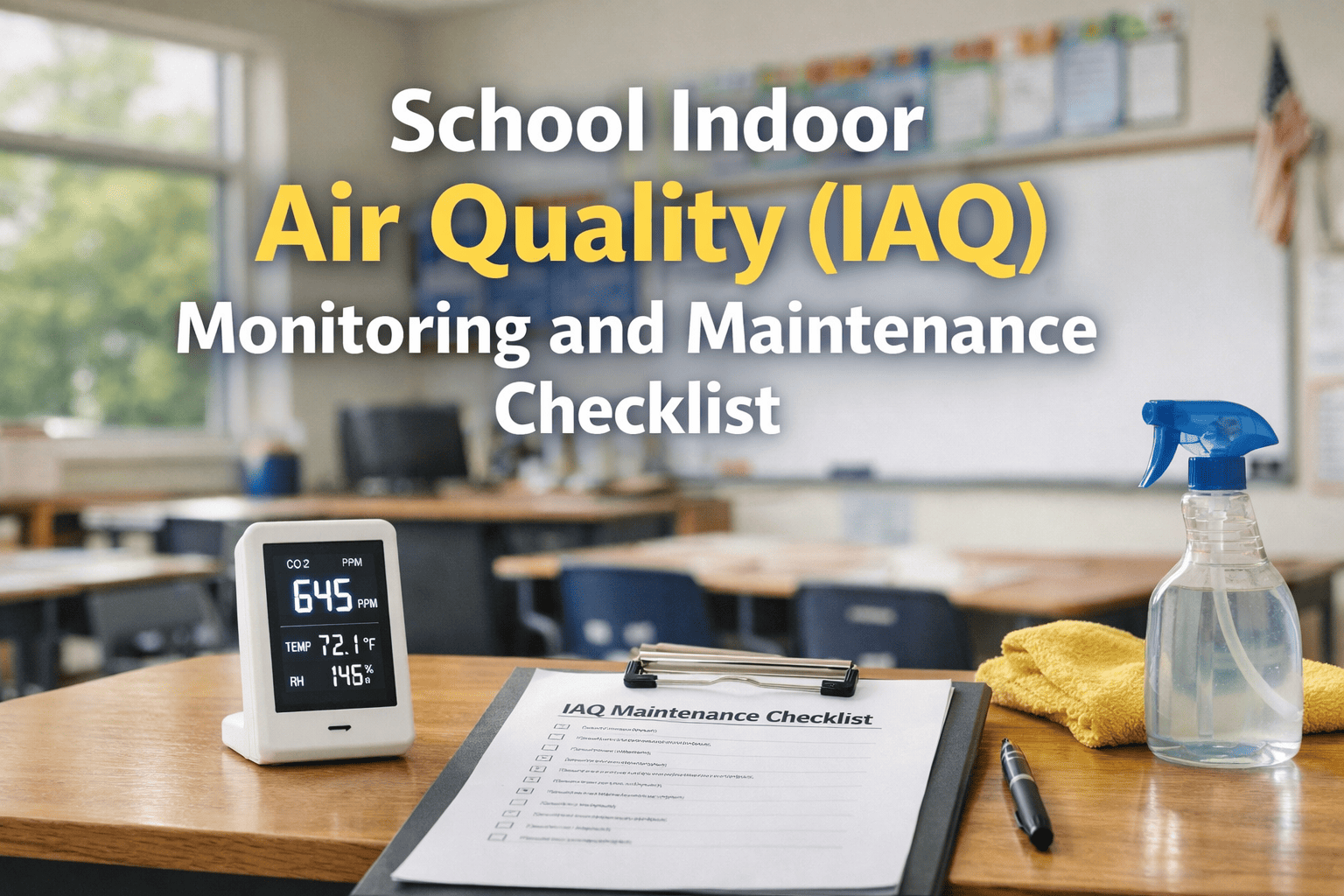
School Indoor Air Quality Management: IAQ Monitoring & Compliance
By Oxmaint on February 6, 2026
A fourth-grade teacher in a Houston elementary school noticed her students growing sluggish every afternoon—yawning, losing focus, complaining of headaches. She assumed it was post-lunch fatigue until a parent donated a portable CO2 monitor. The readings were staggering: by 1:00 PM, carbon dioxide levels in her classroom exceeded 2,500 ppm—more than triple the recommended maximum. The HVAC unit serving her wing had a failed damper actuator that had been silently recirculating stale air for months. No one knew because no one was measuring. When the district tested other classrooms, 43% exceeded safe CO2 thresholds during occupied hours. The investigation revealed no ventilation verification records, no filter change documentation, and no process for monitoring the air students breathe six hours a day. The damper repair cost $340. The lost instructional quality across an entire semester was incalculable.
Students and staff spend more waking hours inside school buildings than any other indoor environment. The air they breathe directly impacts cognitive function, attendance rates, chronic health conditions, and academic performance—yet most districts have no systematic process for measuring, maintaining, or documenting indoor air quality. Digital IAQ management transforms air quality from invisible and assumed to measured and proven. Districts that switched to real-time IAQ tracking discovered ventilation failures in classrooms that had looked normal for years — and fixed most of them for under $500 each. Your buildings likely have the same hidden problems right now. See what your classrooms' air actually looks like start tracking indoor air quality today - Sign Up
The Case for School IAQ Management
$40B
Annual cost of poor IAQ in US schools through absenteeism, reduced cognitive performance, and health-related liability
8-15%
Improvement in standardized test scores documented in schools that improved ventilation to meet ASHRAE 62.1 standards
43%
Of classrooms exceed recommended CO2 levels during occupied hours—indicating inadequate ventilation without anyone knowing
3.4M
School days lost annually to asthma—the leading cause of school absenteeism, directly worsened by poor indoor air quality
A $340 damper repair fixed what an entire semester of headaches couldn't. 43% of classrooms fail CO2 standards without anyone knowing. The only way to find out if yours are among them is to measure. Start monitoring today — your first classroom dashboard goes live in under 24 hours.
Effective school IAQ management combines sensor networks, HVAC maintenance tracking, and digital compliance documentation to create continuous visibility into the air quality of every occupied space. The system transforms invisible air quality problems into measurable, trackable, and fixable maintenance items.
School IAQ Management System ComponentsFrom measurement to corrective action
01
CO2 & Particulate Sensors
Wireless CO2, PM2.5, temperature, and humidity sensors installed in classrooms, gymnasiums, cafeterias, and common areas. Sensors transmit readings every 5 minutes, establishing real-time baselines and detecting ventilation failures within minutes of occurrence.
02
HVAC Performance Tracking
Digital maintenance records for every air handling unit, rooftop unit, and unit ventilator. Track filter changes, damper operation, belt condition, coil cleaning, and outdoor air verification. Connect equipment health to air quality outcomes.
03
Threshold Alerting
Automated alerts when CO2 exceeds 1,000 ppm, PM2.5 exceeds 12 µg/m³, or humidity falls outside 30-60% range. Alerts route to facilities staff with room number, current reading, and suggested corrective action based on equipment history.
04
Work Order Generation
IAQ threshold violations automatically generate maintenance work orders linked to the specific HVAC equipment serving the affected space. Technicians receive the alert, the room, the reading, and the equipment history in one digital package.
05
Compliance Documentation
Every sensor reading, filter change, maintenance action, and corrective response is permanently documented. The next time a parent emails asking what your CO2 levels were in Room 214 last Thursday, you'll have the answer in three clicks — not three weeks. generate audit-ready IAQ reports from day one - Sign Up
Critical IAQ Parameters to Monitor
Indoor air quality is multidimensional—CO2 is the most visible indicator but only one of six parameters that affect student health and cognitive performance. Comprehensive IAQ management requires monitoring all factors that impact the classroom environment.
School IAQ Monitoring Parameters
Carbon Dioxide (CO2)
Primary indicator of ventilation adequacy. Levels above 1,000 ppm indicate insufficient outdoor air. Above 1,500 ppm, cognitive function measurably declines. Above 2,500 ppm, drowsiness, headaches, and inability to concentrate become widespread.
Particulate Matter (PM2.5)
Fine particles from outdoor sources, cleaning chemicals, and building materials that penetrate deep into lungs. Proper MERV-13 filtration reduces PM2.5 by 80-90%. Levels above 12 µg/m³ trigger health concerns for sensitive populations.
Relative Humidity
Optimal range is 30-60%. Below 30%, respiratory membranes dry out, increasing susceptibility to infection. Above 60%, mold growth accelerates and dust mites thrive. Humidity control requires functioning HVAC dehumidification and humidification systems.
Temperature Control
ASHRAE recommends 68-76°F for occupied classrooms. Temperatures outside this range reduce cognitive performance by 2-4% per degree. Consistent temperature maintenance requires properly calibrated thermostats and functioning zone controls.
VOCs (Volatile Organic Compounds)
Off-gassing from cleaning products, building materials, furniture, and art supplies. Elevated VOC levels cause headaches, respiratory irritation, and long-term health effects. Ventilation and low-VOC product selection are primary controls.
Ventilation Rate (CFM/person)
ASHRAE 62.1 requires minimum 15 CFM per person in classrooms. Actual delivery depends on functional outdoor air dampers, clean filters, proper fan speed, and ductwork integrity. CO2 serves as the proxy measurement for ventilation adequacy.
Seeing one live classroom dashboard changes the entire conversation with your board. In 30 minutes, we'll walk through real-time air quality data from schools like yours — color-coded rooms, automated HVAC alerts, and the compliance reports that turn parent questions into trust-building moments.
Understanding the difference between complaint-driven air quality response and sensor-driven proactive management reveals why districts implementing continuous monitoring achieve dramatically better student health outcomes and compliance posture.
IAQ Management Approach Comparison
Reactive (Complaint-Based)
✕
Problems discovered by student symptoms
No baseline data—no way to verify normal
Filter changes on calendar, not condition
Ventilation assumed working until complaint
No documentation for parents or regulators
43%of classrooms silently exceed CO2 limits
Proactive (Sensor-Driven)
✓
Problems detected by sensors before symptoms
Real-time data establishes healthy baselines
Filter changes triggered by pressure drop data
Ventilation verified by continuous CO2 monitoring
Audit-ready compliance records generated automatically
98%+of occupied hours within healthy IAQ range
HVAC Maintenance Requirements for IAQ
Indoor air quality is a direct output of HVAC system performance. Every IAQ failure traces back to a maintenance failure—a clogged filter, a stuck damper, a failed fan motor, or a dirty coil. Systematic HVAC maintenance is the foundation of school air quality.
HVAC Maintenance Schedule for IAQ Compliance
HVAC Component
IAQ Impact
Maintenance Action
Frequency
Air Filters
PM2.5, allergens, dust
Replace MERV-13 filters; verify seal and fit
Quarterly (or by pressure drop)
Outdoor Air Dampers
CO2, ventilation rate
Verify full open/close operation; check actuator
Monthly during occupied season
Cooling/Heating Coils
Temperature, humidity, mold
Clean coil surfaces; verify drain pan drainage
Semi-annual (spring and fall)
Fan Motors & Belts
Airflow delivery
Check belt tension, alignment; verify CFM output
Monthly
Condensate Drain Pans
Mold, microbial growth
Clean pan; verify drainage; treat with biocide
Monthly during cooling season
Ductwork
Particulates, mold, leakage
Inspect for damage, leaks, microbial growth
Annual inspection; clean as needed
Every HVAC maintenance action directly affects the air students breathe. Missed filter changes increase particulate exposure. Failed dampers eliminate ventilation. Dirty coils breed mold. Digital tracking ensures no component is overlooked.
Connect HVAC Maintenance to Air Quality Outcomes
Oxmaint links every filter change, damper check, and coil cleaning to the IAQ data from the spaces that equipment serves—so you can prove that your maintenance program delivers healthy air.
Schools implementing comprehensive IAQ management with continuous monitoring achieve measurable improvements across student health, academic performance, staff wellness, and energy efficiency. The returns compound across multiple value streams.
Measured School IAQ BenefitsBased on published research and district implementation data
64%
Reduction in respiratory-related absences
15%
Increase in standardized test performance
40%
Fewer IAQ-related parent complaints
25%
Reduction in HVAC energy costs through optimized operation
Districts with 10 buildings typically find $50K–$150K in preventable losses within the first 60 days. Create your free account and our team will map your building portfolio, estimate your IAQ improvement potential, and show you exactly where the biggest wins are hiding.
School IAQ is governed by overlapping federal, state, and professional standards. While no single federal law mandates specific IAQ levels in schools, the combination of ASHRAE standards, EPA guidance, state laws, and duty-of-care obligations creates a de facto compliance framework that districts must document.
IAQ Standards Applicable to Schools
Standard / Authority
Key Requirements
Measurement
Documentation Obligation
ASHRAE 62.1
Minimum 15 CFM/person outdoor air in classrooms
CO2 as ventilation proxy (<1,000 ppm)
Ventilation verification records
EPA IAQ Tools for Schools
Comprehensive IAQ management program
Walkthroughs, checklists, monitoring
IAQ coordinator designation, action plans
ASHRAE 62.1 (2022)
Enhanced filtration (MERV-13 minimum recommended)
Filter pressure drop monitoring
Filter change records with MERV rating
State IAQ Laws
Vary by state—many require IAQ plans, CO2 monitoring, or annual assessments
State-specific thresholds
Annual IAQ reports to state agency
OSHA General Duty Clause
Employer must provide workplace free of recognized hazards
Staff exposure documentation
Hazard assessment and corrective action records
CDC/NIOSH Guidance
Ventilation improvements to reduce airborne pathogen transmission
Air changes per hour (ACH), CO2 levels
Ventilation assessment documentation
Multiple states have enacted or proposed school IAQ legislation since 2020. Digital compliance documentation protects districts against regulatory changes by establishing continuous monitoring records regardless of which specific standards apply.
Implementation Roadmap
Successful school IAQ programs require phased implementation that starts with measurement, builds maintenance systems, and scales to comprehensive monitoring. A structured approach delivers measurable improvements within weeks while building toward district-wide coverage.
IAQ Program Deployment Roadmap
Week 1-2
Baseline Assessment
Deploy CO2 sensors in 10-20% of classroomsAudit HVAC equipment serving monitored spacesDocument current filter types and change history
Week 3-4
HVAC Remediation
Repair non-functional dampers and actuatorsUpgrade to MERV-13 filtration where possibleVerify outdoor air delivery meets ASHRAE 62.1
Week 5-6
Digital Integration
Connect sensor data to CMMS platformConfigure automated alerts and work ordersBuild HVAC maintenance schedules per equipment
Week 7-8
Scale & Report
Expand sensors to all occupied spacesLaunch IAQ dashboard for administrationGenerate first compliance report for board
We installed CO2 sensors in every classroom after a parent complaint. The data was eye-opening—half our classrooms exceeded 1,500 ppm by mid-morning. Most of the fixes were simple: stuck dampers, clogged filters, thermostats overriding outdoor air. Within 60 days of addressing the maintenance issues, nurse visits for headaches dropped 38% and teachers reported noticeably better afternoon engagement. The sensors cost $14,000. The maintenance fixes cost $22,000. The improvement in student learning was immediate and measurable.
Measure the Air Your Students Breathe
Your students spend 1,000+ hours per year inside your buildings. Oxmaint connects IAQ sensor data to HVAC maintenance tracking—so every filter change, damper repair, and ventilation adjustment is documented, measured, and proven to deliver healthy air. Stop assuming your air quality is adequate. Start measuring it.
What CO2 level is considered unsafe in a classroom?
ASHRAE 62.1 uses CO2 as a proxy for ventilation adequacy, with 1,000 ppm as the threshold indicating minimum outdoor air delivery is being met. Levels between 1,000-1,500 ppm indicate reduced ventilation. Above 1,500 ppm, published research documents measurable cognitive decline in students. Above 2,500 ppm, drowsiness, headaches, and inability to concentrate become widespread. Outdoor air is approximately 420 ppm, so classroom readings should stay within 600 ppm above outdoor levels per ASHRAE guidance. Most districts that start monitoring are shocked to discover half their classrooms exceed 1,500 ppm before lunch. find out where your classrooms stand - Sign Up
How often should school HVAC filters be changed for good air quality?
Standard practice is quarterly replacement of MERV-13 filters, but optimal timing depends on actual pressure drop across the filter. Heavily loaded filters restrict airflow, reducing both ventilation and filtration effectiveness. Digital tracking with pressure differential monitoring enables condition-based replacement—changing filters when they actually need it rather than on an arbitrary calendar. Schools in high-pollution areas or with construction nearby may need monthly changes. One district saved $18,000 per year by switching from calendar-based to pressure-based filter replacement. see how automated filter tracking works for your district - Book a Demo
Are schools legally required to monitor indoor air quality?
Requirements vary by state. Multiple states have enacted school IAQ legislation since 2020 requiring CO2 monitoring, annual ventilation assessments, or formal IAQ management plans. Even in states without specific IAQ laws, schools have a general duty of care to provide safe environments. ASHRAE 62.1 is referenced in most building codes and establishes the standard of care for ventilation. Districts that document continuous IAQ monitoring demonstrate the proactive compliance posture that protects against liability regardless of state-specific requirements.
What is the most common cause of poor classroom air quality?
Failed or stuck outdoor air dampers are the single most common cause of elevated CO2 in classrooms. When dampers fail closed, HVAC units recirculate indoor air without introducing fresh outdoor air. CO2 from occupant breathing accumulates continuously. The second most common cause is clogged filters restricting airflow below design levels. Both issues are inexpensive to repair but invisible without monitoring—a $340 damper actuator replacement can transform classroom air quality overnight.
How does MERV-13 filtration improve classroom air quality?
MERV-13 filters capture 80-90% of PM2.5 particles (fine particulates that penetrate deep into lungs), 90%+ of pollen and mold spores, and a significant percentage of respiratory droplets. ASHRAE recommends MERV-13 as the minimum for schools. Upgrading from MERV-8 to MERV-13 requires verifying that HVAC equipment can handle the increased pressure drop—some older unit ventilators may need fan speed adjustments. Tracking MERV ratings, install dates, and schedules across every unit is exactly the kind of detail that gets missed on paper. keep every filter documented district-wide - Sign Up