School Pest Control: Integrated Pest Management Programs for Educational Facilities
By Jamie lanister on March 28, 2026
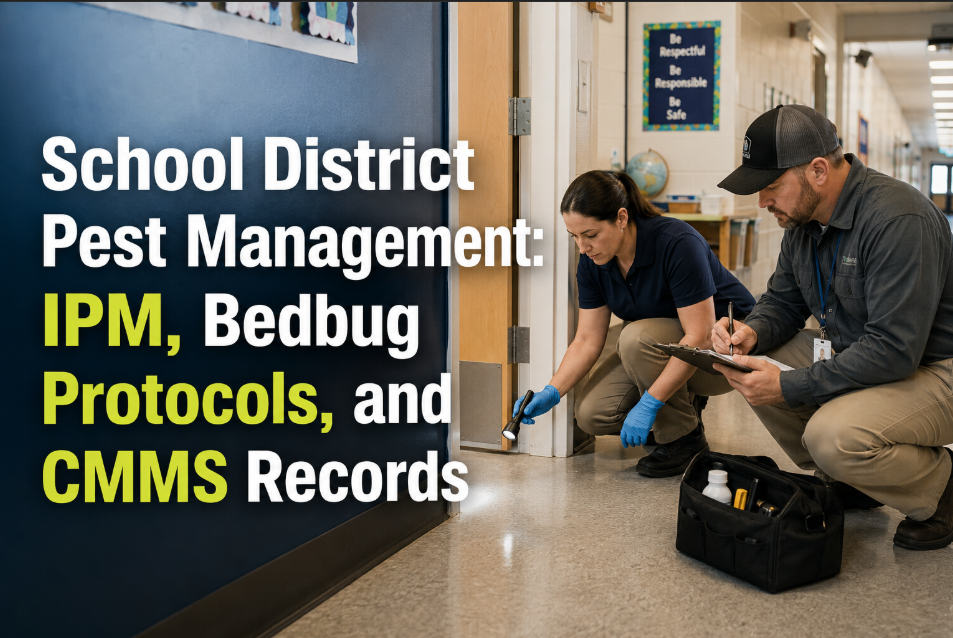
Schools across the USA, UK, Canada, Australia, and UAE face a persistent challenge that no cleaning schedule alone can solve: pest activity that travels through walls, arrives in delivery boxes, and thrives in kitchens, cafeterias, and storage areas occupied daily by hundreds of students and staff. An Integrated Pest Management program replaces reactive pesticide spraying with a prevention-first, data-driven approach — monitoring, identification, threshold-based intervention, and closed-loop documentation that satisfies EPA, state department of education, and OSHA requirements. OxMaint replaces paper pest logbooks and verbal reports with a mobile IPM management platform that captures every sighting, treatment, and inspection in a timestamped digital record from the moment it is submitted — protecting students, reducing chemical exposure, and keeping your operator licence audit-ready at all times.
OxMaint · School IPM Management · Prevention-First Pest Intelligence
Every Sighting Logged. Every Treatment Documented. Every Inspection Compliance-Ready.
CMMS-powered Integrated Pest Management for schools — monitoring protocols, threshold-based intervention, least-toxic treatment tracking, and health department records generated automatically from first inspection.
More pest incidents detected early with CMMS-monitored IPM vs reactive-only programs
71%
Reduction in pesticide applications in year one of structured IPM deployment vs baseline spray schedules
<24 hrs
Average time from pest detection report to assigned IPM treatment response and work order creation
100%
EPA and state IPM-compliant digital records — timestamped, location-tagged, operator-signed, audit-ready
How Mobile IPM Reporting Works: Four Steps, Under 90 Seconds
Eliminating under-reporting starts by making reporting faster than ignoring. OxMaint's IPM app guides any staff member through a complete pest sighting report in four taps — no training required, no pest-control vocabulary needed, offline-capable. Every report generates a timestamped, GPS-tagged, staff-signed record satisfying EPA school IPM notification requirements and state department of education documentation standards. Start free and deploy the OxMaint IPM app across your district within 48 hours — no hardware required.
MOBILE IPM REPORT WORKFLOW — 4 STEPS FROM SIGHTING TO ESCALATION
Step
Staff Action
Data Captured
What OxMaint Does
Time
01
Select pest type and location
Building, zone, room, pest species from guided list — photo diagram tap-to-locate
Timestamps report. Auto-assigns to IPM coordinator. Routes to correct intervention queue.
20 sec
02
Photograph the pest evidence
Photo with GPS coordinates, timestamp, species confirmation, infestation area size estimate
AI analyses photo — confirms species, flags severity mismatch, attaches to IPM record.
25 sec
03
Tag severity and pest category
Severity: P1 Active / P2 Evidence / P3 Preventive — guided species descriptions per level
Digital staff signature, submission timestamp, GPS location, parent notification trigger
Generates EPA/state-compliant IPM record. Work order raised. Notification log created.
15 sec
Works offline — reports queue locally and sync when connectivity returns. Timestamp applied at submission, not sync time.
IPM Response Framework: Three Levels, Three Intervention Paths
A live cockroach in the cafeteria and a single ant trail near a window require completely different responses. OxMaint's three-tier IPM framework removes ambiguity — staff select from plain-English descriptions, the system routes the intervention automatically. IPM coordinators never need to manually triage reports at 06:00. Book a demo to see the IPM framework configured for your pest species and state compliance requirements.
IPM RESPONSE FRAMEWORK — THREE TIERS, AUTOMATED ESCALATION
P1
Active Infestation — Area Closed, Immediate Treatment
Area must not be occupied. Immediate closure and treatment authorised. IPM coordinator and principal alerted within 5 minutes of report submission.
Examples
Live rodents · Cockroach colony · Bed bug confirmation · Wasp nest in occupied zone · Termite activity
Alert time<5 min
Area actionClosed
WO priorityP1
P2
Evidence Detected — Schedule Treatment, Monitor Until Resolved
Area remains operational. Treatment scheduled within 24 hours. IPM coordinator receives dashboard alert. Monitoring station check added to daily rounds.
Examples
Rodent droppings · Cockroach casings · Ant trail · Fly breeding source · Stored-product pest evidence
Alert time<2 hrs
Area actionMonitor
WO priorityP2
P3
Preventive Monitoring — Log and Schedule at Next Inspection Cycle
No active pest found. Monitoring station check, entry-point seal, or sanitation recommendation logged and scheduled at next planned IPM inspection window.
Examples
Gap in door seal · Overflowing bin · Moisture source · Monitoring trap count spike · Seasonal alert
Alert timeNext report
Area actionOperational
WO priorityP3
Most Reported Pest Categories: Where School IPM Risk Concentrates
Across OxMaint's deployed school IPM base, six pest categories account for 84% of all staff-reported sightings. Understanding which species generate the most reports — and which escalate to P1 closure — is the foundation of an effective IPM investment strategy. Schools that map their pest category distribution and adjust monitoring station placement accordingly reduce P1 critical incidents by 45–60% within 90 days. OxMaint generates your school's pest category breakdown automatically — see your first category report within 30 days.
PEST CATEGORY FREQUENCY — % OF ALL STAFF REPORTS · SCHOOL IPM INDUSTRY AVERAGE 2024–25
Pest Category
Share of Reports
Frequency
% Escalate P1
IPM Action
Rodents
28%
48% P1
Seal entry points + increase trap density
Cockroaches
24%
35% P1
Sanitation protocol + bait station review
Ants
18%
12% P1
Barrier treatment + food storage audit
Flies & Gnats
14%
8% P1
Source elimination + drain treatment
Bed Bugs
10%
72% P1
Full room heat treatment + inspection
Wasps & Bees
6%
55% P1
Nest removal + perimeter treatment
Bed bugs have the highest P1 escalation rate (72%) despite low volume — highest priority for morning monitoring checks in boarding and residential school zones.
From Sighting to Closed Record: The Full IPM Lifecycle in OxMaint
A pest report is only valuable if it triggers action. OxMaint tracks every sighting from submission through identification, treatment, follow-up inspection, and record seal — creating a closed-loop IPM compliance record that EPA and state inspectors regard as the documentation gold standard. No pest incident is ever marked closed without a linked treatment work order and a sign-off confirming resolution.
IPM INCIDENT LIFECYCLE — FROM STAFF REPORT TO CLOSED COMPLIANCE RECORD
Stage
P1 Active
P2 Evidence
P3 Preventive
Who Receives
01
Sighting Reported
Immediate — real time
Immediate — real time
Queued — batch
Zone record + staff app confirmation
02
Alert Fired
Push + SMS to IPM coord + principal
Dashboard alert — within 2 hours
Next morning summary
IPM Coordinator · Facility manager
03
Work Order Raised
Auto-generated P1 — within 5 min
Auto-generated P2 — within 24 hrs
Linked to next IPM inspection cycle
IPM technician mobile app
04
Treatment Applied
Least-toxic treatment — same day
Scheduled treatment — within 24 hrs
Preventive measure at next cycle
IPM technician — treatment logged
05
Follow-Up Inspection
72-hr re-inspection — mandatory
7-day follow-up check logged
Next scheduled inspection cycle
IPM coordinator — digital sign-off
06
Record Sealed
Full audit trail — PDF exportable
Full audit trail — PDF exportable
Linked to PM record — archived
Facility director compliance dashboard
Technology Integration: AI Camera, Digital Twin, IoT Sensors, SAP, and Preventive PM
Cameras scan building perimeters, loading docks, and cafeteria entries for pest activity and structural gaps — automatically flagging potential entry points before staff observe active pests.
Detects entry risk before active infestation reported
IoT Sensors
Smart Monitoring Traps
IoT-connected monitoring traps push real-time count data directly to OxMaint — when catch counts exceed threshold, a P2 work order auto-generates without manual trap check.
Zero-visit monitoring — trap alerts direct to CMMS
Digital Twin
Pest Pressure Mapping
Virtual facility model maps pest sighting history by zone, season, and species — predicting high-risk periods and recommending proactive IPM intervention before threshold is breached.
Predictive IPM scheduling from facility pressure model
SAP / ERP
Treatment Cost Tracking
Every IPM treatment work order writes chemical cost, technician time, and zone ID to SAP PM/MM — IPM programme costs tracked at building and district level with zero manual entry.
Zero manual ERP entry per IPM treatment event
Environmental PM
Sanitation & Exclusion Scheduling
Repeat P2/P3 sightings in the same zone auto-trigger a sanitation or exclusion PM review — linking reactive reports to proactive structural and hygiene schedule improvements.
Reduces P1 critical rate by up to 60% in 90 days
PLC / BMS
Environmental Condition Monitoring
Building humidity, temperature, and moisture sensor data feeds into OxMaint — environmental conditions that increase pest pressure trigger preventive IPM scheduling automatically.
Environmental triggers preventive IPM before sightings occur
"We went from a paper pest log nobody trusted to a live dashboard our principal checks every morning. In the first semester, reported sightings went up 340% — not because we had more pests, but because staff finally had a way to report that took less than two minutes. Our pesticide spend dropped 68% in year one."
Director of Facilities & Operations
Greenfield Unified School District — 18 Schools · California, USA
Frequently Asked Questions
Q1Does OxMaint satisfy EPA and state school IPM documentation requirements?
Yes. OxMaint generates timestamped, operator-signed IPM records exportable for EPA, state department of education, and health department inspections — covering sighting logs, treatment records, chemical usage, and follow-up inspections. Book a demo to confirm your state's IPM requirements are covered.
Q2How does OxMaint manage required parent and staff notification for pesticide applications?
OxMaint auto-generates notification records at treatment submission — logging the required advance notice period, chemical used, and application zone. Notification compliance is tracked in the IPM dashboard per state requirement.
Q3Can monitoring station check results be logged directly in OxMaint?
Yes. IPM technicians log monitoring trap counts, species identification, and station condition from the mobile app on rounds. Catch-count trends are tracked per station and auto-trigger threshold alerts when counts exceed configured limits.
Q4How does OxMaint support the IPM hierarchy — prevention before intervention?
OxMaint's P3 tier captures all preventive observations — sanitation gaps, structural deficiencies, moisture sources — and schedules corrective work orders before they escalate to P1 active infestations. Prevention actions are tracked separately from chemical interventions.
Q5How quickly can OxMaint IPM tracking be deployed across a multi-school district?
IPM coordinators and reporting staff are active within 10 minutes. Building profiles and monitoring station locations are pre-loaded. Full district deployment of 50+ staff typically completes within one working day with no hardware required. Start your free trial — deployment support included from day one.
Q6Can OxMaint track both in-house IPM staff and contracted pest control vendors?
Yes. OxMaint assigns work orders to internal IPM technicians or contracted pest control vendors, tracks treatment completion and chemical usage for both, and maintains a single combined compliance record per school site.
Every Sighting Logged. Every Treatment Documented. Every Record Compliance-Ready.
Mobile IPM capture, automated escalation, and closed-loop compliance — deployed across your district in one day.