A mid-sized university with 68 custodial staff and 2.4 million square feet of campus space was managing complaints the hard way — paper logs, radio follow-ups, and no way to prove a restroom had actually been serviced before an angry ticket landed on the facilities director's desk. Within 90 days of deploying Oxmaint mobile checklists with QR scan verification and supervisor dashboards, the department cut custodial complaints by 62%. This case study walks through exactly how they did it — from the first mobile rollout to the compliance metrics that now go directly to campus risk management. If your university custodial team still runs on clipboards and shift handoff calls, Sign Up Free and see what structured mobile inspection workflows do to your complaint rate. Operations managers who want a live walkthrough of the QR verification and dashboard features can Book a Demo before next semester's cleaning contract review. Facilities teams at peer institutions have used Oxmaint to close the gap between what custodial staff document and what building occupants actually experience — turning anecdotal complaints into traceable, correctable data. Whether you manage residence halls, academic buildings, or athletic facilities, the outcome is the same a today gets your team off paper and onto timestamped, audit-ready mobile checklists within a single shift cycle.
Oxmaint mobile checklists, QR scan verification, and supervisor dashboards give university custodial teams the complaint evidence trail — and the complaint reduction — that paper logs never could.
University Custodial · Mobile CMMS · 90-Day Case Study
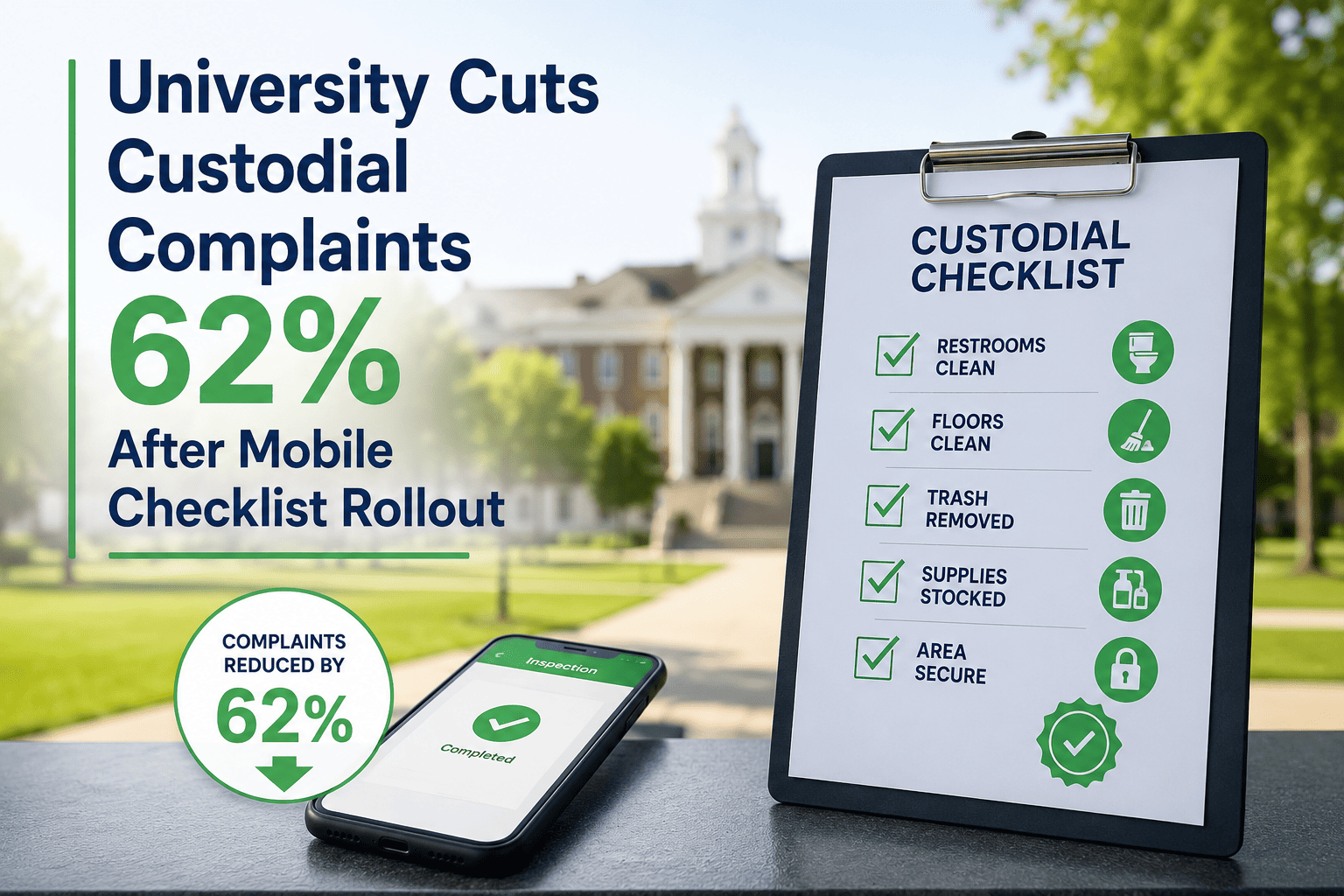
University Cuts Custodial Complaints 62% After Mobile Checklist Rollout
A 68-staff university custodial department reduces occupant complaints by 62% in 90 days — using Oxmaint mobile checklists, QR scan zone verification, and supervisor dashboards that replace paper logs with traceable, shift-by-shift compliance records.
62%Complaint Reduction
90Days to Results
68Staff Deployed
2.4MSq Ft Covered
Root Causes of Custodial Complaints Before Mobile Rollout
No Proof of ServicePaper logs couldn't verify when or whether a space was actually cleaned
Missed ZonesHigh-traffic restrooms and entrances skipped during peak shift hours with no visibility
No Supervisor VisibilitySupervisors couldn't see real-time completion rates across buildings without physical walkthrough
Complaint-to-Resolution LagOccupant complaints took 24–48 hours to reach the right staff member for corrective action
No Audit TrailFacilities director had no documentation to dispute or investigate repeat complaints by building
Inconsistent Shift HandoffsNight and day shift custodians had no structured handoff record for incomplete or deferred tasks
DDaily
WWeekly
MMonthly
QQuarterly
AAnnual
Phase 01
Mobile Checklist Deployment Across All Custodial Zones
The first 30 days focused on replacing paper route sheets with Oxmaint mobile checklists assigned by zone, shift, and building. Every custodial staff member received a mobile device login and a structured task list for their assigned area — with completion timestamps recorded automatically at the point of service.
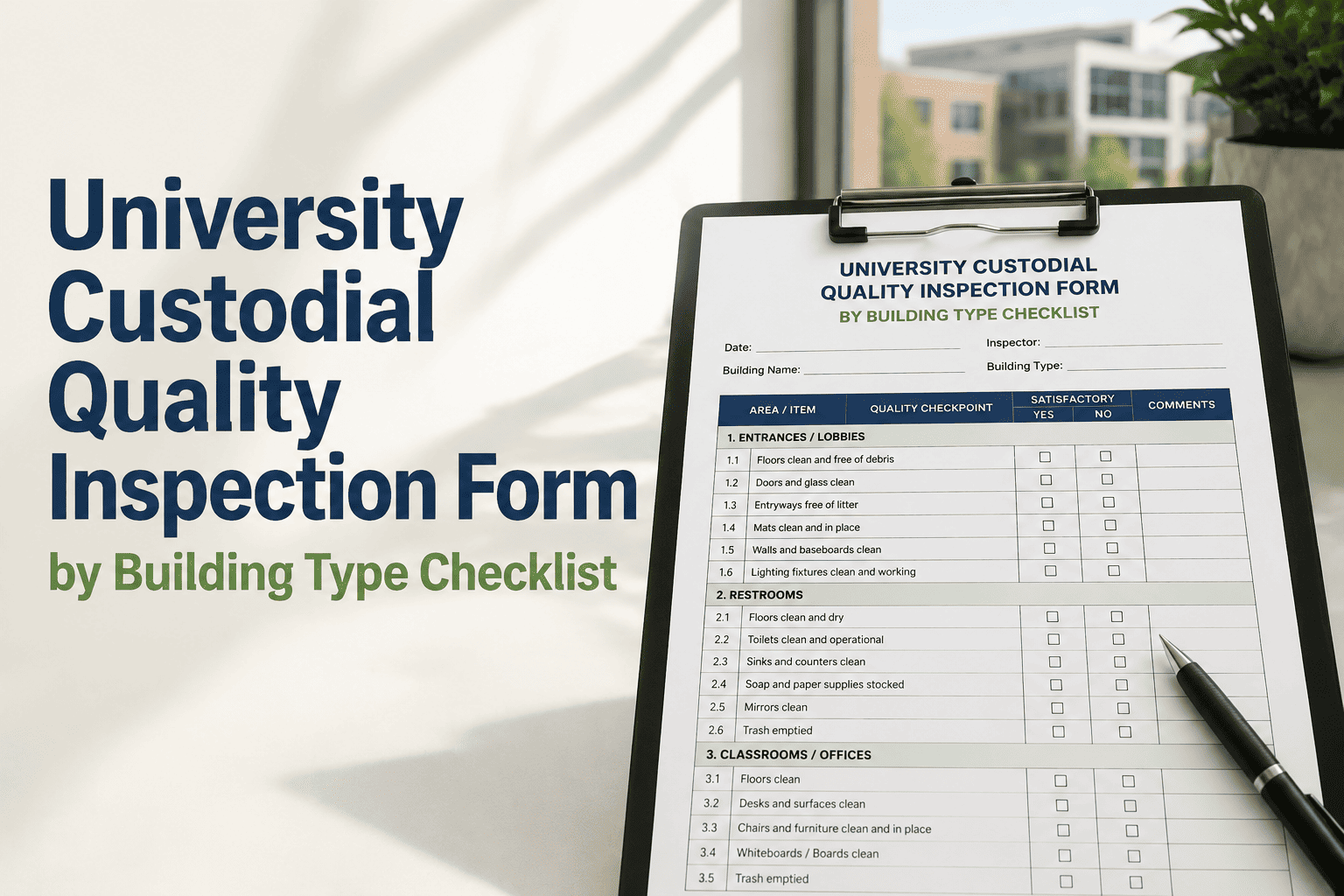
Zone-based mobile checklists configured for every building — each custodial zone (restrooms, corridors, entrances, classrooms, offices) mapped to a digital checklist in Oxmaint with task-level line items, frequency assignments, and assigned staff by shift
DFacilities Manager · Checklist configuration record
Staff onboarded to mobile app with shift-specific task queues — all 68 custodial staff completed Oxmaint mobile app orientation in under two hours; each staff member's daily task queue pre-loaded before shift start, eliminating paper route sheet distribution delays
DSupervisor · Staff onboarding log
Timestamp-verified task completion enabled — every checklist item completed on mobile generates an automatic timestamp and staff ID record; supervisors can pull completion evidence for any zone, any shift, within seconds — eliminating "we cleaned it" vs "it wasn't clean" disputes
DSupervisor · Completion verification log
Incomplete task alerts configured for supervisors — Oxmaint real-time dashboard alerts sent to shift supervisors when any high-priority zone (restrooms, main entrances, food service areas) reaches 30 minutes past scheduled completion without a sign-off; alert-to-response time tracked as a KPI
DSupervisor · Alert response log
Phase 02
QR Scan Zone Verification — Proving Physical Presence
The biggest complaint driver wasn't negligent staff — it was unverifiable service. Anyone could check a paper box. QR scan verification solved this by requiring custodial staff to physically scan a zone-mounted QR code before a checklist task registers as complete in Oxmaint, creating GPS-confirmed, timestamped proof of presence for every service touchpoint.
QR codes deployed at every high-complaint zone — laminated Oxmaint QR codes installed inside each restroom, at building entrances, and in food service zones; scan required to unlock the checklist completion field for that zone, preventing remote or backdated sign-offs
DFacilities Manager · QR deployment log
Scan timestamp tied to staff ID in CMMS record — every QR scan records staff ID, zone, date, and time in Oxmaint; facilities director can produce a full service history for any zone in the building within 30 seconds — including how many times a restroom was serviced during a single shift
DSupervisor · Zone scan history
Missed scan flagged as a route gap — any zone that reaches its scheduled service interval without a QR scan appears as an open gap on the supervisor dashboard; gaps assigned as immediate follow-up work orders rather than discovered through an occupant complaint 12 hours later
DSupervisor · Route gap work order log
Occupant complaint cross-referenced against scan record — when a complaint arrives, the facilities team pulls the QR scan history for that zone and timestamp; if service was completed on time, the complaint is documented with evidence; if a gap exists, a corrective work order is opened immediately and the route schedule reviewed
DFacilities Manager · Complaint resolution log
Phase 03
Supervisor Dashboard — Real-Time Compliance Visibility
Supervisors managing 20+ custodial staff across multiple buildings cannot physically verify completion rates during a shift. The Oxmaint supervisor dashboard gave shift leads a live view of every zone's service status — green for completed, amber for approaching overdue, red for missed — across all 2.4 million square feet from a single screen.
Live shift completion rate visible by building and zone — supervisor dashboard shows real-time percentage of scheduled tasks completed for the current shift, broken down by building and zone type; supervisors redirect staff to under-served areas mid-shift rather than discovering coverage gaps at shift end
DSupervisor · Shift dashboard review
Per-staff task completion tracked without micromanagement — Oxmaint dashboard shows each team member's task completion rate for the shift without requiring supervisor check-ins; performance gaps surfaced in weekly review meetings with data rather than impressions, reducing friction in coaching conversations
WSupervisor · Staff performance report
Recurring complaint zones identified and rescheduled — after 30 days, the supervisor dashboard's building-level complaint overlay showed three academic buildings accounting for 47% of all complaints; service frequency for those buildings increased from once to twice daily, targeted specifically at the complaint-generating time windows
MFacilities Manager · Zone frequency review
Weekly compliance report auto-generated for facilities director — Oxmaint generates a weekly PDF summary of campus-wide custodial task completion rates, open work orders, complaint-to-scan cross-references, and staff coverage metrics; report shared with facilities director without manual data compilation
WFacilities Manager · Weekly compliance report
Phase 04
Work Order Integration — Complaints Become Correctable Data
Before Oxmaint, an occupant complaint triggered a phone call, a radio message, and a paper note that may or may not have reached the right person before the next shift. After rollout, every complaint and every missed QR scan became a structured Oxmaint work order — assigned, tracked, and closed with a documented resolution timestamp.
Occupant complaints logged as structured work orders — facilities staff enter occupant complaints directly into Oxmaint as work orders with zone, building, issue type, and priority; work order assigned to the zone's responsible staff member and tracked to resolution rather than managed through verbal relay
DFacilities Manager · Complaint work order log
Resolution time tracked and benchmarked — Oxmaint records time from complaint work order creation to resolution sign-off; the university reduced average complaint resolution time from 18 hours to under 4 hours by day 60, driven by direct mobile assignment rather than radio chain communication
DSupervisor · Resolution time log
Repeat complaint zones trigger preventive schedule review — any zone generating more than two work orders in a 30-day period flagged in Oxmaint for preventive schedule review; facilities manager reviews zone frequency, staff assignment, and QR scan history before adjusting the service plan rather than waiting for the next complaint cycle
MFacilities Manager · Preventive review log
Supply replenishment requests integrated into work order queue — custodial staff submit paper towel, soap, and liner replenishment requests directly in Oxmaint during zone service; supply work orders routed to the stock room automatically, reducing the time zones go unserviceable due to supply stockouts
DCustodial Staff · Supply work order log
Phase 05
90-Day Outcomes & Compliance KPIs
By day 90, the university's custodial department had a documented 62% reduction in occupant complaints — not through hiring additional staff, but through visibility, accountability, and structured mobile workflows that made every service touchpoint traceable. These are the six KPIs the facilities director now reports to campus administration each semester.
Occupant complaint volume: 62% reduction in 90 days — total campus custodial complaints fell from an average of 87 per month pre-rollout to 33 per month at day 90; the reduction was consistent across all building types — academic, residential, and administrative — with the steepest drop in the three buildings targeted for increased service frequency
MFacilities Director · Complaint volume report
Shift task completion rate: 94% average at day 90 — university-wide custodial task completion rate (tasks completed vs tasks scheduled per shift) reached 94% by day 90, up from an estimated 71% on paper routes that had no verification mechanism
WSupervisor · Shift completion dashboard
Complaint resolution time: reduced from 18 hours to under 4 hours — direct mobile work order assignment eliminated the radio-relay chain that caused complaint resolution delays; 91% of complaint work orders at day 90 were closed within the same shift they were opened
DSupervisor · Resolution time KPI
QR scan compliance: 89% of all scheduled zone scans completed at day 90 — zone QR scan compliance reached 89% campus-wide by day 90, giving supervisors documented proof-of-presence for nearly 9 in 10 scheduled service touchpoints; the 11% gap concentrated in two overnight routes, prompting a targeted schedule adjustment
WSupervisor · QR compliance report
Outcome KPIs
University Custodial Mobile Rollout — 90-Day Results at a Glance
| Metric | Before Oxmaint | Day 90 Result | Improvement |
| Monthly Occupant Complaints |
87 avg / month |
33 avg / month |
62% reduction |
| Shift Task Completion Rate |
~71% (estimated, paper) |
94% (verified, mobile) |
+23 points |
| Complaint Resolution Time |
18 hours avg |
Under 4 hours |
78% faster |
| QR Zone Scan Compliance |
Not measurable |
89% campus-wide |
Full visibility |
| Repeat Complaint Zones Addressed |
Identified only after volume |
Flagged at 2 complaints / 30 days |
Proactive |
| Weekly Compliance Report |
Manual, 3–4 hours to compile |
Auto-generated in Oxmaint |
Zero manual effort |
University custodial teams running on paper route sheets can replicate this 62% complaint reduction — with Oxmaint mobile checklists, QR scan verification, and supervisor dashboards deployed across your campus in a single semester. Sign Up Free or Book a Demo with a custodial operations specialist today.
FAQs
Frequently Asked Questions
How does Oxmaint mobile checklists reduce custodial complaints at universities?
Oxmaint replaces paper route sheets with timestamped mobile checklists and QR scan zone verification — so every service touchpoint generates a proof-of-presence record. Supervisors see real-time completion rates, respond to missed zones before occupants notice, and cross-reference any complaint against the scan history within seconds.
What is QR scan zone verification and how does it work in custodial operations?
A QR code is mounted inside each zone — restroom, entrance, classroom. Custodial staff scan it on their mobile device before the checklist task registers as complete. The scan records staff ID, zone, date, and time in Oxmaint, creating a physical-presence audit trail that paper logs cannot provide.
How long does it take to deploy Oxmaint across a university custodial department?
Most university custodial teams complete mobile app onboarding and QR code zone setup within one to two weeks. Staff orientation averages under two hours per employee. Supervisor dashboard configuration is handled during initial setup with Oxmaint's onboarding team.
Can Oxmaint generate compliance reports for campus facilities directors and risk management?
Yes. Oxmaint auto-generates weekly and monthly PDF compliance reports covering task completion rates, complaint work order volumes, QR scan compliance, and resolution time KPIs — exportable for facilities directors, campus risk management, and contract compliance reviews.
Does Oxmaint work for both day and night custodial shifts at universities?
Yes. Oxmaint assigns separate task queues by shift and staff assignment. Night shift staff see their zone-specific checklist on login; supervisors monitor completion rates for each shift independently. Shift handoff gaps and incomplete tasks from one shift carry forward as open work orders to the next.
University Custodial · Mobile CMMS · 62% Complaint Reduction
Your Campus Custodial Team Can Hit These Numbers Too
Oxmaint mobile checklists, QR zone scan verification, and supervisor dashboards give university facilities teams the real-time visibility and complaint evidence trail that paper-based custodial operations can never produce. Deploy across your campus, cut complaints, and generate the compliance documentation your facilities director and risk management office need — in one semester.



![university-custodial-workloading-appa-levels-issa-612-cmms-mobile[1]](./manage-post-2k26/uploads/university-custodial-workloading-appa-levels-issa-612-cmms-mobile[1].png)