University vivariums are among the most maintenance-intensive facilities on any campus — operating 24/7/365 with environmental tolerances tighter than most hospital operating rooms. A single HVAC failure that pushes room temperature above 78°F for just 4 hours can compromise years of research data and trigger AAALAC non-compliance findings. Yet 61% of university animal research facilities still track cage wash cycles, pressure cascade readings, and biosecurity inspections on paper logbooks or disconnected spreadsheets. The consequences are real: missed PM cycles lead to equipment failures, which lead to animal welfare incidents, which lead to AAALAC citations, which can suspend an institution's entire animal research program and the $50M+ in NIH funding that depends on it. Universities running their vivarium maintenance through Oxmaint's CMMS platform report 94% PM compliance on critical vivarium systems and audit preparation reduced from weeks to hours. If your DLAR or facility team is still chasing paper logs before AAALAC site visits, it is time to see what digital vivarium maintenance looks like — book a demo or start a free trial.
University Vivarium and Animal Research Facility Maintenance: AAALAC Compliance
AAALAC accreditation demands, cage wash validation, HVAC pressure cascades, biosecurity protocols, environmental monitoring, and CMMS-tracked compliance records for university animal facilities.
Track Every Vivarium PM and Inspection Digitally
See how Oxmaint tracks cage wash cycles, pressure cascade readings, HEPA certifications, and biosecurity inspections in one audit-ready platform — built for AAALAC documentation.
What Is Vivarium Facility Maintenance?
Vivarium facility maintenance encompasses every mechanical, environmental, and sanitation system required to house research animals in compliance with AAALAC International standards, the Guide for the Care and Use of Laboratory Animals (the Guide), and institutional IACUC protocols. Unlike standard campus buildings, vivariums operate under continuous environmental monitoring with tolerances of plus or minus 2°F for temperature and plus or minus 5% for relative humidity — 24 hours a day, 365 days a year. Maintenance includes HVAC pressure cascade systems that maintain negative or positive directional airflow between corridors and animal rooms, cage wash equipment operating at validated temperatures of 180°F or higher, HEPA filtration on supply and exhaust air, automated watering systems, biosecurity access controls, and emergency power systems that must activate within 10 seconds of utility failure. Every one of these systems requires documented preventive maintenance with timestamped records that AAALAC site visitors will review during triennial accreditation visits. Universities that cannot produce these records risk probationary accreditation status or revocation — and with it, the suspension of all federal research funding tied to animal protocols. To see how a modern CMMS handles this complexity, start a free trial or book a demo.
Critical Vivarium Systems Requiring CMMS-Tracked PM
Each system below has specific maintenance intervals, compliance documentation requirements, and failure consequences that demand digital tracking.
Vivarium HVAC maintains 10-15 air changes per hour with directional airflow from clean corridors into animal rooms. Room pressure differentials of -0.01 to -0.03 inches WC must be verified weekly. A single supply fan failure can reverse airflow direction and compromise biosecurity within minutes.
Tunnel and cabinet cage washers must reach 180°F minimum rinse temperature for sanitization validation. Temperature probes require quarterly calibration. Rack washers processing 200+ cages per day accumulate scale, debris, and mechanical wear that demands weekly PM checks and monthly deep maintenance.
Supply and exhaust HEPA filters in BSL-2 animal rooms and containment housing require annual DOP or PAO aerosol challenge testing per IEST-RP-CC034. Filters with greater than 0.01% penetration at 0.3 microns fail and must be replaced. Pre-filters upstream require monthly inspection and quarterly replacement to protect HEPA life.
Animal rooms require 68-79°F temperature range (species-dependent) with humidity between 30-70% RH. Monitoring systems must alarm when parameters deviate by more than 2°F or 5% RH. Sensor calibration per NIST-traceable standards is required annually, with monthly spot-checks against reference instruments.
Automated watering manifolds serving IVC racks require monthly flush cycles, quarterly valve inspections, and annual backflow preventer testing. Reverse osmosis systems supplying purified water need membrane replacement every 12-18 months with weekly conductivity checks to verify less than 1 ppm TDS output.
Vivariums require emergency power transfer within 10 seconds per NFPA 110. Generators serving animal facilities need weekly no-load tests, monthly load-bank tests, and annual 4-hour full-load tests. Transfer switches require semi-annual exercising. A generator failure during a power outage can kill hundreds of research animals within hours.
Why Vivarium Maintenance Fails Without a CMMS
The operational pain points below are documented across 74% of university animal facilities still running on paper or generic work order systems.
Cage wash temperature logs from 18 months ago are in a binder somewhere — or they were thrown away during a lab cleanout. AAALAC site visitors ask for 3 years of records. Paper cannot deliver this.
Vivarium systems run 365 days a year but maintenance staff work Monday through Friday. Without automated scheduling and escalation, holiday and weekend PMs are missed 38% of the time.
The HEPA filter in Room 214 was replaced, but the work order does not reference the certification report number, the filter lot number, or the next test date. The compliance trail is broken.
A temperature alarm triggered at 2:00 AM on Saturday. Someone responded. But there is no timestamped record of who, what they found, what corrective action was taken, or when conditions returned to normal. IACUC cannot accept this.
How Oxmaint Solves Vivarium Maintenance Compliance
Oxmaint provides a unified digital platform that connects every vivarium asset to its PM schedule, inspection checklist, compliance document, and audit trail — accessible from any device, in any animal room, even offline. Here is how each capability maps to vivarium operations and what it means for the teams managing these complex research environments on a daily basis, where a single undocumented excursion can trigger an IACUC investigation or jeopardize AAALAC accreditation. To explore these capabilities with your own vivarium data, start a free trial or book a demo.
Every asset mapped: Vivarium Building, Floor, Animal Room, AHU, HEPA Filter, Cage Washer, Autoclave, IVC Rack, Watering Manifold, Biosafety Cabinet. Each asset carries its own PM schedule, compliance documents, warranty data, and full work order history.
PM schedules tied to regulatory intervals: daily room checks, weekly pressure cascade verification, monthly cage washer deep clean, quarterly sensor calibration, annual HEPA certification. Missed PMs auto-escalate to the DLAR director and facility manager within 24 hours.
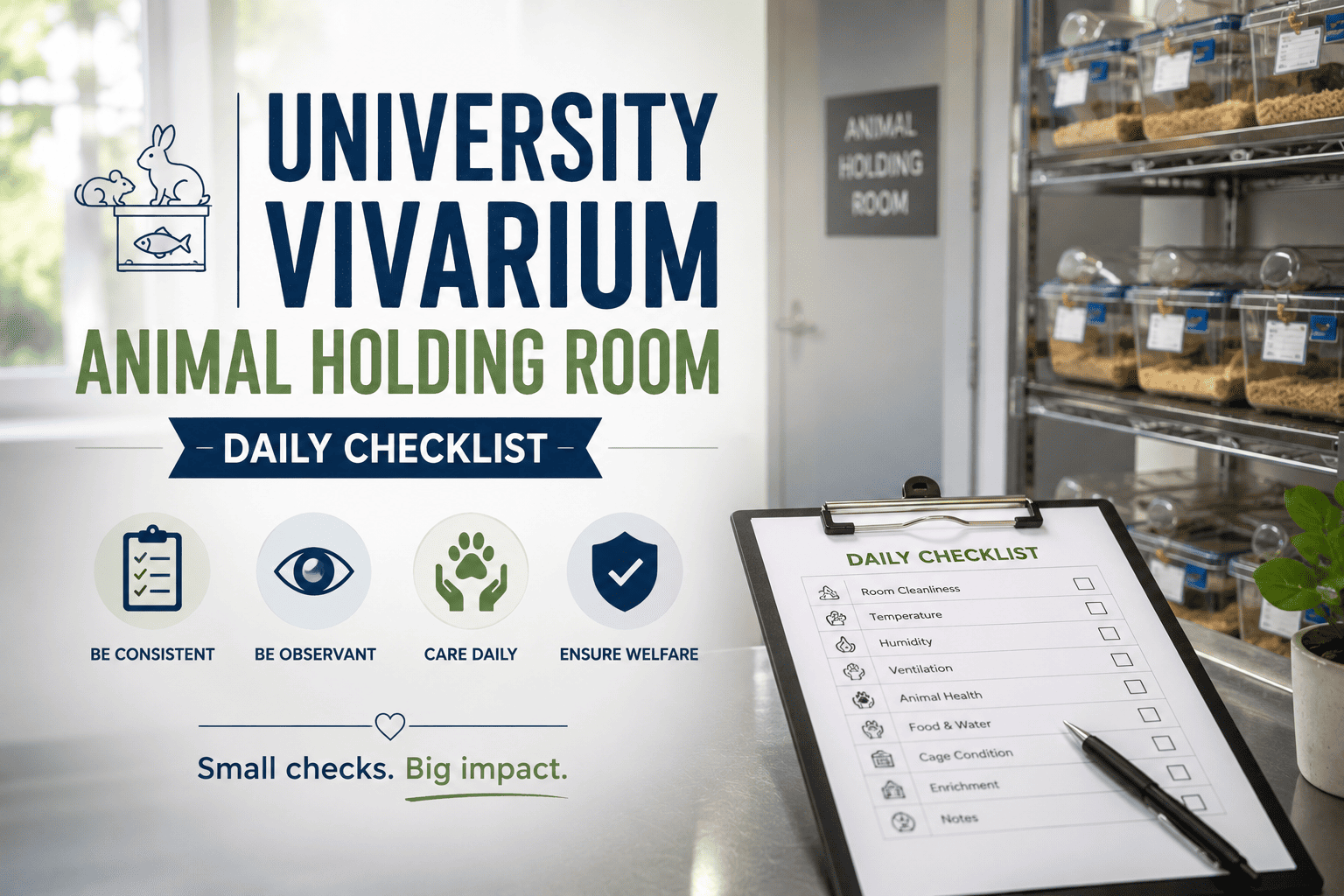
Mobile checklists for daily room walkthroughs capture temperature readings, humidity levels, light cycle status, cage condition, water system checks, and room cleanliness — with photo capture and digital signatures. Completed checklists are timestamped and stored permanently.
Generate filtered compliance reports by room, by system, by date range, by regulatory category — exportable as PDF or CSV. HEPA certifications, cage wash validations, generator tests, and pressure readings all in one searchable archive.
When BAS or environmental monitoring systems detect an out-of-range condition, Oxmaint auto-generates an incident work order with the excursion timestamp, affected room, deviation severity, and assigns it to the on-call technician. Response time, corrective action, and return-to-normal are all documented in the same record.
Vivarium maintenance requires coordination between central facilities (HVAC, electrical, plumbing) and DLAR operations (cage wash, animal care, biosecurity). Oxmaint routes work orders to the correct team based on asset type and auto-notifies DLAR when maintenance activities will affect animal rooms.
Paper Logs vs. CMMS-Tracked Vivarium Maintenance
The comparison below reflects documented outcomes from university vivarium programs that transitioned from paper-based tracking to CMMS platforms.
- Cage wash temp logs lost within 6-12 months
- 38% of weekend and holiday PMs missed
- Excursion response undocumented 45% of the time
- HEPA cert reports filed in separate binders per room
- 120+ hours to prepare for AAALAC site visit
- No escalation when PM tasks are overdue
- All records stored digitally with permanent archive
- Auto-escalation fills 94% of all scheduled PMs
- Every excursion auto-generates incident work order
- HEPA certs linked directly to asset records
- Audit reports generated in under 3 hours
- Missed PM alerts to DLAR director within 24 hours
Your next AAALAC site visit should not require 120 hours of binder assembly. Oxmaint gives your DLAR and facilities teams a single digital record for every cage washer cycle, every pressure reading, every HEPA certification, and every excursion response — searchable, filterable, and exportable in minutes. Most vivarium teams are running digital inspections within 7 days of setup.
Vivarium Maintenance ROI
Frequently Asked Questions
Can Oxmaint integrate with our existing environmental monitoring system?
How does the platform handle cage wash temperature validation records?
Can DLAR staff and central facilities both use the same platform?
What documentation does AAALAC specifically require for facility maintenance?
Protect Your Research, Your Animals, and Your Accreditation
AAALAC compliance is not optional — and neither is the maintenance documentation that supports it. Oxmaint gives your vivarium team digital PM tracking, audit-ready reports, and excursion documentation in one platform.