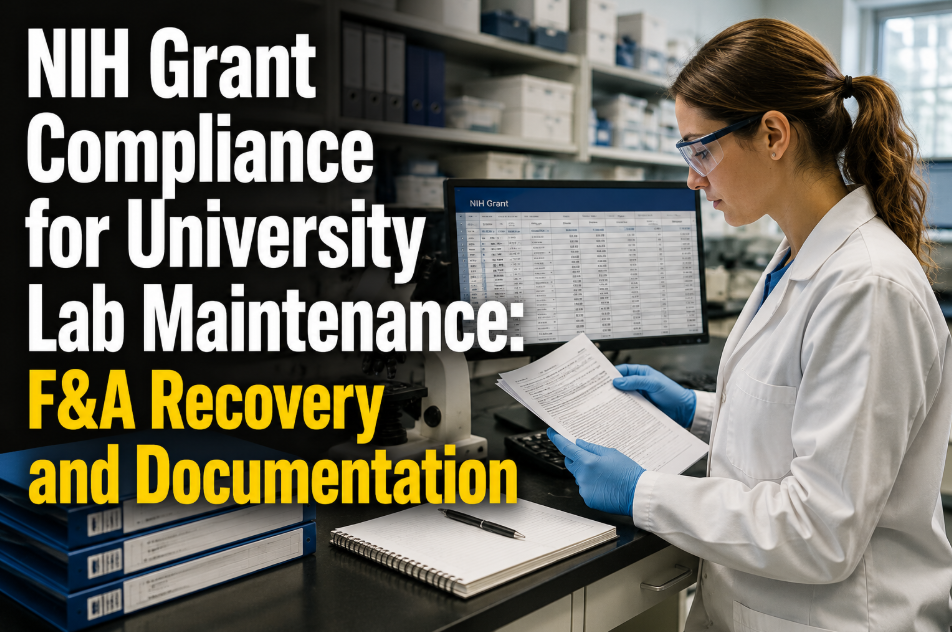
NIH is the largest single source of biomedical research funding in the United States — distributing over $47 billion annually to universities, medical centers, and research institutes. But NIH funding comes with a compliance infrastructure that most university facilities teams are not fully prepared to document: the Facilities and Administrative (F&A) cost rate, instrument and equipment cost allocation, maintenance cost recovery against sponsored awards, and the documentation requirements that defend those charges during federal audits. When the Department of Health and Human Services (DHHS) audits a university's F&A rate — as it does for every major research institution on a rolling 3–5 year cycle — one of the primary areas of scrutiny is whether maintenance costs claimed in the F&A calculation are supported by documented, systematic maintenance records. Universities that cannot produce organized, CMMS-backed maintenance records for NIH-funded lab spaces face cost disallowances, rate adjustments, and in serious cases, restitution demands. The stakes are high: a 1% reduction in an F&A rate at a $200M indirect cost recovery university represents a $2 million annual funding loss. Facilities teams using platforms like Oxmaint are building the documentation infrastructure that protects that recovery — and accelerating audit defense from weeks to days. If your university receives NIH funding, this guide explains the maintenance documentation requirements that your facilities CMMS must support. Ready to build audit-ready documentation? Start a free trial and book a demo with Oxmaint today.
NIH Grant Compliance for University Lab Maintenance: F&A Recovery and Documentation
F&A cost rate defense, instrument maintenance cost allocation, sponsored award documentation requirements, DHHS audit preparation, and CMMS-backed records that protect university indirect cost recovery.
Build the Documentation Infrastructure That Defends Your F&A Rate
Oxmaint gives university facilities teams audit-ready maintenance records organized by building, system, and asset — with cost allocation tracking, work order histories, and export formats aligned to DHHS audit requirements. Stop assembling records manually before every federal review.
What Is F&A Cost Recovery and Why Maintenance Documentation Matters
Facilities and Administrative (F&A) costs — also known as indirect costs or overhead — are the costs universities incur in operating and maintaining research infrastructure that cannot be directly attributed to a single sponsored project. Under 2 CFR 200 (Uniform Guidance), universities negotiate F&A rates with the DHHS Division of Cost Allocation (DCA). The facilities component of the F&A rate includes building depreciation, operations and maintenance costs, utilities, and space costs. To claim these costs in the F&A rate, universities must demonstrate — with documented evidence — that the maintenance programs they are claiming actually exist and are systematically executed. During a DHHS audit, auditors do not take the university's word for it. They ask for work order records, PM completion logs, maintenance cost ledgers by building, and asset-level service histories. Universities that cannot produce organized, system-level maintenance records risk having portions of their O&M cost base disallowed — directly reducing their negotiated F&A rate. Facilities teams at research universities need to understand that their CMMS is not just an operational tool — it is a financial compliance system. Want to see how Oxmaint structures maintenance records for F&A compliance? Start a free trial and configure your first sponsored-space asset hierarchy, or book a demo and we will walk through the F&A documentation workflow on your facility structure.
The F&A Cost Rate: How Maintenance Feeds the Calculation
Maintenance documentation supports the O&M component of this calculation. Without auditable records, O&M costs claimed in the rate are vulnerable to disallowance.
6 Maintenance Documentation Requirements for NIH Grant Compliance
All maintenance labor, materials, and contractor costs must be tracked at the building level — not just aggregated across the campus portfolio. DHHS auditors request maintenance cost ledgers by building to verify that costs claimed in the F&A submission are accurately assigned to research vs non-research space. A CMMS that tracks work order costs by building, floor, and asset class provides this data directly.
2 CFR 200.313 requires universities to maintain a property management system for federally funded equipment — including maintenance records. For equipment purchased with NIH funds above the capitalization threshold ($5,000 federally; lower thresholds institutionally), universities must demonstrate that the equipment is being properly maintained to extend its useful life and protect the federal investment.
Building and equipment depreciation is claimable in the F&A rate only for assets that are properly documented with acquisition cost, installation date, useful life, and maintenance history. A CMMS that maintains asset lifecycle records — condition scores, service history, remaining useful life estimates — provides the documentation foundation that makes depreciation claims defensible under DHHS review.
DHHS auditors evaluating O&M costs look for evidence of a systematic preventive maintenance program — not just reactive repair records. A CMMS that generates PM schedules, tracks completion rates, and reports PM compliance percentages by building provides the evidence that maintenance costs represent a planned, systematic program rather than ad hoc repairs that are difficult to defend as necessary research infrastructure costs.
The facilities component of the F&A rate is applied only to research space. Space utilization surveys — required every 3 years under 2 CFR 200 — must be reconciled with maintenance records to demonstrate that O&M costs are appropriately allocated between research and non-research functions. A CMMS with space-level asset tracking supports this reconciliation without manual cross-referencing.
2 CFR 200.333 requires universities to retain all financial and program records supporting federal awards for 3 years after final expenditure reporting — and often longer for complex F&A submissions under active audit. Maintenance records supporting F&A claims must therefore be retained and retrievable for a minimum of 5 years. A CMMS with cloud-based, permanent record storage provides the retention infrastructure without requiring manual archiving.
Instrument Cost Allocation: The Most Misunderstood NIH Compliance Area
Major research instruments — MRI scanners, electron microscopes, NMR spectrometers, flow cytometers, confocal microscopes — represent some of the largest maintenance cost items in a university research facility. How these costs are allocated has significant F&A implications.
When a major instrument serves one or two specific grants, its maintenance cost can be charged directly to those awards as a direct cost — if a formal cost allocation methodology is documented and applied consistently. The allocation must reflect actual usage patterns, not arbitrary percentages.
When an instrument serves multiple grants or general research purposes, its maintenance cost flows through the F&A rate as an O&M cost — claimable across all sponsored awards proportionally. This is the more common treatment for shared core facility instruments.
University core facilities (genomics cores, imaging centers, materials characterization labs) recover instrument maintenance costs through user fees. Recharge rates must include documented maintenance cost components. DHHS can audit recharge rates to verify that maintenance costs billed to grants are reasonable and consistent with actual service records.
Instruments purchased under NIH S10 Shared Instrumentation Grants or equipment supplements carry specific stewardship obligations. The university must demonstrate ongoing maintenance and appropriate usage. Maintenance records for S10-funded instruments are reviewable by NIH program staff and are considered in future instrumentation award decisions.
DHHS Audit: What Reviewers Actually Ask For
Based on DHHS Division of Cost Allocation audit workpaper templates and published audit findings, these are the maintenance documentation requests that universities most frequently struggle to fulfill on short notice.
| DHHS Audit Request | What They Are Looking For | Common Failure Mode | Oxmaint Response |
|---|---|---|---|
| Maintenance cost by building for the rate period | Labor + materials + contractor costs organized by facility | Costs aggregated in GL without building-level detail | Work order cost reports by building, exportable by date range |
| Evidence of systematic PM program | PM schedules, completion rates, program documentation | PM tracked on paper — no completion rate data | PM compliance dashboard with completion % by building and system |
| Maintenance records for NIH-funded equipment | Service history for each instrument above capitalization threshold | Service records in vendor files, not linked to asset registry | Asset registry with full service history and vendor report attachments |
| Useful life documentation for depreciation claims | Asset acquisition data, condition assessments, useful life estimates | Useful life set at acquisition, never updated with condition data | Asset condition scoring with remaining useful life estimates updated at each PM |
| Research vs non-research space maintenance allocation | Methodology for splitting O&M costs between research and non-research | No space-level cost tracking — allocation is a manual calculation | Space-tagged work orders support GSF-based cost allocation methodology |
| 5-year maintenance record retention | Retrievable records for all maintenance activities in the rate period | Records in expired CMMS, paper archives, or departed staff computers | Cloud-based permanent record retention — all records retrievable by date range |
How Oxmaint Supports NIH Grant Compliance Documentation
Oxmaint is not an accounting system — it is the maintenance record system that feeds the documentation your grants and contracts office needs to defend F&A costs and instrument allocations.
Each major instrument in Oxmaint carries custom fields for funding source (NIH grant number, S10 award, equipment supplement), acquisition cost, purchase date, federal/institutional capitalization status, and assigned space. This enables the maintenance record to be linked directly to the grant and space records that your grants office uses for F&A calculations.
Every work order in Oxmaint carries building, floor, room, and space-type designations. Labor time and materials cost are recorded at the work order level, enabling building-level O&M cost reports that directly correspond to the cost pools in your F&A rate proposal. No more reconstructing maintenance costs from GL entries at audit time.
Oxmaint's PM compliance dashboard reports completion rates by building, department, and asset class — providing the "systematic PM program" evidence that DHHS auditors require to accept O&M costs as legitimate research infrastructure maintenance rather than unplanned reactive spend.
All Oxmaint work orders, PM records, asset histories, and attached documents are retained indefinitely in cloud storage — retrievable by date range, building, asset, or grant tag at any time. When a DHHS audit covers a rate period from 3 years ago, every maintenance record from that period is accessible and exportable in hours, not weeks.
Before vs After: NIH Audit Documentation Readiness
- Building maintenance costs in GL — no asset-level detail
- PM records on paper — no completion rate data
- NIH instrument maintenance in vendor emails and paper files
- Useful life set at acquisition — no condition-based updates
- Space-level cost allocation is a manual annual calculation
- 5-year records in file cabinets or expired software
- DHHS audit prep: 6–8 weeks of manual assembly
- F&A disallowance risk: HIGH — 23% of audits find O&M gaps
- Work order costs by building — exportable by rate period
- PM completion dashboard — 87%+ compliance documented
- NIH instrument records linked to grant tag and asset file
- Condition scoring updated at every PM — RUL estimated
- Space-tagged work orders support GSF allocation methodology
- Cloud retention — all records accessible for 5+ years
- DHHS audit prep: 2–3 days of structured export and review
- F&A disallowance risk: LOW — complete, organized documentation
The Financial Stakes of NIH Grant Compliance Documentation
Frequently Asked Questions — NIH Grant Compliance and Lab Maintenance
What maintenance records does DHHS actually require during an F&A rate audit?
How should universities handle maintenance costs for equipment purchased with NIH S10 grants?
Can Oxmaint integrate with university ERP or grants management systems for cost allocation?
How far back can Oxmaint produce maintenance records for a DHHS audit covering a prior rate period?
Your F&A Rate Is Only as Defensible as Your Maintenance Records
Universities that lose F&A rate points in DHHS audits almost always lose them to documentation gaps — not to illegitimate cost claims. Oxmaint gives your facilities team the maintenance record infrastructure that makes every O&M cost claim defensible: building-level cost tracking, PM compliance evidence, grant-tagged instrument records See Oxmaint configured for your research facility in a 30-minute working demo.

![university-property-insurance-underwriting-cmms-documentation[1]](./manage-post-2k26/uploads/university-property-insurance-underwriting-cmms-documentation[1].png)