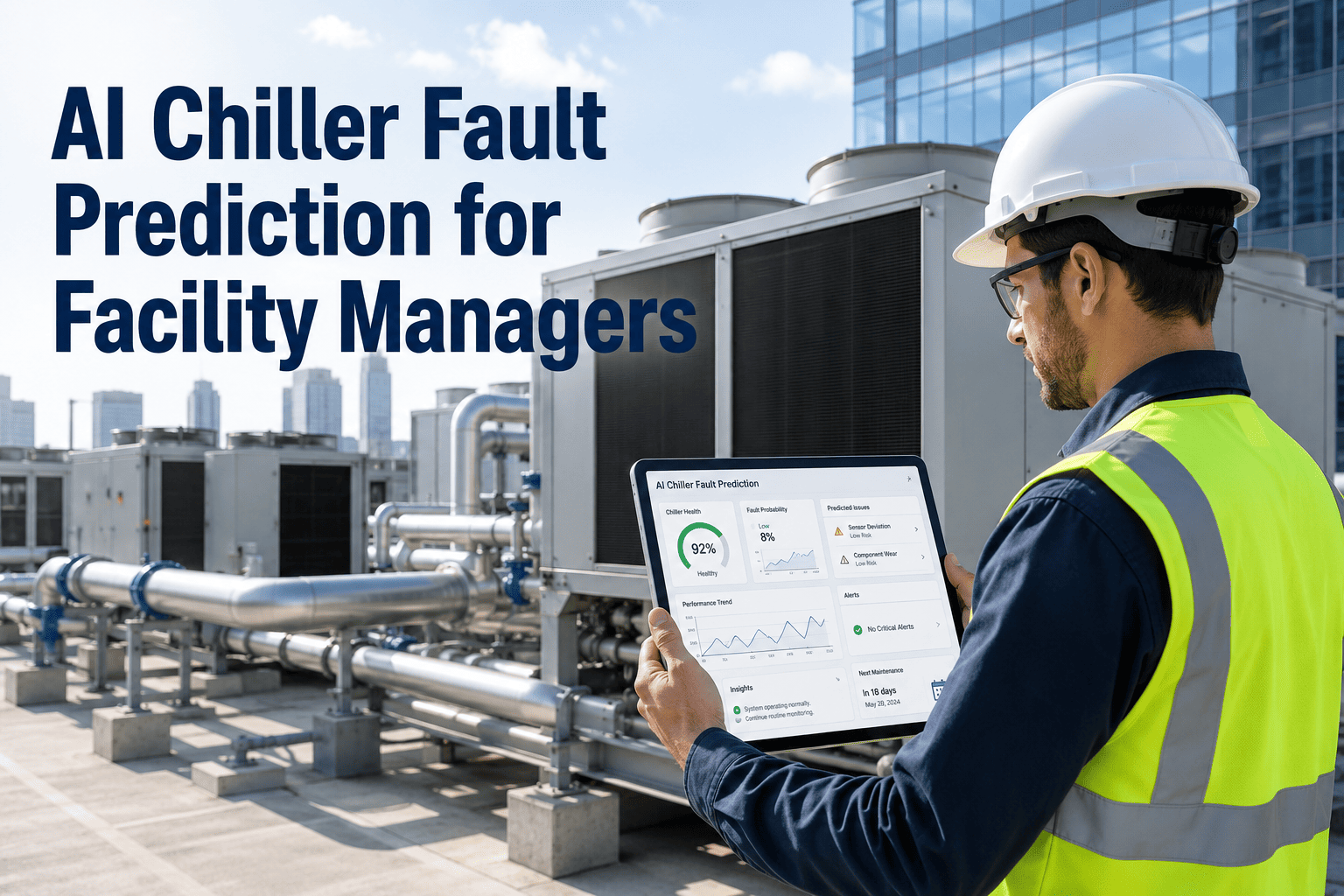
AI Chiller Fault Prediction for Facility Managers

By James Smith on June 10, 2026

ai-chiller-fault-prediction-facility-managers

A chiller failure in the middle of summer is not just uncomfortable — in a hospital, a data center, or a densely occupied office tower, it is a critical operational event. The worst part is that most chiller failures are predictable. Refrigerant issues, vibration anomalies, efficiency degradation, and electrical faults each leave a measurable signature weeks before they cause a shutdown. Oxmaint reads those signatures continuously and generates maintenance actions while the intervention is still planned and affordable. If your chiller program relies on quarterly inspections and operator feel, book a 30-minute demo to see what predictive monitoring changes.

AI Predictive Maintenance

Predict Chiller Faults Before They Cause Downtime

Oxmaint AI monitors chiller performance data continuously — detecting refrigerant drift, vibration trends, efficiency loss, and electrical anomalies 30–60 days before they force an unplanned shutdown.

30–60 day warning window
Auto work order generation
No hardware replacement required
Fault Signatures

Six Chiller Fault Patterns AI Detects Early

Each chiller fault type has a distinct data signature — a combination of temperature, pressure, vibration, runtime, and efficiency parameters that shift in a detectable pattern before the fault becomes critical. Oxmaint AI is trained to recognize each of these signatures across the full chiller operating cycle.

01
Refrigerant Charge Loss
Detection window: 21–45 days
Gradual refrigerant loss appears as rising compressor discharge temperature, decreasing suction pressure, and declining COP over time. AI detects the multi-parameter drift pattern before loss reaches a level that affects chiller capacity or triggers a lockout on low refrigerant pressure.
Auto WO: Refrigerant leak inspection + pressure test + recharge authorization
02
Compressor Vibration Anomaly
Detection window: 14–30 days
Bearing wear, loose mounts, and refrigerant slugging all produce characteristic vibration signatures measurable through sensor data. AI tracks vibration trends by operating speed and load, distinguishing normal operating variation from genuine mechanical degradation requiring intervention.
Auto WO: Vibration analysis + bearing inspection at next planned stop
03
Condenser Fouling
Detection window: 30–60 days
Scale and biological fouling in water-cooled condensers reduces heat transfer efficiency, visible as a rising approach temperature and increasing compressor lift. AI tracks the approach temperature trend against baseline and flags fouling onset 30–60 days before it reaches a level that forces a capacity derating.
Auto WO: Condenser tube cleaning and water treatment review
04
Oil System Degradation
Detection window: 7–21 days
Oil pressure deviations, temperature excursions, and oil separator fouling each produce detectable signatures in operating data. AI monitors oil system parameters at the operating point level — separating load-driven variation from genuine degradation that requires oil analysis or system service.
Auto WO: Oil analysis sample + separator inspection
05
Evaporator Freeze Risk
Detection window: 2–8 hours
Low chilled water flow combined with low entering water temperature creates a freeze risk that can damage evaporator tubes rapidly. AI detects this converging parameter pattern and triggers an immediate alert — well before the chiller's own safeties respond — allowing flow correction before tube damage occurs.
Auto WO: Urgent — chilled water pump and flow verification
06
Efficiency Decline (kW/ton)
Detection window: 30–90 days
A chiller's kW/ton ratio drifts upward as multiple small issues compound — fouling, refrigerant imbalance, worn impellers, and control drift. AI tracks efficiency at each load band separately, isolating which operating condition is degrading and what maintenance action targets the root cause rather than the symptom.
Auto WO: Full chiller performance audit + controls calibration
Chiller downtime costs $15,000–$80,000 per day in commercial facilities. Prediction costs a fraction of that.

Oxmaint AI predictive monitoring turns continuous chiller operating data into early warning signals and structured maintenance actions — replacing the quarterly inspection cycle with a live view of your chiller's actual condition. One prevented unplanned shutdown typically returns 5–8 years of platform cost.

Cost Comparison

Planned vs. Emergency Chiller Intervention — Cost Reality

Intervention Type Trigger Typical Cost Downtime Lead Time for Parts
Refrigerant recharge (planned) AI early warning — 30 days $800–$2,500 2–4 hours Same day
Refrigerant recharge (emergency) Lockout on low pressure $4,000–$12,000 6–18 hours Emergency sourcing
Bearing replacement (planned) AI vibration trend — 14 days $3,500–$8,000 4–8 hours 1–3 days
Compressor rebuild (emergency) Bearing failure + compressor damage $40,000–$120,000 5–21 days 2–8 weeks (OEM)
Condenser tube cleaning (planned) AI approach temp trend — 45 days $2,000–$5,000 4–6 hours None
Chiller replacement (emergency) Complete system failure $150,000–$600,000 3–8 weeks 8–16 weeks (OEM)
Expert Review

The most expensive chiller repair is always the one that was avoidable. In my experience across large commercial portfolios, 80% of major chiller failures show measurable precursor signals in operating data two to eight weeks before the failure event. The facilities that catch them are not using better equipment — they are monitoring more variables, more frequently, and acting on trends rather than waiting for alarms. AI makes that level of monitoring economically practical for any facility team.
Dr. Priya Nambiar, PE, LEED AP
Mechanical Engineering Consultant, HVAC Systems Optimization — 18 years specializing in chiller plant design, performance monitoring, and predictive maintenance strategy for healthcare and Class A commercial facilities
FAQ

Chiller Fault Prediction — Common Questions

Does Oxmaint AI work with our existing chiller sensors and BMS?
Oxmaint connects to chiller operating data via BACnet/IP, Modbus, OPC-UA, or direct API connection to BMS platforms and chiller controllers. The system works with the sensor data your chiller already produces — suction and discharge pressure, entering and leaving water temperatures, motor current, vibration if monitored, and runtime. No additional sensors are required for most fault detection capabilities, though vibration sensors can extend the detection window for mechanical faults if not already installed. Integration typically takes one to two days for standard BMS-connected chillers. Book a consultation to assess your chiller connectivity.
How does the AI distinguish a genuine fault trend from normal seasonal efficiency variation?
Oxmaint AI builds a baseline model for each chiller that accounts for load, ambient conditions, and seasonal operating patterns. Fault detection compares current performance against the expected performance at the same operating conditions — not against a fixed absolute threshold. This means a rising approach temperature in July is evaluated against what the approach temperature should be at that load and ambient condition, not against a winter baseline. This load-and-condition-adjusted analysis eliminates the majority of false positives that trip up threshold-based alarm systems, and it makes the detection meaningful for chillers with variable load profiles and significant seasonal operating range. See baseline modeling in a free trial.
Can the system monitor multiple chillers in a central plant configuration?
Yes. Oxmaint supports chiller plant monitoring across multiple units with plant-level efficiency tracking in addition to individual chiller fault detection. In a central plant with primary and standby chillers, the system monitors each unit independently and also tracks plant-level kW/ton, sequencing efficiency, and the performance of common components like cooling towers and condenser water pumps. When a fault is predicted in one chiller, the system can also assess standby capacity availability — giving the facility team context for scheduling the repair without risking cooling capacity shortfall during the intervention window. See chiller plant monitoring in a demo.
What do work orders generated by chiller fault predictions include?
Every work order generated from a chiller fault prediction includes the fault type and severity classification, the specific parameters that triggered the detection, a trend graph showing the data over the relevant window, the recommended intervention with suggested parts and labor, the asset's maintenance history, and a configurable urgency classification that determines notification routing. Technicians receive all of this context on mobile before arriving at the equipment — eliminating the round trip back to a desktop system or paper file to understand what the repair history looks like. This structured context is one of the primary reasons predictive-maintenance-driven work orders close faster than reactive ones. Explore work order detail in your free trial.
Your chiller is telling you what it needs. Is your team listening?

Oxmaint AI reads continuous chiller operating data and surfaces fault patterns weeks before they force an unplanned shutdown — turning reactive emergency calls into planned, cost-controlled interventions. Book a 30-minute demo to see predictive chiller monitoring in your facility context.
Share This Story, Choose Your Platform!