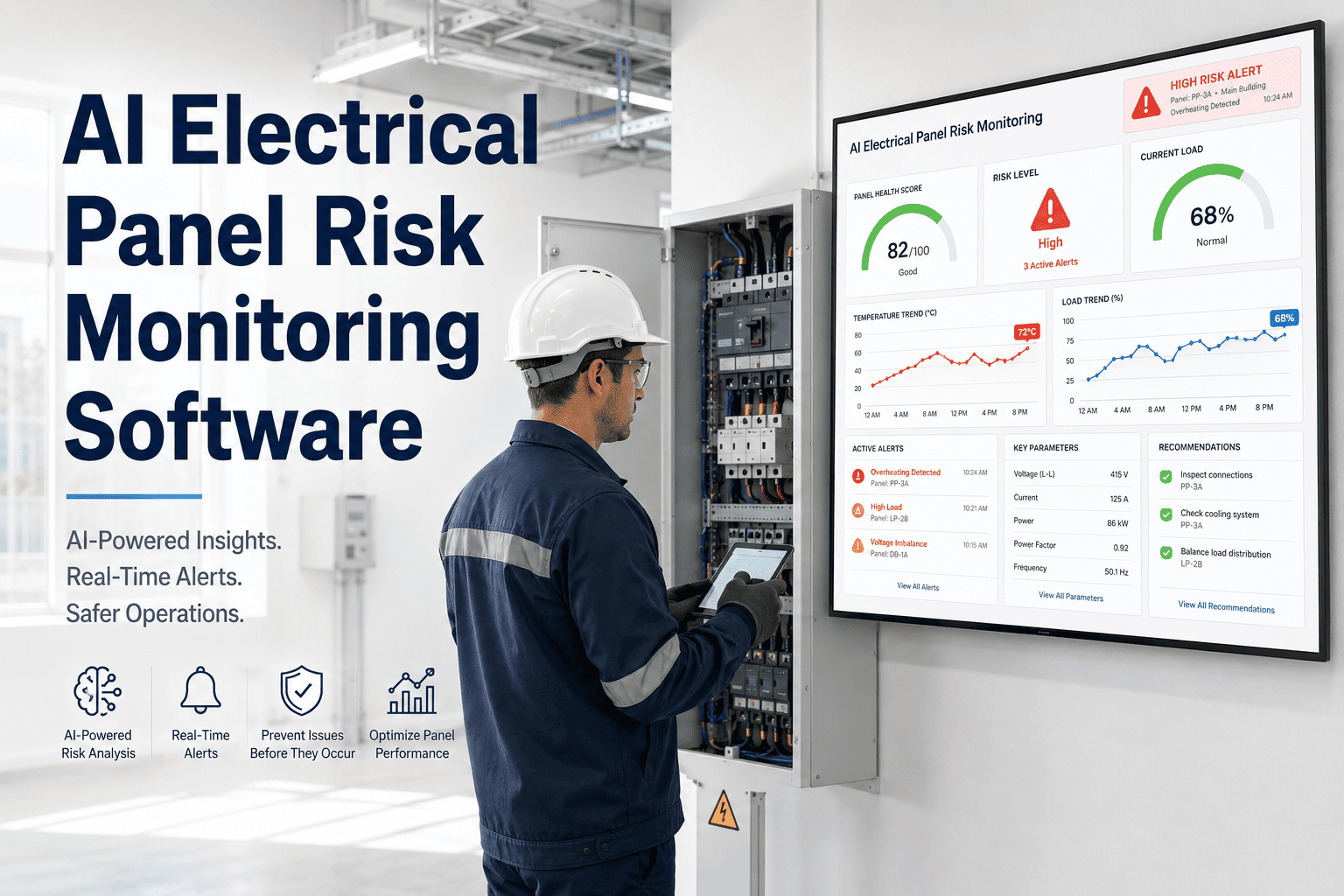
AI Electrical Panel Risk Monitoring Software

By James Smith on June 10, 2026

ai-electrical-panel-risk-monitoring-software

Electrical panel failures are the most preventable cause of facility fires — and the most overlooked. Unlike HVAC or plumbing failures that announce themselves through comfort complaints or visible leaks, electrical panel degradation is invisible until it isn't. Overloaded circuits, loose connections, and insulation breakdown accumulate silently and appear in thermal imaging data that most facilities capture annually, if at all. Oxmaint brings AI analysis to your electrical panel maintenance program — using inspection history, thermal signals, and risk scoring to prioritize panel maintenance and safety work orders before a failure event. If your electrical maintenance program runs on annual inspections and reactive responses, book a demo to see what risk-driven prioritization changes.

AI Asset Health Monitoring

AI Electrical Panel Risk Monitoring — Catch Failures Before They Catch You

Oxmaint scores every electrical panel by inspection history, thermal risk signals, age, and circuit load patterns — surfacing the highest-risk panels for priority maintenance before they become safety events.

Panel Risk Score — Live Example
MDF — Level B2
Risk: 91
Thermal delta 22°C — last inspection 14 months ago
Panel 4A — Level 6
Risk: 74
3 overload events — 18-year-old breakers
Panel 2C — Level 3
Risk: 48
Inspection due in 60 days — no thermal flags
Panel 1A — Level 1
Risk: 18
New installation — inspected 3 months ago
Risk Scoring Model

How Oxmaint Calculates Electrical Panel Risk Score

The Oxmaint electrical panel risk score is a composite of five weighted factors, each contributing to an overall risk number from 0 to 100. Panels scoring above 70 generate automatic work orders for priority inspection. Panels above 85 trigger urgent safety work orders with supervisor notification.

Thermal Inspection Finding
35% weight

Temperature delta above ambient in last thermal scan. Deltas above 10°C indicate hotspot risk; above 20°C indicate immediate intervention required. AI tracks trend between inspections using available sensor data.
Inspection Currency
25% weight

Days since last completed thermal inspection, relative to the required inspection interval for this panel's criticality class. A critical panel overdue by 90+ days scores at maximum for this factor.
Equipment Age
20% weight

Panel age relative to expected service life. Breaker panels older than 25 years and switchgear older than 30 years score higher regardless of inspection history, due to manufacturer end-of-life and parts availability constraints.
Circuit Load Events
12% weight

Number of overload trips, GFCI faults, or breaker replacements recorded in maintenance history for this panel in the trailing 24 months. Recurring events on the same circuit indicate a systemic load or wiring issue requiring investigation.
Maintenance History Pattern
8% weight

Whether previous inspection findings were acted upon with documented corrective work orders, and whether those work orders were completed within the prescribed time window. Unresolved prior findings compound the overall risk score.
Maintenance Workflow

From Risk Score to Safety Work Order — How the Workflow Runs

1
Risk Score Calculated Continuously
All five risk factors are evaluated for every panel in your asset register. Scores update when inspection records are logged, when maintenance history changes, or when the inspection interval elapses without a completed record.

2
Threshold Trigger Generates Work Order
Panels crossing the 70-point threshold generate an inspection work order automatically. Panels above 85 generate an urgent safety work order with escalation to the facility manager or chief engineer.

3
Technician Performs Thermal Inspection
The work order includes the panel's full risk history, prior findings, and a digital checklist for the thermal inspection. The technician logs temperature readings, photos, and findings directly on mobile — no paper forms.

4
Finding Triggers Corrective or Deferred WO
If the inspection identifies a hotspot, loose connection, or overloaded circuit, a corrective work order is generated immediately from the inspection record — with the finding as evidence and the repair task pre-populated based on finding type.

5
Risk Score Resets After Clean Inspection
A clean inspection with no findings resets the relevant risk factors and pushes the next inspection date forward. Panels with persistent findings that remain uncorrected retain elevated risk scores until the corrective work is documented and closed.
Do you know which electrical panels in your building are the highest risk right now?

Most facility managers can name the panels they know about — not the ones carrying the most risk. Oxmaint's AI risk scoring surfaces that ranked view automatically, so your team is always prioritizing the right panels for inspection. Book a demo to see your electrical asset program through a risk lens.

Expert Review

The NFPA reports that electrical failures account for approximately 13% of all non-residential building fires annually. Nearly all of these are preventable with systematic thermal inspection programs — but most facilities cycle through inspections on an annual schedule that misses panels that deteriorate rapidly between visits. Risk-based prioritization changes that dynamic: instead of treating every panel the same, you put your inspection resources where the actual risk is concentrated. That is how you prevent the fires that annual programs miss.
Sandra Khoo, PE, CESCP
Licensed Electrical Engineer & Certified Electrical Safety Compliance Professional — 17 years specializing in electrical safety programs, thermal inspection protocols, and NFPA 70B compliance for commercial and institutional facilities
FAQ

Electrical Panel Risk Monitoring — Common Questions

Does Oxmaint require thermal cameras or sensors connected to the system?
No continuous thermal sensors are required. Oxmaint's electrical panel risk scoring uses thermal inspection findings logged during periodic inspections — whether annual or more frequent — combined with maintenance history, equipment age, and load event data from the CMMS. When a thermographer performs an inspection and logs findings in Oxmaint, those findings update the risk score immediately. If your facility uses thermal camera systems with data export capabilities, Oxmaint can ingest that data directly via integration to supplement the manually logged inspection records. The system is designed to work with the inspection program you already have, and make it smarter. Book a consultation to map your inspection workflow to Oxmaint.
How does the risk score help with NFPA 70B and local electrical code compliance?
NFPA 70B recommends risk-based inspection intervals for electrical equipment, with higher-risk equipment inspected more frequently. Oxmaint's risk scoring operationalizes this recommendation — panels with higher risk scores generate inspection work orders at shorter intervals, while lower-risk panels maintain longer intervals, optimizing inspector time. Every inspection, finding, and corrective action is documented in a timestamped audit trail that satisfies NFPA 70B record-keeping requirements and provides the documented evidence insurance carriers and local authorities require during facility audits and incident investigations. See compliance documentation in your free trial.
Can the system track corrective work orders from electrical inspection findings through to completion?
Yes, and this tracking is a core feature of the workflow. When an inspection finding generates a corrective work order, the link between the finding and the repair is maintained throughout the work order lifecycle. The corrective WO cannot be closed without a completion record, and if the WO ages past its due date without closure, the panel's risk score remains elevated and an escalation notification goes to the supervisor. This prevents the common failure mode where a hotspot is identified, a repair is scheduled, and then the repair falls through the cracks without anyone noticing — leaving the safety risk unresolved while the inspection record shows the panel was "inspected." See finding-to-corrective workflow in a demo.
Can the system handle both facility-owned panels and tenant-space panels in a mixed-use building?
Yes. Oxmaint supports ownership and responsibility tagging at the asset level — distinguishing between base building electrical infrastructure managed by the facility team and tenant-demised panels that are the tenant's responsibility but the building's liability to track. The dashboard can filter by ownership classification, so facility managers see their own panel risk scores separately from tenant spaces, while still maintaining visibility into tenant panels that could pose shared safety risks. Tenant panel inspection coordination can also be managed through Oxmaint's vendor and tenant work order workflows for buildings with third-party electrical maintenance contractors. Set up your electrical asset hierarchy in a free trial.
Electrical fires are preventable. The information to prevent them is already in your inspection history.

Oxmaint AI turns your electrical panel inspection records, thermal findings, and maintenance history into a live risk-ranked list of panels that need attention — today, not at next year's inspection. Book a 30-minute demo to see risk-based electrical panel management in your facility context.

Share This Story, Choose Your Platform!