A galvanized steel basin does not fail overnight. It fails one micron of wall thickness at a time, hidden beneath waterline scale, inside a header pipe nobody opens until the annual shutdown, or behind insulation on a condenser line that looks perfectly fine from the catwalk. By the time a technician spots the rust bloom or a pinhole leak during a routine walkdown, the metal loss has usually been accelerating for months. Structural corrosion failures on a cooling tower often end in a full replacement rather than a repair, and that single decision can swing a facility's capital budget by hundreds of thousands of dollars. AI cooling tower corrosion prediction software closes that blind spot by turning water chemistry readings into a rolling forecast of where corrosion is accelerating, weeks before a coupon test or a visual inspection would ever catch it. Book a demo to see a live corrosion forecast built from your own tower's water data.
Guide · Predictive Corrosion Analytics · 2026 Edition
AI Cooling Tower Corrosion Prediction Software
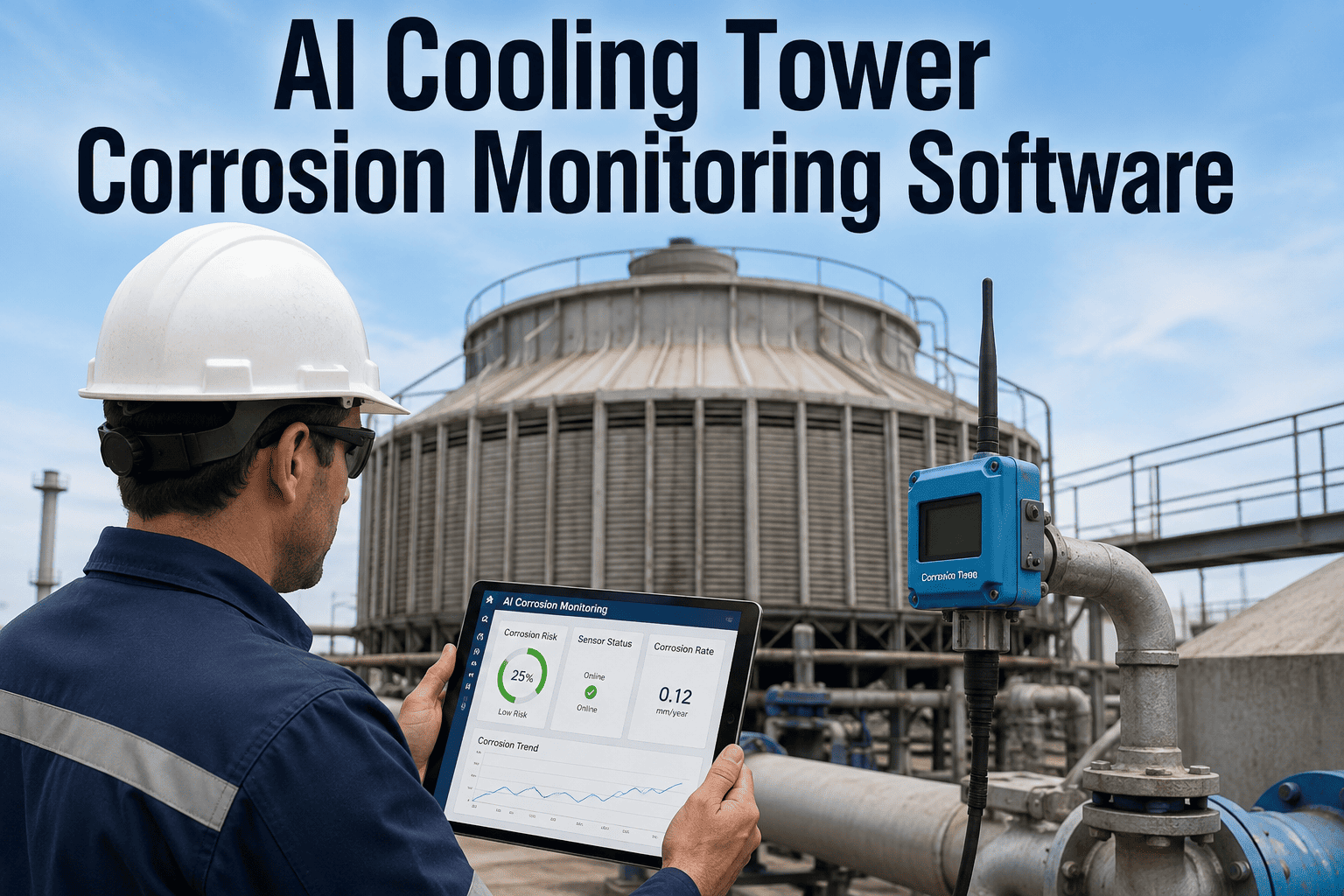
Machine learning models trained on pH, conductivity, dissolved oxygen, ORP, and temperature data forecast cooling tower corrosion severity 3 to 6 weeks before it shows up on a coupon test or a visual inspection — turning every early warning into a maintenance work order automatically.
4%
Lowest reported prediction error (MAPE) for AI corrosion rate models on industrial cooling circuits
$5.2B
Projected global cooling tower water treatment market size by 2034, up from $2.8B in 2025
$600K
Upper end of full tower replacement cost once structural corrosion passes the point of repair
3-6 wks
Typical forecast lead time AI corrosion models give facility teams ahead of visible failure
Why Cooling Towers Corrode
The Water Chemistry Variables That Drive Corrosion
Corrosion in a cooling tower is not random. It follows measurable patterns in the water itself — patterns that shift slowly enough to be missed by a technician but clearly enough for a trained model to see coming.
01
pH and Alkalinity Drift
Low pH water strips the protective oxide layer off steel and copper surfaces almost immediately, while alkalinity swings destabilize dosing chemistry. A slow drift toward acidic conditions over several days is one of the earliest and most reliable predictors of accelerating corrosion rate.
02
Conductivity and Dissolved Solids
As cycles of concentration climb, dissolved chlorides and sulfates build up in the recirculating water. High chloride concentration is one of the strongest chemical drivers of pitting corrosion on stainless and galvanized components, and it climbs quietly if blowdown control drifts out of range.
03
Dissolved Oxygen and ORP
Oxidation-reduction potential tracks how aggressively dissolved oxygen is attacking exposed metal. Sudden ORP spikes, often tied to biocide dosing or aeration changes, correlate closely with short bursts of accelerated metal loss on fill supports and basin walls.
04
Biological and Microbial Fouling
Biofilm colonies create localized oxygen-depleted pockets on metal surfaces that drive microbiologically influenced corrosion. These pits form under deposits that are invisible from the outside and are frequently the true root cause behind a pipe that "suddenly" leaked.
How It Works
From Water Sensor Reading To Corrosion Forecast
1
Continuous water chemistry capture
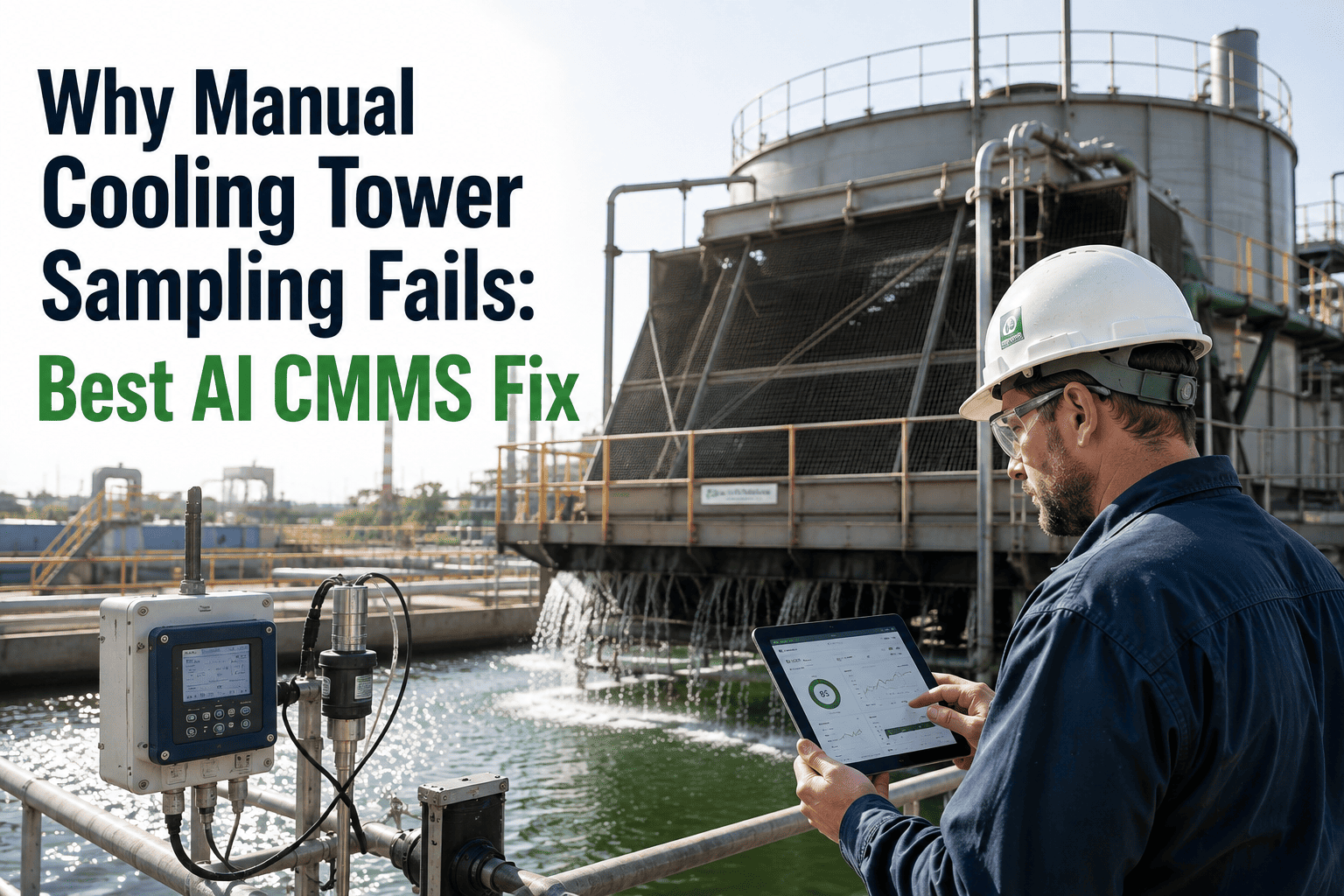
Inline probes stream pH, conductivity, ORP, temperature, and flow readings every few minutes instead of relying on a weekly manual grab sample sent to a lab.
2
Virtual corrosion sensor modeling
A trained neural network converts the raw chemistry stream into an estimated real-time corrosion rate, functioning as a virtual probe even in circuits without a physical coupon rack.
3
Trend and severity forecasting
A second predictive layer looks at how the corrosion rate and its influencing variables have moved over recent weeks and projects severity forward, flagging when a threshold will likely be crossed.
4
Automatic work order creation
Once a forecast crosses a configured risk threshold, the system opens a maintenance work order with the affected asset, recommended action, and supporting chemistry data attached — no manual review queue required.
Stop Finding Corrosion After It Has Already Cost You
Connect your cooling tower's water chemistry data to OxMaint and let the corrosion forecast create the work order before the coupon test ever gets pulled.
The Cost of Waiting
What Undetected Corrosion Actually Costs a Facility
Corrosion rarely shows up as one clean line item. It hides inside repair budgets, energy bills, compliance fines, and eventually a capital replacement decision nobody wanted to make this year.
40-60%
Repair-to-replace threshold rule most facility teams use once corrosion repair costs climb this close to a new tower's price
$150K-$600K
Typical capital cost range for a full cooling tower replacement once structural corrosion is beyond economical repair
$10,000+
Approximate cost of a single Legionella remediation event that corrosion and biofilm buildup can help trigger
$2.50-$4.50
Cost per 1,000 gallons of makeup water for the corrosion inhibitor dosing that AI models help fine-tune
Manual Testing vs AI Monitoring
Lab Coupon Testing vs Continuous AI Corrosion Prediction
Corrosion coupons are typically pulled and weighed only every 30 to 90 days
Grab samples capture a single moment and miss short chemistry excursions entirely
Results arrive after the water condition that caused them has already changed
No forward-looking forecast, only a historical rate reading
Water chemistry sampled continuously through inline sensors, not on a fixed schedule
Short chemistry excursions and dosing failures are captured the moment they happen
Corrosion rate is estimated in near real time by the virtual sensor model
Severity is forecast 3 to 6 weeks ahead, giving teams time to plan intervention
Detection Performance
How Much Earlier Does AI Catch Corrosion Risk
Corrosion rate reading available
Lab coupon test
30-90 days
AI virtual sensor
Near real time
Chloride or pH excursion noticed
Manual grab sample
Days later
Continuous AI sensor feed
Minutes
Severity forecast lead time before failure
Scheduled inspection program
Little to none
AI corrosion forecast model
3-6 weeks
Deployment Requirements
What a Facility Needs To Run AI Corrosion Prediction
Most commercial and light industrial cooling towers can add AI corrosion prediction without a major mechanical overhaul, since the core requirement is a reliable water chemistry data stream rather than new tower hardware.
| Requirement |
Specification |
Notes |
Status |
| pH and ORP probes |
Inline continuous sensors on the recirculating loop |
Core input for the corrosion virtual sensor model |
Usually added new |
| Conductivity sensor |
Tracks cycles of concentration and dissolved solids |
Often already present for blowdown control |
Often existing |
| Corrosion coupon rack or LPR probe |
Linear polarization resistance probe preferred for faster readings |
Used to calibrate and validate the AI model against real metal loss |
Recommended addition |
| Data gateway or logger |
Streams sensor readings to the prediction platform on an interval |
Works over existing building network or cellular gateway |
Lightweight install |
| CMMS integration |
API connection from the prediction engine to OxMaint work orders |
Converts a forecast alert directly into an assigned maintenance task |
OxMaint native |
Facility teams have always had the data to see corrosion coming. The problem was never a lack of sensors — it was that pH, conductivity, and ORP readings sat in a spreadsheet nobody had time to correlate against a corrosion rate. A trained model can hold all of that context at once and notice a slow chemistry drift that no human reviewing a weekly report would ever catch in time. What used to be a surprise pipe failure during a summer peak load is now a forecast that shows up on a maintenance calendar three or four weeks in advance, with enough lead time to fix the dosing problem instead of replacing the pipe. That shift alone changes the entire economics of running a cooling tower fleet.
RM
Rajiv Mehta, CWT, PE
Certified Water Technologist and Professional Engineer, 14 years in industrial water treatment and reliability engineering, former plant reliability lead for a multi-site manufacturing portfolio, focused on predictive corrosion modeling and cooling water asset strategy
Frequently Asked Questions
How does AI actually predict corrosion before it happens?
The model learns the relationship between chemistry variables like pH, ORP, and conductivity and the resulting corrosion rate, then projects that relationship forward using recent trend data.
Sign in to OxMaint to see the forecasting model applied to your own water chemistry history.
Do we need new sensors, or can existing water treatment equipment be used?
Most facilities already have conductivity and flow sensors for blowdown control, which the model can use immediately. Adding a pH and ORP probe closes the gap in most cases without major mechanical work.
Book a demo to review your current instrumentation.
How accurate are AI corrosion rate predictions compared to lab testing?
Published research on industrial cooling circuits shows the strongest models reaching prediction error as low as 4 percent against measured corrosion rate, which is well within the range needed for planning maintenance decisions confidently.
How does a corrosion forecast turn into an actual maintenance task?
Once a forecast crosses a configured risk threshold, OxMaint automatically opens a work order with the affected asset, the trend data behind the alert, and a recommended dosing or inspection action attached.
Sign up free to see the workflow end to end.
Is this only useful for large industrial towers, or does it work for smaller commercial systems?
Commercial and light industrial towers benefit just as much, since a single undetected corrosion event can still mean a five or six figure repair or replacement bill regardless of tower size.
Book a demo to get a deployment plan sized to your facility.
Catch Corrosion In The Chemistry, Not In The Repair Invoice
OxMaint turns pH, conductivity, ORP, and temperature data from your cooling towers into a rolling corrosion forecast and an automatic maintenance work order — weeks before the coupon test would ever tell you.