Janitorial operations represent 20–35% of total facility management operating costs in commercial buildings — yet most facility managers have less data about their janitorial workforce's productivity, task allocation, and service quality than they have about any other cost centre in the building. The irony is that janitorial staff generate a continuous stream of actionable data: route completion times, task durations, restocking frequencies, complaint response records — all of which currently disappears into paper logs or unconsolidated mobile records. OxMaint's AI automation layer transforms this dormant data into workforce planning intelligence: optimal route assignments, predictive staffing models for occupancy fluctuations, and real-time productivity tracking that facility managers can act on, not just review. Book a demo to see AI workforce analytics for your facility or start a free trial on OxMaint.
Article · Janitorial Operations · AI Automation · Facility Management
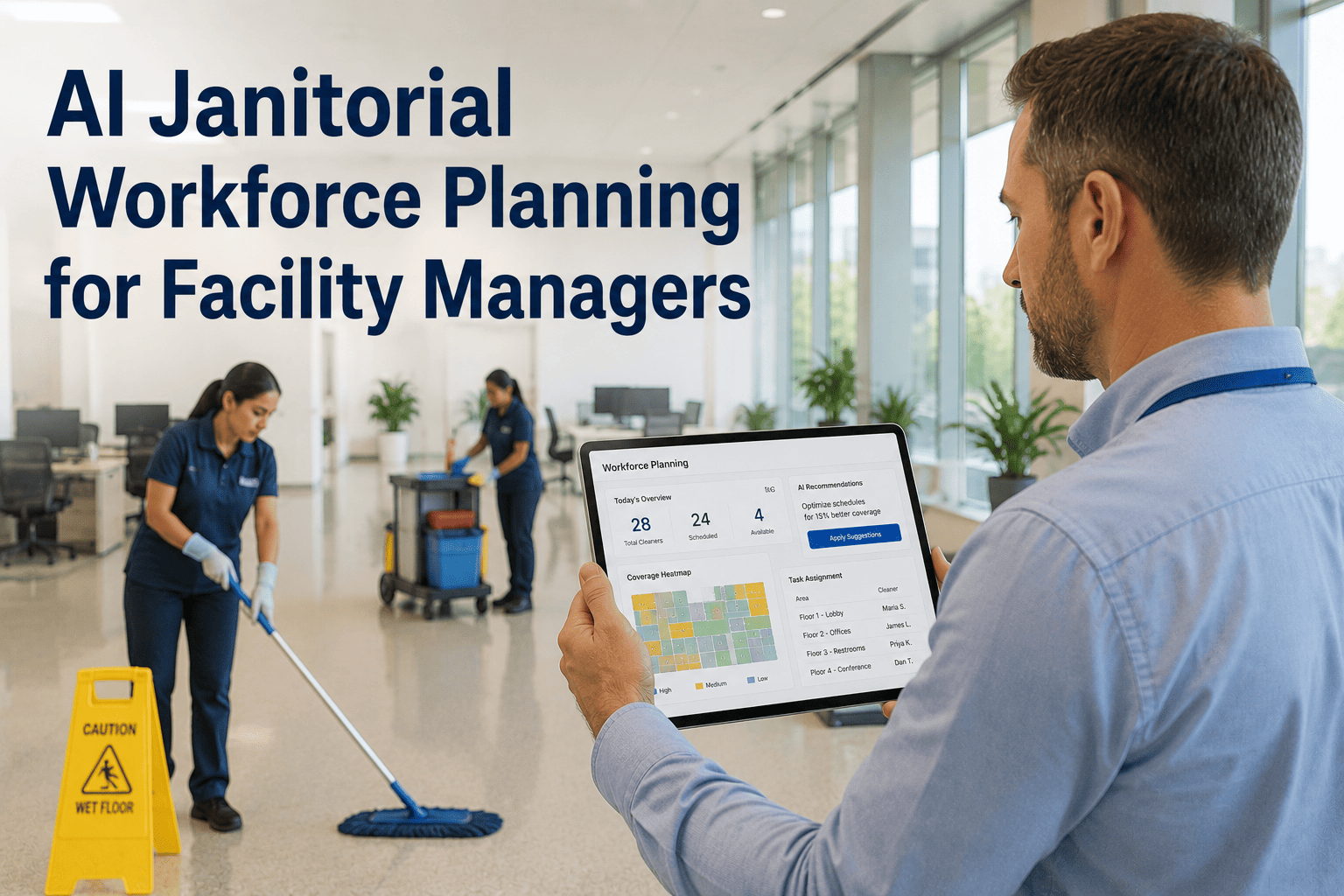
AI Janitorial Workforce Planning for Facility Managers
How facility managers are using AI-enabled analytics to right-size janitorial teams, optimise task routes, reduce overtime, and hit service quality targets without adding headcount.
35%
Average share of FM operating cost that is janitorial labour
18%
Productivity gain from AI-optimised route and task assignment
60%
Reduction in overtime hours from predictive staffing models
4x
Faster complaint resolution with real-time workforce visibility
Contents
01 · The Data Gap in Janitorial Management
02 · AI Planning Models Explained
03 · Route Optimisation
04 · Predictive Staffing
05 · Expert Review
06 · FAQs
The Data Gap — Why Janitorial Workforce Management Stays Inefficient
Facility managers can tell you exactly how many work orders their HVAC technicians completed this month, what the mean time to repair was, and which assets generated the most corrective work orders. Ask the same manager for equivalent data on their janitorial team and the answer is typically: completed tasks from sign-off sheets, headcount by shift, and complaint volume from the tenant helpdesk. The gap between these two data environments is the gap between efficient and inefficient workforce management.
| Management Question | HVAC / Technical Team | Janitorial Team (Without AI) |
| Are staff completing tasks on time? |
CMMS shows work order completion time vs due date per technician |
Sign-off sheet shows task completed — no time data |
| Which staff are most productive? |
Work orders per day, MTTR, first-time fix rate by technician |
Unknown — no per-worker task data |
| Are routes efficient? |
Route optimisation visible in dispatch system |
Routes set by supervisor intuition — never analytically reviewed |
| Are you over- or under-staffed? |
Backlog analysis shows demand vs capacity |
Based on historical headcount — not demand-linked |
| Where did quality failures occur? |
Failed inspection records linked to asset and technician |
Complaint locates the problem, not the cause |
How OxMaint AI Models Janitorial Workforce Demand
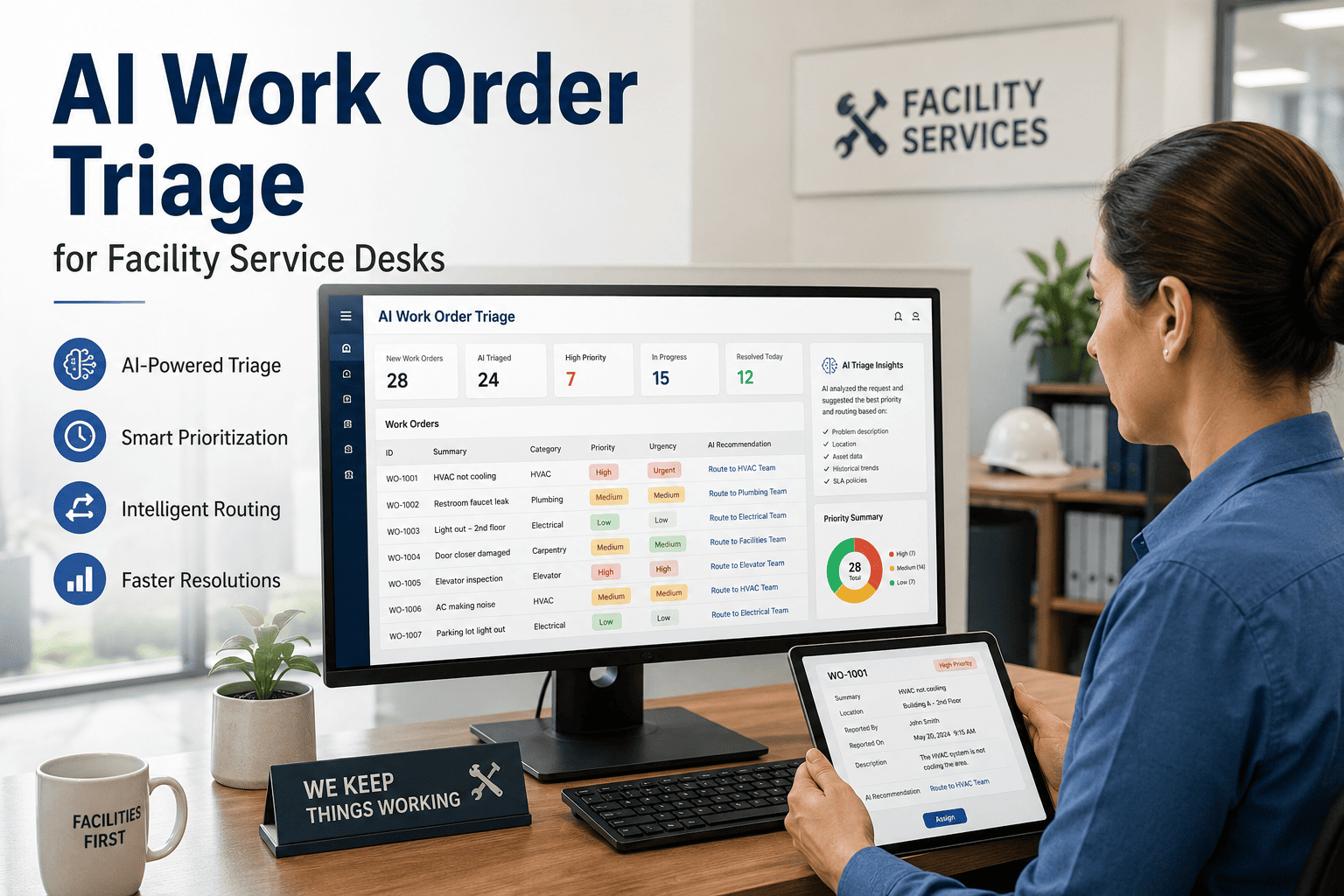
OxMaint's AI workforce planning engine builds a demand model for janitorial services based on occupancy data, historical task completion records, seasonal patterns, and event schedules — then calculates the optimal staffing level and route configuration for each day and shift. The output is not a recommendation the supervisor can ignore; it is the actual work order queue that janitorial staff receive on their mobile app each morning.
Input Layer
Occupancy and Schedule Data
Building occupancy forecast (from badge access, calendar bookings, event schedules), floor-by-floor historical usage patterns, day-of-week and seasonal variation factors, and special events (large conferences, facility changeovers) that spike service demand. OxMaint ingests this data automatically from your existing building access and calendar systems.
AI Layer
Demand Prediction and Route Optimisation
The AI model predicts service demand by zone and task type for the next 24 hours, then optimises route assignments to minimise travel time between tasks while prioritising high-demand zones. Route optimisation accounts for staff skill level (some tasks require specific trained staff), equipment location (where carts and supplies are staged), and priority sequence (complaint-triggered tasks override scheduled tasks automatically).
Output Layer
Shift Work Orders and Staffing Recommendations
Each shift begins with a pre-generated, AI-optimised work order queue on each staff member's mobile app — listed in route sequence, with estimated time per task based on historical completion data for that individual in that zone. The supervisor dashboard shows real-time completion status across all staff, flagging deviation from expected pacing before tasks fall behind.
Learning Layer
Continuous Model Improvement
Every completed work order feeds back into the model — updating individual task time estimates, refining zone demand patterns, and recalibrating occupancy-to-demand relationships. The model becomes more accurate with each shift cycle, typically reaching stable accuracy within 60–90 days of full deployment.
OxMaint's AI workforce planning module is pre-configured for commercial office, healthcare, retail, and campus facility environments — deployable without custom modelling work. Book a 30-minute demo to see demand forecasting for your building type.
Predictive Staffing — Right-Sizing the Team to Demand
Most janitorial teams are staffed to the peak demand scenario — the busiest day in the facility's operating calendar — and maintain that headcount year-round. AI demand modelling enables a shift to dynamic staffing: a core permanent team sized to average demand, supplemented by a pre-qualified flexible pool dispatched based on AI forecast on high-demand days.
Traditional Fixed Staffing
Staff levelSized to peak demand, year-round
Low-demand days20–35% labour over-deployment
Peak demand daysSometimes understaffed — no forecast
OvertimeHigh — reactive to event surprises
Annual labour costStatic — no occupancy-linked savings
OxMaint AI Dynamic Staffing
Staff levelCore team + AI-dispatched flex pool
Low-demand daysCore team deployed — flex pool not activated
Peak demand daysFlex pool pre-notified based on 24-hr forecast
Overtime60% reduction — peaks anticipated, not surprised
Annual labour cost12–22% reduction vs fixed staffing model
Productivity Benchmarks — What Good Looks Like
OxMaint's AI platform benchmarks individual and team productivity against facility-type norms — giving supervisors an objective reference for performance management conversations and identifying training needs before they become service quality problems.
| Task Type | Facility Type | Benchmark Completion Time | OxMaint Alert Threshold |
| Restroom service (full clean) |
Commercial Office |
12–18 minutes per restroom |
Alert if 2x benchmark |
| Hard floor vacuuming |
Commercial Office |
1,000–1,200 sq ft / 15 min |
Alert if 40% below pace |
| Restroom service (full clean) |
Healthcare / High Traffic |
18–25 minutes per restroom |
Alert if 2x benchmark |
| Trash collection and liner replacement |
Corporate Campus |
45–90 seconds per bin |
Alert if route takes 50% over estimate |
| Dispenser restocking (soap + paper) |
Any |
3–5 minutes per unit |
Alert if route completion 30 min behind |
| Post-event common area reset |
Hospitality / Campus |
200–300 sq ft / 10 min |
Alert if behind pace before end of event window |
Expert Review
CM
Carlos Mendez, CFM, FMP
Facility Director · 2.4M sq ft Corporate Campus · IFMA Fellow · Former Chair, IFMA Sustainability Facility Project
The productivity benchmark capability is the one I wish I had had 10 years ago. When a facility manager tells a janitorial contractor their team is underperforming, the contractor asks for evidence — and without task-level time data, you do not have it. With OxMaint, the work order record shows the task, the time logged in and out, and the deviation from the benchmark for that task type in that facility category. That data transforms a subjective performance conversation into an objective one, and it almost always produces better outcomes for both parties — because it identifies real training needs rather than assigning blame for performance gaps that neither party had been measuring accurately.
FT
Fatima Torres, MSc Operations Research
Head of Smart Operations · Global Integrated Facility Services · Workforce Analytics Specialist · 15 Years FM Technology Implementation
Route optimisation in janitorial operations is consistently undervalued as a cost lever. In a 500,000 sq ft office building, a janitorial team member walking an unoptimised route spends 18–25% of their shift in transit between tasks — time that does not generate any cleaning output. AI route optimisation applied to the same building reduces transit time to 8–12% of shift time, which translates directly to more tasks completed per shift hour without any change in effort or headcount. Across a 10-person team, that is the equivalent of 1.5 to 2 additional effective staff every shift — recovered entirely from smarter task sequencing.
Frequently Asked Questions
Does janitorial staff need smartphones or special devices to use OxMaint's AI-dispatched work order system?
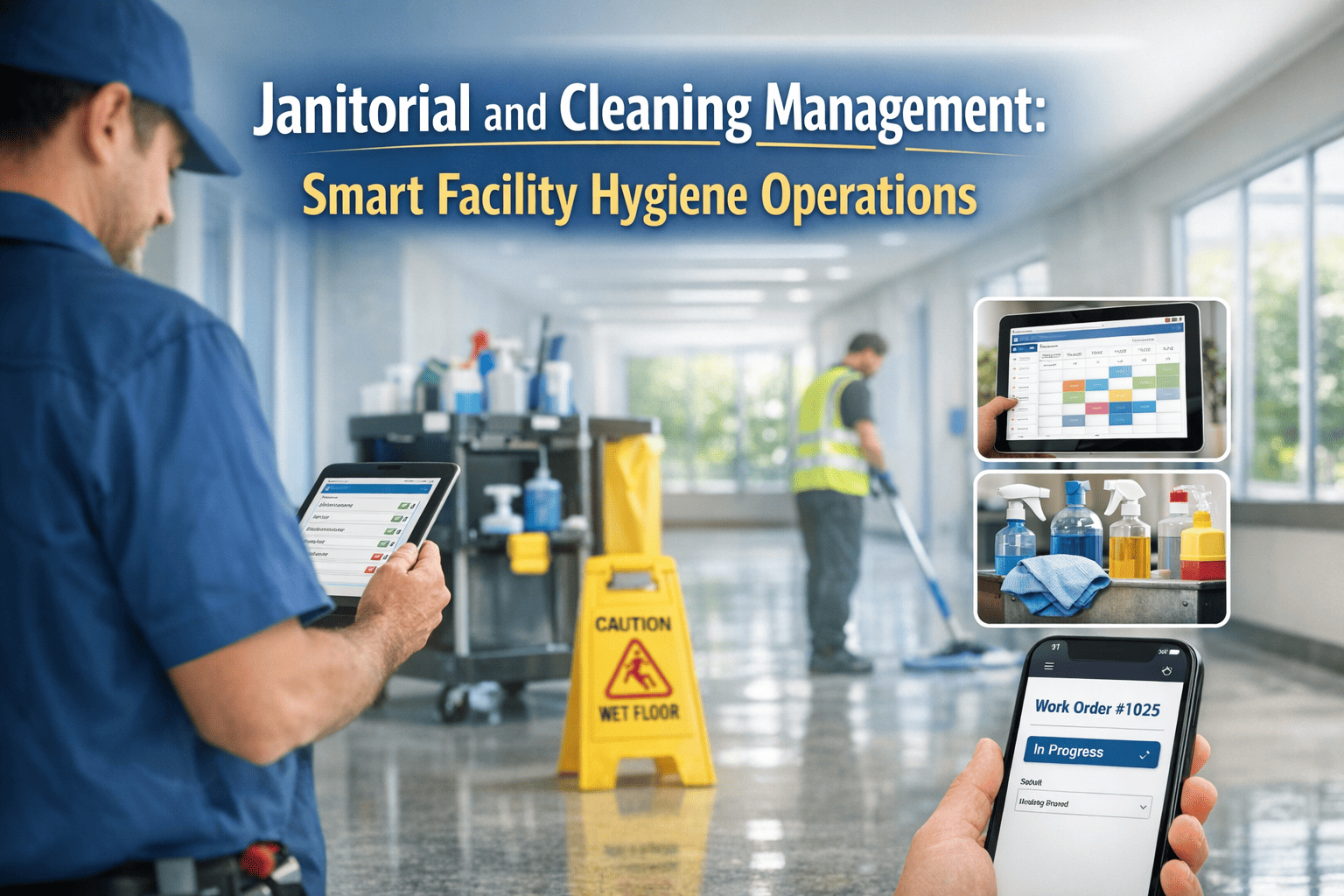
OxMaint's mobile app operates on any Android or iOS smartphone — personal device or facility-issued — and does not require a dedicated hardware investment. The interface is designed for operational simplicity: staff see their task queue in route sequence, check in at each task location via QR code scan or GPS confirmation, record condition results from a simple picklist (not free text), and close the work order with a single confirmation. Training for frontline staff typically takes 45–60 minutes. For facilities with staff who prefer minimal technology interaction, OxMaint also supports a simplified SMS-based check-in workflow that does not require app installation.
Book a demo to see the staff-facing mobile interface.
How does OxMaint's AI staffing model handle sudden occupancy changes — like a major tenant event or building closure?
OxMaint integrates with building calendar and event management systems to receive scheduled event data automatically — adjusting the demand forecast and staffing recommendation for the affected date range without manual input from the facilities manager. For unscheduled occupancy changes (emergency building closure, sudden event cancellation), the supervisor can trigger an immediate demand recalculation in the OxMaint dashboard, which redistributes the remaining work order queue and updates the staffing recommendation in real time. The flex staff pool receives updated notifications within minutes of a demand model change.
Start a free trial to see demand recalculation in action.
How does OxMaint handle multi-contractor janitorial environments where different vendors serve different building zones?
OxMaint's multi-vendor facility model supports separate work order queues, productivity dashboards, and SLA tracking for each contractor operating in the building — while the facility manager's dashboard consolidates performance across all vendors in a single view. Contractor supervisors see only their team's work orders and performance data; they cannot view other contractors' data. This architecture is common in large commercial towers and healthcare campuses where a primary janitorial contractor handles day-cleaning and a specialist handles clinical or sensitive area cleaning under a separate contract. Each contractor's SLA performance is tracked independently, providing the facility manager with objective comparative data at contract renewal time.
See the multi-vendor dashboard in a live demo.
What measurable outcomes should a facility manager expect in the first 90 days after deploying OxMaint janitorial workforce planning?
Based on OxMaint deployments across commercial office, healthcare, and campus facility environments, facility managers typically see three measurable outcomes within the first 90 days: a 15–25% reduction in overtime hours as demand peaks are anticipated rather than discovered; a 20–30% reduction in occupant service complaints as task dispatch aligns with actual usage rather than fixed schedules; and a 10–18% improvement in task completion rate per shift hour from route optimisation. The 30-day model calibration period produces usable workforce analytics from week five onward, with full optimisation effects visible by day 60–75.
Start your free trial to begin the 30-day calibration or
book a demo to see projected outcomes for your facility size.
AI AUTOMATION · JANITORIAL OPERATIONS · OXMAINT
Turn Your Janitorial Team's Data into a Workforce Planning Advantage
OxMaint's AI workforce planning engine optimises janitorial routes, predicts staffing demand from occupancy data, tracks productivity against facility benchmarks, and surfaces service quality gaps before they reach the tenant complaint stage. Most facilities see measurable outcomes within 60 days of deployment.