The debate between AI predictive maintenance and traditional preventive maintenance is no longer theoretical — it is being decided on factory floors and facility dashboards right now. 71% of maintenance professionals still rely primarily on preventive maintenance in 2026, yet the organizations that have made the shift to AI-driven predictive strategies are recording 35 to 45% downtime reductions, 25 to30% lower maintenance costs, and ROI ratios of 10:1 to 30:1 within 12–18 months. Meanwhile, industrial manufacturers collectively lose $50 billion annually to unplanned downtime — and most of that loss occurs at facilities still running on fixed service schedules that cannot account for real equipment condition. This guide gives facility managers, plant managers, and operations directors the complete comparison: how each strategy works, where each one wins, what each costs, and how to implement the right approach for your specific asset portfolio. If you want to see how Oxmaint bridges both strategies in a single platform, book a free demo and we will walk through your assets directly.
$50B
Annual cost of unplanned downtime to industrial manufacturers — most at facilities still using fixed PM schedules (Deloitte)
10–30x
ROI ratio achieved by organizations implementing AI predictive maintenance within 12–18 months (McKinsey)
71%
Of maintenance professionals still use preventive maintenance as primary strategy in 2026 — AI adoption sits at 27%
65%
Of maintenance teams plan to adopt AI by end of 2026 — the crossover point is this year
See How Oxmaint Combines Preventive and Predictive Maintenance in One Platform
Oxmaint gives facility and plant managers a unified CMMS that runs structured preventive schedules for routine assets while enabling condition-based AI monitoring for critical equipment — without switching tools or rebuilding your maintenance programme.
The Core Distinction
What Each Strategy Actually Does — and Where the Gap Between Them Comes From
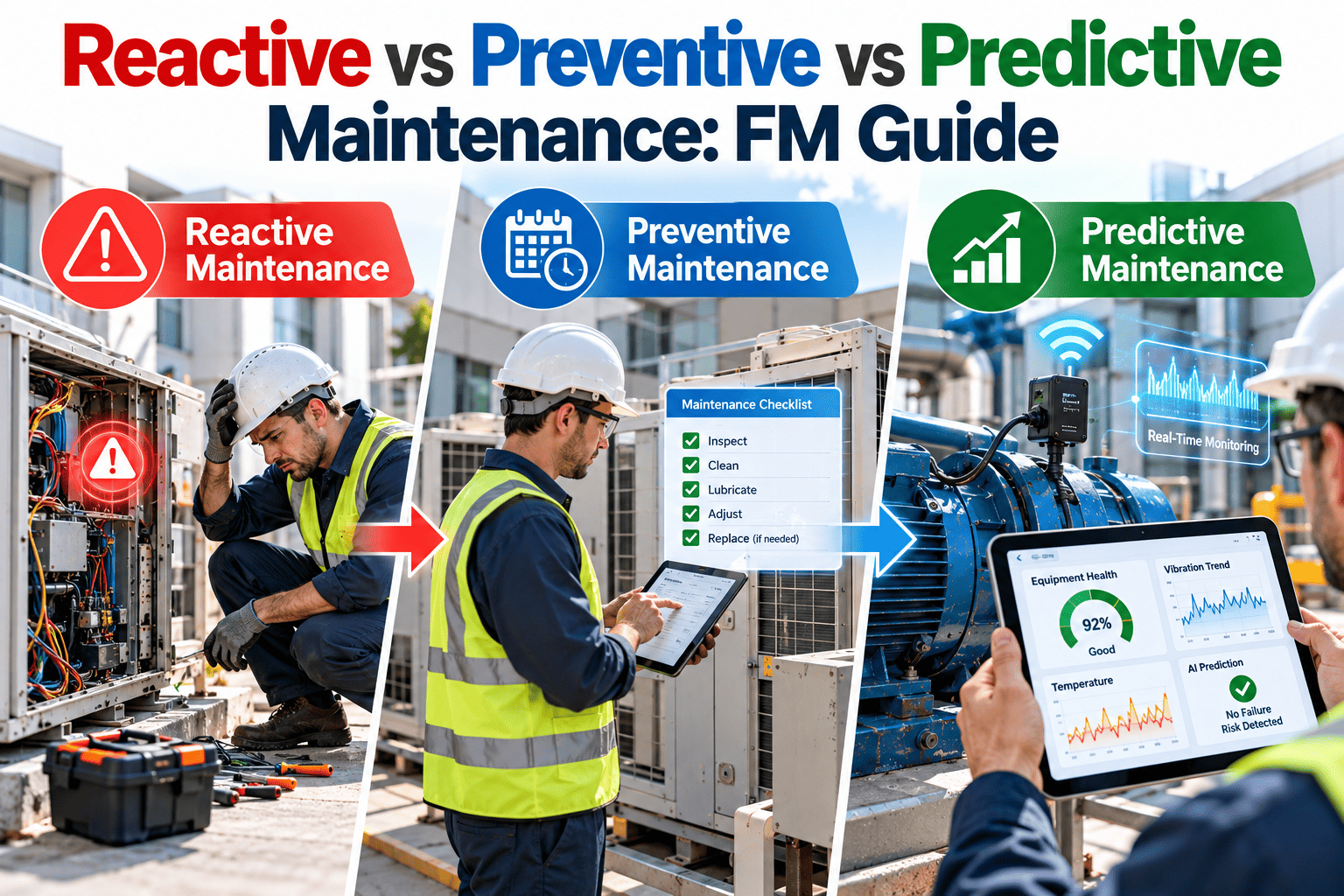
Traditional Preventive Maintenance
Service Based on Time. Not Condition.
Traditional preventive maintenance (PM) services equipment on fixed calendar or usage intervals — replace the bearing every 6 months, change the oil every 500 hours, inspect the HVAC every quarter — regardless of actual equipment condition. The schedule is derived from manufacturer recommendations and historical averages, not from what the specific asset is experiencing right now.
Result: Over-maintenance on assets in good condition. Under-maintenance on assets degrading faster than the schedule assumes. And zero warning before failures that occur between intervals.
AI Predictive Maintenance
Service Based on Condition. Not Calendar.
AI predictive maintenance uses continuous sensor data, operational logs, and machine learning models to detect early warning signals of equipment degradation — vibration anomalies, temperature trends, current draw deviations — and predict failures before they occur. Maintenance is triggered by actual equipment condition, not by a date on a schedule. The AI model improves its accuracy as it accumulates more operational data.
Result: Parts replaced when condition data indicates replacement is needed — not when a calendar says so. Unplanned failures prevented. Maintenance costs reduced. Asset lifespan extended.
How Each Strategy Works
4 Operational Differences That Determine Which Strategy Wins for Your Assets
01
Maintenance Trigger
PM: Fixed interval — calendar date or usage threshold reached. No real-time condition input. A bearing scheduled for replacement at 6 months gets replaced whether it has 2 months of life left or 18 months.
AI: Condition signal — sensor anomaly, temperature deviation, vibration pattern shift, or current draw change triggers a maintenance work order. The bearing is replaced when data says it needs to be, not when the calendar says it should be.
02
Failure Prevention Capability
PM: Reduces failures from predictable wear patterns but cannot prevent failures that occur between scheduled intervals or are caused by unusual operating conditions the schedule doesn't account for.
AI: Catches 70–75% of unexpected breakdowns by continuously monitoring equipment and detecting developing fault patterns 2–6 weeks before the failure point. Unusual operating conditions that accelerate wear are detected in real time.
03
Parts and Labour Cost Structure
PM: Generates "false work" — functional parts replaced before end of useful life because the schedule says it is time. Industry estimates suggest 30–40% of preventive maintenance tasks replace components with significant life remaining.
AI: Eliminates premature replacement by 38%. Parts are ordered and scheduled when condition data indicates they are approaching end of life — not before. Emergency labour rate premiums and expedited parts costs are eliminated by planned intervention.
04
Data and Learning Capability
PM: Generates historical records of when maintenance was performed — but provides no feedback on whether the service interval was too early, too late, or appropriately timed. The schedule does not improve over time without manual review.
AI: Self-improving model — every maintenance action and its outcome feeds back into the prediction model. False positive rates decrease and failure prediction accuracy improves over time. Systems reach 88–97% failure prediction accuracy for well-defined equipment types as the dataset matures.
Performance Data 2025–2026
AI Predictive vs Traditional Preventive — What the 2025–2026 Industry Data Shows
35–45%
Downtime Reduction
AI predictive maintenance delivers 35–45% reduction in unplanned downtime according to Deloitte research. Traditional PM reduces breakdowns but cannot prevent failures between intervals — typically achieving 15–20% downtime reduction over reactive-only approaches.
25–30%
Maintenance Cost Reduction
AI predictive maintenance reduces total maintenance costs by 25–30% versus preventive approaches and up to 40% versus reactive maintenance. The saving comes from eliminated premature parts replacement, reduced emergency labour rates, and optimised service timing.
20–40%
Asset Lifespan Extension
Condition-based maintenance extends asset operational life by 20–40% by eliminating the destructive cycle of run-to-failure events and by servicing assets at the precise point that maximises remaining useful life rather than at fixed calendar points.
95%
Positive ROI Rate
95% of predictive maintenance adopters report positive ROI. 27% achieve full investment payback within one year. For mid-size facilities (50–200 critical assets), full payback typically occurs within 6–18 months — with annual savings of $950,000+ on a 25-unit fleet investment of $125,000.
Head-to-Head Comparison
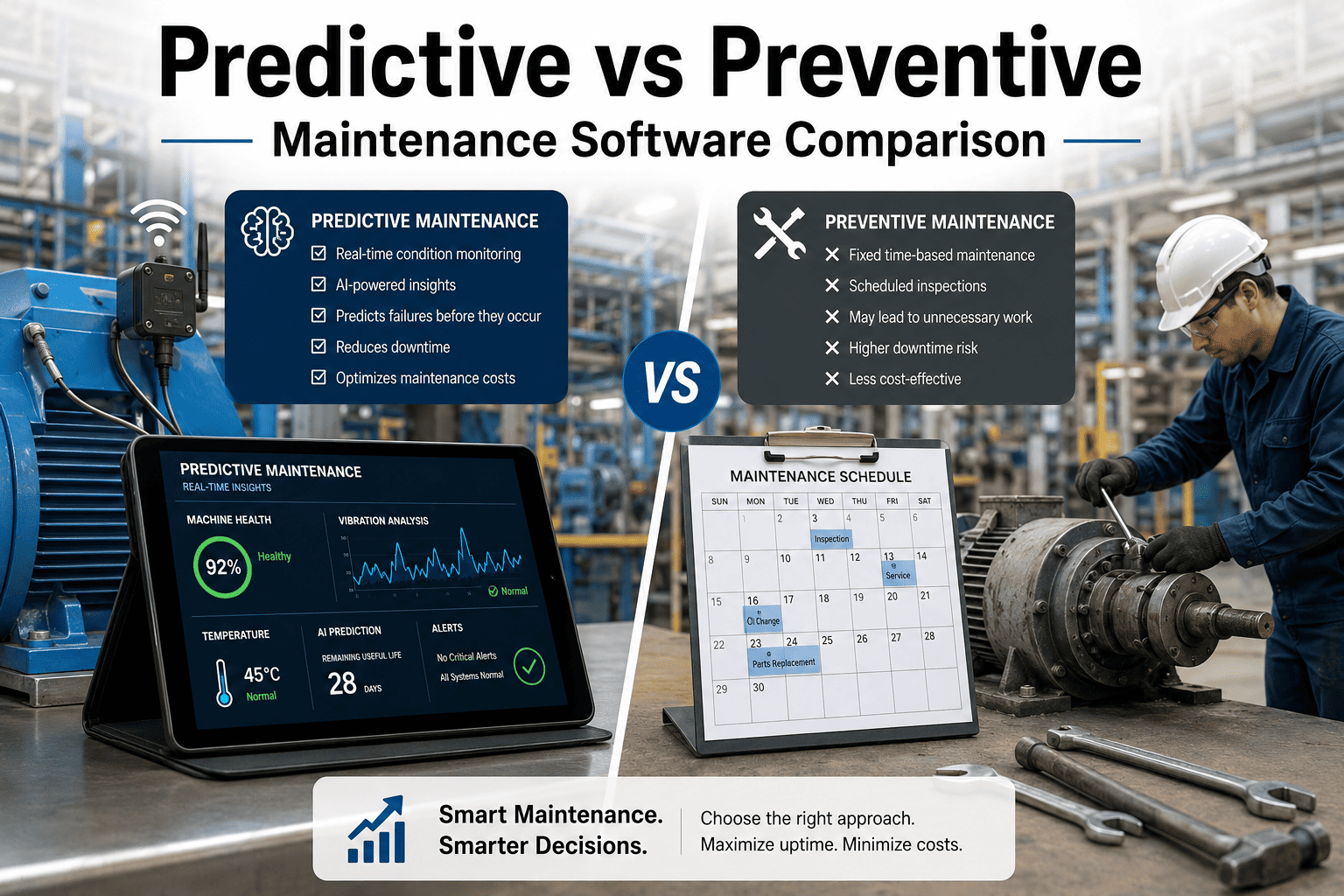
AI Predictive Maintenance vs Traditional Preventive Maintenance — Complete 2026 Comparison
Comparison Factor
Traditional Preventive Maintenance
AI Predictive Maintenance
Maintenance Trigger
Fixed calendar or usage interval — time-based, not condition-based. Cannot respond to actual equipment state.
Real-time condition signal — AI triggers work orders when sensor data indicates developing fault, not when calendar says to.
Upfront Investment
Low — primarily labour, parts, and CMMS scheduling. No sensor hardware or AI platform required.
Higher — IoT sensors ($50–500/asset), AI platform ($500–5,000/month), integration and training costs. Payback in 6–18 months.
Failure Prevention Rate
Reduces predictable wear-pattern failures but misses failures between intervals and under abnormal conditions. 15–20% downtime reduction.
Eliminates 70–75% of unexpected breakdowns. Catches developing faults 2–6 weeks before failure point. 35–45% downtime reduction.
Parts Cost Efficiency
30–40% of parts replaced still have significant useful life remaining — "false work" inflates annual parts spend with no failure prevention benefit.
38% reduction in premature parts replacement. Parts ordered and scheduled at condition-indicated end of life — not at calendar-dictated intervals.
Implementation Complexity
Low — configurable in any CMMS. Asset registry, PM schedules, and work order templates are straightforward to set up. Deployable in days.
Higher — requires sensor installation, data integration, model training period (30–90 days), and technician upskilling. Only 29% of technicians "very prepared."
Maintenance Cost Reduction
10–15% reduction vs. reactive maintenance. Cannot eliminate over-maintenance costs — the schedule creates fixed cost floor regardless of actual equipment need.
25–30% reduction vs. preventive maintenance. 40% reduction vs. reactive. $127,000 average annual cost per heavy equipment unit drops to $84,000 under predictive.
Asset Lifespan Impact
Moderate improvement over reactive — prevents catastrophic failures but over-maintenance cycles can reduce component life through unnecessary disturbance.
20–40% extension in asset operational life. Condition-based servicing at optimal intervals maximises useful life while preventing degradation-driven failures.
Best Suited For
Non-critical assets with predictable failure patterns and low downtime cost. Low-value equipment where sensor investment does not justify payback.
High-value, failure-critical assets where downtime cost is significant. Equipment where failure between intervals is a realistic operational risk.
When to Use Each Strategy
The Decision Framework: Which Strategy Wins for Which Assets in Your Facility
Neither strategy is universally better. 66% of manufacturers in 2026 use a hybrid approach — preventive maintenance for routine and non-critical assets, predictive for high-value failure-critical equipment. The decision comes down to asset criticality, failure cost, and investment threshold.
Use Traditional Preventive Maintenance When
Asset replacement cost is under $50,000 and failure does not halt production
Failure patterns are predictable and well-established from manufacturer data
Downtime cost per hour is below $5,000 and production can absorb delays
Sensor installation cost exceeds the annual maintenance saving the data would generate
Equipment is non-critical infrastructure: lighting, general HVAC, plumbing fixtures
Annual maintenance costs per unit are below $80,000 — payback threshold for predictive investment
Maintenance team lacks data science capability or AI implementation bandwidth currently
Facility is in early digitization phase — structured PM programme builds the data foundation AI requires
Use AI Predictive Maintenance When
Asset value exceeds $150,000 and failure creates production halt or safety risk
Downtime cost exceeds $50,000 per hour — semiconductor, automotive, food processing lines
Failures occur between scheduled PM intervals with regularity — fixed schedule is demonstrably insufficient
Parts premature replacement cost exceeds sensor and platform investment annually
Equipment operates under variable load or environmental conditions the schedule cannot account for
Annual maintenance cost per unit exceeds $80,000 — predictive payback threshold is clearly achievable
Regulatory compliance requires continuous condition monitoring records (OSHA, FDA, NHS)
CMMS work order history and sensor data infrastructure is in place — AI has data to train on
How Oxmaint Bridges Both
How Oxmaint Runs Preventive and Predictive Maintenance in One Unified Platform
The most effective maintenance programmes in 2026 do not choose between preventive and predictive — they run both strategically across their asset portfolio. Oxmaint is built to support this hybrid approach from a single platform.
Automated PM Scheduling
Set preventive maintenance triggers by calendar interval, runtime hours, production cycles, or mileage per asset class. Schedules auto-generate work orders and send reminders before due dates — ensuring PM completion rates above 85% without manual coordination.
Condition-Based Work Order Triggers
Connect IoT sensors and SCADA systems to Oxmaint's analytics engine. When sensor readings cross defined thresholds — vibration, temperature, pressure, current draw — work orders are automatically generated and assigned before the failure occurs.
Full Asset Registry with Condition Scoring
Every asset maintains a complete record: maintenance history, parts consumed, downtime events, current condition score, and remaining useful life estimate. The condition score updates automatically as work orders close and sensor data feeds in — giving managers a live picture of fleet health.
Rolling CapEx Forecasting
Oxmaint's 5–10 year CapEx forecasting models use actual maintenance cost trends per asset to predict replacement cycles — telling operations directors when specific assets will exceed their economic repair threshold, with data-backed confidence rather than depreciation guesswork.
OEE Tracking and Analytics
Real-time OEE dashboards at the individual production line level connect maintenance events to production output — quantifying exactly how much downtime reduction translates to production capacity and revenue recovery. The ROI case for maintenance investment becomes visible in the OEE data.
Multi-Site Portfolio Dashboard
For organisations managing multiple facilities, Oxmaint aggregates PM completion rates, condition scores, open work orders, and CapEx forecasts across all sites in a single dashboard — giving portfolio managers the visibility to identify which facilities are under-maintaining before a failure event forces the issue.
Run Preventive and Predictive Maintenance From One Platform — Starting Today
Oxmaint gives you automated PM scheduling, condition-based work order triggers, full asset condition scoring, and rolling CapEx forecasting in a single mobile-first CMMS. Free to start. Deployed in days. No heavy implementation fees.
Frequently Asked Questions
AI Predictive vs Traditional Preventive Maintenance — What Facility and Plant Managers Ask First
Is AI predictive maintenance actually better than preventive maintenance — or is it just more expensive?
The honest answer is: it depends on which assets you are comparing against which cost structure. For high-value, failure-critical equipment — production line motors, compressors, CNC machines, HVAC chillers serving critical spaces — AI predictive maintenance is demonstrably better. The data is consistent: 35–45% downtime reduction, 25–30% cost reduction, and 10:1 to 30:1 ROI within 12–18 months. For a mid-size facility with 50–200 critical assets, the investment pays back in 6–18 months and delivers compounding returns as the AI model improves. For non-critical, low-value assets — general lighting, standard plumbing fixtures, low-cost HVAC units — traditional preventive maintenance is the right choice. The sensor investment and platform cost do not achieve payback against assets where failure impact is low and replacement is inexpensive. The most successful facilities in 2026 run a hybrid strategy: preventive maintenance for routine and non-critical assets, predictive for the high-value assets where failure cost justifies the investment. Oxmaint supports both strategies within a single CMMS — you do not need separate tools for each approach.
Sign up free to configure your hybrid strategy, or
book a demo to see how Oxmaint handles both asset classes simultaneously.
How long does it take for AI predictive maintenance to start delivering results — and what does the transition from preventive look like?
The timeline breaks into three distinct phases. Phase one (Days 1–30): data foundation. Sensors are installed and begin transmitting baseline readings. The AI model is initialising — learning what "normal" operating conditions look like for each asset. No predictions yet, but the historical data required for accurate forecasting is being built. During this phase, preventive maintenance schedules should continue unchanged. Phase two (Days 30–90): pattern detection. The AI model has enough historical data to begin detecting anomalies. Early-stage alerts may have higher false positive rates — the model is still calibrating against your specific operating environment. Maintenance teams should treat alerts as high-priority inspection triggers rather than definitive failure predictions. Most organisations see first measurable results — reduced emergency callouts, improved parts planning — during this phase. Phase three (90 days onward): predictive confidence. The model has learned your equipment's specific operating signature and is generating failure predictions with 88–97% accuracy for well-defined asset types. Work orders are being triggered by condition data rather than calendar dates for the monitored assets. The 35–45% downtime reduction benchmark becomes measurable in this phase. For facilities transitioning from a pure preventive approach, the practical recommendation is to run preventive schedules in parallel with AI monitoring during the calibration period — using PM as the safety net while the predictive model builds confidence. Oxmaint's platform supports this parallel operation natively.
Book a demo to see the transition workflow configured for your asset types.
What does AI predictive maintenance actually cost — and how does it compare to the ongoing cost of traditional preventive maintenance?
The cost comparison breaks down across three categories. Initial investment: AI predictive maintenance requires IoT sensors ($50–500 per asset depending on type and data requirements), a software platform ($500–5,000 per month depending on scale and features), integration with existing CMMS and ERP systems, and technician training. For a mid-size facility with 50–200 critical assets, initial investment typically ranges from $50,000–$200,000 with annual operating costs of $20,000–$60,000. Traditional preventive maintenance's primary costs are labour (technician time for scheduled service visits), parts (often replaced prematurely — 30–40% of PM parts still have significant useful life), and CMMS subscription for scheduling. Annual maintenance cost per heavy equipment unit averages $127,000 under preventive approaches versus $84,000 under predictive — a 34% reduction per unit annually. Payback timeline: for fleets of 10–25 units, predictive maintenance investment typically pays back in 4–6 months. Larger fleets of 25+ units achieve payback in 3–4 months. For smaller operations of 10–15 units with high-value assets (over $150,000 each), payback runs 12–18 months — still strongly positive against annual savings of $43,000 per unit. The key comparison metric: if your annual maintenance cost per critical asset exceeds $80,000 and each hour of downtime costs more than $50,000, predictive maintenance delivers positive ROI at almost any scale.
Sign up for Oxmaint free to run a cost-per-asset analysis on your current maintenance spend, or
book a demo for a customised ROI calculation.
Can a CMMS like Oxmaint run both preventive and predictive maintenance strategies simultaneously — or do you need separate systems?
Oxmaint is specifically designed to run both strategies within a single unified platform — and this is the approach that 66% of manufacturers are using in 2026. Within Oxmaint, preventive maintenance runs through automated PM scheduling: you set the interval (calendar, runtime hours, production cycles), and the system automatically generates work orders, assigns them to technicians, and tracks completion rates. The PM completion benchmark of 85% or higher is tracked in real time at the asset, site, and portfolio level. Predictive maintenance runs through the condition monitoring layer: IoT sensors and SCADA systems feed real-time equipment data into Oxmaint's analytics engine. When sensor readings cross configured thresholds — vibration amplitude, temperature deviation, current draw anomaly — the system automatically generates a condition-triggered work order with the relevant sensor data attached. The same technician workflow, the same work order interface, and the same asset record receives both PM-scheduled and condition-triggered work orders. This unified approach means maintenance teams do not need to switch between systems, learn two interfaces, or reconcile data across platforms. The asset condition score, maintenance cost history, and CapEx forecast all incorporate both PM-scheduled and condition-triggered work orders automatically. For multi-site operations, portfolio managers see PM completion rates and condition alert status for every facility in a single dashboard.
Sign up free to configure your hybrid maintenance programme, or
book a demo to see the unified PM and predictive workflow running on live asset data.
What are the biggest risks of staying on traditional preventive maintenance in 2026 — and what do facilities lose by not making the transition?
The risk of staying on a pure preventive maintenance strategy in 2026 has three dimensions that are all compounding. First, the competitive cost gap: facilities running predictive maintenance on critical assets are spending 25–30% less on maintenance annually than facilities running equivalent preventive schedules. For a facility with $2 million in annual maintenance spend, that is $500,000–$600,000 in avoidable cost per year. Over five years, the cumulative competitive disadvantage reaches $2.5–3 million — before counting the revenue impact of downtime. Second, the downtime exposure: 31% of maintenance and operations managers report that downtime costs increased in 2025 despite stable or improving breakdown frequency. The primary driver is aging equipment and parts cost inflation — the same equipment is failing in more expensive ways over time. Preventive schedules do not adapt to aging equipment; they service it on the same interval regardless of its increasing fragility. Third, the compliance risk: regulators in the USA (OSHA), UK (HSE), UAE, and Germany are increasingly requiring continuous monitoring records for high-hazard equipment — documentation that point-in-time preventive maintenance inspections cannot provide. Facilities that have not invested in digital condition monitoring are building compliance gaps that enforcement timelines will make costly to close. The practical path forward for most facilities is not a complete replacement of preventive maintenance but a strategic upgrade: keep PM for routine and low-criticality assets, implement AI monitoring for the high-value, failure-critical equipment where the cost justification is clear.
Book a demo with Oxmaint to identify which assets in your portfolio represent the highest-value predictive maintenance targets based on your current maintenance spend data.
65% of Maintenance Teams Plan to Adopt AI by End of 2026. The Facilities That Move First Lock In the Competitive Advantage.
Oxmaint gives facility and plant managers a unified CMMS that bridges preventive and predictive maintenance — automated PM schedules, condition-based work order triggers, full asset condition scoring, OEE tracking, and rolling CapEx forecasting. Free to start. No implementation fees. Deployed in days.


.jpeg)