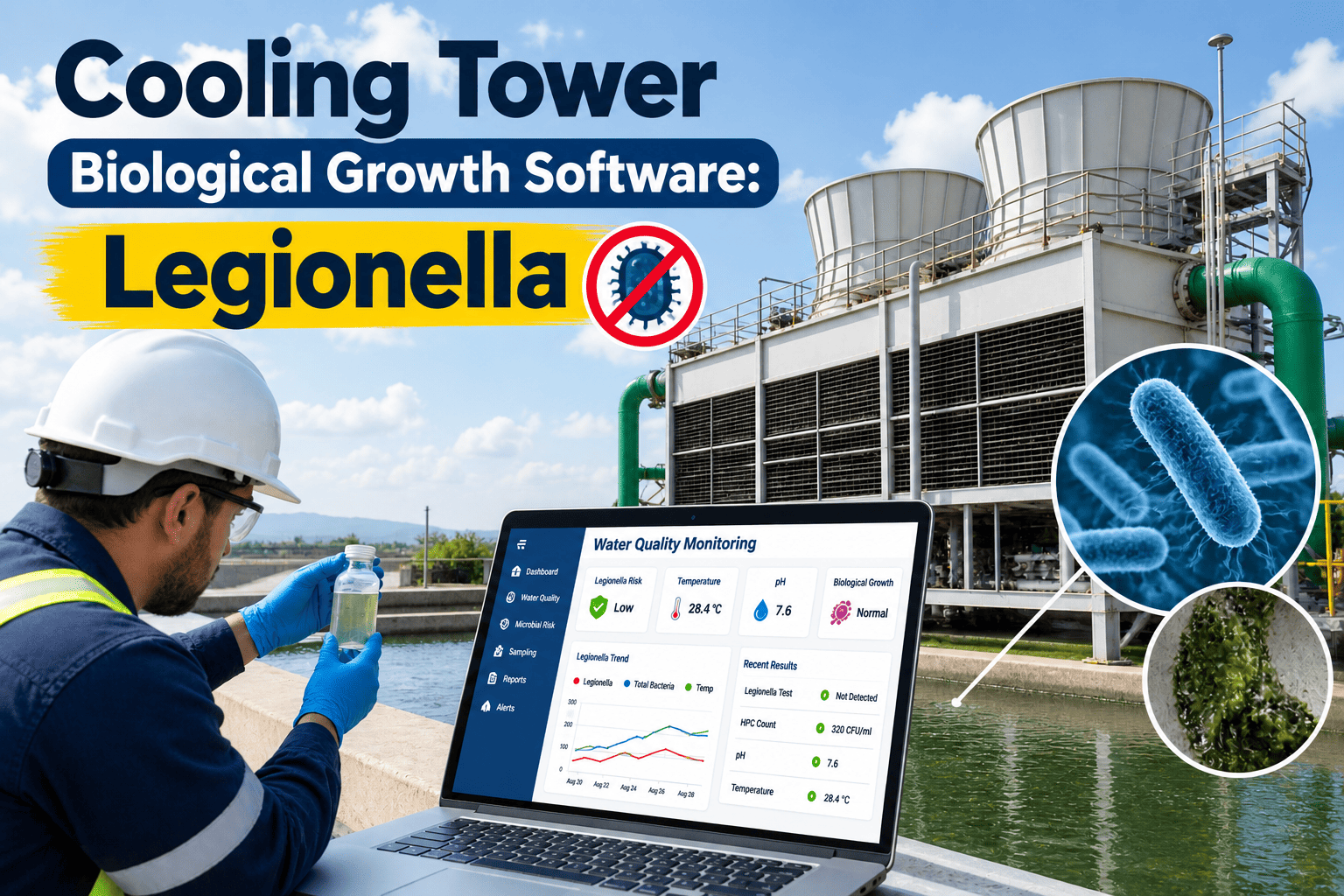
Cooling Tower Biological Growth Software: Legionella

By Corin Hale on August 27, 2026

cooling-tower-biological-growth-software-legionella

A cooling tower is warm, wet, and constantly aerosolizing water into the air — which makes it one of the best environments Legionella bacteria can ask for, and one of the worst places for that bacteria to be. Legionnaires' disease cases have climbed sharply over the past two decades, cooling towers remain the source of the largest community outbreaks on record, and regulators from New York to New Jersey have turned ASHRAE 188 water management from a best practice into a legal requirement with real deadlines. This guide covers what a compliant water management program actually requires, what building teams get wrong, and how OxMaint turns cooling tower water treatment into an audit-ready digital record instead of a logbook nobody can find when an inspector calls.

Cooling Tower Water Safety · ASHRAE 188 · 2026 Compliance Guide

Cooling Tower Biological Growth Software: Building a Legionella-Ready Water Management Program

ORP monitoring, biocide dosing records, ASHRAE 188 risk assessments, and the documentation trail that keeps a cooling tower off the outbreak list and out of a courtroom.

900%
Rise in reported Legionnaires' disease incidence between 2000 and 2018
7–10%
Mortality rate among diagnosed Legionnaires' disease cases
95%
Of diagnosed patients require hospitalization
24 hrs
Typical deadline to notify health authorities after an exceedance
Why This Matters Now

Cooling Tower Legionella Regulation Has Moved From Guidance to Law

New York became the first state to regulate cooling tower Legionella risk after a single contaminated tower caused a major outbreak, and California, Michigan, Illinois, and New Jersey have since followed with their own ASHRAE 188-aligned requirements. Healthcare facilities face an even sharper edge: accreditation standards now require a documented water management program as a condition of continued certification. The common thread across every regulation is the same — a program has to be documented, monitored, and provable, not just described in a policy binder.

Program Requirements

The Six Elements of an ASHRAE 188 Water Management Program

1
System Survey and Diagram
A complete inventory of every cooling tower, evaporative condenser, and connected water system, mapped as a flow diagram.
2
Hazard Analysis
Identification of where conditions allow Legionella growth, amplification, or aerosolized transmission across each system.
3
Control Measures
Defined biocide dosing, disinfectant residual targets, and mechanical controls for scale, corrosion, and sediment at each control point.
4
Monitoring Procedures
Scheduled ORP, pH, conductivity, and disinfectant readings, plus routine Legionella culture sampling at representative locations.
5
Corrective Actions
A documented response plan for any reading or sample result that falls outside an established control limit.
6
Verification and Annual Review
Confirmation the program is being followed as written, reviewed at least annually or after any significant system change.
OxMaint · Water Management Program Digitization
Build an ASHRAE 188 Program an Inspector Can Actually Verify

OxMaint turns every one of the six ASHRAE 188 program elements into a scheduled, timestamped digital record — from the system survey through corrective action sign-off — so your water management program is provable, not just written down.

Monitoring Parameters

What Gets Measured, How Often, and Why It Matters

A compliant water management program is only as good as the readings behind it. Each control parameter answers a different question about whether the tower is currently a safe operating environment or drifting toward one that supports biological growth.

Parameter What It Indicates Typical Frequency Corrective Trigger
ORP / Disinfectant Residual Active biocide effectiveness in real time Continuous or daily Reading drops below the control limit
Legionella Culture Sampling Direct bacterial presence and concentration Monthly while operating Result exceeds the facility's action level
pH and Conductivity Scale, corrosion, and treatment chemistry balance Weekly to daily Drift outside the treatment program range
Biofilm and Sediment Inspection Physical conditions that shelter bacteria from biocide Quarterly visual inspection Visible biofilm or sediment accumulation found
Compliance Site Inspection Overall program adherence and equipment condition At least every 90 days Any deviation from the written program
Where Programs Fail

The Documentation Gaps That Turn an Inspection Into a Violation

Highest Risk
No Corrective Action Trail
An out-of-range reading with no documented follow-up is treated as an unmanaged hazard, not a one-time anomaly, by most regulators and auditors.
Highest Risk
Gaps in Sampling History
A missed monthly culture sample or a skipped quarterly inspection breaks the continuous monitoring record regulations require.
Common Miss
Outdated System Survey
A tower added or reconfigured after the last program review means the written survey no longer matches the actual installed equipment.
Common Miss
Paper Logs Nobody Can Retrieve
Handwritten dosing logs stored on a clipboard rarely survive staff turnover, and a missing binder page is functionally the same as a missing record.
The OxMaint Advantage

How OxMaint Digitizes Every Layer of the Water Management Program

01
One Asset Record Per Tower and Connected System
The system survey, hazard analysis, and control measures for each cooling tower live against that tower's permanent digital asset record, updated the moment equipment changes.
02
Scheduled Monitoring Rounds With No Missed Readings
ORP, pH, and biocide dosing checks are scheduled automatically, technicians log readings from a mobile device on site, and a missed round is flagged the same day rather than discovered at renewal.
03
Automatic Corrective Action Work Orders
A reading that falls outside its control limit opens a work order automatically, tracks the corrective action taken, and closes with a technician sign-off — building the exact trail auditors look for.
04
Audit-Ready Export in Minutes
A complete water management program record — surveys, readings, sample results, and corrective actions — exports for a health department or accreditation audit without assembling a single binder.
Facility Team Questions

Cooling Tower Legionella Compliance — Common Questions

Does ASHRAE 188 apply to every facility with a cooling tower?+
ASHRAE 188 itself is a voluntary standard, but a growing list of state laws and healthcare accreditation rules now require facilities with cooling towers to follow it as a legal or certification condition. Start a free trial to see your program mapped to the standard.
How often does a cooling tower need Legionella culture sampling?+
Many current regulations require monthly Legionella culture sampling while a tower is operating, alongside site compliance inspections at least every 90 days.
What happens if a Legionella sample exceeds the action level?+
Most programs require immediate remediation of the affected system and notification of local health authorities within a short window, commonly 24 hours, along with a documented corrective action record.
Can a paper logbook satisfy an ASHRAE 188 documentation requirement?+
Technically yes, but paper logs are the most common source of documentation gaps auditors and litigation cite, since missing pages, illegible entries, and lost binders are difficult to defend after the fact. Book a demo to see the digital alternative.
How often should the water management program itself be reviewed?+
At minimum annually, and immediately after any significant system change, a confirmed Legionella case, or a facility expansion that adds or alters water systems covered by the program.
OxMaint · Legionella Water Management · Facility CMMS
Make Your Water Management Program Provable, Not Just Written

OxMaint schedules every ORP reading, biocide dose, culture sample, and corrective action against your cooling tower asset records — building the audit-ready ASHRAE 188 documentation trail your inspector, insurer, or accreditor will ask for.


Share This Story, Choose Your Platform!