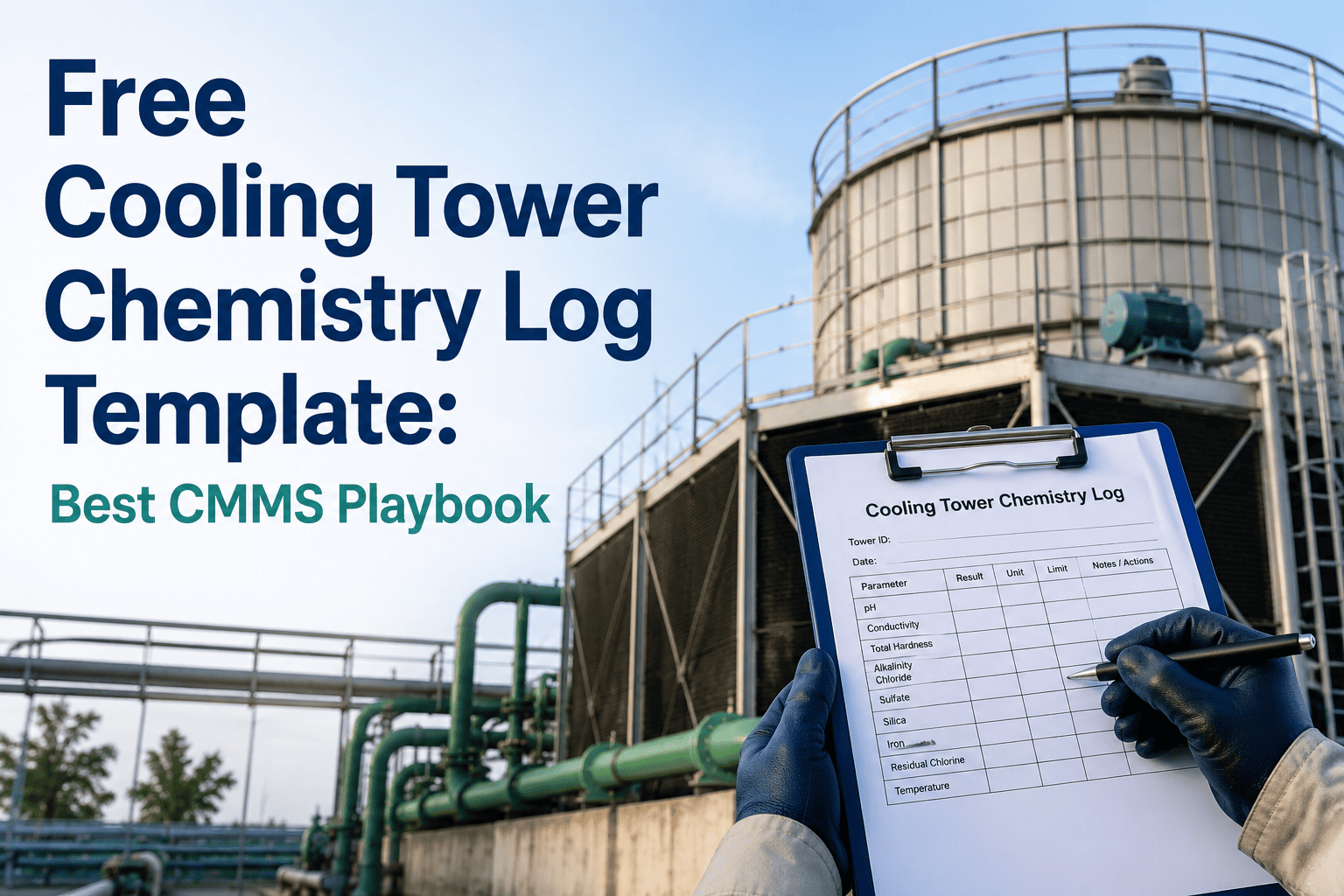
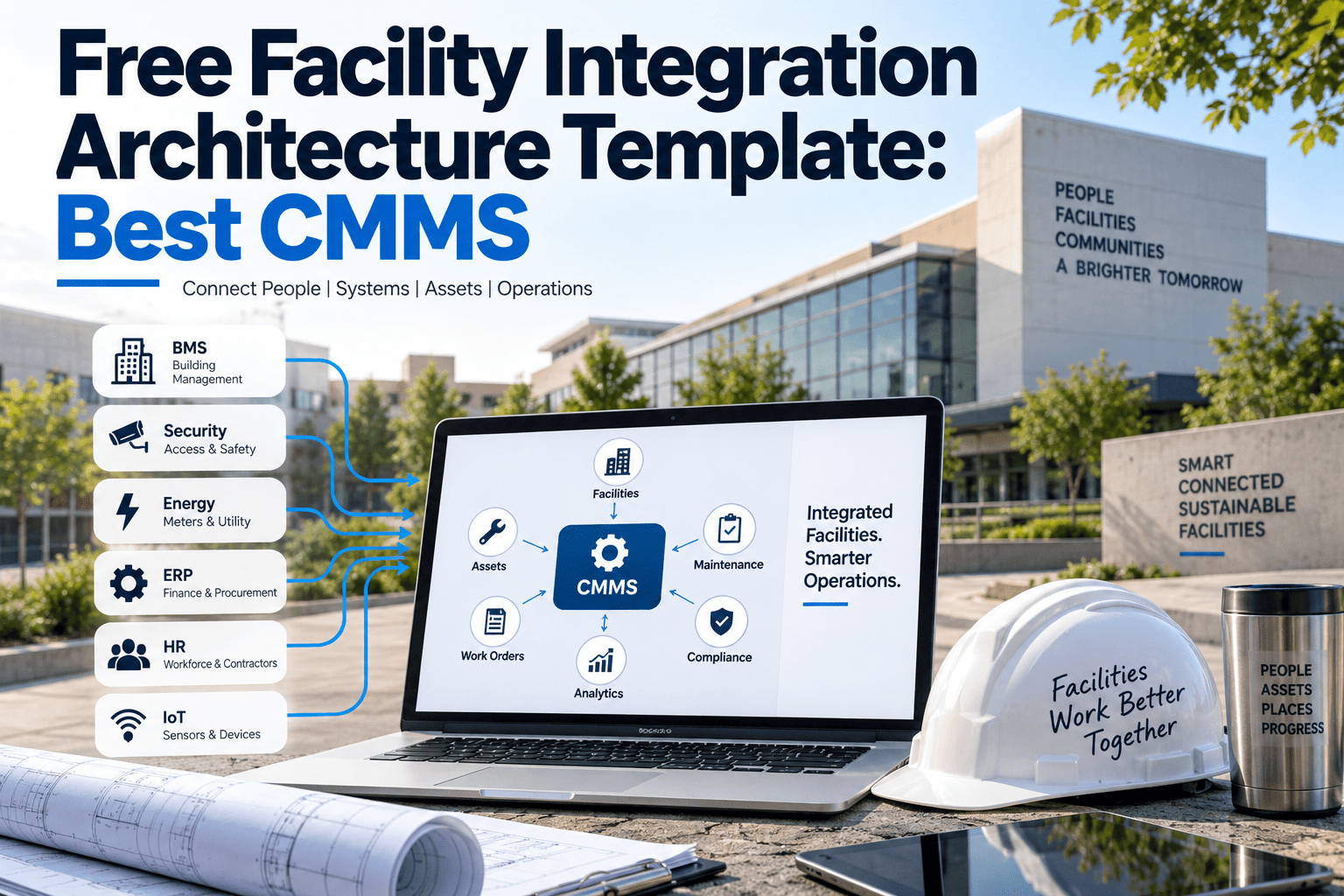
Facility managers searching for a reliable cooling tower chemistry log template in 2026 usually run into the same wall: paper sheets and disconnected spreadsheets that fall apart the moment an auditor asks for a complete testing history. A proper log has to track pH, conductivity, ORP, hardness, alkalinity, and biocide residuals against defined limits, on a schedule that matches ASHRAE 188 guidance, with every entry timestamped and attributed to a technician. Building that structure from scratch eats hours most facility teams do not have during cooling season. This guide breaks down the exact parameters, testing frequencies, and log structure your cooling tower program needs, plus the free template most teams start with. If you would rather skip the manual setup, OxMaint builds this log automatically inside its CMMS platform — you can see it working at app.oxmaint.ai.
Cooling Tower Compliance · Water Chemistry · 2026 Template
Free Cooling Tower Chemistry Log Template — Built Around ASHRAE 188
pH, ORP, conductivity, hardness, and alkalinity — the exact parameters, limits, and testing cadence auditors look for, plus the CMMS that logs it automatically so nobody has to chase a spreadsheet again.
5M+
US buildings that fall inside ASHRAE 188's water management scope
6.5–8.5
Target pH range most cooling tower treatment programs are held to
Weekly
Minimum required testing frequency for biocide residuals under ASHRAE guidance
Annual
Required review cycle for the full Water Management Plan document itself
The Six Numbers Every Log Needs
What Actually Belongs in a Cooling Tower Chemistry Log
A chemistry log is not a place to record whatever number is convenient — it is a defense document. Every parameter below exists because it answers a specific question an auditor, an insurer, or an attorney will eventually ask. Track these six and the rest of your water management program has a foundation to stand on.
Daily
pH
Balance between hydrogen and hydroxyl ions in the water. Low pH drives corrosion, high pH drives scale formation on heat exchange surfaces.
Typical target: 6.5–8.5, depending on treatment chemistry
Daily
Conductivity / TDS
Rises as the tower concentrates through evaporation. This is the number that controls blowdown timing and cycles of concentration.
Set relative to makeup water quality and target cycles
Continuous or Daily
ORP
Oxidation-reduction potential shows whether an oxidizing biocide is actually active against organic load, not just present in the water.
Many programs hold ORP above roughly 650 mV during feed
Weekly
Calcium Hardness
Dissolved calcium and magnesium that reacts with alkalinity to form scale on fill media and heat transfer surfaces as the water concentrates.
Tracked directly against your cycles of concentration
Weekly
M-Alkalinity
Too high and you get scale, too low and you get corrosion. Alkalinity and hardness move together and neither means much read alone.
Maintained inside a defined band set by your treatment vendor
Weekly Minimum
Biocide Residual
Free chlorine, bromine, or a non-oxidizing biocide — the direct measure of whether your biological control program is actually working.
ASHRAE 188 sets weekly as the floor; continuous is best practice
Testing Calendar
The Frequency Matrix Auditors Expect to See
ASHRAE 188 does not prescribe a single universal schedule — it expects a documented one, matched to your tower's risk profile, and followed consistently. This is the cadence most commercial cooling tower programs are built around.
Free Template · Ready in Minutes
Download the Log, Then Let OxMaint Fill It In Automatically
The free template gives you the columns and limits above, structured and ready to print or share with your water treatment vendor. Most teams use it for a week or two — then move the same fields into OxMaint so readings, alerts, and audit exports stop depending on someone remembering to update a file.
Paper vs. Digital
Where Spreadsheet Logs Fall Apart During an Audit
A spreadsheet can hold the same numbers as a digital log. What it cannot hold is proof that the numbers weren't edited last week to fill a gap. That distinction is exactly what an auditor, an insurer, or an opposing attorney is trained to look for first.
Paper or Spreadsheet Log
Entries can be backdated, edited, or left blank with no record of why. Missing weeks are invisible until someone goes looking. Multi-site portfolios mean chasing files from a dozen different folders.
OxMaint Digital Log
Every reading is timestamped at entry and locked from editing after the fact. Missed testing windows trigger an automatic alert. Every tower across every site sits in one exportable record.
How It Works
From Field Reading to Audit-Ready Export in Four Steps
01
Set Your Limits Once
Enter the target range for pH, ORP, conductivity, hardness, alkalinity, and biocide residual per tower — matched to your water treatment vendor's program, not a generic default.
02
Technicians Log Readings From the Tower
Mobile entry captures the reading, the technician, and the timestamp at the moment of testing — including offline, for basements and mechanical rooms with weak signal.
03
Out-of-Range Readings Open a Work Order
A biocide residual below limit or a pH excursion automatically creates a corrective action task, so the response is documented in the same place as the reading that triggered it.
04
Export the Full History in Under a Minute
Pick any date range across any tower or site and generate a complete, timestamped chemistry log ready to hand to an inspector, insurer, or your own compliance team.
What Changes
What Facility Teams Notice in the First Season
Zero
Missed testing windows once reminders are active
60 sec
To export a full audit-ready chemistry log for any date range
100%
Of entries timestamped and attributed to the technician who logged them
1
Dashboard covering every tower, every parameter, every site
Questions Facility Teams Ask
Cooling Tower Chemistry Logs — Common Questions
What exactly is a cooling tower chemistry log template?
+
It is a structured record — usually a spreadsheet or digital form — that captures pH, conductivity, ORP, hardness, alkalinity, and biocide readings against defined limits on a set schedule. Grab the free version at
app.oxmaint.ai to see the full column structure.
How often does ASHRAE 188 actually require water chemistry testing?
+
ASHRAE 188 does not set one universal cadence — it requires a documented schedule matched to your tower's risk profile, typically daily for pH and conductivity, weekly for biocide and hardness, and quarterly for Legionella testing.
Why do alkalinity and hardness need to be read together?
+
Alkalinity and calcium hardness react with each other to form scale. Reading either one alone tells you half the story — the balance between them, not either single number, determines whether the tower is scaling or corroding.
Can a spreadsheet actually satisfy ASHRAE 188 documentation requirements?
+
It can hold the required data, but it cannot prove the data wasn't edited after the fact — which is often the first thing an auditor checks. A timestamped digital log closes that gap. See how at
app.oxmaint.ai.
Does OxMaint replace my water treatment vendor?
+
No — OxMaint documents the readings, limits, and corrective actions your program already runs on, including vendor site visits. Most teams keep their existing water treatment contractor and use OxMaint for the record-keeping layer.
Book a demo to see how the two fit together.
OxMaint · Cooling Tower Compliance · Free Template
Stop Rebuilding This Log Every Renewal Season
Download the free cooling tower chemistry log template to get started today, or move straight to OxMaint and let every pH, ORP, conductivity, hardness, alkalinity, and biocide reading log itself — timestamped, attributed, and ready to export the moment an inspector asks.