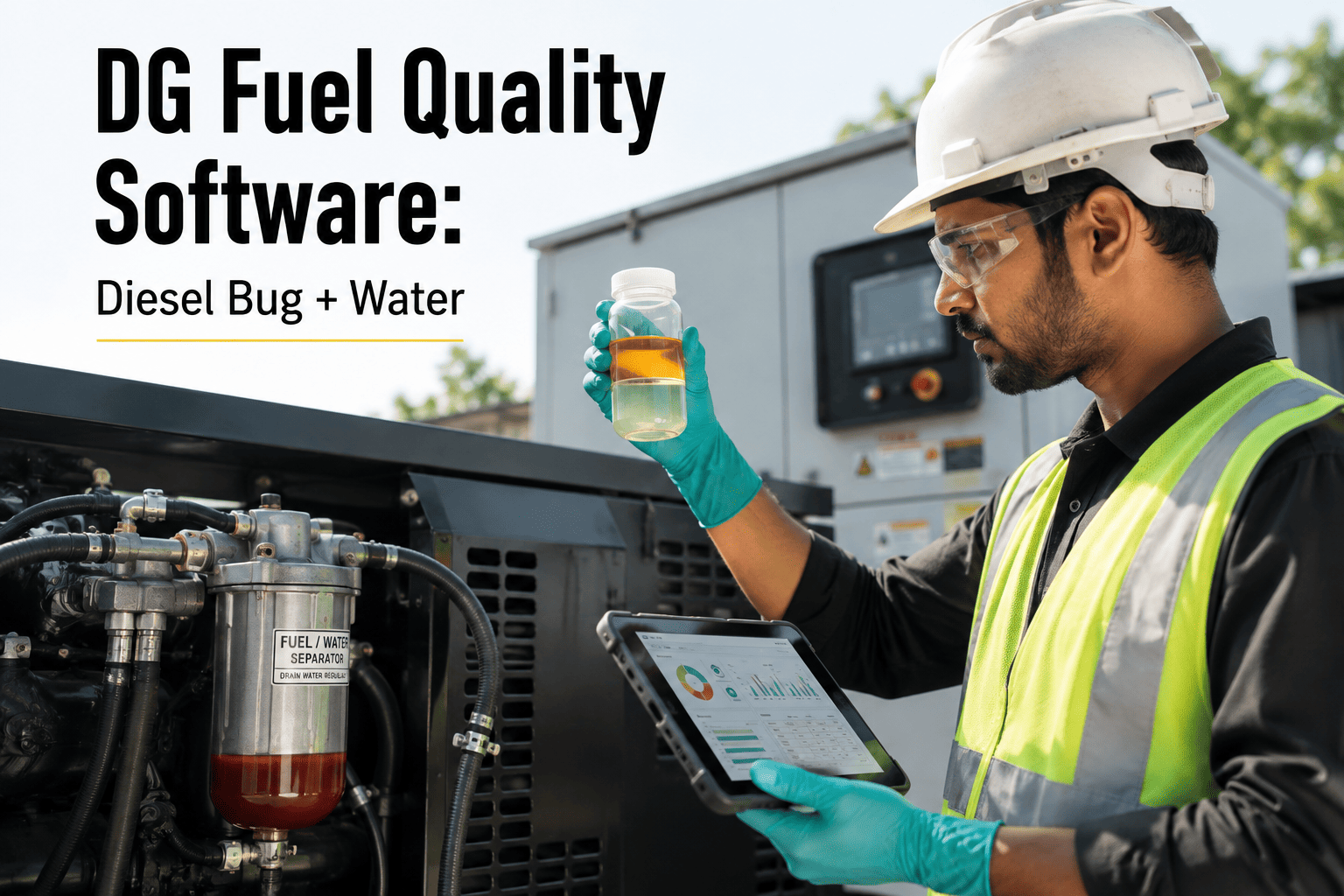
When a diesel generator fails to start during a power outage, the cause is rarely the engine itself. In most confirmed startup failures investigated across hospitals, data centers, and industrial sites, the trail leads back to the fuel tank — water pooled at the bottom, diesel bug sludge choking a filter, or fuel that quietly degraded months before anyone checked it. Diesel bug is the common name for the microbial colonies that feed on water trapped in stored diesel, and once conditions are right, that population can double roughly every twenty minutes, turning a clean tank into a fuel-polishing emergency within days. Facilities that depend on standby power cannot treat fuel quality as a once-a-year paperwork exercise; they need continuous, documented visibility into water content, microbial risk, and remediation status across every generator and every tank on site. Book a free fuel quality readiness assessment with our facility engineering team and find out which of your generators are already carrying contamination risk.
20 min
Approximate doubling time for diesel bug colonies once water is present in the tank
0.05%
Maximum water and sediment allowed in diesel fuel under ASTM D975
90 days
Recommended testing interval for standby generator fuel tanks
72 hrs
Typical lab turnaround for a full microbial contamination result
NFPA 110
Code requiring documented annual fuel testing for emergency power systems
Compliance Reality
NFPA 110 and most state fire and health codes require documented, ASTM-method fuel testing for emergency and standby power systems at hospitals, data centers, senior care facilities, and communication hubs. A binder of lab PDFs and a spreadsheet of due dates is technically a record — but it cannot tell a facility director which tank is trending toward contamination before it fails an inspection or, worse, fails during an outage.
Why Diesel Bug and Water Quietly Disable Standby Generators
Diesel fuel is hygroscopic — it absorbs moisture from the air. Every time a tank breathes as temperature rises and falls, humid air enters the vapor space, condenses on the cooler tank walls overnight, and drips down into the fuel as free water. Biodiesel blends, now common in ULSD supply, make the problem worse because the fatty acid methyl esters (FAME) in the blend actively attract and hold water rather than letting it separate cleanly. Once that water sits at the tank bottom, dormant bacterial and fungal spores that arrived with the original delivery find exactly the environment they need to activate.
The failure mode that follows is rarely dramatic. Sludge builds slowly at the water-fuel interface, filters start blocking a little faster than usual, injectors see marginally dirtier fuel, and none of it is visible from outside the tank. By the time a generator is called on to run — during a real outage, under real load — the accumulated sediment can be pulled straight into the fuel pickup, starving the engine at the worst possible moment. Because most facilities only physically inspect fuel once a year to satisfy a compliance requirement, months of undetected degradation is the norm, not the exception.
Annual Test + Spreadsheet Log
The default process at most facilities
Satisfies the minimum annual NFPA 110 test requirement
Catches gross contamination if the sample happens to be representative
Blind for 11+ months between scheduled tests
No alert when a delivery introduces contaminated fuel mid-cycle
No linkage between a failed test and an automatic remediation work order
Audit prep means chasing PDFs across email threads and shared drives
11 months
of average blind spot between one annual test and the next
OxMaint Fuel Quality Software
Scheduled testing plus continuous record-keeping
Automated test scheduling by tank, generator, and risk profile
Field and lab results logged against each tank's contamination history
Instant flag when a water or microbial result crosses a safe threshold
Auto-generated fuel polishing or remediation work order on a failed test
One-click, audit-ready compliance report by site or by portfolio
Mobile logging for technicians pulling samples in the field
100%
of tanks tracked against schedule with zero manual reminders
How OxMaint Fuel Quality Software Works
Fuel quality management does not need a lab technician staring at every tank around the clock — it needs a system that never forgets a due date, never misfiles a result, and never lets a failed test sit unactioned. OxMaint turns the testing-to-remediation workflow into a structured pipeline that any facility team can run consistently, site after site.
Fuel Quality Workflow — From Sample to Compliance Report
1
Schedule
Testing cadence set per tank based on hazard class, climate, and biodiesel blend percentage
2
Sample & Test
Technician logs a field water-cut and clarity check, or ships a sample to a certified lab
3
Result Capture
Field readings and lab reports both land in one contamination history per tank
4
Threshold Alert
Any water, sediment, or microbial reading past the safe range triggers an immediate notification
5
Remediation Order
A fuel polishing or draining work order is generated and assigned automatically
6
Compliance Report
Every test, result, and closed work order rolls into an audit-ready record on demand
Fuel Quality Status Levels — What Each Result Should Trigger
Not every reading needs the same response, and treating every deviation as an emergency trains technicians to ignore alerts. OxMaint classifies every fuel test result into one of four status levels, each with a defined action so the response is consistent regardless of who is on shift.
Clear
Water and sediment within ASTM D975 limits, no visible haze or biological growth detected
Logged to history, next scheduled test date confirmed, no further action required
Watch
Minor haze or a trace water reading approaching, but not yet over, the safe threshold
Retest scheduled within 30 days, tank flagged for closer monitoring cycle
Contaminated
Free water layer confirmed or a positive microbial spore result on the fuel sample
Fuel polishing work order auto-created, tank owner and facility manager notified
Critical
Active sludge, blocked filter reports, or a failed generator start linked to fuel condition
Emergency remediation dispatched, generator flagged unreliable until resolved and retested
Compliance Standards Every DG Fuel Program Has to Satisfy
Facilities running standby diesel generators are almost never answering to just one code. Fire marshals, health department surveyors, insurance auditors, and internal reliability teams each reference a different standard, and a fuel quality program needs to produce evidence for all of them without building a separate filing system for each.
| Standard |
What It Requires |
How OxMaint Supports It |
| NFPA 110 |
Annual fuel testing using recognized ASTM methods for emergency and standby power systems |
Automated annual test scheduling with a locked audit trail per generator |
| ASTM D975 |
Diesel fuel must contain no more than 0.05% water and sediment by volume |
Every logged result is checked against the threshold and flagged automatically |
| ASTM D4176 |
Visual clarity and haze inspection to identify free water or particulate contamination |
Field checklist captures clarity rating with photo evidence attached to the tank record |
| ASTM D6469 |
Guidance on microbial contamination in fuels and fuel systems and how to manage it |
Microbial test results and remediation history tracked per tank over its full life |
| Local Fire and Health Codes |
Varies by jurisdiction — often layers additional documentation on top of NFPA 110 |
Configurable reporting templates matched to the specific requirements of each site |
Fuel Quality KPIs Facility Teams Report to Leadership
A fuel quality program is only as credible as the numbers behind it. These are the metrics facility engineering and reliability teams use to prove the program is working — to auditors, to insurers, and to the executives who need to trust that backup power will actually work when it is needed.
100%
Tank Testing Coverage
Share of registered fuel tanks with a current, on-schedule test on record
< 48 hrs
Mean Time to Remediation
Average time from a failed test result to a dispatched fuel polishing work order
0
Unresolved Contamination Alerts
Open alerts on Contaminated or Critical tanks left without an active work order
100%
Audit-Ready Records
Generators with a complete, exportable test and remediation history on request
90 days
High-Risk Site Test Cycle
Testing frequency applied automatically to coastal, tropical, or high-humidity locations
1 record
Single Source Per Tank
Field checks, lab reports, and remediation history unified instead of scattered across systems
Stop Finding Out About Fuel Problems During an Outage
OxMaint gives facility engineering teams one platform to schedule fuel testing, log field and lab results, catch diesel bug and water contamination early, and generate the audit-ready reports that NFPA 110 and internal reliability programs demand — across a single site or an entire generator fleet.
Frequently Asked Questions
How often should a standby generator's fuel actually be tested?
Most codes set an annual minimum, but that is a compliance floor, not a safety target. Standby and emergency fuel tanks are commonly tested every 90 days, and every delivery, with high-humidity or coastal sites moving to monthly checks.
Can diesel bug be treated once it is found, or does the fuel have to be replaced?
Contaminated fuel can usually be treated with fuel polishing and biocide dosing rather than a full replacement, but the process takes the generator out of service temporarily and costs far more than routine testing would have. Early detection through
a structured monitoring platform is what keeps that cost down.
Does water evaporate out of diesel fuel over time on its own?
No. Once free water settles at the bottom of a tank it stays there under normal storage conditions, creating an ongoing environment for microbial growth and corrosion until it is actively drained or the fuel is polished.
Are biodiesel blends more prone to water contamination than standard diesel?
Yes. Biodiesel blends are hygroscopic and absorb atmospheric moisture more readily than petroleum diesel, which means tanks running B5, B10, or higher blends generally need a shorter testing interval.
How does fuel quality software actually reduce the risk of a failed generator start?
It replaces a once-a-year paper check with scheduled testing, instant alerts on failed results, and automatic remediation work orders, so contamination is caught and cleared months before a generator is ever called on to run.
Book a readiness assessment to see the gaps in your current program.
Protect Every Generator on Your Site With One Fuel Quality Platform
From a single standby generator to a portfolio of facilities, OxMaint keeps fuel testing on schedule, contamination visible early, and every compliance report one click away.