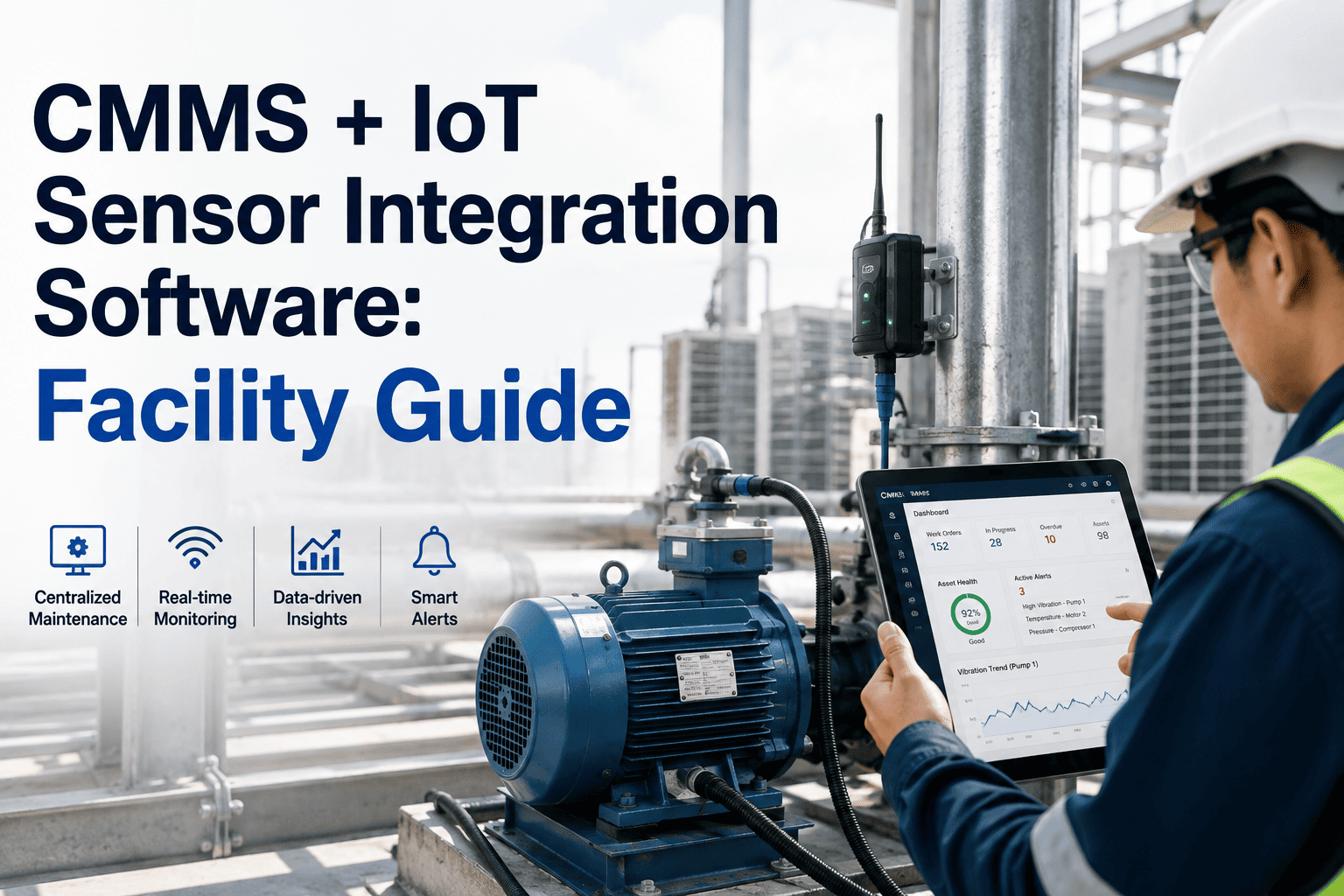
A vibration sensor bolted onto a bearing is worthless if the reading it sends never reaches a technician before the bearing fails. Most facilities already have sensors — on pumps, chillers, compressors, transformers, and conveyors — but the data sits in a separate dashboard that maintenance teams rarely open, while work orders still get created manually days after the anomaly first appeared. The value of IoT is not the sensor itself, it is the path from a reading to a dispatched technician, and that path only exists if the CMMS and the sensor network are actually talking to each other. Connect your sensors to Oxmaint free and see the first auto-generated work order.
Every stage in this pipeline already exists somewhere in most facilities today, just disconnected from the others. The sensor already collects the reading. Someone, somewhere, could probably eyeball whether that reading looks normal. A technician exists who could go fix the problem if they knew about it in time. What is usually missing is the automatic handoff between each stage — the moment a reading crosses a threshold, does anything happen without a human noticing it first, and does the technician who eventually responds have the context to fix the right thing quickly? Oxmaint is built specifically to own that handoff, so the five steps above happen as one continuous, auditable sequence rather than five separate systems a maintenance planner has to stitch together by hand every single day.
Why Sensor Data and Maintenance Work Stay Disconnected
Most facilities did not plan their IoT rollout and their CMMS rollout together, so the two systems ended up speaking different languages. The sensor platform is excellent at charting trends and flagging outliers, but it has no concept of a work order, a technician, or a parts inventory. The CMMS is excellent at scheduling and tracking labor, but it has no way to know that a bearing has been trending three degrees hotter for the past six days. The result is a dashboard that someone has to remember to check, and a maintenance team that keeps running the same fixed-interval schedule regardless of what the equipment is actually telling them. By the time a person notices the trend manually, the anomaly has often been building for days, and the window for a cheap, planned repair has already closed.
This gap tends to get worse, not better, as facilities add more sensors. A plant that starts with vibration monitoring on ten critical pumps often ends up with temperature, current, and pressure sensors across dozens of assets within a year or two, each reporting through its own vendor dashboard with its own login and its own alert logic. Maintenance planners end up juggling five or six browser tabs to get a full picture of equipment health, and inevitably some alerts get missed simply because no one was looking at that particular screen when the reading crossed the line. Oxmaint solves this by becoming the single place every sensor feed reports into, so an anomaly on any connected asset produces the same kind of work order regardless of which vendor's hardware detected it.
A Sensor Trend No One Is Watching Is the Same as Having No Sensor at All
Oxmaint connects directly to your sensor network and turns anomalies into dispatched, tracked work orders — no dashboard-watching required.
Speaking Every Sensor's Language
Facility sensor networks rarely use a single protocol, because equipment gets added in phases, from different vendors, over many years. A plant might have legacy SCADA infrastructure talking Modbus over serial, a newer chiller plant reporting through OPC-UA, wireless vibration sensors publishing over MQTT, and a rooftop unit vendor offering only a REST API. Any integration layer that only supports one of these protocols forces a facility to either rip and replace working hardware or leave part of its sensor investment permanently disconnected from maintenance workflow. Oxmaint's integration layer speaks Modbus, OPC-UA, MQTT, LoRaWAN, and REST natively, so a facility can connect its entire mixed sensor estate — old and new, wired and wireless — into one pipeline without waiting for a hardware refresh cycle to finish first. This matters most for facilities managing brownfield sites, where the fastest path to condition-based maintenance is making existing sensors useful, not buying new ones.
What Oxmaint Does With Your Sensor Data
Oxmaint is not a new sensor platform to buy and install — it is the layer that turns the sensors you already have into maintenance action.
These four capabilities work together rather than as separate features: ingestion feeds the trigger logic, the trigger logic generates the work order, and every closed work order in turn sharpens the predictive model for that specific asset. A facility does not need all of this running on day one — most start with condition-based triggers on their most critical assets and expand into predictive scheduling once several months of combined sensor and repair history has accumulated.
Connecting Your Sensor Network
Sensor integration is a configuration project, not an IT overhaul — most facilities are receiving their first auto-generated work order inside two weeks.
Where Sensor-Driven Maintenance Matters Most
Across every one of these settings, the underlying problem is the same: sensor investments only pay off once the readings reliably turn into scheduled labor. A facility that adds thermal imaging or vibration hardware without also connecting it into the maintenance workflow ends up with better dashboards and the same reactive repair pattern it had before, just with more data proving the failure happened. Oxmaint is built specifically to close that gap, regardless of which industry or sensor vendor a facility is standardized on.
You Already Paid for the Sensors. Are They Actually Preventing Failures?
Connect your existing sensor network to Oxmaint and turn every anomaly into a tracked, dispatched work order — not another dashboard alert.
Oxmaint vs Other Facility CMMS Platforms
Swipe to view the full comparison table
| Capability | Oxmaint | MaintainX | UpKeep | Fiix (Rockwell) | Limble CMMS | IBM Maximo | Hippo (Eptura) |
|---|---|---|---|---|---|---|---|
| Multi-Protocol Sensor Ingestion | Modbus, OPC-UA, MQTT, REST | Not available | Limited | Rockwell ecosystem | Not available | Custom build | Not available |
| Condition-Based Work Orders | Automatic threshold triggers | Manual rules only | Manual rules only | Configurable | Manual rules only | Full (complex) | Manual rules only |
| Asset Trend History | Built into asset record | Basic logs | Basic logs | Enterprise tier | Basic logs | Configurable | Basic logs |
| Predictive Scheduling | Learns from sensor + WO data | Not available | Not available | Add-on module | Not available | Custom build | Not available |
| Offline Mobile Response | Full offline with sync | Online only | Limited offline | Limited offline | Limited offline | Limited | Online only |
| Multi-Site Sensor Dashboard | Built-in, real-time | Basic multi-site | Basic multi-site | Enterprise tier | Basic multi-site | Enterprise | Basic multi-site |
| Deploy Time | 7–14 days | 2–3 weeks | 2–4 weeks | 4–12 weeks | 1–2 weeks | 6–18 months | 2–6 weeks |
What Changes After Sensors Connect to the CMMS
The pattern behind these numbers is consistent across facility types: the sensors were already producing accurate data before Oxmaint arrived, and the equipment itself did not change. What changed was the distance between a reading and a person who could act on it. Once that distance shrinks from days to minutes, maintenance teams stop treating sensor alerts as background noise and start treating them as the primary signal for where labor should go each day, which is the entire point of investing in condition monitoring in the first place.
How Sensor and Work Order Data Are Protected
Connecting a facility's sensor network to its maintenance system means that operational data — asset performance, downtime patterns, and site layouts — now lives in one place. Oxmaint secures that data to the same standard used by enterprise reliability and security teams, so the convenience of a single connected pipeline does not come at the cost of data control.
This matters in practice for two reasons that go beyond a standard compliance checklist. First, sensor and downtime data increasingly informs insurance underwriting and warranty claims, so its chain of custody needs to hold up the same way a fire pump test record does. Second, multi-site industrial and data center operators often connect dozens of facilities into one Oxmaint account, which means access control has to scale cleanly from a single-site reliability engineer up to a corporate director reviewing performance across an entire portfolio without either group seeing more than their role requires.
Frequently Asked Questions
Which sensor protocols does Oxmaint actually support?
Do we need to replace our existing sensor hardware?
How does an anomaly turn into a work order automatically?
Can technicians respond to alerts without cell signal on site?
How long does it take to connect a multi-site sensor network?
Every Unconnected Sensor Is a Warning Nobody Will See in Time
Multi-protocol sensor ingestion. Automatic work order triggers. Trend history on every asset. Predictive scheduling. All from one platform, live in 14 days.