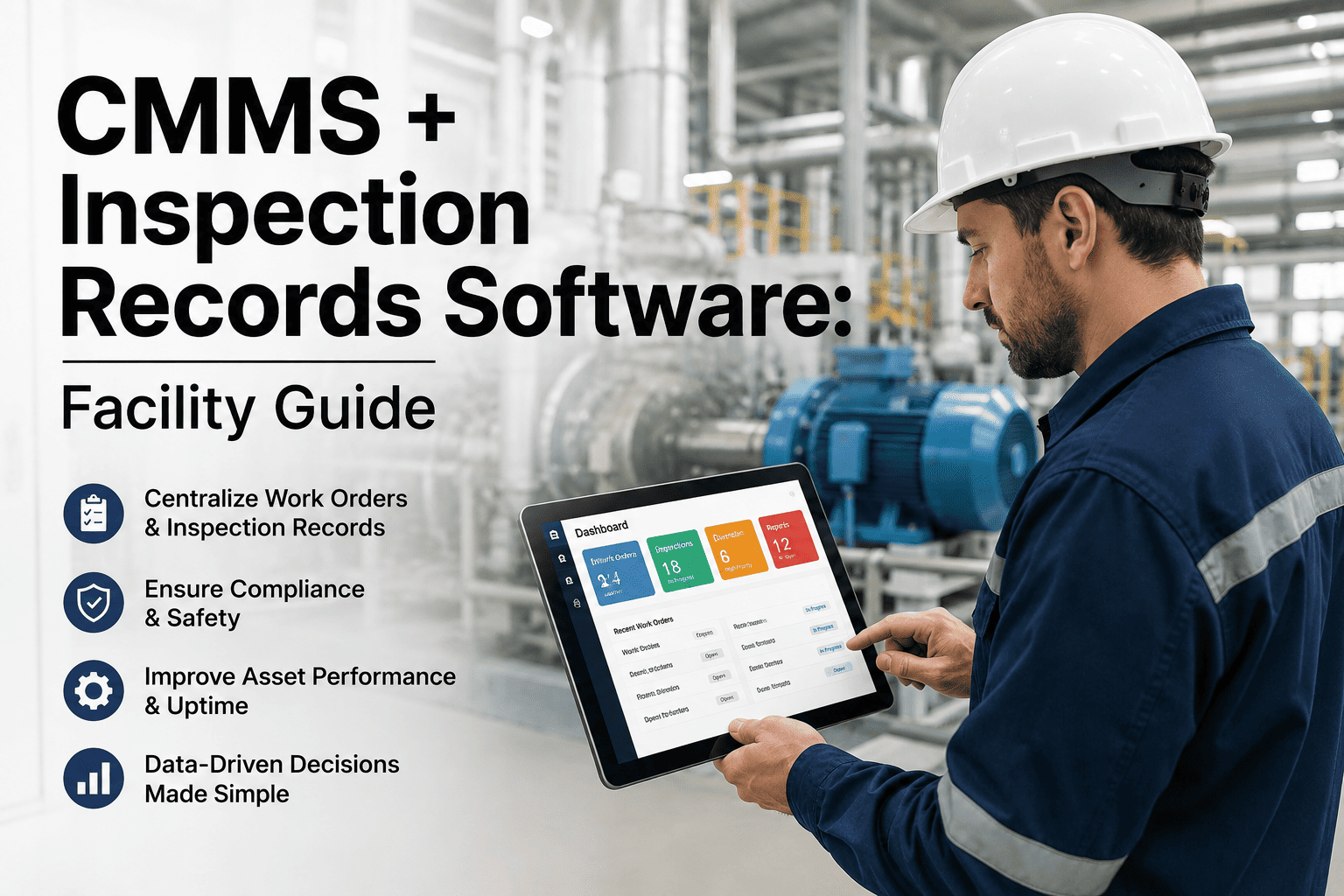
An inspector arrives unannounced, asks for the last six months of exhaust hood inspection records, and the facility manager pulls out a binder with three months missing because the technician who filled them out left the company and nobody continued the log. To an auditor, a record that cannot be produced on the spot is treated exactly the same as an inspection that never happened. This is the quiet failure mode behind most compliance citations — not a genuinely unsafe building, but a paper trail with gaps, illegible handwriting, or a defect that got written down and never turned into an actual repair. CMMS and inspection records software closes that gap by making the inspection, the photo evidence, and the resulting work order all part of the same digital record from the moment a technician taps "defect found" on their phone. Book a demo to see a defect become a tracked work order in under two minutes.
Facility Guide · CMMS + Inspection Records · 2026 Edition
CMMS + Inspection Records Software: Facility Guide
Every inspection checklist, every photo, and every defect lives inside the same system as your work orders — so a flagged item never sits disconnected from the repair that closes it out.
Under 2 min
Time from a flagged defect to a live work order in a connected CMMS
4-24 hrs
Typical delay from defect to work order when inspections still run on paper
4-7
Average number of regulatory inspections a commercial property faces per year
$161,323
Maximum 2026 OSHA penalty per willful or repeat violation tied to undocumented hazards
Where Paper Breaks Down
Four Ways a Paper Inspection Log Fails an Audit
None of these failures come from a genuinely unsafe building. They come from a record-keeping process that was never built to hold up under scrutiny.
01
Records Not Retrievable On Demand
A paper form filed in a site office is not available during an unannounced enforcement visit, and inspectors treat an unproducible record the same as an inspection that was never performed at all.
02
No Photo or Timestamp Evidence
A checkmark on a form without a timestamped, location-stamped photo increasingly fails to satisfy fire marshal and OSHA scrutiny, which now expects visual proof an inspector physically stood at that point.
03
Defects Noted But Never Repaired
A deficiency written on a paper sheet that never gets converted into an assigned, tracked work order becomes an open gap that resurfaces as a repeat finding with escalating penalties.
04
Illegible or Disputed Handwriting
Rushed handwriting on a clipboard creates records that are genuinely disputed later — was that reading a 6 or an 8 — which undermines confidence in the entire log during a formal review.
The Connected Workflow
From Defect Found To Work Order Closed
1
Inspector Flags Defect
Technician marks a checklist item as failed on a phone or tablet during the walkthrough, no return trip to the office required.
2
Photo and Severity Captured
The app prompts for a photo, a severity rating, and a short description before the inspector can move to the next item.
3
Work Order Auto-Generated
Asset ID, defect description, photo, and priority pre-fill a new work order the instant the checklist item is submitted.
4
Technician Notified and Assigned
The assigned technician gets a push notification with the defect photo, asset history, and procedure already attached.
5
Closure Links Back to the Inspection
Completion photos and a digital signature close the loop, and the original inspection record updates automatically.
Stop Losing Defects Between the Clipboard and the Work Order
OxMaint links every inspection checklist to your work order system, so a flagged defect is never more than one tap away from an assigned repair.
The Cost of Disconnected Records
What a Gap Between Inspections and Work Orders Costs
$16,131
Maximum 2026 OSHA fine per serious violation when documentation cannot demonstrate the hazard was addressed
$161,323
Maximum 2026 OSHA fine per willful or repeat violation, common when a defect was noted but never resolved
Repeat Finding
An unresolved defect from a prior inspection is treated as an aggravating factor, not a fresh, first-time issue
Shutdown Risk
Missing or expired certification records on life-safety systems can trigger immediate closure orders from the AHJ
Paper vs Connected CMMS
Paper Inspection Sheets vs a Connected Inspection-to-Work-Order System
Findings sit on paper until someone manually re-keys them into a work order
No photo evidence tied to the exact checklist item that failed
Records stored in site offices are not retrievable during a surprise audit
A closed repair has no automatic link back to the inspection that raised it
Failed checklist items generate a work order automatically, with zero re-entry
Photo and timestamp evidence attached to every flagged defect by default
Full inspection history retrievable in seconds from any device, anywhere
Every closed work order stays permanently linked to its originating inspection
What to Look For
Features That Actually Connect Inspections to Maintenance
Many platforms sell "inspections" and "work orders" as two separate modules that never truly talk to each other. These are the capabilities that determine whether they actually function as one system.
| Capability |
What It Should Do |
Why It Matters |
Status |
| Automatic deficiency-to-work-order conversion |
Failed checklist item creates a work order without manual re-entry |
Removes the most common point where defects get lost |
OxMaint native |
| Mandatory photo capture |
Inspector cannot submit a failed item without attaching a photo |
Produces the visual evidence auditors and insurers now expect |
OxMaint native |
| Offline mobile execution |
Checklists work in basements, plant rooms, and low-signal areas |
Keeps inspections happening in the exact areas most likely to fail |
OxMaint native |
| Two-way traceability |
Every work order links back to the inspection and item that raised it |
Lets an auditor trace a finding from defect to closure in one view |
OxMaint native |
| Searchable audit archive |
Full inspection and repair history exportable by asset, site, or date range |
Turns a multi-day audit prep into a query that runs in seconds |
Configured during setup |
The mistake most facilities make is buying an inspection app and a maintenance system separately and assuming the export-import process between them counts as integration. It does not. The moment a defect has to be re-typed by a human into a different system, you have reintroduced the exact failure point digital tools were supposed to remove — a transcription error, a missed item, a defect that sits in someone's inbox for two weeks. A properly connected platform treats the inspection and the work order as two views of the same event, not two separate records that happen to reference each other. That single design decision is the difference between an audit that takes an afternoon and one that takes a week of chasing down paperwork.
LN
Laura Nakamura, CMRP
Certified Maintenance and Reliability Professional, 15 years building inspection and maintenance programs for commercial and healthcare facility portfolios, former compliance systems lead for a multi-site hospital network
Frequently Asked Questions
What actually makes inspection software and a CMMS "connected" instead of just compatible?
A connected system creates the work order automatically the moment a checklist item fails, with no export, import, or manual re-typing step in between.
Sign in to OxMaint to see the automatic conversion in action.
Do inspectors need special training to use a digital checklist in the field?
Most teams are productive within a single shift, since the workflow mirrors the same walkthrough they already perform, just captured on a phone instead of a clipboard.
Book a demo to see the technician-side experience.
Can the system work in mechanical rooms and basements with poor cell signal?
Yes. Checklists, photos, and defect flags are captured offline and sync automatically once the device reconnects to a network, so signal-dead areas never block an inspection.
How does this help during an unannounced regulatory or insurance audit?
Every inspection, photo, and linked repair is retrievable in seconds by asset, site, or date range, replacing what used to be a multi-day scramble through filing cabinets.
Sign up free to see the audit export.
What happens to a defect that is flagged but not fixed right away?
The work order stays open and visible on the dashboard until it is closed, so an unresolved defect cannot quietly disappear the way a paper note easily can.
Book a demo to see how open items are tracked.
One Defect. One Photo. One Work Order. No Gap In Between.
OxMaint connects every inspection checklist directly to your work order system, so a flagged defect becomes a tracked, photo-documented repair in under two minutes.