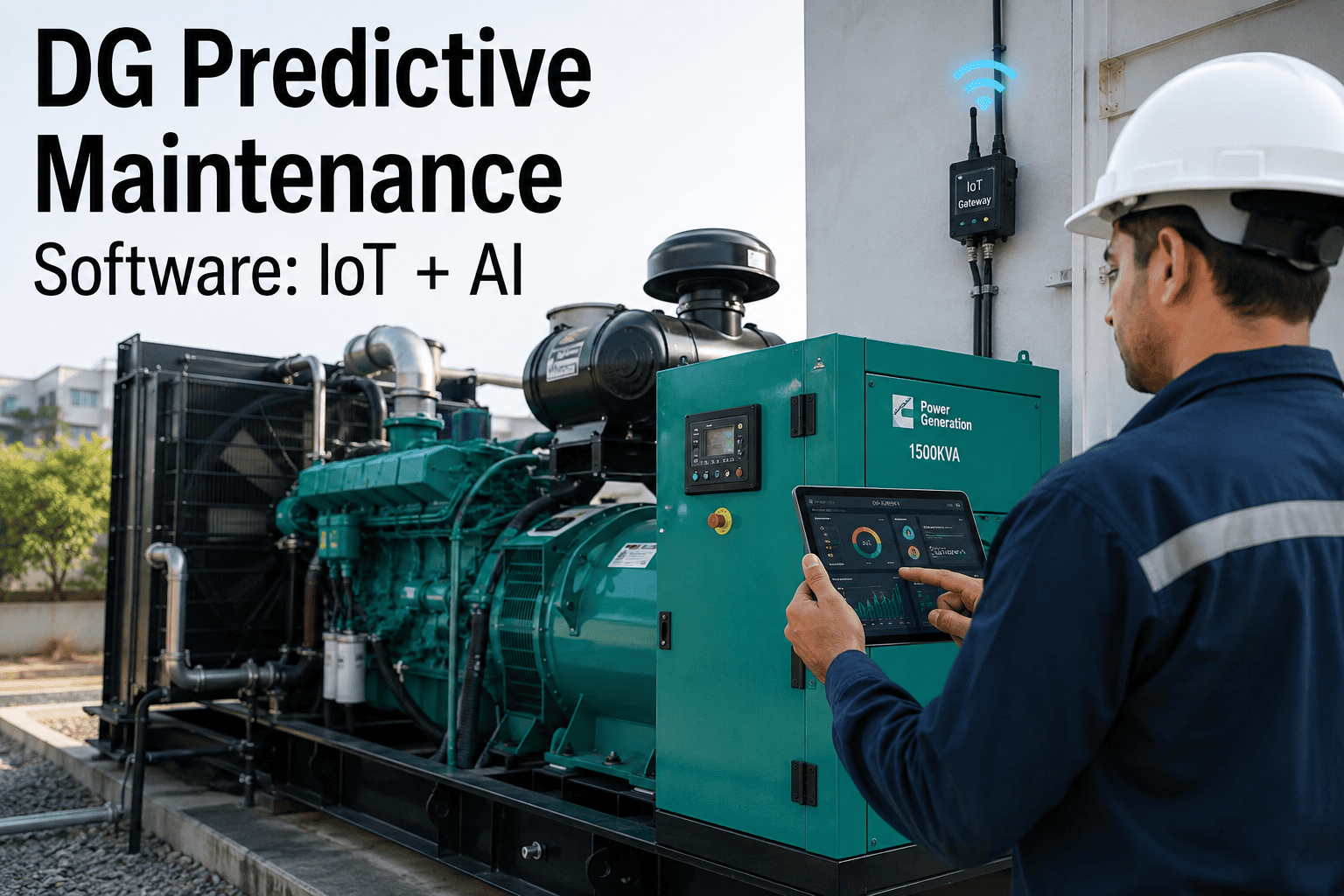
When mains power fails, a diesel generator is supposed to take over in seconds — but a silently degrading battery or a clogging fuel filter can leave a critical facility running on nothing at all. Most DG failures are never sudden surprises; they build up for days or weeks inside voltage curves, coolant temperatures, and fuel readings nobody is watching between rounds. A monthly or quarterly inspection only catches what is wrong on that one visit, so a battery that starts failing on day twelve goes unnoticed until it strands an operating room, a server rack, or a production line. IoT sensors paired with AI models flip that timeline by reading generator health every few seconds and surfacing trouble long before the next scheduled walk-through. See how that shift works for a real DG fleet at app.oxmaint.ai.
DG Predictive Maintenance Software Built On IoT + AI
OxMaint reads battery, fuel, coolant, and load signals in real time and turns them into early warnings — so your team schedules the repair instead of reacting to the outage.
Built for facility, biomedical, and energy teams running standby DG fleets across hospitals, data centers, telecom towers, and manufacturing plants — one dashboard replaces the clipboard rounds, the spreadsheet log, and the guesswork about which unit needs attention next.
Why Scheduled Checks Still Let Generators Fail
Calendar-based preventive maintenance only tells you the truth on the day someone shows up with a clipboard. Between visits, batteries sulfate, injectors clog, and coolant chemistry drifts — and none of it shows on a monthly checklist until the generator refuses to start. Facility teams that switch to continuous sensor monitoring stop guessing at intervals and start reacting to the actual condition of the asset.
Battery degradation is not the only blind spot. Fuel system problems from diesel degradation account for another 15 to 20 percent of start failures, cooling system issues from extended idle periods add 10 to 15 percent more, and control system faults contribute a further 10 percent. Each of these builds quietly, and a once-a-month inspection has roughly a one-in-thirty chance of landing on the exact day a problem is visible.
How Predictive Maintenance Actually Works
Five steps turn raw sensor noise into a repair that happens on your schedule, not the generator's.
Capture
Sensors log voltage, current, coolant temperature, fuel quality, and load data every few seconds instead of once a month.
Analyze
Machine learning compares live readings against thousands of documented failure signatures to spot drift early.
Alert
Technicians receive a plain-language warning days to months ahead — not an emergency callout at 2 a.m.
Resolve
The fix happens in a planned window, with the right part and technician already assigned in OxMaint.
Verify
Sensor readings confirm the fix held, and the failure signature updates the model for the next unit in your fleet.
See Your DG Fleet's Health Before It Fails
Connect your generators to OxMaint and get early, plain-language warnings instead of emergency callouts — most teams are live within weeks. Bring your battery, fuel, and coolant data into one dashboard and let the model tell you which unit needs attention first.
Reactive vs. Scheduled vs. Predictive DG Maintenance
The gap between "we found out when it failed" and "we knew three weeks early" is the entire business case for predictive maintenance.
| Approach | How The Fault Is Found | Typical Warning Time | Downtime Risk | Cost Impact |
|---|---|---|---|---|
| Reactive (run-to-failure) | Generator fails to start during an outage | None | High — unplanned outage | Highest — emergency repair plus lost uptime |
| Scheduled (calendar PM) | Manual inspection, monthly or quarterly | Hours to days, if timing aligns | Medium — gaps between visits | Moderate — parts swapped too early or too late |
| Predictive (IoT + AI) | Continuous sensor monitoring with ML pattern detection | 72 hours to 6 months | Low — repair is planned | Lowest — right part, right time, no overtime |
| Prescriptive (2026 frontier) | AI monitoring plus automated corrective recommendations | 72 hours to 6 months | Lowest — action is suggested automatically | Lowest — parts and labor pre-scheduled |
The pattern holds across every fleet size: the earlier a fault is visible, the cheaper and less disruptive the fix. Predictive monitoring does not remove the need for technicians — it removes the guesswork about which generator needs them next.
What OxMaint's DG Predictive Platform Delivers
Continuous Sensor Monitoring
Voltage, current, coolant temperature, fuel quality, and load are tracked every few seconds through connected IoT hardware.
Failure Pattern Recognition
Models trained on real battery, fuel, and cooling failure signatures flag drift long before a hard stop.
Plain-Language Alerts
Technicians get "battery degradation, predicted failure in 14 days," not a raw sensor dump to interpret.
Automated Work Orders
Every flagged issue becomes a scheduled work order with the right part and technician already assigned.
Fleet-Wide Health Dashboard
Every DG unit across every site shows up on one screen, ranked by risk, so nothing gets missed between locations.
Manufacturer-Aligned PM Templates
Preventive schedules follow each generator's manufacturer instructions, so predictive alerts and routine PM stay in sync.
Where Predictive DG Maintenance Pays Off
Facilities that switched from manual checks to connected monitoring are already seeing the difference in uptime and cost.
Data Centers
A regional data center cut DG failure rates by roughly 50% after moving to predictive monitoring, protecting always-on server load.
Mining & Remote Sites
Remote IoT monitoring cut generator downtime by about 40% at an off-grid mining operation, without adding site visits.
Hospitals & Healthcare
Early battery-degradation alerts give biomedical and facilities teams weeks of lead time before a backup generator is needed on the floor.
Manufacturing & Industry
Plants pairing predictive maintenance with load optimization have reported around 15% better fuel efficiency on their DG sets.
Telecom & Remote Towers
Sites that are expensive or slow to reach benefit most from early alerts, since a predicted fault can be fixed in one planned trip instead of two.
Commercial Real Estate
Property teams managing standby power across several buildings use fleet-wide dashboards to prioritize which generator needs a technician first.
Frequently Asked Questions
Stop Finding Out About Generator Failures The Hard Way
Join facility teams using OxMaint to turn silent DG failures into scheduled, planned repairs.