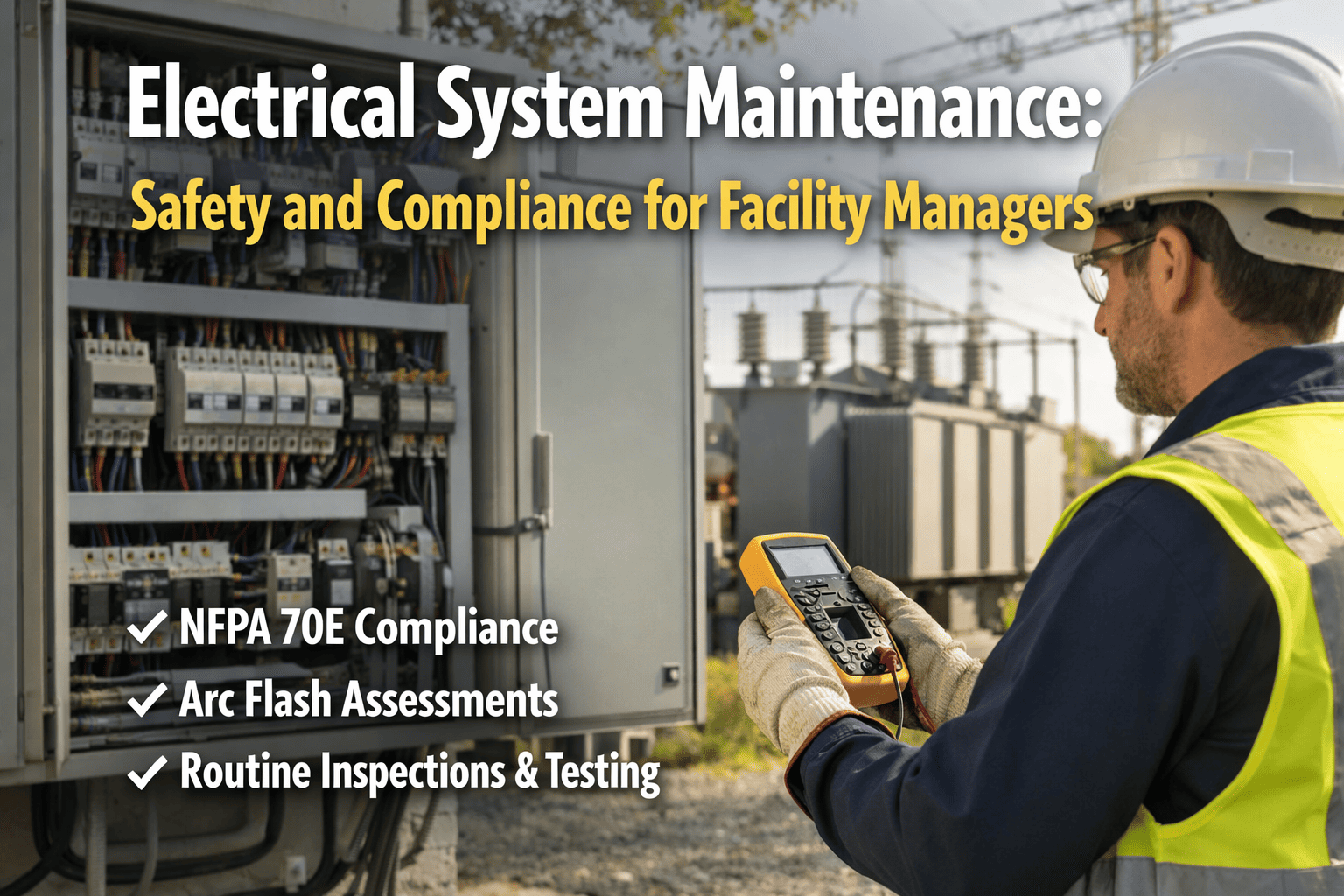
Electrical Systems Maintenance: Building Safety

By Arman Tsarukyan on March 19, 2026

electrical-systems-maintenance-buildings-safety

Electrical systems are the most dangerous and most under-maintained asset class in commercial buildings. They are invisible until they fail — and when they fail, the consequences range from nuisance outages to catastrophic fires. The U.S. electricians industry reached $347.5 billion in 2026, driven largely by demand for maintenance, code compliance retrofits, and safety upgrades in aging commercial infrastructure. NFPA 70B transitioned from a recommended practice to a mandatory standard in 2023, making structured electrical preventive maintenance a legal requirement for most commercial facilities — not just best practice. Buildings that still manage electrical PM on spreadsheets and paper binders are one missed panel inspection away from an insurance claim, a failed audit, or an arc flash incident. Sign up free to see how Oxmaint structures electrical PM programmes for commercial facilities, or book a demo and we will walk you through the platform live.

Run Your Electrical PM Programme From One Platform — Not a Folder of Paper Records.

Oxmaint gives facility teams digital inspection checklists, NFPA 70E arc flash records, thermal imaging schedules, breaker test logs, and audit-ready compliance documentation — all linked to individual panel and switchgear assets. Deploys in days. No consulting required.

$347.5B US electricians industry in 2026 — maintenance and safety upgrades are the fastest-growing segment
4.8x Cost of emergency electrical repair vs planned preventive maintenance — the core financial argument for structured PM
20–40% Documented repair and energy cost savings achieved by facilities with structured electrical PM programmes in place
2023 Year NFPA 70B became a mandatory standard — making structured electrical PM a legal obligation for commercial facilities

What Electrical Systems Maintenance Covers in Commercial Buildings

Commercial electrical maintenance is a structured programme of inspections, testing, and preventive repairs that keeps every distribution, emergency, and safety system operating within safe parameters. It is not a one-off inspection event. It is a recurring schedule tied to each asset's risk profile, regulatory requirement, and operational criticality.

NFPA 70B
Recommended Practice for Electrical Equipment Maintenance — now a mandatory standard for commercial facilities requiring documented inspection and testing intervals for all distribution, emergency, and safety electrical equipment.
NFPA 70B: Standard for Electrical Equipment Maintenance, 2023 Edition
Three Core Programme Areas
Distribution Panels, switchgear, transformers, power distribution units — the building's primary power infrastructure
Emergency Systems Generators, UPS, ATS, emergency lighting — systems that must function precisely when primary power fails
Safety Equipment Arc flash labels, LOTO procedures, PPE requirements, ground fault protection — personnel protection framework
Compliance Records Inspection logs, test results, thermal scan reports, certification status — the audit documentation layer

Complete Electrical Maintenance Schedule by System

Every electrical asset class has its own inspection frequency, testing protocol, and documentation requirement. The table below maps the full commercial building electrical programme to NFPA 70B and OSHA requirements.

Asset / System Daily / Weekly Monthly Quarterly Annual
Main Distribution Panel Visual check for heat, smell, sound anomalies Thermal imaging scan of all breakers and bus bars Torque verification of all lugs and terminals Full infrared scan, insulation resistance test, arc flash label review
Switchgear and MCCs Indicator light status check Dust and contamination removal; connection inspection Breaker operation test under load Full dielectric test, contact resistance measurement, relay calibration
Transformers Temperature gauge and cooling fan check Oil level and leak inspection (oil-filled) Vibration and noise assessment; connection torque Oil sampling, insulation resistance test, turns ratio test
Emergency Generator Fuel level and battery voltage check No-load start and 15-minute run test Full-load transfer test; coolant and oil check Load bank test at 100% rated capacity; exhaust and emissions inspection
UPS Systems Runtime and alarm status check Battery voltage and discharge rate check Full discharge and recharge cycle test Battery replacement assessment; full load test under bypass
Ground Fault Protection GFCI outlet test in wet areas GFCI breaker trip test in all circuits Ground fault relay sensitivity check Full ground fault coordination study review
Emergency Lighting Visual indicator check 30-second discharge test per NFPA 101 Battery capacity assessment Full 90-minute discharge test; luminaire replacement programme
Arc Flash PPE Station PPE availability check PPE condition inspection and labelling audit Arc flash label currency check on all panels Full arc flash hazard study review per NFPA 70E

8 Electrical Maintenance Failures That Cost Facilities the Most

These are not theoretical risks. Every one of these failure modes appears in commercial buildings operating without structured electrical PM programmes — and every one is preventable with scheduled inspection and digital work order management.

Loose Terminations
Thermal expansion and contraction under varying electrical loads loosens wire lugs over time. Loose terminations create resistance, generate heat, and initiate fires. Most common single finding in annual infrared surveys — and entirely prevented by quarterly torque verification work orders.
Lapsed Arc Flash Labels
Arc flash hazard studies must be reviewed every 5 years per NFPA 70E, or whenever the electrical system changes. Labels applied in 2019 for a system that has been modified since are not compliant. Technicians working from outdated labels face incorrect PPE assignments and unquantified incident energy exposure.
Generator Wet Stacking
Generators run on no-load or light-load test cycles accumulate unburned fuel in exhaust systems — wet stacking. It reduces performance and damages the engine. Annual load bank testing at 100% rated capacity prevents it. Most facilities skip load bank tests because scheduling them requires advance planning that paper-based PM systems do not support.
Overloaded Circuits
Smart building upgrades, EV charging stations, and additional IT loads added to buildings designed for 2000s-era electrical demand are creating systematic circuit overloading that facility electrical records do not reflect. Load surveys are annual maintenance items. Buildings without them are operating circuits above rated capacity without knowing it.
Missing LOTO Procedures
OSHA 29 CFR 1910.147 requires documented lockout/tagout procedures for every panel and circuit before any maintenance work. Facilities relying on verbal instruction or generic LOTO templates instead of asset-specific procedures are in violation before any inspection begins. OSHA penalties for LOTO violations average $15,625 per citation in 2026.
Thermal Scan Gaps
Annual thermal imaging surveys are the single most cost-effective electrical maintenance intervention available. A $500 infrared scan identifies hot spots that would cost $50,000 to $500,000 to remediate after a fire or failure event. Buildings that skip annual thermal scans because they have no PM scheduling system to trigger them are taking unnecessary risk with quantifiable financial consequence.
UPS Battery Degradation
UPS batteries degrade silently. A battery that shows 100% state-of-charge in a monitoring display may deliver 40% of rated runtime under actual load at elevated temperature. Quarterly discharge testing under load is the only method that reveals actual available runtime. Data centre and healthcare facilities that discover UPS battery degradation during an actual outage face consequences far exceeding the cost of a quarterly test programme.
Compliance Record Gaps
Insurance underwriters, regulatory inspectors, and property due diligence teams all require documented evidence of a structured electrical PM programme. Paper binders with inconsistent dates, missing test results, and undated thermal scan reports do not satisfy any of these requirements. The facility that cannot produce an electrical maintenance history loses the insurance claim, fails the audit, and depresses the property valuation.

How Oxmaint Manages the Complete Electrical PM Programme

Oxmaint structures every electrical asset — from individual panels and breakers to generator sets and UPS systems — as a digital asset record with its own PM schedule, compliance calendar, and inspection history. No paper binders. No spreadsheet reminders. No missed arc flash review cycles.

Asset Registry
Digital Panel and Switchgear Register
Every panel, MCC, transformer, UPS, and generator registered with location, rated capacity, installation date, last test date, and next inspection due. Arc flash labels, panel schedules, and circuit maps attached to each asset record — accessible on mobile from the panel floor.
PM Scheduling
NFPA 70B-Aligned Inspection Calendars
PM schedules for each asset class configured to NFPA 70B intervals — thermal scans, torque verification, load tests, discharge tests, and arc flash reviews all auto-scheduled as recurring work orders. Zero missed cycles. Every overdue item visible on the compliance dashboard before it becomes a violation.
Safety Compliance
Digital LOTO and Arc Flash Procedures
Asset-specific LOTO checklists built into every work order for panels and circuits — ensuring technicians complete OSHA-mandated isolation steps before opening any enclosure. Arc flash PPE requirements assigned per panel based on incident energy level. Every LOTO completion digitally signed and timestamped.
Thermal Imaging
Infrared Scan Scheduling and Record Management
Annual thermal imaging work orders auto-scheduled per panel. Scan reports, hot spot images, and remediation findings attached directly to the panel asset record. Trending of thermal findings across years identifies developing issues before they reach failure threshold — the predictive layer that calendar-only maintenance cannot deliver.
Emergency Systems
Generator and UPS Test Programme Management
Monthly no-load starts, quarterly load transfer tests, and annual load bank tests scheduled as recurring work orders for every generator. UPS quarterly discharge tests with runtime measurement logged against each unit. ATS transfer time recorded at every test — building the performance history that insurance and due diligence require.
Audit Readiness
Continuous Compliance Record Generation
Every inspection completed, every test performed, every thermal scan attached — audit-ready from the first day of operation. Regulatory inspections, insurance underwriting reviews, and property due diligence requests answered in minutes, not days. Export in any required format with digital signatures and timestamps intact.
Mobile Field Access
Panel Floor Operations Without Paper
Technicians scan QR codes on panels to pull up current inspection checklists, last test results, arc flash labels, and LOTO procedures on their mobile device. Work order completion, photo documentation, and digital signatures captured in the field. Zero paper, zero administrative overhead, zero lost records.
Compliance Tracking
NFPA 70E Arc Flash Study Renewal Alerts
Every arc flash hazard study expiry date tracked in Oxmaint with automatic 90-day advance work orders to initiate the renewal process before the 5-year NFPA 70E deadline. System modification events trigger arc flash review alerts automatically — ensuring labels are always current for the system as it actually exists today.

Reactive Electrical Management vs. Structured PM with Oxmaint

These are the operational and financial differences that separate facilities running structured electrical PM from those responding to failures as they occur.

Performance Factor Structured PM with Oxmaint Reactive Electrical Management
Thermal Hot Spots Detected annually by scheduled infrared scan. Remediated at planned cost before failure. Findings tracked per panel across years to identify developing trends. Discovered at failure event — fire, tripped breaker, or melted lug. Emergency electrician at 4.8x standard rate. Insurance claim and production downtime follows.
NFPA 70E Compliance Arc flash study renewal auto-scheduled 90 days before expiry. PPE requirements assigned per panel in work orders. Every technician working from current incident energy data. Arc flash labels from 2018 still in place on modified systems. Technicians using incorrect PPE class. OSHA violation and personal liability exposure on every panel access.
Generator Reliability Monthly starts, quarterly transfer tests, annual load bank tests on schedule. Performance history shows runtime trend. No wet stacking. Full capacity at every real outage event. Generator tested when someone remembers. Wet stacking reduces capacity over time. Discovery during an actual outage that generator runs at 60% rated capacity.
Insurance and Audit Complete electrical PM history exportable in minutes. Every inspection, test, and thermal scan documented with timestamps and digital signatures. Insurance underwriter satisfied in one meeting. 2–5 days assembling paper records before each audit. Gaps standard. Insurance claim disputed because maintenance documentation does not demonstrate due diligence.
OSHA LOTO Compliance Asset-specific LOTO checklists built into every work order. Completion digitally signed. Every isolation step confirmed before panel access. Zero generic LOTO violations. Verbal LOTO instruction or generic templates applied to all panels. OSHA 29 CFR 1910.147 violation on every work order. Average citation penalty $15,625 per finding in 2026.
Maintenance Cost 20–40% lower total electrical maintenance cost. Planned work eliminates emergency call-out premiums. Condition-based component replacement replaces time-based calendar programmes. Emergency call-out rates at 4.8x standard. Unplanned transformer replacement at $25,000–$150,000 premium when no lead time allows standard procurement.

Electrical PM Compliance by Region — What Building Managers Must Meet

Every commercial property market has its own statutory framework for electrical safety inspection and documentation. Oxmaint configures inspection intervals and compliance record formats per site jurisdiction under one unified platform.

Region Primary Frameworks Key Electrical PM Obligations Oxmaint Coverage
USA NFPA 70B, NFPA 70E, OSHA 29 CFR 1910.147, NEC, Local Law 97 energy reporting PM documentation per NFPA 70B, arc flash studies per NFPA 70E, LOTO procedures per OSHA 1910.147 NFPA-aligned PM schedules, digital LOTO checklists, arc flash record management, thermal scan scheduling
UK BS 7671 (IET Wiring Regulations), PUWER 1998, Electricity at Work Regulations 1989, HSE guidance Fixed wire testing every 5 years, portable appliance testing, periodic inspection and certification Fixed wire test scheduling, PAT programme management, EICR documentation per asset record
UAE DEWA regulations, OSHAD-SF electrical safety, Dubai Civil Defence fire and electrical codes, SASO Annual electrical inspections, emergency system testing, compliance certificate tracking Inspection scheduling, certificate expiry alerts, compliance dashboard across multi-site portfolios
Australia AS/NZS 3000, Work Health and Safety Act, state electrical safety legislation, NABERS energy reporting Periodic verification inspections, RCD testing, emergency evacuation lighting compliance RCD test scheduling, emergency lighting programme, energy consumption tracking for NABERS
Germany BetrSichV, DIN VDE standards, DGUV regulation, GEG 2024 energy efficiency, TUV inspection Periodic electrical equipment inspection per BetrSichV, TUV inspection documentation TUV interval scheduling, inspection records per DIN classification, compliance documentation archiving
Canada CSA C22.1 Canadian Electrical Code, Provincial OHS Acts, NFPA 70E adopted by most provinces Inspection and testing per provincial electrical safety authority, arc flash programme documentation Multi-province compliance dashboards, inspection audit trails, arc flash record management
30%
Electrical Maintenance Cost Reduction
Total electrical maintenance spend reduction vs reactive baseline — documented in year one of structured PM deployment across commercial FM operations
$15,625
OSHA LOTO Citation Penalty
Average OSHA penalty per LOTO violation citation in 2026. Digital asset-specific LOTO checklists in Oxmaint eliminate this exposure on every work order
40%
Energy Cost Reduction
Buildings with structured electrical PM and load balancing programmes documented 20–40% energy cost savings versus unmanaged electrical infrastructure
Days not weeks
Deployment Timeline
Oxmaint deploys electrical asset registers, PM schedules, LOTO templates, and compliance dashboards in days — with no implementation consultants required

Stop Managing Electrical PM on Paper. Start Today — Free.

1,000+ commercial facility operations use Oxmaint to replace paper-based electrical maintenance with structured PM schedules, digital LOTO procedures, arc flash record management, and audit-ready compliance documentation. No credit card. No consulting fees. Operational in days.

Frequently Asked Questions — Electrical Systems Maintenance

Questions from facility managers and maintenance directors building or upgrading electrical PM programmes in 2026. Sign up free or book a demo to see how Oxmaint maps to your building's electrical asset base.

How often does a commercial building electrical panel require inspection under NFPA 70B?
NFPA 70B (2023 edition, now a mandatory standard) requires annual maintenance inspections for electrical distribution equipment including panels and switchgear, with infrared thermographic surveys at a minimum annual frequency. High-risk environments including healthcare, data centres, and critical manufacturing warrant semi-annual thermal scans. In addition, NFPA 70E requires arc flash hazard studies to be reviewed every 5 years or whenever the electrical system is modified in a way that could affect incident energy levels. Oxmaint auto-schedules all of these intervals per asset — ensuring nothing is missed regardless of personnel changes or maintenance team turnover. Sign up free to configure your panel inspection schedule, or book a demo to see the NFPA 70B programme built out for a commercial building fleet.
What is arc flash protection and why does it matter for building maintenance teams?
An arc flash is an electrical discharge through the air between energised conductors or between a conductor and ground — releasing a burst of thermal energy, pressure, and light that can be lethal at distances up to 10 feet. NFPA 70E requires building facilities to conduct arc flash hazard studies for all electrical distribution equipment, label each panel with the incident energy level and required PPE class, and ensure every technician working on energised equipment is trained on the correct PPE and procedures for that specific panel. Facilities without current arc flash labels and NFPA 70E-compliant LOTO procedures are in violation on every panel access event. Oxmaint attaches arc flash labels and PPE requirements to individual panel work orders, so every technician receives the correct protective equipment assignment before they open any enclosure. Book a demo to see how arc flash records are managed in Oxmaint, or sign up free to start building your electrical safety programme today.
What does a commercial building generator load bank test involve and how often is it required?
A load bank test connects an artificial load equal to the generator's rated capacity for a sustained period — typically 2–4 hours — verifying that the generator can deliver full rated output under operating conditions. It burns off accumulated carbon and unburned fuel from wet stacking caused by frequent no-load or light-load test cycles, tests the cooling system under actual thermal load, and verifies that voltage and frequency regulation remain within specification throughout the test. Most regulatory frameworks and insurance underwriting standards require annual load bank testing at 100% rated capacity for commercial building emergency generators. Monthly no-load starts and quarterly light-load transfer tests do not substitute for annual full-load testing. Oxmaint schedules monthly, quarterly, and annual generator PM work orders separately — each with the specific test procedure, pass/fail criteria, and documentation requirements for that interval. Sign up free to set up your generator PM schedule, or book a demo to see emergency system PM management in action.
How does Oxmaint handle electrical PM compliance documentation for multi-site portfolios across different regulatory frameworks?
Each property in Oxmaint is configured with the applicable regulatory framework for its site jurisdiction — NFPA 70B and NFPA 70E for US buildings, BS 7671 and Electricity at Work Regulations for UK sites, AS/NZS 3000 for Australian properties, and BetrSichV/DIN VDE for German facilities. Inspection intervals, compliance record formats, and statutory documentation requirements are set per asset based on jurisdiction. Portfolio-level compliance dashboards show all electrical assets across all properties with their current inspection status — giving portfolio directors immediate visibility into compliance exposure without assembling records from individual site teams. The complete electrical PM record for any property can be exported in audit-ready format in under 5 minutes. Book a demo to see the multi-jurisdiction compliance dashboard for your operating regions, or sign up free to configure your first site today.

Oxmaint Is the Electrical PM Platform Built for Compliant Commercial Operations.

Panel inspections. Arc flash record management. Digital LOTO checklists. Generator load test scheduling. NFPA 70B-aligned PM calendars. Audit-ready compliance records from day one. All in one platform. All without implementation consultants. Start free — your first month costs nothing and delivers measurable compliance results.


Share This Story, Choose Your Platform!