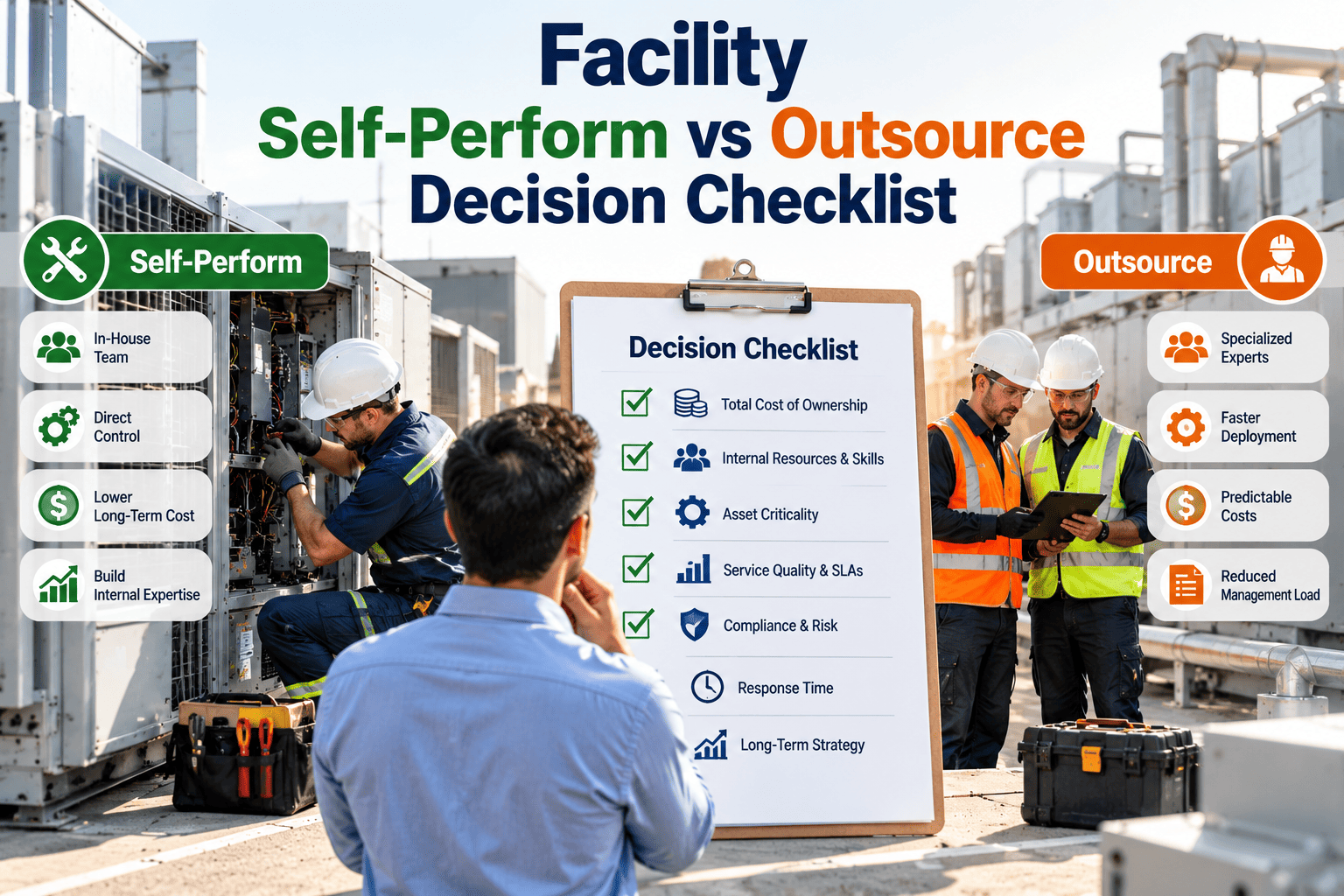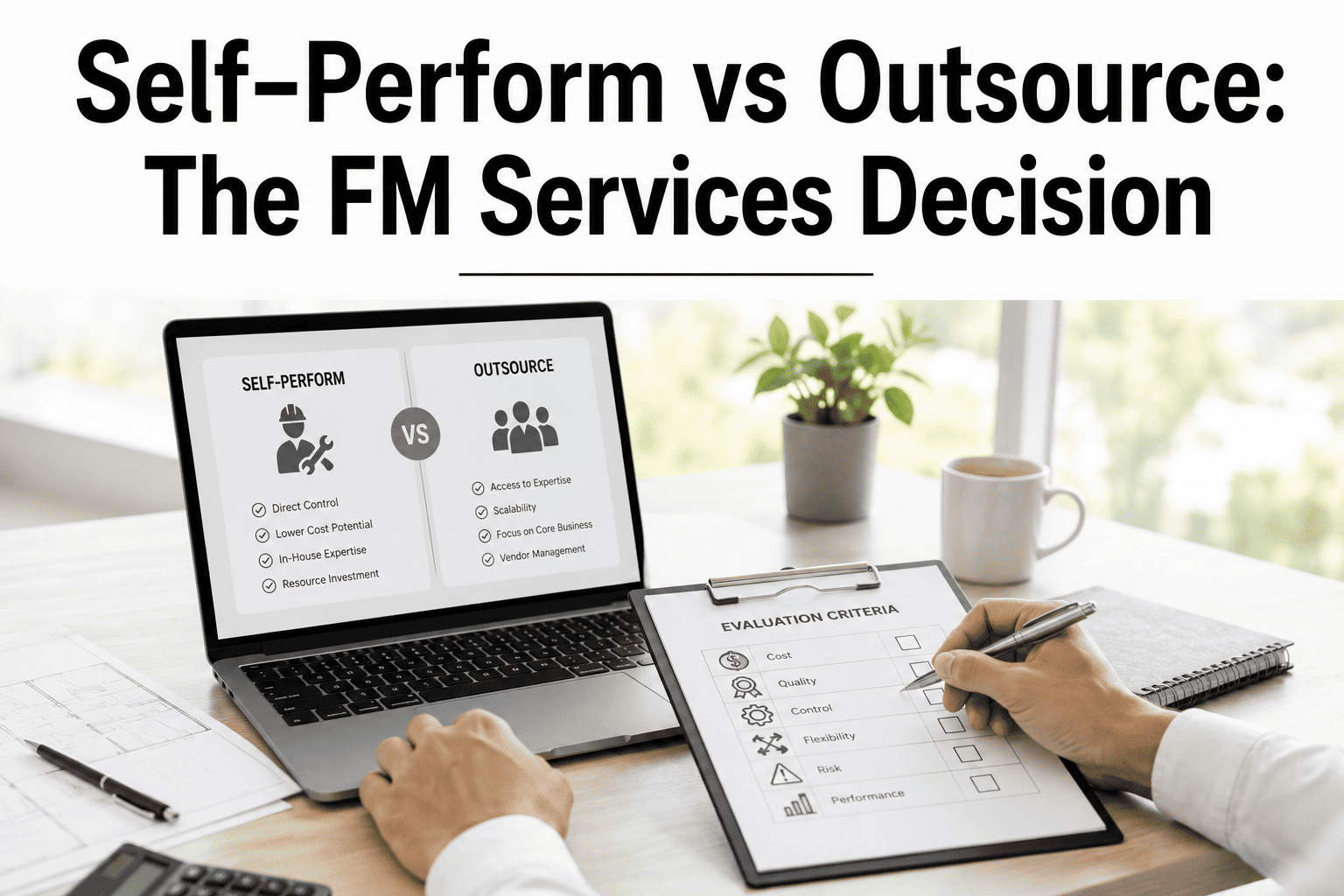
Facility managers are often told to outsource everything or nothing, and both extremes tend to disappoint. Cleaning, security, and elevator service usually outsource well because they are specialized, regulated, or labor-intensive. Controls, tenant-facing engineering, and critical HVAC response are different, since they need building-specific knowledge and fast reaction. A clear suitability matrix helps you decide service by service instead of by habit or budget pressure. See how contractor work can be tracked.
Facility Bundled Services: Which to Outsource First
Score each service on specialization, risk, and building knowledge, then outsource in the right order while keeping control of the data.
Four Questions That Decide Whether a Service Should Leave Your Team
Why Order Matters
Outsourcing everything at once makes problems hard to trace. Start with services that are easy to define and measure, and learn contract management before moving critical work.
Core Versus Non-Core: The Test Behind the Matrix
Facility management guidance usually starts by separating core services from non-core ones. Core services are tied to the mission and typically stay in-house. Non-core services can go to outside providers.
A Simple Customer Test
Ask how your tenants or occupants would react if a service were no longer delivered by your own staff. If the answer is neutral, the service is a strong outsourcing candidate.
Valid Reasons to Outsource
- Facility management is not a core function of your organization.
- You need a workforce that can expand and contract with demand.
- A provider brings specialist skills and best practices you cannot build quickly.
- You want a predictable cost for routine work.
If your only motive is a lower first-year price, pause. That reason alone rarely survives contract reality.
Service-by-Service Outsourcing Suitability
| Service | Suitability | Main Reason | Key Risk |
|---|---|---|---|
| Janitorial cleaning | High | Labor-heavy, routine, easy to specify | Quality drift and turnover |
| Security | High | Licensing, scheduling, and liability handled by vendor | Weak post orders |
| Elevator service | High | Certified technicians and code inspections | Slow response times |
| Landscaping and grounds | High | Seasonal and equipment-heavy | Inconsistent visits |
| Fire and life safety | High | Regulated testing and documentation | Missed inspection dates |
| Commercial HVAC | Mixed | Specialist repairs outsourced, daily rounds kept internal | Slow emergency response |
| Electrical | Mixed | Major work contracted, routine tasks internal | Unclear safety ownership |
| Building automation | Low | Deep system knowledge and cyber exposure | Vendor lock-in |
| Tenant-facing engineering | Low | Relationships and fast judgment calls | Lost tenant trust |
Treat the ratings as a starting point. Local labor markets, building type, and contract terms can shift any row.
A Practical Order for Moving Services to Vendors
Where Each Service Sits on Knowledge and Failure Impact
Cost Beyond the Monthly Fee
| Cost Element | In-House | Outsourced |
|---|---|---|
| Labor | Wages, benefits, overtime, and turnover | Built into the contract rate with vendor margin |
| Training | Paid by you, including certifications | Vendor-paid, but you pay in time if staff rotate |
| Management | Supervisors and scheduling effort | Contract administration and performance reviews |
| Parts and tools | Inventory you stock and track | Often marked up or billed separately |
| Change requests | Reassign staff | Scope changes priced as extras |
| Exit | Redeployment or severance | Transition cost and data recovery |
Hand Off the Work, Not the Records
Track vendor work orders, inspections, and compliance dates in the same system as your internal team.
Single Services, Bundled Services, or One Integrated Provider
- Best specialist for each scope
- More contracts to manage
- Clear accountability per vendor
- Related scopes under one agreement, such as cleaning and waste
- Fewer invoices and meetings
- Check that each service still has its own measures
- One firm runs most services
- Strong convenience, higher dependence
- Needs a capable client-side manager
Bundles work best when services share a workforce or a site, such as cleaning and waste, or HVAC and plumbing. Bundling unrelated scopes mainly adds risk.
Questions to Ask Every Bidder
- Which staff will actually work on our site, and how long have they been with you?
- How do you cover absences, holidays, and after-hours calls?
- What records will we receive, and in what format?
- Which tasks do you subcontract?
- Can we speak with a current client of similar size?
What to Know Before Outsourcing Each Service
Cleaning
- Define scope by area type and frequency, not by headcount.
- Use inspection scores and tenant complaints as measures.
- Specify supplies, equipment, and restroom restocking duties.
Elevator
- Require a maintenance control program matched to the equipment.
- Set entrapment response times in writing.
- Keep copies of inspection certificates and callback history.
Security
- Write post orders for each station and review them yearly.
- Confirm licensing, insurance, and training requirements.
- Audit incident logs for completeness.
HVAC
- Decide who owns daily rounds and who owns repairs.
- Define emergency response by equipment criticality.
- Require service reports tied to specific asset records.
Write the Scope So Vendors Cannot Misread It
- List every asset or area covered, with location and quantity.
- State task frequency, such as monthly filter changes or quarterly inspections.
- Name what is excluded, including parts, after-hours calls, and tenant damage.
- Define reporting format and delivery dates.
- Require documented hand-over of drawings, manuals, and service history.
Define Response by Priority, Not by Hope
| Priority | Typical Example | What the Contract Should State |
|---|---|---|
| Emergency | Elevator entrapment, fire alarm fault, loss of cooling to critical space | Maximum time to arrive, on-call coverage, and escalation contacts |
| Urgent | Tenant comfort failure, door access issue | Same-day target and update interval |
| Routine | Minor repairs, cosmetic issues | Completion window and reporting method |
| Planned | PM and inspections | Calendar, checklist, and proof of completion |
Set the actual time targets with your vendors and your tenants. They differ widely by building type and local labor conditions.
In-House, Outsourced, or Blended: How They Compare
- Strongest building knowledge
- Fast, flexible response
- Higher fixed labor and training cost
- Access to specialist labor
- Predictable monthly cost
- Less control and slower knowledge transfer
- Internal team owns data and critical systems
- Vendors handle specialized and routine scopes
- Requires strong contract oversight
Measures to Write Into Every Service Agreement
Common Mistakes
- Choosing the lowest bid without comparing scope.
- Leaving out reporting requirements.
- Letting vendors keep records in their own systems only.
- Having no one internally accountable for vendor management.
Managing Internal and Vendor Work in One Place
Oxmaint supports preventive maintenance, work orders, asset management, inspections, mobile workflows, and reporting, which helps compare vendor performance against internal results.
What to Track for Each Outsourced Service
| Service | Primary Measures | Evidence to Request |
|---|---|---|
| Cleaning | Inspection scores, complaint count, supply availability | Signed inspection sheets and tenant feedback |
| Security | Post coverage, incident report quality, patrol completion | Daily logs and incident files |
| Elevator | Callbacks, entrapment response, inspection status | Maintenance logs and inspection certificates |
| Fire and life safety | Tests completed on schedule, deficiencies closed | Test reports and impairment records |
| HVAC | PM completion, repeat repairs, first-visit fix | Service reports tied to asset records |
| Grounds | Visit frequency, seasonal tasks, safety hazards | Visit logs and photos |
Review these measures monthly with the vendor, and record agreed corrective actions so progress is easy to verify.
Signs a Contract Is Not Working
- Reports arrive late or lack detail.
- The same fault is repaired repeatedly.
- Your staff spend time fixing vendor misses.
- Tenant complaints rise while vendor scorecards stay green.
How a Blended HVAC and Controls Model Usually Divides the Work
Why This Split Holds Up
The in-house team keeps the building knowledge that makes fast diagnosis possible. Vendors supply scarce certifications and surge capacity without a permanent payroll cost.
Warning Signs You Outsourced Too Much
- No one on staff can explain how the central plant is controlled.
- Vendors hold the only copy of equipment history.
- Every small repair needs a purchase order and a quote.
- Tenant requests wait for a contractor visit that staff could have handled.
Checklist Before You Sign
- Document current scope, cost, and performance for each service.
- Score every service against the four decision questions.
- Write measurable service levels before requesting bids.
- Check references, insurance, and licensing.
- Plan how asset data and history will be handed over.
- Pilot one wave and review results before extending.
Managing Vendors After the Contract Is Signed
Protect Your Data and Your Exit
- Require vendors to log work in your system or deliver structured records.
- Limit vendor access to building automation networks and review it regularly.
- Keep as-built drawings and equipment lists under your control.
- Include transition assistance and a data return clause in every agreement.
Run a Controlled Pilot Before You Commit a Whole Portfolio
- Pick one service and one building, ideally with a stable scope and a clear baseline.
- Record current cost, response times, complaints, and PM completion for at least one full quarter.
- Run the vendor for a defined trial period with the same measures.
- Compare results side by side, including the staff time spent on supervision.
- Decide whether to extend, adjust the scope, or return the service in-house.
Treat the pilot as a learning exercise for your own team as much as a test of the vendor. Write down what surprised you, because those notes shape the next contract. Share the findings with tenants and finance so expectations stay realistic before you expand.
What a Good Pilot Proves
- The vendor can follow your procedures and report in your format.
- Your team can manage the contract without losing site knowledge.
- The measures you chose reflect what tenants actually notice.
- The baseline numbers were accurate enough to support a fair comparison.
Bundled Services Questions
Cleaning and grounds are common starting points because scope and quality are easy to define and inspect.
Often as a hybrid: contractors handle specialist repairs while staff manage rounds and first response.
It can reduce management effort, but compare bundled pricing against separate scopes before deciding.
Track response times and completion in one system. Sign up to centralize vendor work orders.
Yes, if you keep asset history and procedures. Book a demo to see how records stay with you.
Outsource the Right Services and Keep Control of the Results
Use one maintenance platform to compare vendor and internal performance on every asset.