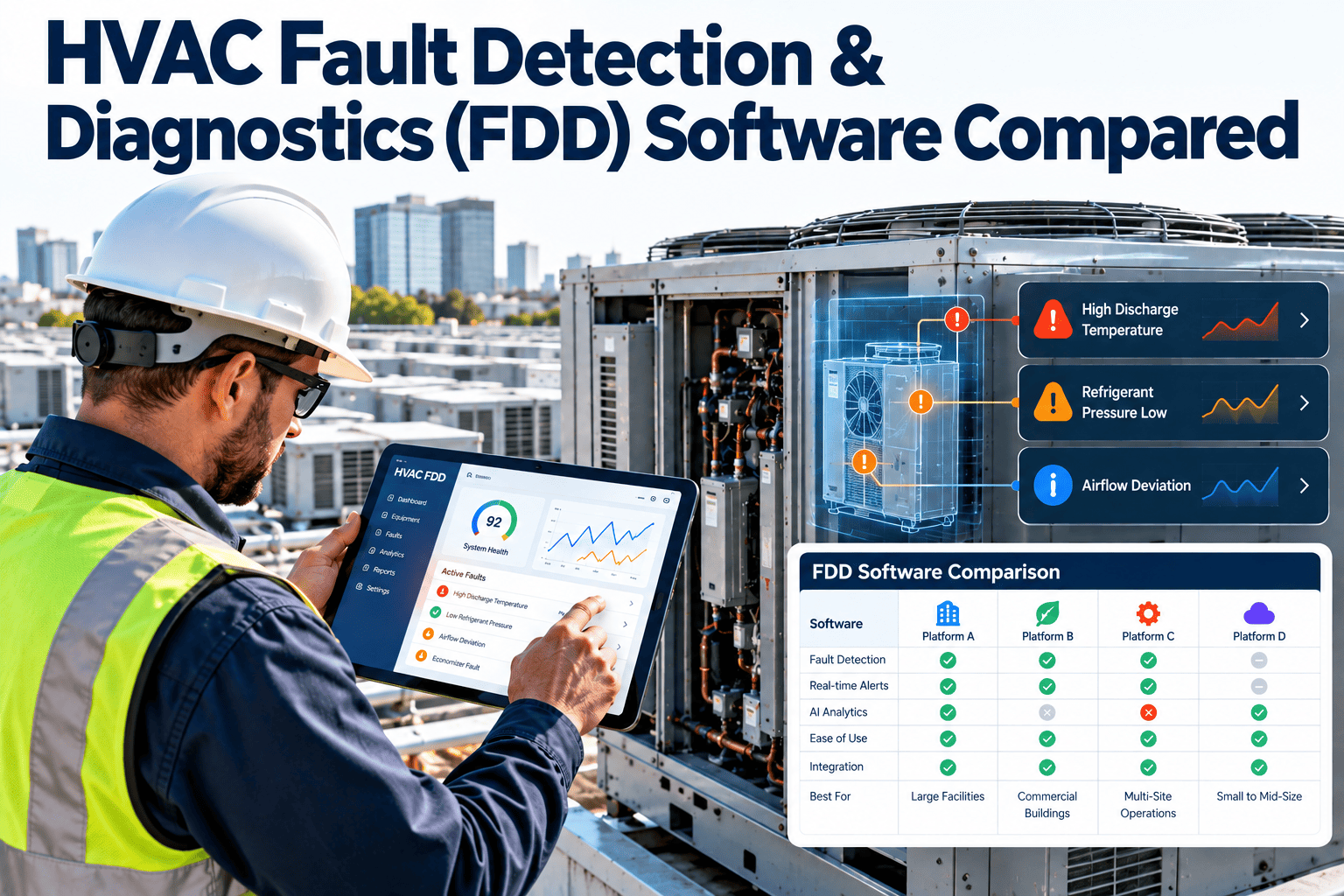
HVAC systems rarely fail loudly. A stuck damper, a drifting sensor, or a valve that leaks heating and cooling at once can run for months while comfort complaints and energy bills creep up. Fault detection and diagnostics software watches building automation data and flags these problems automatically. Choosing a platform matters, but so does what happens after a fault appears, which is where a maintenance system such as Oxmaint turns findings into assigned, tracked repairs.
HVAC Fault Detection & Diagnostics (FDD) Software Compared
Compare how Clockworks, SkySpark, Facilio, and Aquicore approach rules, machine learning, and building coverage, then see how detected faults become completed work.
What FDD Software Actually Finds
Rules-Based vs Machine Learning FDD
- Engineers encode expected behavior as logic
- Faults are explainable and traceable to a condition
- Strong for well-understood HVAC faults
- Needs tuning to avoid false alarms
- Learns normal patterns from historical data
- Can surface unusual behavior rules did not anticipate
- Needs clean, sufficient history
- Results can be harder to explain to technicians
Most mature platforms blend both. Ask any vendor exactly where rules end and models begin, and how faults are explained to the person who must fix them.
Platform Comparison at a Glance
These are general positioning notes, not a verified feature audit. Capabilities change, so confirm each point in a live demo.
| Platform | General approach | Typical strength | Questions to ask |
|---|---|---|---|
| Clockworks | Cloud analytics applied to building automation data, built around curated fault rules | Prioritized fault lists aimed at HVAC and energy teams | How are faults ranked, and how fast do new buildings onboard? |
| SkySpark | Flexible analytics engine with tagged data and custom rule authoring | Deep customization for engineers and integrators | Who writes and maintains the rules in our team? |
| Facilio | Connected building platform pairing analytics with operational workflows | Linking fault detection with operations and portfolio views | How deep is the analytics versus the workflow layer? |
| Aquicore | Commercial real estate performance and energy visibility | Portfolio dashboards and tenant-level insight | How granular is equipment-level fault diagnosis? |
Detection Is Only Half the Job
Route every confirmed fault into a work order with an owner, a priority, and a verified outcome.
An Evaluation Scorecard You Can Reuse
Weight each criterion for your portfolio. The weights below are a starting suggestion, not a standard.
Data Requirements Before You Buy
Trended points
Supply and return temperatures, valve and damper positions, fan status, and setpoints need reliable history.
Consistent naming or tagging
Standard point names or semantic tags let rules apply across many similar units.
Controls access
Confirm how data leaves the building automation system and who authorizes it.
Equipment inventory
Know which air handlers, VAVs, and plant equipment serve which spaces.
Implementation Timeline
- Scope the pilot. Pick one or two buildings with known problems and good controls data.
- Map points and equipment. Match trends to equipment records and fix gaps.
- Tune detection. Review early faults with technicians and remove noise.
- Connect to work orders. Define which faults create tasks automatically.
- Verify results. Confirm faults clear after repair, then expand to more buildings.
Why Faults Pile Up Without a Maintenance Workflow
- Long fault lists with unclear owners
- Technicians unsure which items matter
- No record of what was fixed
- Repeat faults reappear unnoticed
- Each fault becomes a prioritized work order
- Assigned to a named technician
- Repairs, parts, and notes logged to the asset
- Recurring faults trigger root-cause review
How Oxmaint Supports an FDD Program
Oxmaint is a maintenance management platform. It handles the work that follows detection rather than replacing an analytics engine.
- Work orders. Create corrective tasks from FDD findings with priority and due dates.
- Asset management. Keep air handlers, VAVs, valves, and sensors with full repair history.
- Preventive maintenance. Add sensor calibration and damper checks that prevent repeat faults.
- Mobile inspections. Technicians confirm and document fixes on site.
- Inventory. Track actuators, sensors, and filters needed for common fixes.
- Reporting. Show fault-related work, backlog, and repeat repairs by building.
Common Pitfalls to Avoid
Frequently Asked Questions
Is rules-based or ML FDD better?
Neither alone. Look for clear, explainable faults and test accuracy on your own data.
Does FDD replace preventive maintenance?
No. It complements PM by finding issues between scheduled tasks.
Can faults feed a CMMS?
Yes, and Oxmaint can hold the resulting work orders and equipment history.
What data is needed first?
Reliable trended points and consistent equipment naming from your controls system.
How do we plan the workflow side?
You can book a demo to map fault-to-work-order routing.
Why HVAC Faults Persist Unnoticed
Comfort complaints catch only the visible failures. Many costly faults leave occupants comfortable while energy and equipment life suffer.
- Controls mask problems. Automation compensates for a failing component by running other equipment harder.
- Trend data goes unreviewed. Building automation systems log vast amounts of data that nobody has time to inspect.
- Alarms are limited. Standard alarms fire on thresholds, not on patterns like a valve hunting or a damper stuck partly open.
- Sensor errors mislead. A drifting sensor can look like normal operation while driving wrong decisions.
- Staff time is short. Reactive work crowds out proactive investigation.
Questions to Ask in Every Vendor Demo
- Which building automation protocols and brands do you connect to, and how is data extracted?
- How many fault types are included, and can we add or edit rules ourselves?
- How does the platform rank faults by energy, comfort, or maintenance impact?
- What does a fault look like to a technician, and does it explain the likely cause?
- How are false positives handled, and who tunes the system?
- Can faults be pushed into our work order system, and can closed work be matched back to fault clearing?
- What is typically involved in onboarding one building versus fifty?
- Can we see the platform running on a building similar to ours?
- How is pricing structured, by square foot, by point, or by building?
A Practical Fault Prioritization Model
Not every fault needs action this week. Rank findings so the team works on what matters.
| Priority | Criteria | Example | Response |
|---|---|---|---|
| 1: Urgent | Safety, major comfort loss, or equipment damage risk | Coil freeze risk, fan running with failed belt | Same-day work order |
| 2: High | Large ongoing energy waste or critical area impact | Simultaneous heating and cooling on a large air handler | Schedule within days |
| 3: Medium | Moderate waste or developing wear | Damper leakage, valve hunting | Bundle into planned visit |
| 4: Low | Minor inefficiency or data quality issue | Slight sensor offset | Fix during routine PM |
From Fault to Fix: Typical Maintenance Responses
| Detected fault | Likely maintenance cause | Typical work order |
|---|---|---|
| Economizer not opening | Failed actuator, linkage, or sensor | Inspect damper and actuator, test control signal, replace as needed |
| Simultaneous heating and cooling | Leaking valve or poor control sequence | Check valve seating, review sequence, calibrate |
| Supply air temperature off target | Drifting sensor, fouled coil, or low airflow | Calibrate sensor, inspect coil and filters |
| VAV box not reaching setpoint | Stuck damper or airflow sensor error | Test damper stroke, recalibrate airflow |
| Fan running outside schedule | Override left in place or schedule error | Clear overrides, correct schedule |
Cost and Value Considerations
- Licensing model. Understand whether pricing scales with buildings, points, or square footage.
- Internal effort. Budget time for point mapping, tuning, and reviewing faults.
- Repair costs. Finding faults creates repair work, so plan maintenance budget and labor for the fixes.
- Benefit tracking. Define in advance how you will measure results, such as energy changes, fewer complaints, or reduced emergency calls.
- Contract flexibility. Consider a pilot period before committing to the full portfolio.
Considerations by Building Type
Office portfolios
Many similar air handlers and VAV boxes suit rule-based detection that scales across buildings.
Healthcare and labs
Pressure relationships and airflow requirements make fault priorities different from standard offices.
Education campuses
Mixed vintages and controls brands make data integration the main hurdle.
Retail and hospitality
Many smaller rooftop units benefit from simple, high-value fault categories.
KPIs for an FDD and Maintenance Program
Standards and Data Models Worth Knowing
Consistent equipment and point naming makes analytics far easier to scale across buildings.
- Project Haystack. An open tagging approach that describes points and equipment with semantic tags, widely used by analytics platforms.
- Brick schema. An open schema that models building systems and the relationships between equipment, points, and spaces.
- BACnet and other protocols. Common ways building controllers expose data, which determine how readily an FDD platform can connect.
- Vendor naming conventions. If a platform relies on its own mapping, clarify who performs and maintains it.
Ask whether a vendor supports open data models. It reduces lock-in and makes switching or adding tools easier later.
Building the Business Case Without Inflated Claims
- Start with your own data. Identify known problem buildings, energy trends, and recurring comfort calls.
- Use pilot results. Measure faults found, repairs completed, and any energy or complaint changes in the pilot buildings.
- Separate energy from maintenance value. Fewer emergency repairs and longer equipment life matter even where energy savings are modest.
- Account for repair cost. Savings only appear after faults are fixed, so include the work required.
- Be cautious with vendor estimates. Treat percentages from marketing material as hypotheses to test in your buildings.
Roles After Go-Live
| Role | Responsibility | Frequency |
|---|---|---|
| Energy or controls engineer | Review new faults, tune rules, confirm diagnoses | Weekly |
| Maintenance planner | Convert approved faults into scheduled work orders | Weekly |
| Technician | Investigate, repair, and record findings on the work order | As assigned |
| Facility manager | Review KPIs, repeat faults, and budget needs | Monthly |
Preventive Maintenance Tasks That Reduce Repeat Faults
- Calibrate temperature, pressure, and airflow sensors on a schedule.
- Exercise and inspect damper and valve actuators for full travel and tight shutoff.
- Replace filters and clean coils to protect airflow and heat transfer.
- Check belts, bearings, and motor alignment on fans and pumps.
- Review control sequences and schedules after any tenant or occupancy change.
- Verify manual overrides are removed once repairs are complete.
Security and Data Governance Questions
- How does the platform connect to the building network, and does it require inbound access?
- Who owns the data, and what happens to it if the contract ends?
- What security certifications or audits can the vendor share?
- Can access be limited by building, role, or portfolio?
- Does the IT team need to approve the connection method, and how long does that usually take?
Running a Fair Pilot Comparison
- Use the same building. Compare platforms on identical equipment and the same period of data.
- Define success up front. Agree on measures such as valid faults found, false alarm rate, and time to onboard.
- Have technicians validate findings. Field confirmation is the true test of diagnostic quality.
- Track effort. Record the internal hours each platform needs for mapping, tuning, and review.
- Test the workflow. Push several faults into work orders and confirm the handoff works smoothly.
When FDD May Not Be the Right First Step
Software cannot compensate for weak foundations. Address these first if they apply.
- Controls systems that do not trend data reliably or cannot share it.
- No maintenance capacity to act on faults once they are found.
- Equipment so old that replacement is a better investment than diagnosis.
- No equipment inventory or asset records to connect findings to.
Quick Selection Guide
- Need deep customization and have in-house analytics skill. A flexible, rule-authoring platform may fit best.
- Want curated fault detection with minimal rule writing. Look for platforms with maintained rule libraries and prioritization.
- Want analytics tied closely to operations workflows. Evaluate platforms that combine detection with task management, and compare against a dedicated CMMS.
- Managing a commercial real estate portfolio. Prioritize portfolio-level reporting and onboarding speed.
- Running a small portfolio with limited staff. Favor platforms that rank faults clearly so a small team can act on the highest-value items first.
Turn Every Detected Fault Into a Finished Repair
Pair your FDD platform with work orders, asset history, and reporting that prove the fix.