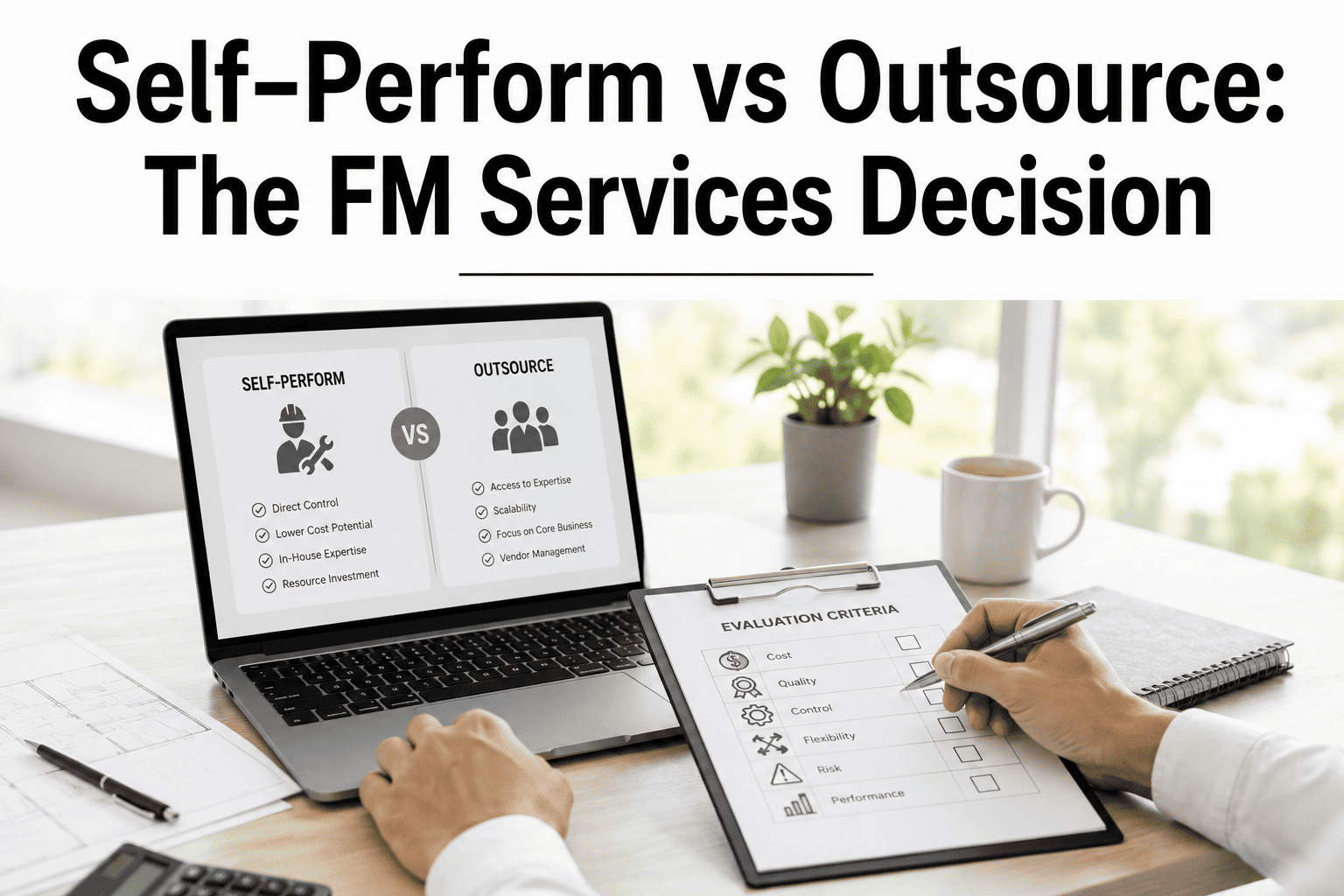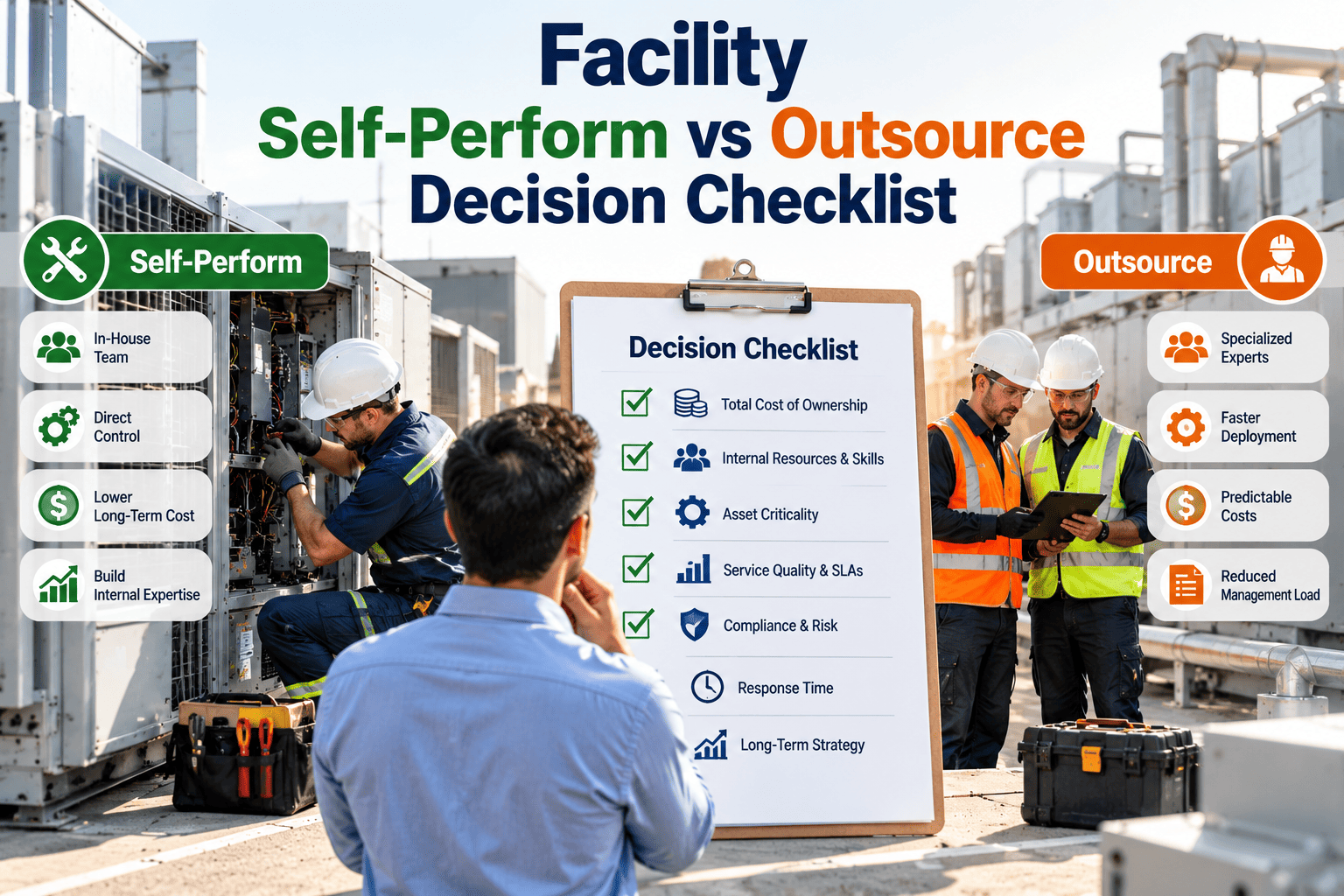
Every facility team eventually asks the same question about each service line: keep the work in-house, or hand it to a contractor? Most organisations answer it one service at a time, in different meetings, using different assumptions, and end up with a patchwork nobody can defend when budgets tighten. This checklist turns the make-versus-buy question into a repeatable score across four lenses: cost, capability, risk, and strategic value. Run it in a single workshop and back every score with real work history from Oxmaint maintenance management software.
Facility Self-Perform vs Outsource Decision Checklist
Score every facility management service on cost, capability, risk, and strategic value, then place it on the sourcing spectrum with evidence instead of habit.
Why Sourcing Decisions Drift Without a Scoring Method
Sourcing choices are usually made after a pain event: a contractor misses a response time, a senior technician retires, or finance asks for a cut. The decision that follows is reactive, and nobody records why it was made.
Decision by habit
- Triggered by a failure, a resignation, or a budget cut
- Each service judged on a different basis
- In-house cost shown as hourly pay only
- Reasoning never written down
- Not revisited until the contract expires
Decision by checklist
- Every service scored on the same four lenses
- Labour, tools, overhead, and contract management priced on one sheet
- Work-order history supplies the real workload
- Red flags and overrides recorded with the score
- Review date set on the day of the decision
The Four Lenses and What a Score Means
Each lens is scored from 1 to 5 by how strongly it favours keeping the work in-house. A 5 means self-perform is clearly better on that lens. A 1 means a contractor is clearly better.
Cost
Capability
Risk
Strategic value
The Per-Service Workshop Checklist
Work through one service at a time. Answer each question with data where possible, then enter a 1 to 5 score for the lens at the end of each group.
Lens 1: Cost
Lens 2: Capability
Lens 3: Risk
Lens 4: Strategic Value
Turning Scores Into a Sourcing Decision
Add the four lens scores for a total between 4 and 20. Use the band as a starting position, then apply the override rules before you commit.
| Total score | Starting position | What to do next |
|---|---|---|
| 15 to 20 | Self-perform | Protect the capability with training, spares, and documented procedures. |
| 10 to 14 | Hybrid | Split the service: routine tasks in-house, specialist or peak work contracted. |
| 4 to 9 | Outsource | Write a performance-based scope with clear service levels and exit terms. |
Override rules
- If a statutory licence is required and you do not hold it, outsource that task regardless of score.
- If a single lens scores 1 on a life-safety service, escalate to a risk review before deciding.
- If no qualified vendor exists locally, treat outsourcing as high risk and build in-house capability.
- If the scores sit within one point of a band edge, run a time-limited pilot instead of a full switch.
Starting Hypotheses by Service Line
These are common starting points, not answers. Your own scores, market, and contracts decide the outcome.
| Service | Common starting lean | Deciding question |
|---|---|---|
| Routine HVAC preventive maintenance | Self-perform or hybrid | Can you cover filters, belts, and inspections with consistent skills? |
| Chiller and boiler overhaul | Outsource | Do you need OEM tools or licensed refrigerant handling? |
| Elevator maintenance | Outsource | Does local law restrict who may service lifts? |
| Fire alarm and sprinkler testing | Hybrid or outsource | Are certified testers available in-house? |
| Janitorial | Outsource or hybrid | Does demand vary by occupancy and shift? |
| Grounds and snow removal | Outsource | Is equipment idle for most of the year? |
| Electrical minor works | Self-perform | Do licensed electricians cover normal workloads? |
| Building automation controls | Hybrid | Who holds programming access and documentation? |
Building a True Cost Comparison
Most sourcing errors come from comparing a contract price with only part of the in-house cost, or the reverse. List both stacks in full.
In-house cost stack
- Wages, benefits, and payroll taxes
- Training and licence renewals
- Vehicles, tools, and test instruments
- Supervision and administration time
- Parts holding and storage
- Cover for absence and out-of-hours work
Contract cost stack
- Contract fee and annual indexation
- Out-of-scope and call-out charges
- Parts markup and consumables
- Contract management and audit time
- Mobilisation and handover
- Exit and re-tendering cost
Sourcing Mistakes the Checklist Prevents
Most poor sourcing outcomes trace back to a handful of repeatable errors. Use this table as a sanity check before approving any change.
| Mistake | What goes wrong | Checklist control |
|---|---|---|
| Comparing price with wages only | In-house looks cheaper than it is, or contracts look dearer than they are | Complete both cost stacks |
| Outsourcing after one bad incident | A people or process problem moves to a new vendor unchanged | Score all four lenses, not just risk |
| Losing asset knowledge | New vendors repeat past failures because history sits with the old team | Strategic value lens, plus records in the CMMS |
| Vague contract scope | Disputes over what is included and constant change orders | Scope sheet used for benchmark quotes |
| No exit plan | Dependence on one provider and weak bargaining power | Governance checklist and review date |
Piloting a Borderline Service
When a service lands near a band edge, a time-limited pilot is safer than a permanent switch. Keep the pilot small and measurable.
- Choose one site, building, or asset group so the comparison stays clean.
- Write the success measures before the pilot starts, using the KPIs in this checklist.
- Run the pilot long enough to include a seasonal peak, usually at least one full quarter.
- Keep the old model available as a fallback until the pilot results are reviewed.
- Record every work order the same way under both models so results compare fairly.
Signs the current model is failing
- Preventive maintenance completion keeps slipping despite reminders.
- The same assets return with repeat faults after each visit.
- Invoices rise faster than workload, and out-of-scope charges grow.
- Key knowledge sits with one person or one account manager.
- Audit findings recur on the same regulated tasks.
Keep Sourcing Evidence in One Place
Oxmaint records labour hours, parts, and response times for in-house and contractor work, so your next sourcing review starts with facts.
Running the Decision in One Workshop
A single half-day session works when the data is gathered beforehand. Invite operations, finance, safety, and procurement so no lens is scored by one department alone.
After the Decision: Governance Checklists
Choosing the model is the easy part. The decision only holds if you run the chosen model with discipline.
If you self-perform
- Keep a skills matrix and training plan per technician
- Write standard job plans for recurring tasks
- Track parts and critical spares
- Audit completed work through supervisor sign-off
- Rebenchmark costs against the market yearly
If you outsource
- Define service levels and response times in the contract
- Require work orders and completion evidence for every visit
- Agree who owns asset data and records
- Audit a sample of completed jobs each quarter
- Negotiate exit and transition terms upfront
How Oxmaint Supports the Sourcing Decision
Sourcing reviews fail when nobody trusts the numbers. A maintenance system gives you a single record whichever model you pick.
| Oxmaint capability | How it helps the decision |
|---|---|
| Work orders and labour tracking | Shows real hours and cost per service before you score cost. |
| Asset management | Links repair history to each asset, which exposes skill gaps and repeat failures. |
| Preventive maintenance scheduling | Keeps recurring tasks on time under either model. |
| Inspections and compliance records | Provides evidence for risk scores and audit trails for regulated tasks. |
| Mobile workflows | Lets in-house technicians and contractor staff close jobs with notes and photos on site. |
| Inventory and reporting dashboards | Tracks parts use and compares performance across vendors and teams. |
Documenting the Decision for Auditors and Successors
A sourcing decision that cannot be explained in two years will be reopened from scratch. Store a short decision record for every service.
Decision record contents
KPIs to Track After the Decision
Measure the same indicators under both models. If a sourcing choice is working, the numbers show it within a few quarters.
| KPI | What it shows | Review |
|---|---|---|
| Preventive maintenance completion | Whether planned work is actually done on time | Monthly |
| Response time against target | Service level performance, including contractor SLAs | Monthly |
| First-time fix rate | Skill and parts readiness | Quarterly |
| Repeat call-out rate | Quality of repair and diagnosis | Quarterly |
| Actual cost against scorecard forecast | Accuracy of the original cost lens | Quarterly |
| Compliance task completion | Audit readiness for regulated services | Monthly |
Frequently Asked Questions
How often should we revisit a sourcing decision?
Can one service be split between in-house and contractor?
What data do we need before the workshop?
Should cost outweigh the other lenses?
Does this checklist work for a single building?
Make Every Sourcing Decision Defensible
Replace opinion with scored evidence and live maintenance data. Set up Oxmaint and bring your next sourcing workshop real numbers.