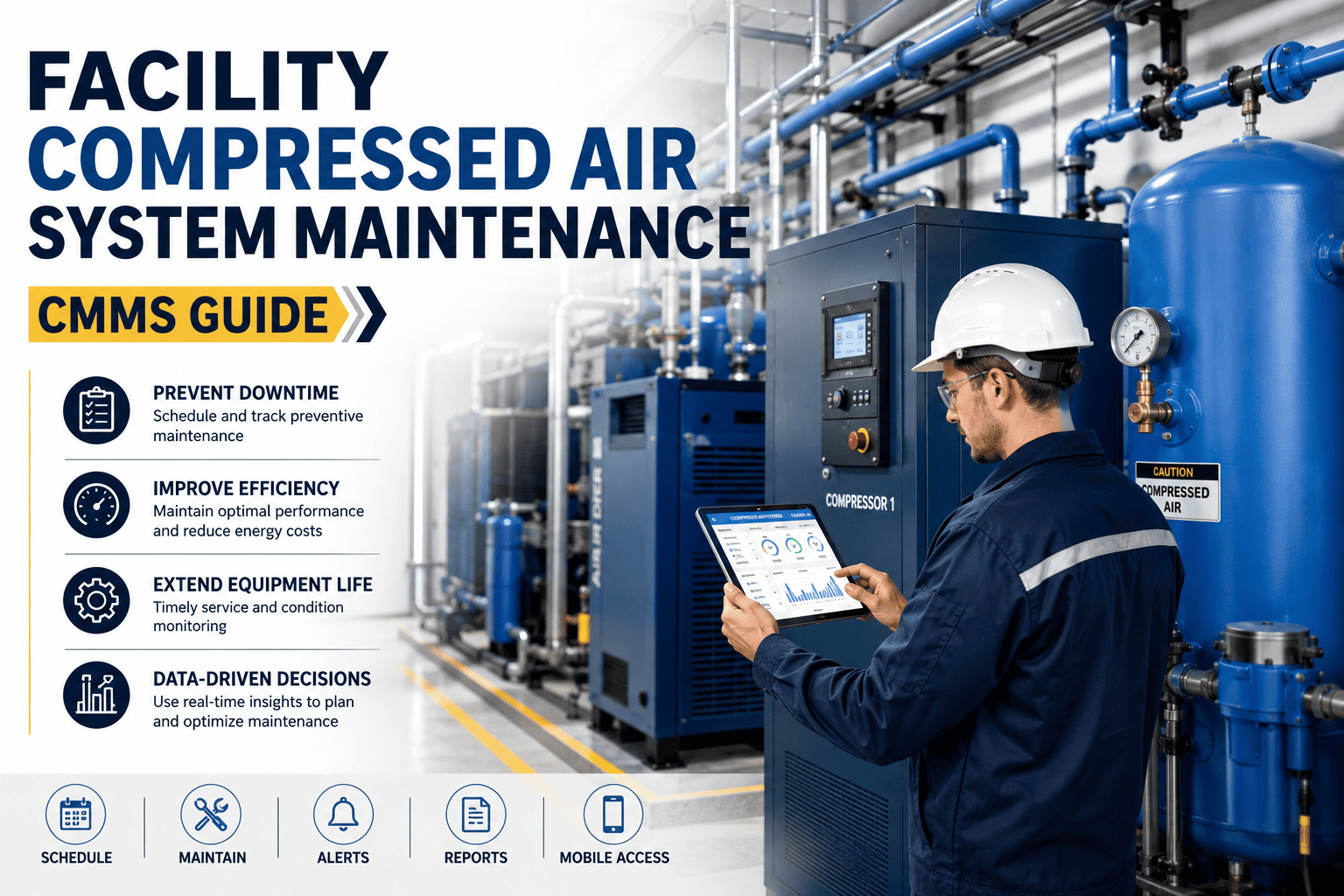
Compressed air is called the fourth utility in most facilities, and it is usually the least monitored one. A single leaking fitting the size of a pencil tip can quietly add over a thousand dollars a year to a utility bill, and most teams never find out until an energy audit forces the question. Compressor duty cycles, air dryer dew points, and filter differential pressures rarely get the same maintenance attention as HVAC or electrical systems, even though compressed air can account for close to a third of total facility electricity use. The result is a system that runs inefficiently for years, wasting energy on leaks, over-pressurization, and filter changes nobody tracked. OxMaint's CMMS gives facility teams a structured way to schedule compressor PM, monitor dryer performance, and run leak detection programs before the energy bill tells the story instead.
Your Compressed Air System Is Quietly Costing More Than Your Chiller
Compressed air can consume up to 30% of a facility's electricity, and energy alone makes up 70 to 90% of what a compressed air system costs over its lifetime. Untested distribution systems typically leak away 20 to 30% of everything the compressor produces. None of that shows up on a maintenance calendar unless someone puts it there.
Where Your Compressed Air Budget Actually Goes
Facility teams budget for the compressor purchase. They rarely budget for what runs it. Department of Energy lifecycle studies consistently show the same pattern across industrial sites.
What One Small Leak Actually Costs You
Leak size and annual cost do not scale in a straight line — they scale with the square of the opening. A leak twice as wide can cost close to four times as much to run.
The Compressed Air PM Task List
| Component | Maintenance Task | Frequency | Risk If Skipped | CMMS Trigger |
|---|---|---|---|---|
| Compressor | Oil change & air-oil separator element | Every 2,000–4,000 run hours | Overheating, bearing wear, early failure | Run-hour meter trigger fires PM automatically |
| Compressor | Intake filter check & replacement | Monthly visual, per pressure drop | Reduced airflow, higher energy draw | Differential-pressure reading triggers work order |
| Air Dryer | Dew point verification | Weekly to monthly | Moisture in lines, line corrosion, tool damage | Logged readings flagged when trend drifts |
| Condensate Drains | Function test (timer / zero-loss) | Monthly | Wasted air or moisture buildup | Scheduled inspection checklist per drain |
| Distribution Piping | Ultrasonic leak survey | Quarterly | Up to 30% of compressor output lost | Leak tags logged as ranked repair work orders |
| Filters | Particulate & coalescing element swap | Per pressure drop or 3–6 months | Pressure drop forces harder compressor cycling | Auto reorder at differential pressure threshold |
Building a Compressed Air Program in Your CMMS
The conversation I have most often with plant managers starts with "the compressor just isn't keeping up." Nine times out of ten, the compressor is fine. What's missing is a leak survey nobody scheduled and a filter that should have been swapped three months ago. Compressed air doesn't fail loudly — it just costs a little more every single day until someone finally audits the bill and asks why generation went up 20% with no change in production. A CMMS that puts PM schedules and leak tags on the same asset record turns that slow leak into a line item someone actually owns.
Frequently Asked Questions
How does OxMaint schedule compressor and dryer PM automatically?
Each compressor, dryer, and filter bank is logged as an asset with run-hour meters or calendar rules attached. When a threshold is reached, OxMaint generates the work order and assigns it without anyone checking a spreadsheet. Start your free trial to set up run-hour PM for your compressor fleet.
Can OxMaint track leak detection findings as work orders?
Yes. Technicians log leak location, estimated size, and cost impact during rounds, and OxMaint ranks findings into repair work orders so the highest-cost leaks get fixed first instead of whichever one was found last. Book a demo to see the leak tagging workflow.
How often should a facility run an ultrasonic leak survey?
Quarterly is the common baseline for most industrial and commercial systems, with more frequent surveys for older piping or facilities that have never had one. Untested systems typically leak 20 to 30% of total compressor output.
What happens if air dryer dew point isn't monitored?
Moisture carries downstream into piping and tools, causing corrosion, contamination, and pneumatic equipment damage. Logging weekly dew point readings in OxMaint flags drift before it turns into a line failure.
Does reducing system pressure really save meaningful energy?
Yes — DOE benchmarks show roughly 1% energy savings for every 2 psi reduction in system pressure, and many facilities run higher than necessary because of one demanding application. Book a demo to discuss a pressure and PM review for your site.
The Leak Was 1/8 Inch. The Bill Was $1,200 a Year. Nobody Was Watching.
OxMaint puts every compressor, dryer, and filter on a PM schedule, turns leak surveys into ranked work orders, and flags dew point and pressure drift before they become downtime or an inflated energy bill.