What gets measured gets managed — but most facility managers are measuring the wrong things, or measuring too few things too infrequently to act on the data. In 2026, the performance gap between facility teams running structured KPI dashboards and those relying on complaint-driven feedback is widening. Buildings tracked systematically catch faults earlier, spend less on reactive repairs, retain tenants longer, and demonstrate measurable ROI on every maintenance dollar. OxMaint's Analytics & Reporting module tracks all 20 KPIs in this guide automatically from work order, PM, and asset data — no manual reporting required.
Blog · Analytics & KPIs · Facility Management · 2026
Facility Management KPIs Every Manager Should Track in 2026
The 20 most critical facility management KPIs — from MTTR and PM compliance to energy intensity and tenant NPS — with target benchmarks, measurement methods, and improvement tactics
Maintenance Performance
Financial Efficiency
Compliance & Risk
Tenant Experience
Energy & Sustainability
KPI Categories in This Guide
01–05 · Maintenance Operations
06–10 · Work Order Management
11–14 · Financial Performance
15–17 · Compliance & Risk
18–19 · Energy & Sustainability
20 · Tenant & Occupant
01–05 · Maintenance Operations KPIs
| KPI |
Definition |
2026 Benchmark Target |
How to Improve |
| 01. PM Completion Rate |
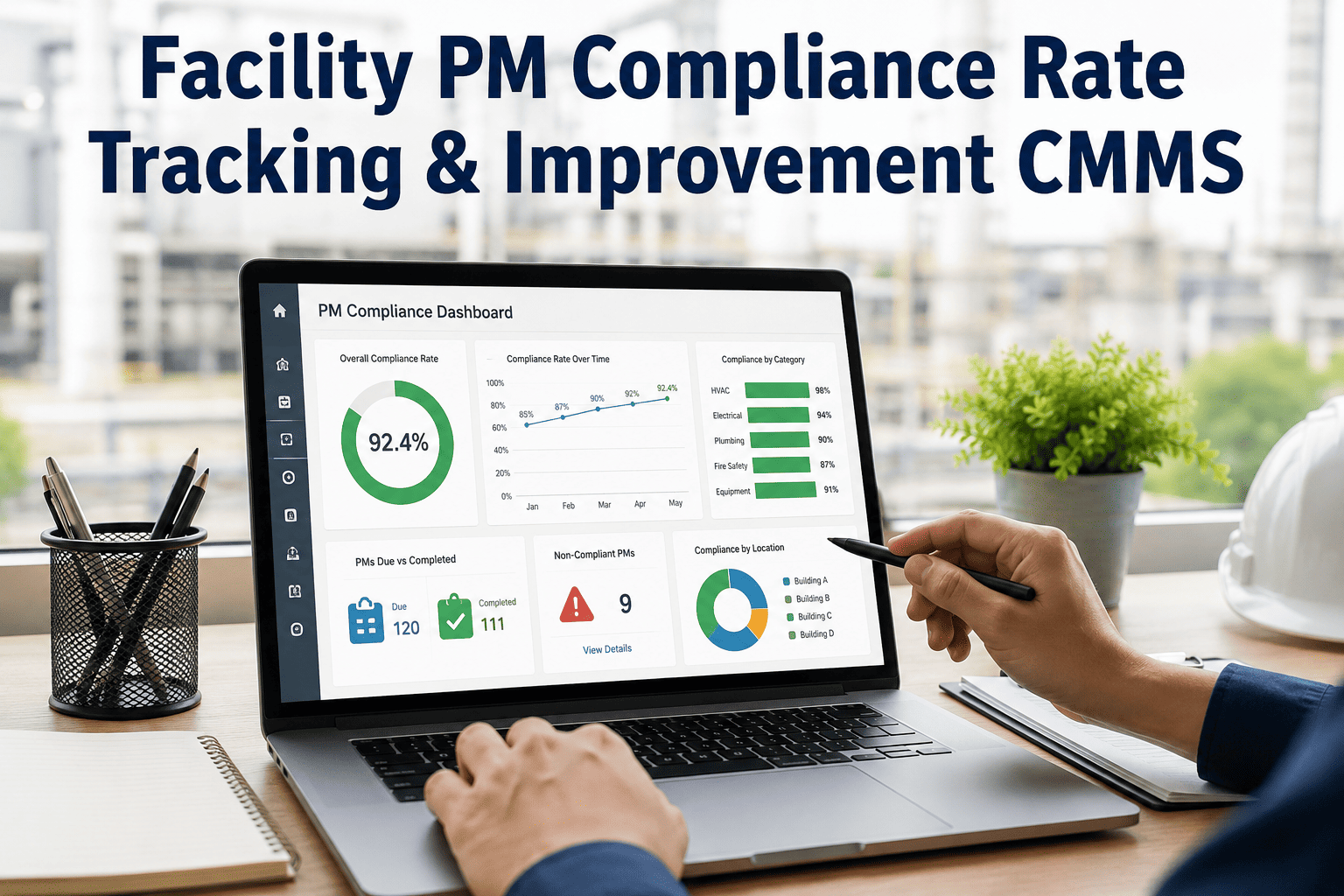
% of scheduled PM tasks completed on time |
Target: ≥ 90% |
Auto-schedule in CMMS, mobile sign-off, escalate overdue items |
| 02. MTTR (Mean Time to Repair) |
Avg time from fault reported to asset restored |
Target: < 4 hrs (commercial) |
Improve parts availability, streamline WO assignment and notification |
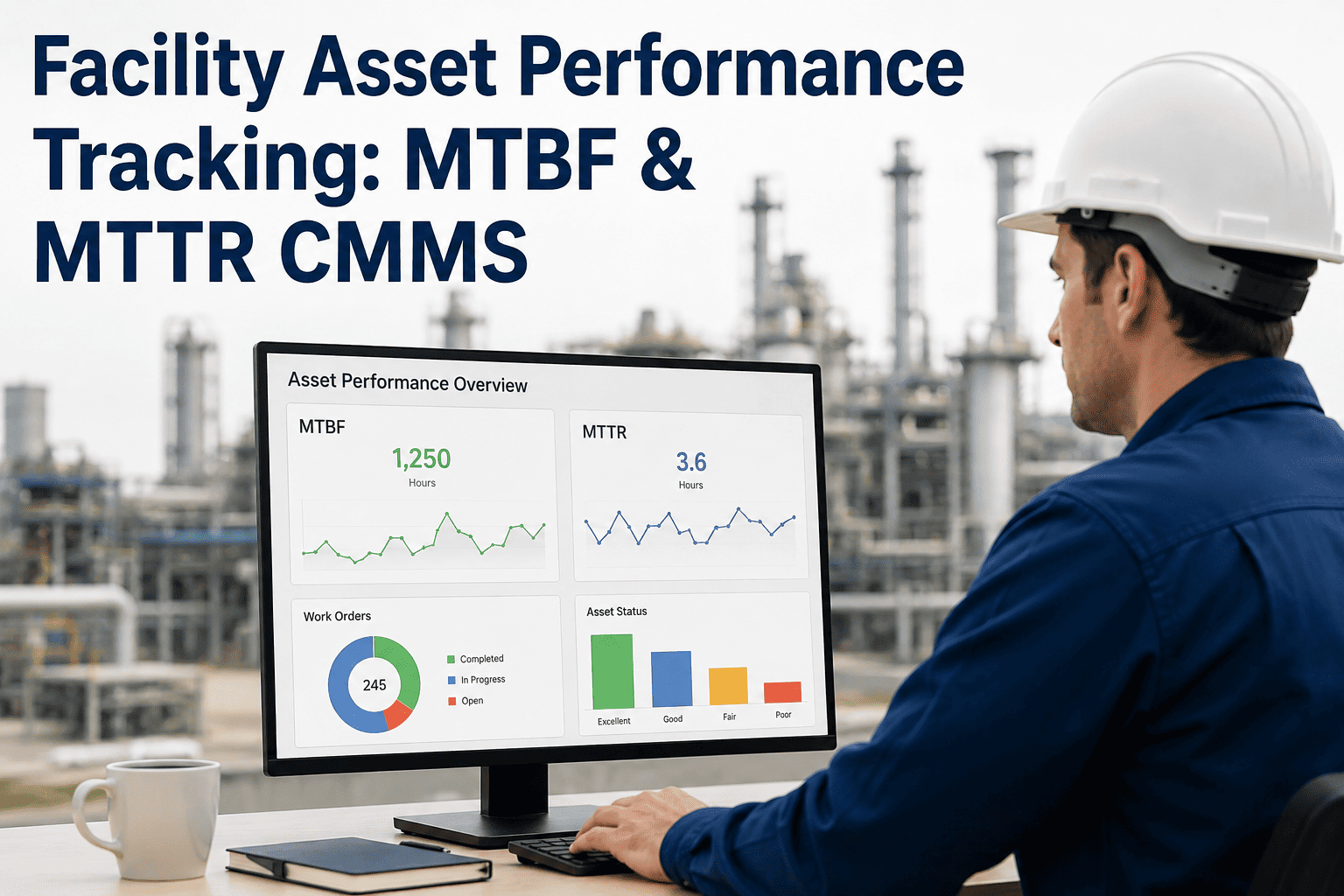
| 03. MTBF (Mean Time Between Failures) |
Avg operating time between unplanned failures |
Trend upward YoY |
Increase PM frequency on high-failure assets, use condition monitoring |
| 04. Reactive vs. Planned Ratio |
% of work orders that are unplanned / reactive |
Target: < 25% reactive |
Increase PM coverage, audit top 10 reactive assets monthly |
| 05. Asset Uptime Rate |
% of operating hours an asset is available and functional |
Target: ≥ 97% critical assets |
Predictive maintenance for critical systems, fast-track spares for critical assets |
06–10 · Work Order Management KPIs
| KPI |
Definition |
2026 Benchmark Target |
How to Improve |
| 06. Work Order Backlog Age |
Avg age of open work orders beyond due date |
Target: < 5 days avg backlog |
Daily backlog review, auto-escalation for WOs overdue > 48 hrs |
| 07. First-Time Fix Rate |
% of WOs resolved without a follow-up visit |
Target: ≥ 78% |
Better fault diagnosis at intake, pre-stage correct parts before dispatch |
| 08. WO Closure Rate (30-day) |
% of WOs closed within 30 days of opening |
Target: ≥ 92% |
Identify stalled WOs weekly, separate long-lead capital WOs from operational |
| 09. Emergency WO Frequency |
Number of Priority 1 / emergency WOs per month |
Benchmark: < 5% of total WO volume |
Root cause every emergency WO — trace to missed PM or late response |
| 10. Technician Utilisation Rate |
% of technician hours spent on productive tasks vs. travel/admin |
Target: ≥ 72% productive |
Location-group tasks, mobile CMMS eliminates return-to-office for paperwork |
OxMaint calculates all 20 KPIs in this guide automatically from your work order data — with a live dashboard visible to every team member. Book a demo or start tracking today.
11–14 · Financial Performance KPIs
11
Maintenance Cost Per Square Foot
2026 Benchmark: $6.50–$9.80/sqft (Class A Office)
Total maintenance spend divided by total maintained area. The primary financial KPI for portfolio benchmarking. Track monthly and compare against property type benchmarks. Rising cost-per-sqft without a building age or regulatory explanation signals operational inefficiency.
12
Reactive Maintenance Cost as % of Budget
Target: < 15% of total maintenance budget
Reactive spend as a share of total maintenance budget. Top-quartile facilities keep reactive at 10–15%. Facilities over 35% reactive are effectively funding equipment degradation — every dollar of PM deferral generates $3–5 in future reactive spend.
13
Maintenance ROI
Measure: Cost of PM ÷ Reactive spend prevented
Calculated by comparing the cost of planned maintenance against the estimated value of failures prevented. Difficult to measure without asset failure history in a CMMS. Buildings tracking this consistently demonstrate 3–8× ROI on PM investment — a powerful budget justification tool for CFO conversations.
14
Contractor Invoice Accuracy Rate
Target: < 3% invoice dispute rate
Percentage of contractor invoices that match work order completion records. Buildings without digital WO sign-off average 8–14% invoice discrepancy rate. Digital WO sign-off at point of service reduces this to under 2% — typically saving 10–15% of contractor spend annually.
15–17 · Compliance & Risk KPIs
15
Compliance Certificate Currency Rate
Target: 100% current — zero expired certificates
% of mandatory inspection certificates (fire alarm, elevator, electrical, cooling tower) that are current and not expired. Any expired certificate creates immediate legal and insurance exposure. OxMaint tracks all expiry dates and sends alerts 30 and 7 days before each renewal date.
16
Safety Incident Rate (Maintenance-Related)
Target: Zero RIDDOR-reportable maintenance incidents
Number of safety incidents per 100,000 maintenance hours attributable to equipment condition or maintenance procedures. Track separately from occupant incidents. Rising rate is an early indicator of maintenance programme deterioration — often visible 6–12 months before a major incident.
17
Permit-to-Work Compliance Rate
Target: 100% PTW issued for high-risk tasks
% of high-risk maintenance tasks (confined space, hot work, live electrical, HVAC rooftop) completed with a valid permit-to-work on file. A PTW compliance gap is the most common finding in HSE inspections of commercial facilities — and the hardest to close with paper-based systems.
18–20 · Energy, Sustainability & Tenant KPIs
18
Energy Intensity (kWh/sqft/yr)
2026 Target: < 18 kWh/sqft (Class A Office, temperate climate)
Total building energy consumption per square foot per year. Maintenance-driven: dirty HVAC coils, misaligned BMS setpoints, and deferred lighting maintenance add 15–30% to this figure. Trend monthly and correlate spikes to maintenance events using OxMaint's energy reporting module.
19
Carbon Intensity (kgCO₂e/sqft/yr)
Target: Year-on-year reduction aligned to net zero pathway
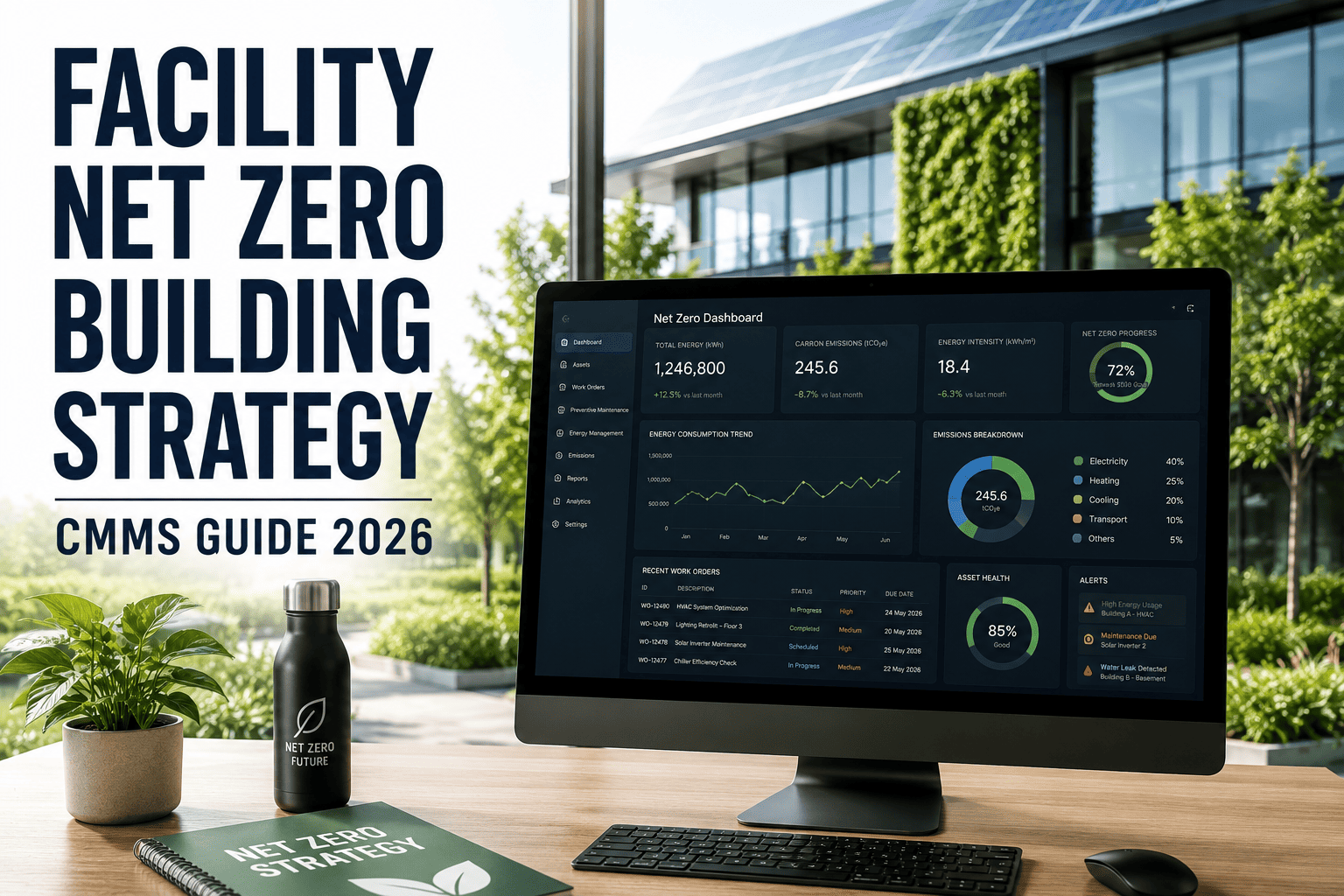
Scope 1 and 2 emissions per square foot — now required for GRESB, BREEAM In-Use, and corporate tenant ESG reporting. Maintenance quality directly affects carbon intensity through HVAC efficiency, refrigerant leakage, and generator fuel consumption. Document maintenance evidence for ESG audits in OxMaint's compliance module.
20
Tenant Maintenance Satisfaction (NPS)
Target: NPS > +35 for commercial office
Net Promoter Score specifically for maintenance and facilities responsiveness. The strongest predictor of lease renewal in Class A office buildings. Measured quarterly via short survey — tracked per floor or per tenancy. MTTR under 4 hours and SLA compliance above 95% are the two most reliable drivers of high maintenance NPS.
KPI Dashboard — Where Most Buildings Stand in 2026
Industry Average
OxMaint Users
Track All 20 KPIs Automatically — Live FM Dashboard in OxMaint
OxMaint calculates PM completion rate, MTTR, reactive ratio, compliance currency, cost per sqft, and energy intensity automatically from your operational data. No spreadsheets. No manual reports. Always current.
Expert Review
JW
James Whitfield
Director of Facilities Performance — Global Commercial Portfolio (35M sqft), 28 years · RICS Fellow, CFM
"The most common KPI mistake I see in facility management is tracking too many metrics at the top-line level and too few at the asset level. A portfolio PM completion rate of 88% sounds acceptable — until you look at the breakdown and find that five critical assets are running at 52% completion and driving 70% of your reactive spend. The KPIs that matter most are granular: asset-level MTBF, PM completion by technician, reactive-to-planned ratio by building. These are the metrics that tell you where to focus — and they are only available if your team is executing maintenance in a CMMS that captures the data at the point of work. OxMaint is the platform I have standardised across my portfolio for exactly this reason: it makes granular KPI tracking the default, not the exception."
Frequently Asked Questions
What is a good PM completion rate for a commercial facility?
A PM completion rate of 90% or above is the industry target for well-managed commercial facilities in 2026. Buildings averaging 60–74% completion — which is where most paper or spreadsheet-managed programmes operate — are generating 30–45% more reactive repair spend than those above 90%. The benchmark for OxMaint-managed facilities is 88–96% PM completion, achieved through automatic scheduling, mobile sign-off, and real-time overdue escalation. If your current rate is below 80%, improving PM completion is the single highest-ROI action available. Start tracking at
app.oxmaint.ai.
How is MTTR calculated in facility management?
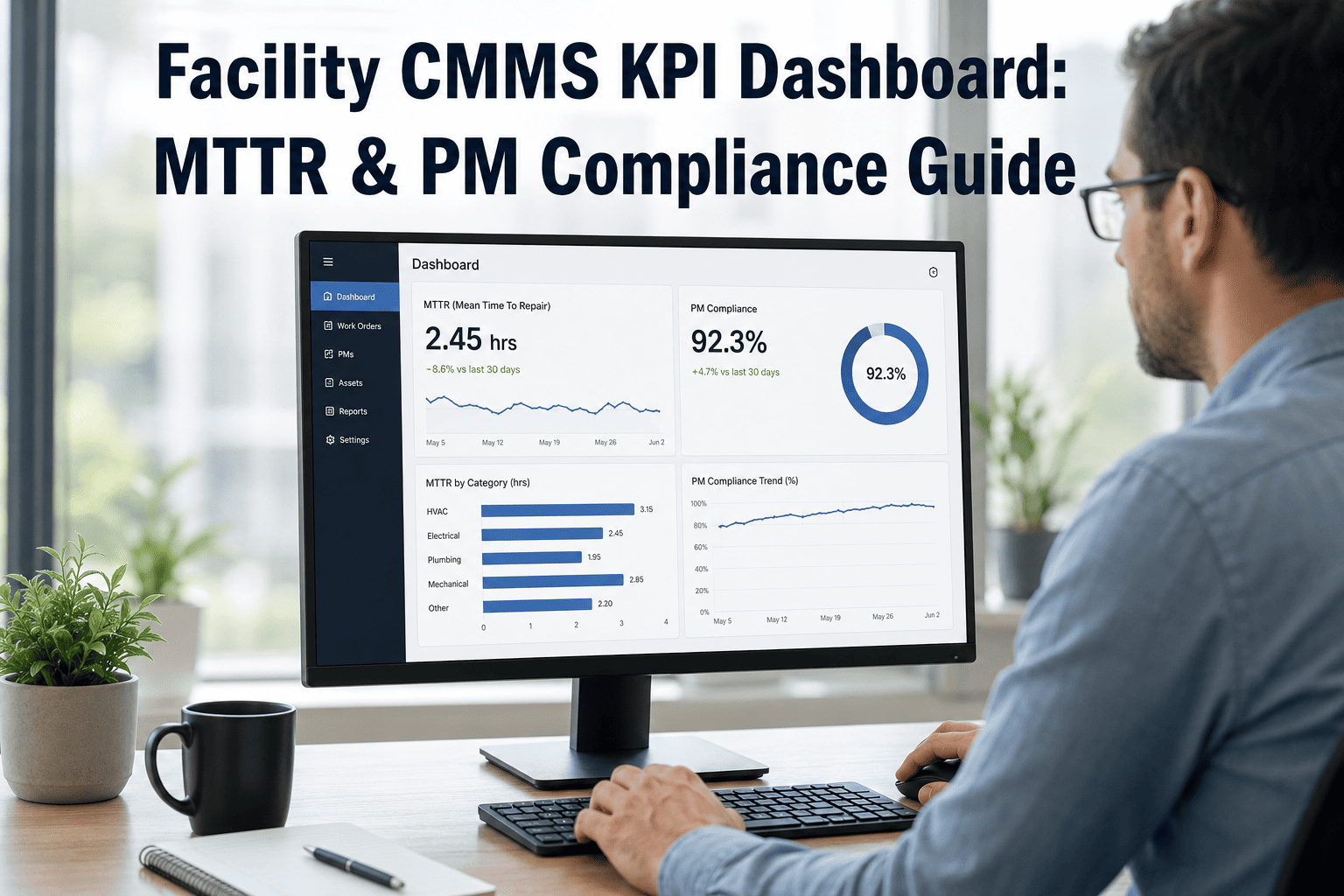
MTTR (Mean Time to Repair) is calculated as the total repair time across all incidents divided by the number of repair incidents in the measurement period. In facility management, repair time is measured from fault notification (when the work order is opened) to asset restoration (when the work order is closed as resolved). A CMMS like OxMaint calculates MTTR automatically for every asset and system category, allowing facility managers to identify which assets have the slowest response times and investigate whether the cause is parts availability, technician assignment, or fault complexity.
Book a demo to see the MTTR breakdown dashboard.
How many KPIs should a facility manager actively track?
Most FM practitioners recommend a core dashboard of 8–12 KPIs reviewed weekly, supported by a broader set of 15–20 KPIs reviewed monthly. The most important distinction is between leading indicators (PM completion rate, overdue WOs, compliance currency) which predict future performance, and lagging indicators (MTTR, reactive ratio, cost per sqft) which measure past outcomes. A balanced dashboard has both — and is only sustainable if the data is collected automatically rather than manually compiled. OxMaint generates all leading and lagging KPIs from operational data with zero manual input.
How does tenant satisfaction link to maintenance KPIs?
Research consistently shows that maintenance responsiveness is the primary driver of tenant satisfaction scores in commercial office buildings — ranking above physical condition, amenities, and even location in lease renewal surveys. The two maintenance KPIs most strongly correlated with tenant NPS are MTTR (faster response = higher satisfaction) and SLA compliance rate (consistent response = trust and predictability). Buildings achieving MTTR under 4 hours and SLA compliance above 95% score an average of 28 points higher on tenant NPS than those below these thresholds — a difference that translates directly to lease renewal probability and rental premium.
If You Can't Measure It, You Can't Improve It
OxMaint tracks your 20 most critical FM KPIs automatically — PM completion, MTTR, reactive ratio, compliance currency, cost per sqft, energy intensity — all in a live dashboard your entire team can see. Start a free account or book a 30-minute walkthrough today.