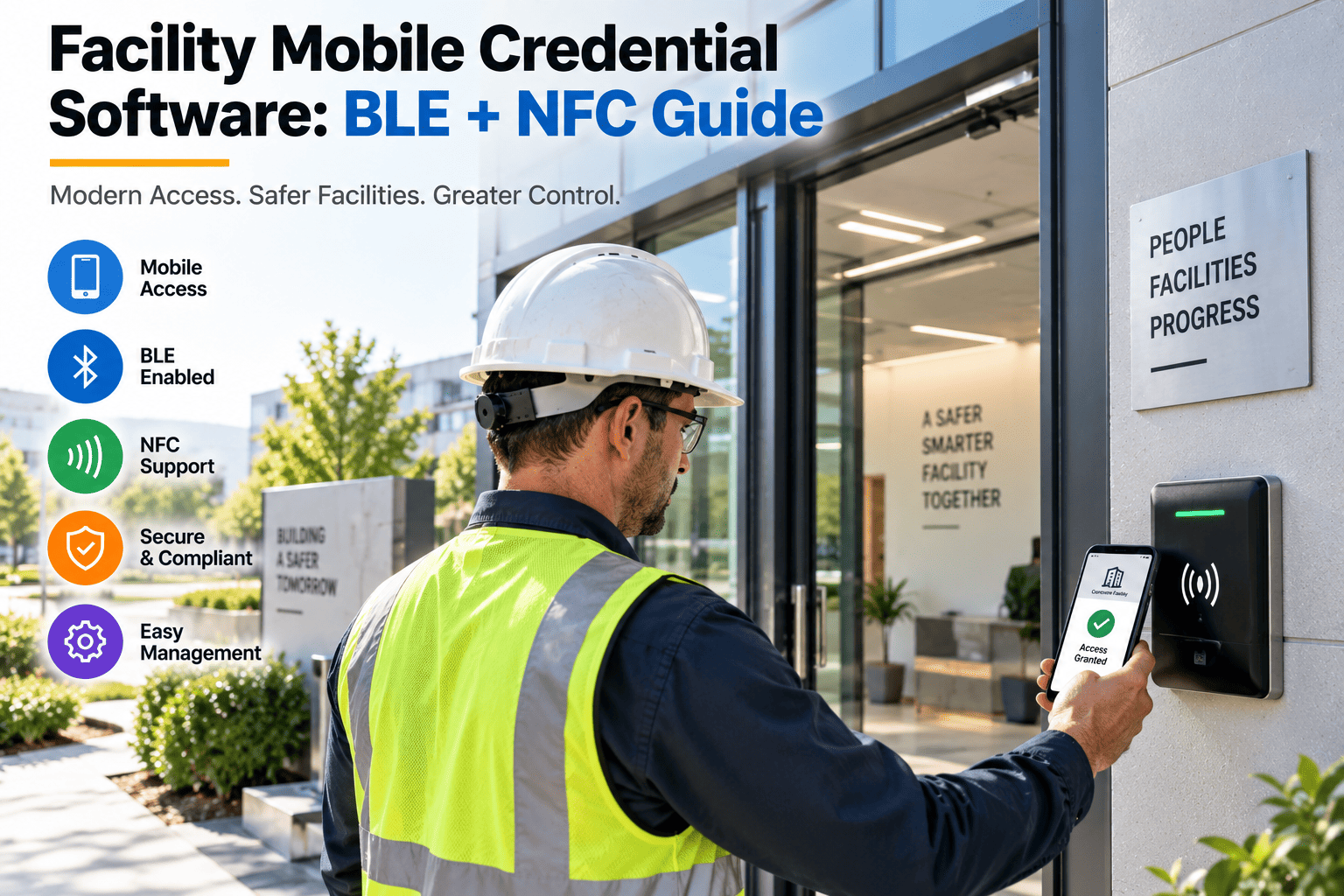
Plastic access cards are disappearing from facility badge programs faster than most maintenance teams have planned for. Bluetooth Low Energy and NFC mobile credentials turn a smartphone into the key, cutting issuance costs and letting security teams revoke access remotely the moment someone leaves. But a mobile credential rollout is not just a security project — it is a reader fleet, a battery schedule, and a deprovisioning workflow that has to be maintained with the same discipline as any other building system. This guide covers how BLE and NFC credentials actually work, what fails in the field, and how facility teams keep a mobile-first access program reliable long after the pilot phase ends.
Retiring Plastic Cards Means Managing A New Hardware Fleet
BLE and NFC credentials remove the badge desk bottleneck, but every reader, gateway, and battery-powered lock still needs scheduled service. Facility teams pairing mobile credential rollouts with a CMMS avoid the silent reader failures that undermine the whole program.
BLE Versus NFC: Two Different Reader Behaviours
Facility teams often assume BLE and NFC are interchangeable because both live on a phone. They behave very differently at the door, and that difference drives how each reader type needs to be maintained.
| Attribute | Bluetooth Low Energy | Near-Field Communication |
|---|---|---|
| Typical range | Centimeters up to roughly 30 meters, configurable | A few centimeters, tap-to-enter |
| Best fit | Hands-free entry, accessibility-friendly doors, vehicle gates | Turnstiles and busy lobbies needing deterministic taps |
| Power draw on reader | Continuous scanning increases battery drain on wireless locks | Powers the phone's credential exchange, lighter reader load |
| Common failure mode | Pairing drift, phone Bluetooth permissions disabled by the user | Reader antenna misalignment, phone case interference |
Field Note: Many facilities standardize on NFC for high-traffic turnstiles where a fast, predictable tap matters, then layer BLE onto secondary doors, loading docks, and parking gates where hands-free entry outweighs the need for split-second timing.
The Reliability Gaps Mobile Credential Vendors Do Not Advertise
A mobile credential program can look flawless in a vendor demo and still generate a steady stream of help-desk tickets once it is deployed across a real building.
Wireless Lock Battery Drain
BLE-enabled locks on interior doors run on battery power, and continuous scanning for nearby phones shortens replacement cycles compared to a standard card reader.
Firmware Version Sprawl
Readers deployed in phases end up on different firmware versions, causing inconsistent credential recognition between buildings on the same campus.
Gateway And Controller Drops
BLE gateways that bridge readers to the access control panel can silently disconnect from Wi-Fi, leaving a door functional but unreported.
Stale Deprovisioning
A revoked credential that still shows an active pairing on a reader's local cache creates a compliance gap until the reader syncs again.
Where A CMMS Fits Into A Mobile Credential Program
Access control teams own the credential platform. Facility teams own whether the physical reader, gateway, and lock are functioning. A CMMS is where those two responsibilities meet.
Register Every Reader As An Asset
Door readers, BLE gateways, and wireless lock controllers each get a location, install date, and firmware version logged.
Schedule Battery And Firmware PM
Preventive maintenance triggers replace batteries on a cycle informed by actual drain data rather than a generic annual guess.
Route Fault Alerts To Work Orders
A reader reporting offline or a gateway losing sync automatically opens a work order with the device's full service history attached.
Confirm Deprovisioning Closure
Offboarding tickets tie back to a technician confirming the credential no longer works at the door, not just that it was revoked in software.
Bring Your Reader Fleet Into One Maintenance View
Book a 30-minute demo and see how OxMaint tracks reader firmware, battery cycles, and fault history across a mobile credential rollout.
Planning A Phased Migration Away From Plastic Cards
Very few facilities rip out every card reader in one weekend. A phased migration keeps the building secure while the fleet transitions.
- Pilot mobile credentials on a single low-traffic entrance before touching perimeter doors
- Keep dual-technology readers active during transition so lost or uninstalled phones do not lock staff out
- Register each reader's firmware baseline before rollout so drift is visible immediately after updates
- Set battery replacement PM before the first wireless lock reaches manufacturer end-of-life voltage
- Require a technician-confirmed test after every deprovisioning event during the pilot phase
What Facility Teams Report After Bringing Readers Into A CMMS
The Standards Shaping Mobile Credential Reliability
Mobile credentials are only as secure and interoperable as the standards their readers and phones agree to speak. A handful of technical decisions determine whether a rollout scales cleanly or turns into a patchwork of one-off integrations.
Wallet-Based NFC Credentials
Credentials that work through Apple Wallet or Google Wallet rely on standards like MIFARE, so a facility does not need separate provisioning paths for iPhone and Android populations.
BLE Pairing And Permissions
BLE-based systems depend on device pairing, encryption key management, and background scanning permissions — a phone with Bluetooth restricted will silently fail to present a credential.
Emerging Identity Frameworks
Standards such as OPACITY are extending mobile credentialing beyond building access into interoperable identity verification, a trend worth watching as campus security converges with broader identity initiatives.
Where IT, Security, And Facilities Responsibilities Meet
Mobile credential programs frequently stall because three departments each assume another one owns the hardware layer.
| Layer | Typical Owner | Common Gap |
|---|---|---|
| Identity and credential issuance | IT / Identity Team | Owns provisioning but rarely tests the physical door hardware |
| Access control platform and policy | Security | Owns door schedules and alarms but not reader firmware upkeep |
| Reader, gateway, and lock hardware | Facilities / Maintenance | Often has no visibility into which readers are on outdated firmware |
| Battery and consumable replacement | Facilities | Frequently reactive rather than scheduled against manufacturer specs |
A CMMS does not replace the identity platform or the access-control policy engine. It closes the gap in the bottom two rows, giving facilities a documented, scheduled view of the physical layer that the entire credential program depends on.
What A Mobile Credential Rollout Actually Costs Over Time
The headline savings from retiring plastic cards are real, but facility teams should budget for the maintenance layer that replaces card issuance overhead.
Lower Issuance Cost, Higher Support Load
Eliminating badge printing saves recurring material cost, but help-desk tickets shift toward phone pairing issues, permission settings, and app troubleshooting.
Reader Hardware Investment
Upgrading legacy readers to BLE and NFC-capable models is a capital cost that should be sequenced against a documented replacement plan rather than an all-at-once swap.
Battery Replacement Cadence
Wireless lock batteries become a recurring facilities line item that needs its own budget line once the fleet grows past a pilot deployment.
Firmware Management Overhead
Keeping firmware current across a distributed reader fleet requires ongoing staff time that is easy to underestimate during initial project scoping.
Handling Lost Or Compromised Phones Without A Facility Lockout
A lost phone is functionally a lost master key, and the response process needs to be faster and better documented than a traditional lost-badge policy ever required.
Unlike a physical badge, a mobile credential can typically be revoked the instant a user reports a lost device — a genuine advantage over plastic cards that stay valid until someone manually deactivates them. That advantage only holds if the deprovisioning event is confirmed to actually take effect at the door rather than assumed to have worked once the software shows the credential as revoked. Facility teams that treat lost-device reports as a work order rather than a help-desk ticket get a documented technician check confirming the credential no longer opens a sample door, closing the gap between software-side revocation and physical enforcement.
Running Mobile And Card Credentials Side By Side
Most facilities run a hybrid credential environment for years rather than completing a full cutover, and that reality shapes how the reader fleet should be maintained.
Dual-technology readers that accept both a legacy card and a mobile credential reduce the risk of a hard lockout during rollout, but they also mean each reader now has two failure surfaces to test instead of one. A device can correctly read cards while silently failing to recognize any mobile credential at all, so facility teams should test both credential paths independently during routine service visits rather than assuming both technologies behave identically inside the same enclosure.
Where Smartwatches And Wearables Fit The Fleet
Mobile credentials increasingly extend beyond phones to smartwatches and wearable tokens, and each form factor introduces its own maintenance profile.
Paired Smartwatch Credentials
A watch credential inherits its paired phone's connectivity and battery dependencies, so troubleshooting a failed watch tap means checking the phone's status too.
Standalone Wearable Tokens
Common in healthcare and industrial settings where staff cannot always carry a phone, these behave like BLE beacons and need the same battery tracking and testing cadence.
One Register For Every Form Factor
As wearable adoption grows, the asset register becomes the only practical way to know whether a "badge isn't working" ticket refers to a phone, a watch, or a dedicated token.
A Practical First Step For A Mobile Credential Pilot
Facility teams evaluating a first mobile credential deployment do not need to solve the entire reader fleet at once.
Pick one low-traffic, low-risk door, register the reader and any associated gateway as a tracked asset, and run it through a full month of normal use before expanding. Log every fault, every battery check, and every firmware update against that single device so the pattern of what actually breaks in your specific environment becomes visible before it scales across dozens of doors. That documented month becomes the basis for setting realistic maintenance intervals across the rest of the fleet.
Mobile Credential Questions Facility Teams Ask
Should we choose BLE or NFC for our facility?
Most multi-door facilities run both — NFC for fast, predictable taps at busy turnstiles, and BLE for hands-free entry at secondary doors, loading docks, and vehicle gates where range matters more than speed.
Do mobile credential readers need more maintenance than card readers?
BLE-enabled wireless locks typically need closer battery monitoring than hardwired card readers, since continuous scanning for nearby phones increases power draw and shortens replacement cycles.
How do we confirm a revoked credential is actually blocked at the door?
Treat deprovisioning as a work order with a technician-confirmed field test, not just a status change in the access-control software, since local reader caches can lag behind the platform. Start a free trial to see how that confirmation step attaches to the offboarding record.
What causes inconsistent credential recognition between buildings?
Firmware version sprawl is the most common cause. Readers installed in different rollout phases often end up on different firmware, and tracking each device's version inside a CMMS makes the drift visible before it causes lockouts.
Can a CMMS manage the credential platform itself?
No. A CMMS does not replace your access-control or identity platform. It manages the physical readers, gateways, and locks, and gives facility teams a documented maintenance trail for the hardware that platform depends on.
How long should a dual-technology transition period last?
Most facilities keep legacy card readers active for several months to a year alongside mobile credentials, giving staff time to onboard and giving the facility team time to build a real fault history on the new hardware before removing the fallback option.
Keep Your Mobile Credential Fleet Running After Rollout Day
Register every reader, gateway, and wireless lock as a tracked asset and stop finding out about failures from a locked-out employee.
Free 14-day trial · No credit card