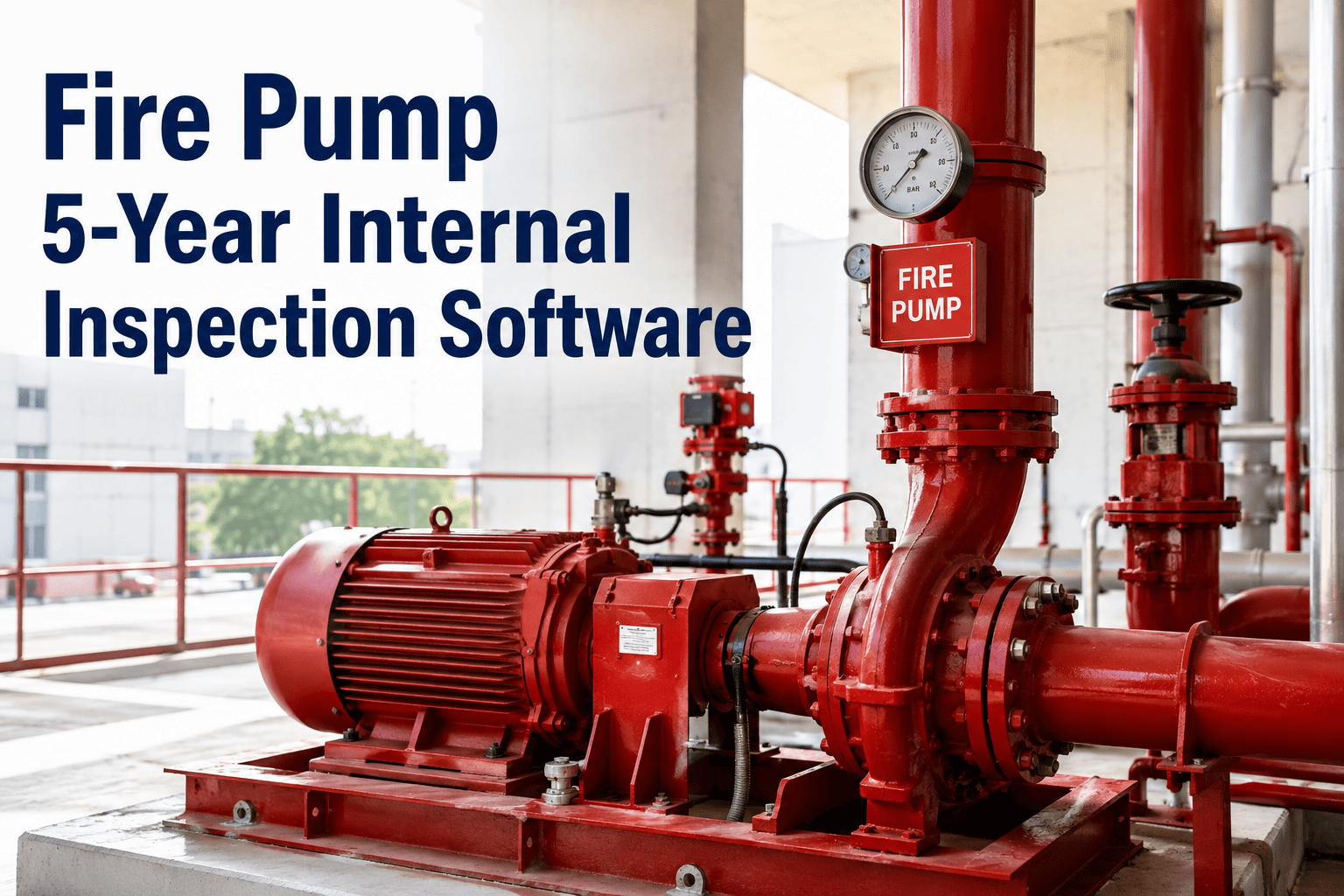
The five-year internal inspection is the only NFPA 25 requirement that regularly outlives the person who scheduled it. Weekly churn tests and annual flow tests build their own memory — someone is on site, the calendar repeats, the contractor invoices every twelve months. The five-year cycle has none of that rhythm. Between one internal assessment and the next, a facility usually changes maintenance managers, swaps ITM contractors at least once, and sometimes changes owners entirely, and the interval quietly resets to zero in everyone's head while the clock keeps running. That is why fire pump and internal pipe five-year work is the most commonly skipped item in the standard, and why the interval belongs in a system rather than a memory — OxMaint counts the five years from the last documented completion date, not from whoever happens to still work there.
73.7%
Sprinkler system compliance rate found in a Chicago Office of Inspector General audit — fire pumps scored 79.6%
73%
Of dry pipe systems show significant internal corrosion by 12.5 years of service — well inside a single five-year window
47,522
Violation orders issued by the FDNY Bureau of Fire Prevention in FY2025 alone, a 22% year-over-year increase
6 yrs
How long a five-year record must survive — one year past the next inspection of the same type, per NFPA 25 recordkeeping
Why the Five-Year Interval Fails While the Weekly Test Never Does
Nobody forgets the weekly churn test. It is short, it is visible, and the pump room is on someone's rounds. Nobody forgets the annual flow test either, because a contractor calls to book it. The five-year internal assessment is different in kind: it is expensive, it takes the system down, it requires opening pipe, and it arrives on a schedule that no human workflow naturally reinforces. In practice the interval is not missed by a decision — it is missed by drift. Each event below looks harmless on its own. Stacked across sixty months, they erase the due date completely.
The Sixty-Month Memory Gap — How a Documented Interval Disappears
Year 1
Assessment completed. Report filed as a PDF in a contractor email thread or a shared drive folder nobody indexes.
Year 2
Facility manager changes. Handover covers keys, vendors, and open work orders — not a due date sixty months out.
Year 3
ITM contract goes out to bid. New contractor prices annual scope only, because nobody hands them the five-year history.
Year 4
Capital budget is built from last year's invoices. A line item that never appeared last year does not get funded.
Year 5+
AHJ or insurance carrier asks for the internal assessment record. There is no record, and no evidence it was ever due.
NFPA 25 does not distinguish between work that was never performed and work that was performed without documentation. Both are cited the same way.
The failure mode is administrative, not technical. Fire pump five-year software exists to solve exactly that: to hold an interval longer than the average tenure of the people responsible for it, and to keep the evidence attached to the asset instead of to an individual. Walk through your own interval history with our team and you will usually find at least one cycle where the trail simply stops.
What the Five-Year Internal Assessment Actually Requires
Chapter 14 of NFPA 25 is short, and that brevity causes most of the confusion in the field. Section 14.2 governs the periodic assessment of internal pipe condition and applies to all water-based system types. It is an assessment, not a pass-fail inspection — the technician is judging whether foreign organic or inorganic material is present in a quantity capable of obstructing piping or sprinklers. What follows is what the standard asks for at minimum, and what a defensible record has to show.
01
Open a flushing connection at the end of one main
The far end of a main is where sediment, scale, and loose corrosion product settle out of low-velocity water. Discharge condition, water colour, and any solids recovered all belong in the record — not just a checkbox.
02
Remove a sprinkler toward the end of one branch line
Branch-line ends show tuberculation and biofilm before mains do. The removed sprinkler and the exposed pipe interior are both evidence, and both should be photographed at the point of removal.
03
Assess for organic and inorganic obstructing material
Tubercles, slime, sludge, scale, pipe coupons, gravel and zebra mussel shell have all been recovered from live systems. The judgement to document is whether the quantity found could obstruct a sprinkler or a pipe.
04
Record the corrosion indicators, including MIC evidence
Excessive rust, black water, a sulfur odour, tubercles or slime are the annex-referenced flags that escalate an assessment into a full obstruction investigation. Each needs a written observation, not an inference.
Two practical notes that cost facilities money every year. First, the interval starts at the date of installation for a new system, not at the date somebody first thought to look. Second, more corrosion-resistant non-metallic piping is not held to the same 14.2 frequency, which means a mixed-material building may carry two different assessment obligations on two different assets in the same riser room. A CMMS that treats "the building" as the asset will get this wrong every time; the interval has to sit on the system.
Five-Year Interval Tracking — OxMaint
If You Cannot Produce the Last Internal Assessment Report in Under a Minute, You Do Not Have a Compliance Program.
OxMaint attaches the five-year clock to the fire pump, the riser, and the system — with the completion date, the technician, the findings, the photos, and the next due date on the same record. When the inspector asks, you open one screen.
When an Assessment Becomes an Obstruction Investigation
This is the decision that separates a routine five-year visit from a five-figure remediation project, and it is the decision most often made badly — usually by leaving it undocumented. Section 14.3 is condition-triggered rather than calendar-driven. It is not something you schedule; it is something a finding forces on you. The ladder below is how the escalation actually runs, and each rung has to produce a written artifact.
Stage 01
Scheduled assessment performed
Openings made, interior condition observed and photographed, water discharge characterised, findings written up against the asset record with date, technician name, and result.
Stage 02
Trigger condition identified
Obstructing material found, pinhole leaks, plugged sprinklers, discoloured or foul-smelling discharge, tubercles or slime, or a main drain test showing a 50% or greater pressure reduction against the baseline.
Stage 03
Obstruction investigation opened
A wider, systematic examination at multiple points through the system — riser, cross mains, branch lines, and a removed sprinkler — to establish how far the material extends rather than merely that it exists.
Stage 04
Corrective scope determined
Findings dictate the remedy: targeted branch flushing, full system flush, chemical treatment programme, or section replacement where corrosion has compromised wall thickness.
Stage 05
Impairment managed and closed out
Chapter 15 applies the moment the system comes out of service: impairment coordinator designated, fire department and carrier notified, valves tagged, and a fire watch where impairment exceeds ten cumulative hours in twenty-four.
Two things go wrong here without software. The trigger gets observed but never recorded, so the investigation is never opened and the finding dies in a technician's memory. Or the investigation happens, the flush is performed, and nobody links the corrective work order back to the original assessment — so the closure evidence exists somewhere but cannot be produced as a chain. OxMaint keeps the chain intact by generating the follow-on work order from the finding itself, with the parent assessment permanently referenced.
Everything That Comes Due on the Same Five-Year Clock
Facilities budget for "the five-year inspection" as if it were one line item. It is not. Several distinct obligations share the interval, they are performed by different specialists, and they produce different documents. Missing one of them is enough to fail an audit even when the headline internal assessment was done properly.
Five-Year Item
Reference
What It Requires
Record To Capture
Internal pipe condition assessment
NFPA 25 §14.2.1
Open a main flushing connection and remove a branch-line sprinkler; assess for obstructing material
Photos, water condition, material found, escalation decision
Valve internals — check, dry pipe, preaction
NFPA 25 Ch. 13
Valves opened so internal components can be verified free of corrosion and debris
Component condition, parts replaced, reset verification
Strainers, filters, restricted orifices
NFPA 25 §13.4
Internal inspection every five years unless test results demand a shorter interval
Debris recovered, cleaning performed, interval justification
Gauges — fire pump and system
NFPA 25 Ch. 13
Replaced, or tested against a calibrated gauge, every five years
Serial numbers, install date, calibration comparison result
Backflow prevention assembly
NFPA 25 §13.7
Internal inspection to confirm components move freely and are in good condition
Internal condition, forward flow test result, certification
Standpipe full flow test
NFPA 25 §6.3
Flow at system demand through the hydraulically most remote hose valve outlets
Flow, pressure, outlet location, comparison to design demand
Pressure-regulating devices
NFPA 25 Ch. 13
Full flow test to verify the device still limits downstream pressure to its rated range
Inlet and outlet pressures, static and residual readings
Sprinkler sample laboratory testing
NFPA 25 Ch. 5
Age-based sampling — fast-response, dry, high-temperature and standard spray each on their own clock
Sample location, manufacture date, laboratory result, retest year
Note that the fire pump itself does not have a single tidy five-year test. It carries a weekly no-flow churn run, an annual full-flow performance test at churn, 100% and 150% of rated capacity, and then a cluster of five-year obligations on its supporting hardware — suction-side strainers, gauges, relief and regulating devices, and the piping feeding it. Fire pump five-year software has to model that fan-out, because the pump passes its annual test perfectly well while its suction strainer quietly fills with the material a five-year assessment would have found.
What a Defensible Five-Year Record Contains
The standard is explicit that records must show the date of the activity, who performed it, and the result. In practice, an AHJ or an insurance adjuster looking at a five-year file wants more than that, because the interval is long enough that they cannot rely on anyone's recollection. These are the fields that decide whether a record survives scrutiny.
What Every Record Must Carry
Completion date, and the calculated next-due date derived from it rather than typed in
Named technician with certification or licence reference where the jurisdiction requires one
Asset identity — the specific pump, riser, or system, not the building address
Exact opening locations used, so the next cycle can compare like with like
Photographic evidence timestamped at the point of inspection
Explicit escalation decision — investigation opened, or reasoned finding that none was warranted
What Usually Goes Missing
A due date that survives a change of contractor or facility manager
The link between a finding and the corrective work order that resolved it
Proof the impairment was coordinated and the fire watch was staffed
Baseline data from the previous cycle to show whether corrosion is progressing
Retention past the next cycle — the file that was deleted at the reorganisation
Evidence for the weekly and monthly checks the building itself owns, not the contractor
That second column is where most citations come from. Facility directors hand inspectors a professionally produced contractor report and still get written up, because the owner-responsibility items around it were never captured. Book a demo and bring your last inspection report — the gap is usually visible in the first five minutes.
How OxMaint Runs the Five-Year Cycle
OxMaint is a maintenance management platform, not a form filler. The difference matters for an interval this long: the schedule, the asset history, the corrective work order, the parts, the contractor record, and the retained evidence all live in the same system, so nothing depends on a person remembering to move information between tools.
1
Asset register built at system level
Every fire pump, riser, standpipe, backflow assembly and system is a distinct asset with its own installation date, material, and interval obligations — including mixed-material buildings where the frequency differs by system.
2
Intervals generated from completion, not from a calendar
Closing a five-year assessment writes the next due date automatically. Escalating notifications begin months ahead so the work reaches the capital budget cycle instead of arriving as a surprise.
3
Digital checklists mirrored to the standard
Technicians work through the assessment on mobile, capture photos at each opening, record water condition and material found, and cannot close the task with the escalation decision left blank.
4
Findings become linked corrective work
A trigger condition raises an obstruction investigation task against the same asset, carrying the parent reference, so flushing, treatment or pipe replacement is always traceable to the finding that caused it.
5
Impairment and fire watch tracked as work
Out-of-service periods are logged with the coordinator, notification timestamps, tagged valves, and fire watch hours — the evidence carriers ask for after a loss, and the part paper programmes almost never have.
6
Audit-ready export on demand
Full interval history per asset, retained past the next cycle, exported in the format an inspector or underwriter can review without a guided tour of your shared drive.
Where the Five-Year Cycle Bites Hardest
Every occupancy carries the same obligation, but the consequences of missing it are distributed very unevenly. These four are where an undocumented interval turns into a real financial or regulatory event rather than a correction notice.
Warehouse and Cold Storage
Dry systems corrode fastest
Trapped water from trip and hydrostatic testing accelerates internal corrosion
Ice obstruction checks apply where piping passes through freezers
High-value stored goods make a flow failure a total-loss event
Large system counts multiply the number of intervals to track
Healthcare Facilities
Two auditors, one record set
Accreditation surveys examine ITM documentation alongside the AHJ
Systems cannot be taken down without clinical coordination and lead time
Impairment procedures are scrutinised more closely than in other occupancies
Records must be retrievable on the day the survey team arrives
High-Rise and Commercial
Standpipes join the clock
Five-year standpipe flow testing at the most remote outlets is logistically heavy
Pressure-regulating device testing runs on the same interval
Tenant access and after-hours scheduling stretch the work over weeks
Local ordinances add filing requirements on top of the standard
Manufacturing and Industrial
Downtime is the constraint
Assessment openings must be planned into a production shutdown window
Process water quality and make-up sources influence corrosion rates
Fire protection competes with production assets for the same technicians
Property insurers audit ITM evidence as part of renewal
The Numbers That Justify the Line Item
The five-year cycle is the most expensive routine obligation in NFPA 25 and the easiest to defer. These are the figures worth putting in front of whoever signs the budget.
1 in 4
Facilities lacking adequate sprinkler documentation in audited populations — a liability exposure at claim time, not just a code issue
61%
Of sprinkler activation failures nationally trace to a closed control valve — the failure mode routine documented checks are designed to catch
10–30%
Share of sprinkler corrosion damage attributed to microbiologically influenced corrosion; the remainder is generalised oxygen corrosion
$2.5B
Projected fire prevention inspection software market by 2034, growing at roughly 9% annually as AHJs move to electronic records
The direction of travel is clear enough. Inspectors are moving to electronic submission, carriers are asking for evidence rather than assurances, and the paper file in the riser room is becoming the thing that costs you money rather than the thing that protects you. Start a free OxMaint trial and load a single fire pump with its full interval history — it takes about twenty minutes to see what a complete record looks like.
Frequently Asked Questions
What does the NFPA 25 five-year internal assessment actually involve?
A qualified technician opens a flushing connection at the end of a main and removes a sprinkler toward the end of a branch line, then assesses the pipe interior and discharge for obstructing material and corrosion. Findings, photos and the escalation decision all belong on the asset record —
OxMaint captures all three in one task.
Does the fire pump have its own separate five-year test?
The pump itself runs on a weekly churn test and an annual full-flow performance test at churn, 100% and 150% of rated capacity. The five-year obligations sit on the hardware around it — suction strainers, gauges, relief and regulating devices, and the piping feeding the pump. All of them need tracking as separate intervals.
How long do we have to keep five-year inspection records?
Records are retained until at least one year after the next inspection of the same type, so a five-year record needs to survive roughly six years. Acceptance documents and hydraulic calculations are kept for the life of the system, and AHJs commonly request three to five years of history during a survey.
What turns an assessment into a full obstruction investigation?
Finding organic or inorganic material capable of obstructing pipe or sprinklers is the primary trigger. Others include pinhole leaks, plugged sprinklers, tubercles or slime, discoloured or foul-smelling discharge, and a main drain test showing a 50% or greater pressure reduction against baseline. Each trigger must be written down when observed.
Can a CMMS replace our fire protection contractor?
No, and it should not try to. Licensed contractors perform the tests; the CMMS owns the schedule, the owner-responsibility checks, the deficiency-to-closure chain, and the retained evidence that ties it together.
A short demo shows how the two roles fit alongside each other.
Fire Pump Five-Year Inspection Software
The Next Five-Year Cycle Is Already Running. Make Sure Someone Still Knows When It Ends.
6 yrs
record retention handled
1 screen
for the full interval history
Put every fire pump, riser, standpipe and system on an interval that outlives staff turnover, contractor changes and reorganisations — with the evidence attached to the asset where an inspector can find it.