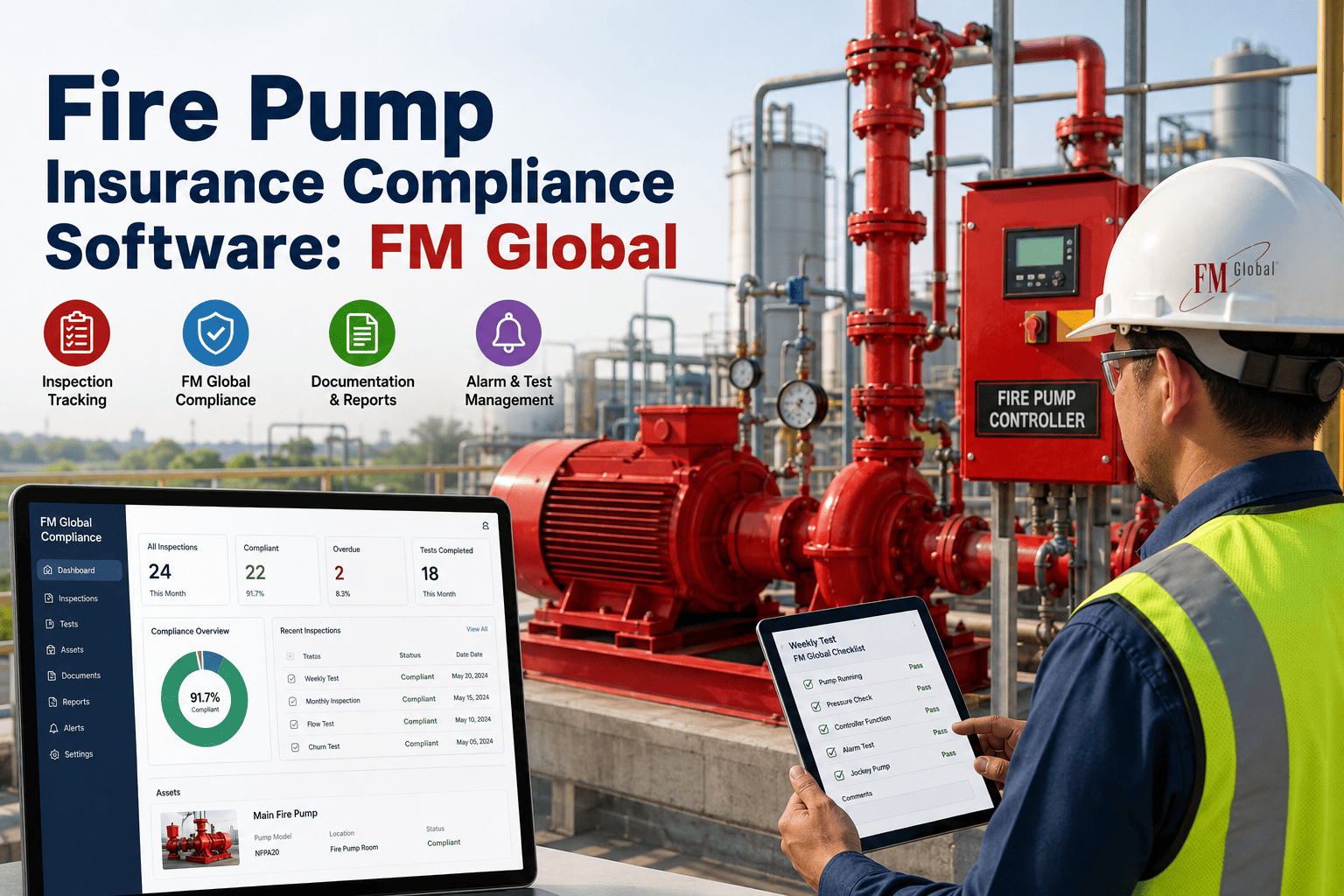
Fire pumps sit at the top of every insurer's risk model for a reason: FM Global's own loss data shows nearly 40% of fire pump failures happen because the pump simply never started, or started too late to matter. That single statistic explains why FM Global's testing requirements run stricter than the general fire code baseline, and why an insurance carrier will comb through fire pump test records before renewing a policy or settling a claim. A missed weekly run, an undocumented start-time delay, or a flow test filed on paper somewhere in a site office can quietly turn into a denied claim or a premium increase that outlasts the paperwork that caused it. Start a free trial with Oxmaint to see how digitized fire pump testing keeps every weekly run, annual flow test, and acceptance threshold audit-ready the moment an underwriter asks.
Fire Pump Insurance Compliance Software: FM Global
FM Global holds fire pumps to a stricter weekly standard than the general fire code, and insurers use the resulting test records to price risk. Here is exactly what compliant fire pump documentation needs to look like.
Why FM Global-Insured Facilities Face a Higher Bar
NFPA 25 relaxed electric fire pump run frequency to monthly years ago, but FM Global never adopted that change. Under FM Global Data Sheet 2-81, both diesel and electric fire pumps still need to run weekly — diesel for 30 minutes, electric for 10 — regardless of what the local fire code technically permits. A facility that is fully compliant with its jurisdiction's fire code can still be out of step with its own insurance policy if testing only happens monthly.
That gap matters most at claim time. Insurers evaluate risk financially, not just legally, and a fire pump testing gap discovered after a loss gives an adjuster grounds to challenge coverage regardless of what the fire marshal signed off on. Meeting the stricter of the two standards, and proving it with clean records, is the only position that protects both life safety and the policy itself.
The Four-Tier Fire Pump Test Schedule
No-flow run for both diesel and electric pumps under FM Global. Diesel runs 30 minutes, electric runs 10 minutes, checking start time and churn pressure.
The NFPA 25 baseline for standard electric configurations — superseded by FM Global's weekly requirement wherever an FM Global policy applies.
Confirms the pump starts on its own signal without manual intervention, catching control and sensor faults before an emergency does.
Flow tested at churn, 100%, and 150% of rated capacity, with every result plotted against the original acceptance curve.
The Numbers an Underwriter Actually Checks
| Test Point | Electric Pump | Diesel Pump |
|---|---|---|
| Start Time | 15 seconds or less | 30 seconds or less |
| Churn Pressure | Below 140% of rated pressure | |
| Annual Flow Test | At least 95% of nameplate flow at each point | |
| Degradation Trigger | Over 5% drop from acceptance curve requires investigation | |
A single missed number does not have to mean a failed pump — but it does have to mean a documented, investigated, and resolved finding. Underwriters and AHJs are far less concerned with a one-time anomaly than with a record that shows nobody noticed it.
What a Testing Gap Actually Costs
Insurers price fire protection risk directly into premiums. A history of missed or undocumented tests is one of the fastest ways to see that number climb at renewal.
After a loss, an incomplete test history gives an adjuster grounds to question coverage, even when the fire code itself was technically satisfied.
An AHJ finding a gap in required testing can issue citations or, in serious cases, order the system offline until compliance is restored.
Turn Your Test Records Into a Renewal Advantage
See how a facility filters by pump ID, date range, or test type and hands a complete record to an underwriter or AHJ in seconds, not a filing-cabinet search.
Built for FM Global's Weekly Standard, Not Just the Fire Code Minimum
Weekly churn, quarterly automatic-start checks, and annual flow tests generate automatically on the correct interval for every diesel and electric pump on site.
Start times over 15 or 30 seconds, churn pressure past 140%, or flow test results under 95% nameplate trigger an immediate alert with a recommended corrective action.
Every annual flow result plots against the original acceptance test automatically, flagging any drop past 5% without a manual chart comparison.
When an AHJ or underwriter arrives, filter the full test history by pump, date range, or test type and produce a complete record in seconds.
What Digitized Fire Pump Compliance Delivers
Common Questions About Fire Pump Insurance Compliance
Does FM Global really require weekly testing for electric fire pumps?
Yes. While NFPA 25 relaxed electric pump testing to monthly, FM Global Data Sheet 2-81 still requires both electric and diesel pumps to run weekly. Start a free trial to schedule the stricter cadence automatically.
What happens if a fire pump test result falls outside acceptance thresholds?
A result outside the acceptable range, such as flow below 95% of nameplate, triggers a required investigation under NFPA 25 rather than an automatic failure — but it must be documented and resolved.
Can incomplete fire pump records actually affect an insurance claim?
Yes. Insurers evaluate fire protection risk financially, and a gap in required testing gives an adjuster grounds to challenge coverage even when the local fire code was technically satisfied.
How long should fire pump test records be retained?
Records should stay legible, complete, and available immediately for review, since local authorities and insurance policies both typically specify defined retention periods.
Can one platform handle both weekly churn runs and the annual flow test?
Yes, and it should — a single system tracking every tier keeps the full test history connected instead of scattered across paper logs. Book a demo to see the full workflow.
Meet FM Global's Standard Before the Next Underwriter Visit
Oxmaint schedules every weekly, monthly, quarterly, and annual fire pump test automatically, flags any result outside acceptance thresholds, and hands over a complete audit trail in seconds.