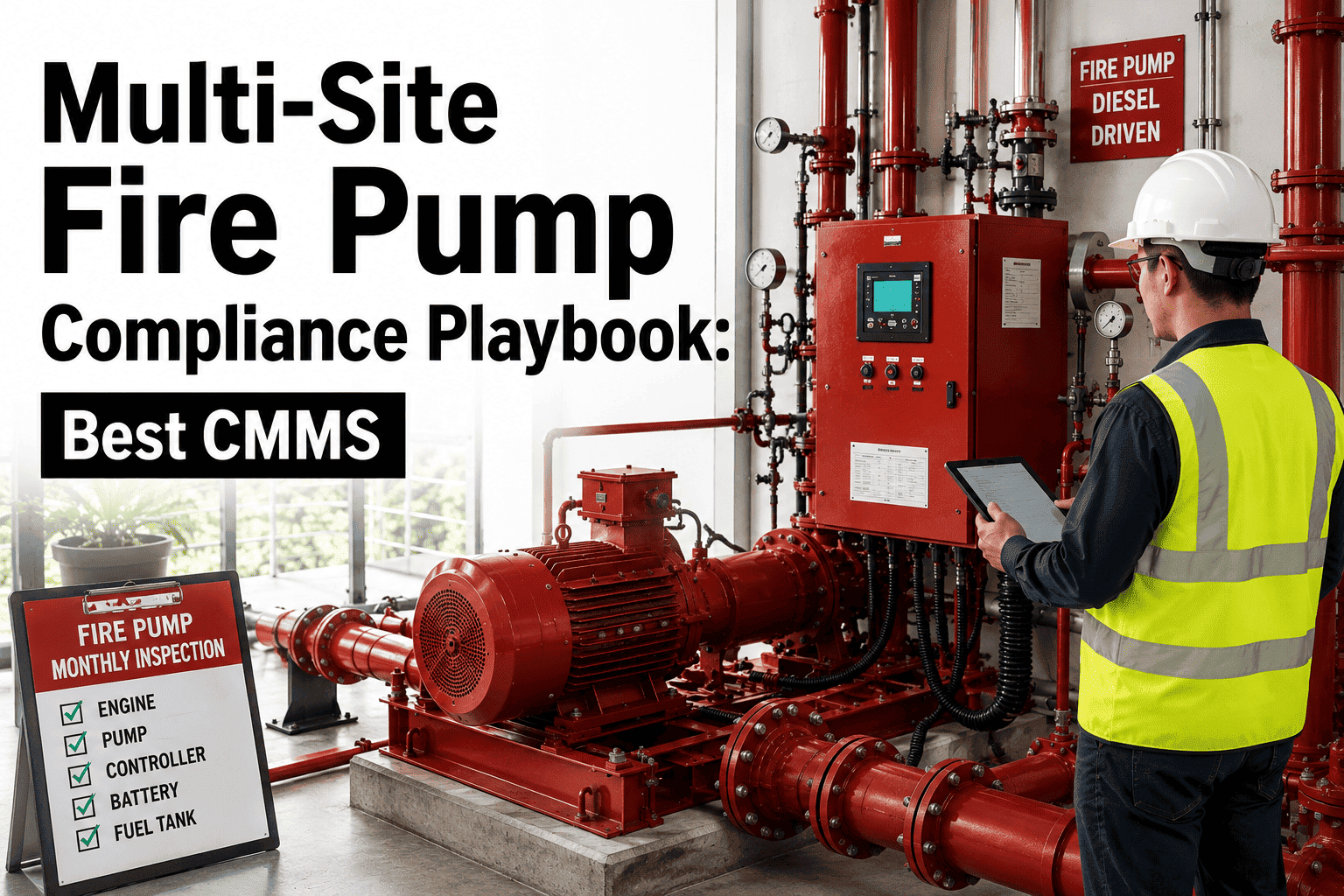
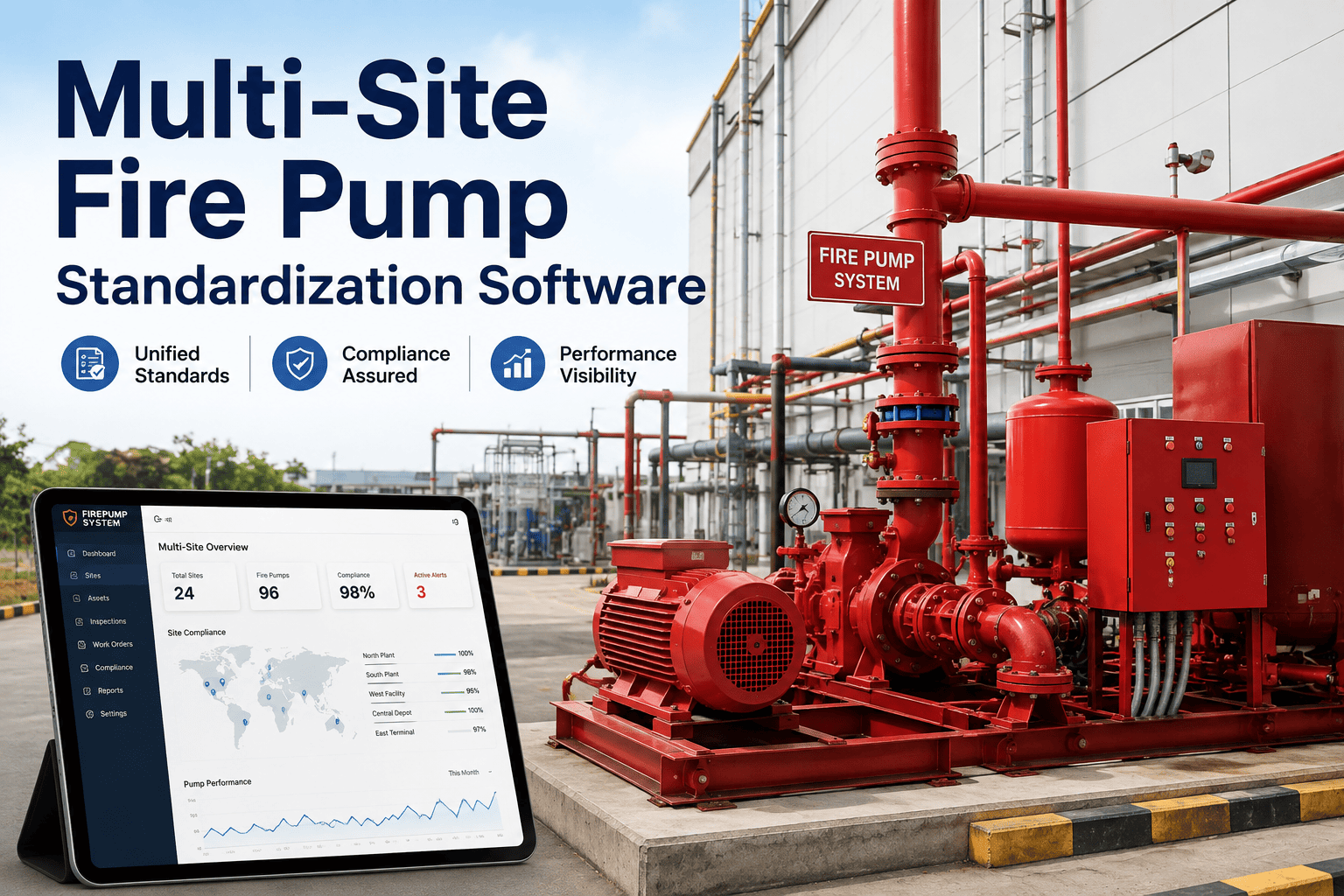
Picture eleven fire pumps across nine properties in a REIT portfolio. One is due for its annual flow test, three are overdue on monthly churn runs, and a diesel unit at your busiest asset failed its automatic start check last week — but nobody at the corporate office knows yet because the report is sitting in a technician's truck. This is how multi-site fire pump compliance actually breaks down: not from a lack of rules, but from a lack of visibility across properties. NFPA 25 gives you the exact testing calendar; the hard part is running it consistently everywhere at once. Sign in to OxMaint to see how portfolio-wide fire pump compliance looks when every site reports into one system.
Compliance Playbook · NFPA 25 · Multi-Site Portfolios
The Multi-Site Fire Pump Compliance Playbook for 2026
Every weekly churn test, monthly run, annual flow test, and 3-year overhaul that NFPA 25 requires — mapped into one repeatable schedule you can run identically across every property in your portfolio, with the CMMS structure that keeps every site audit-ready at once, no matter how many buildings, contractors, or pump models are involved.
52
Weekly diesel churn tests required per pump, per year, under NFPA 25
3
Operating points measured in every annual flow test — shutoff, 100%, 150%
5%
Performance drop from the acceptance curve that triggers a mandatory investigation
15 sec
Maximum start time for an electric fire pump on pressure drop
The Testing Calendar
Every NFPA 25 Fire Pump Test, Broken Down by Interval
Fire pumps carry the heaviest testing burden of any water-based fire protection component, because they are the one piece of equipment the entire sprinkler and standpipe system depends on when municipal pressure alone is not enough. Miss one interval at one site and the whole portfolio's compliance record has a gap in it. Here is the complete schedule, interval by interval.
Weekly
No-Flow Churn Test
Diesel-driven pumps run a churn test every single week without exception, regardless of building occupancy or weather. Technicians verify automatic start on pressure drop, check pilot lights and controller indicators, confirm the power supply status, and make sure the controller returns to automatic mode after the manual stop. Electric pumps run this same no-flow test monthly rather than weekly, though many portfolios choose to run it weekly anyway for consistency across every pump type on site.
Monthly Condition Assessment
Monthly
Alarm signals are tested against the fire alarm panel, jockey pump cycling is checked to confirm it holds system pressure within range, and every visible component is inspected for leaks, corrosion, or loose connections. This is also when electric pump churn testing happens if it was not run weekly, and when technicians confirm the suction and discharge valves remain fully open and unobstructed.
Annual Full-Flow Test
Annual
The cornerstone test. Pump performance is measured at three points — shutoff, 100% of rated capacity, and 150% of rated capacity — using pitot tubes, flow meters, and a hose manifold, then compared against the pump's original acceptance curve. Any result showing more than 5% degradation from that baseline requires a documented investigation before the next cycle, and many contractors skip this comparison step entirely if the flow curve data is not stored anywhere central.
3-Year Comprehensive Test
Every 3 Years
A deeper mechanical and electrical inspection layered on top of the annual flow test, covering internal wear points, controller calibration, and driver condition that don't show up in a routine annual check. Diesel units also get engine-specific testing at every interval — fuel quality, cooling system operation, battery condition, and exhaust inspection — since stale or contaminated fuel is one of the most common causes of a diesel pump failing to start.
Run the Same Fire Pump Calendar at Every Site, Automatically
OxMaint schedules every weekly, monthly, annual, and 3-year fire pump task for every pump in your portfolio, assigns it to the right technician or contractor at the right site, and locks the record the moment it's completed — so no property quietly falls behind while corporate assumes everything is current.
Where Portfolios Fall Behind
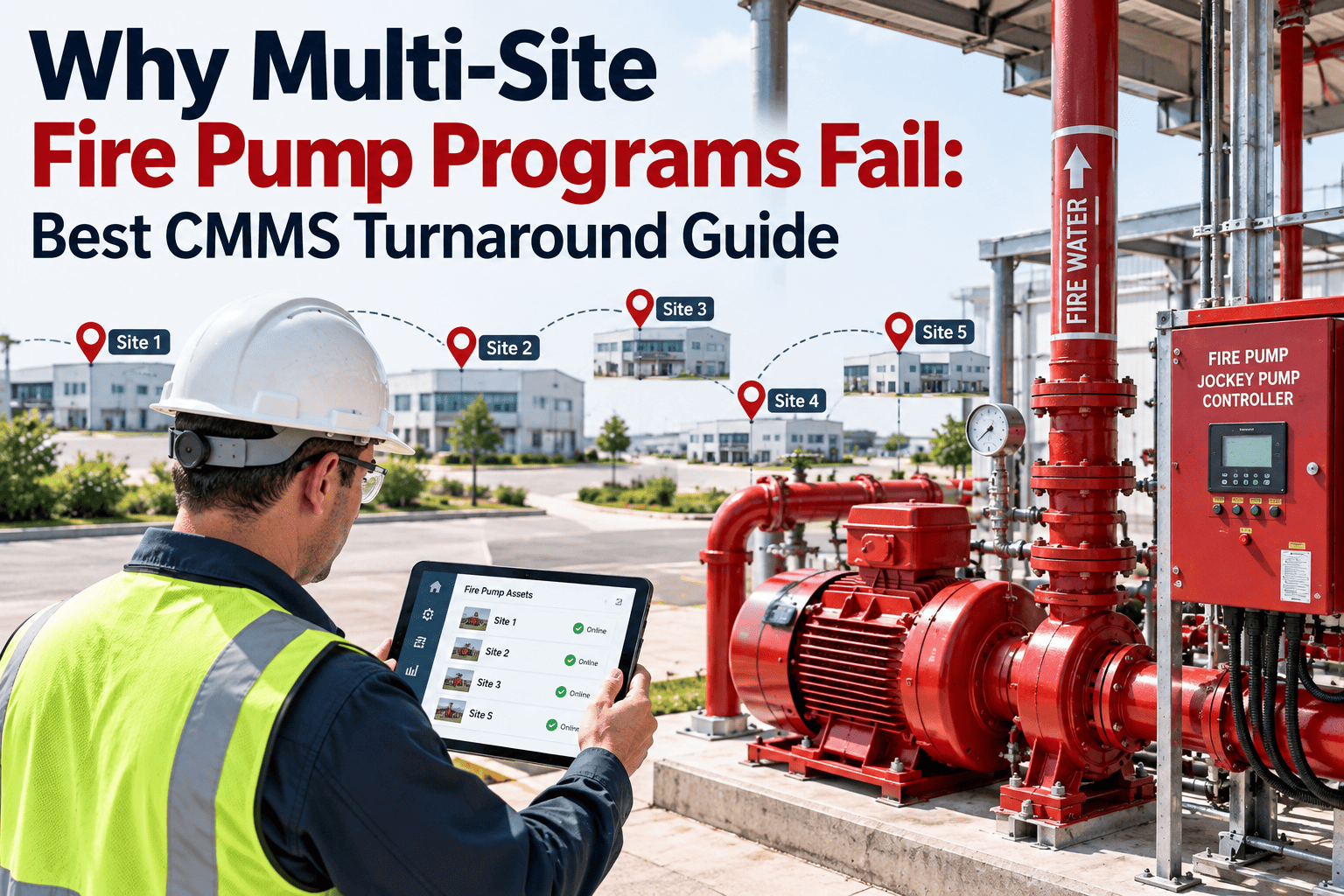
Why Fire Pump Compliance Breaks Down Across Multiple Properties
A single-site facility manager can usually keep a fire pump schedule in their head. A portfolio manager overseeing a dozen properties, a dozen different contractors, and hundreds of individual test dates cannot — and that gap is exactly where violations start, usually quietly, months before anyone at corporate finds out.
Paper Records Trapped at the Site
Weekly churn logs and annual flow charts get filled out on clipboards and filed in a binder in the pump room. Corporate has no visibility until an auditor or insurer asks for the records, and by then a gap from three months ago is impossible to explain or reconstruct with any confidence.
Inconsistent Contractors Across Sites
Different properties often use different fire protection contractors, each with their own report format, their own interpretation of the flow test procedure, and their own idea of what counts as a passing result. Portfolio-wide standards quietly erode.
No Central Trigger for Degradation
A 5% drop from the acceptance curve should trigger an investigation under NFPA 25, but if annual results live in separate PDFs at separate sites, nobody is comparing this year's curve to last year's curve until a pump has already failed a real fire event.
Controller Left in Manual Mode
A common and dangerous NFPA 25 violation: a technician switches a controller to manual during a maintenance event and it never gets switched back. Without a centralized check built into every weekly task at every property, a pump can sit unable to auto-start for months without anyone at the portfolio level knowing.
The Real Stakes
Why Skipping One Fire Pump Test Costs More Than You Think
A missed weekly churn test looks minor on a checklist. In practice, it is the exact gap that insurers, fire marshals, and courts look for after a real event, and the consequences rarely stay contained to a single property. Here is what a single overlooked interval can trigger across a portfolio.
Insurance Claim Denial
Commercial property insurers routinely request fire pump test records after any water damage or fire loss claim. A documented gap in weekly or annual testing gives the carrier grounds to reduce or deny the payout, turning a maintenance oversight into a direct financial loss for the property.
Failed AHJ Reinspection
When a fire marshal or authority having jurisdiction finds an overdue test during a routine inspection, the property is typically issued a violation notice and a reinspection deadline. Repeated reinspection fees, legal notices, and in some jurisdictions occupancy restrictions follow if the gap is not closed quickly.
Certificate of Occupancy Risk
In many municipalities, fire pump compliance is tied directly to a building's certificate of occupancy or its annual fire safety certification. A lapsed test record can delay lease closings, refinancing, or property sales until the compliance record is brought current and re-certified.
Life Safety Exposure
Beyond paperwork, a pump that cannot start automatically because a controller was left in manual mode, or a diesel unit with degraded fuel, simply will not deliver water when a real fire event demands it — the exact scenario every interval on this calendar exists to prevent.
Audit Readiness
Building an Audit-Ready Record at Every Property
Passing an audit at one site is a matter of good habits. Passing an audit at every site in a portfolio, on the same day, without a single property scrambling to backfill records, is a matter of process rather than individual diligence. These habits make the difference.
Standardize the Field Form
Every technician at every site, regardless of which contractor they work for, should capture the exact same data points on the exact same digital form — gauge readings, run times, and flow results — so no property's records look different from another's.
Attach Photo Evidence Every Time
A gauge reading on its own is easy to dispute months later. A gauge reading paired with a timestamped photo, captured on a phone during the actual test, becomes evidence an auditor or insurer cannot easily challenge.
Compare Every Annual Result to History
Store every year's flow test result against the same pump's original acceptance curve, not just against last year's number, so a slow multi-year decline is caught before it crosses the 5% investigation threshold.
Escalate Deficiencies Automatically
A failed weekly test or a flagged deficiency should generate a work order the same day, assigned to a specific person with a due date — not sit in a report that nobody reviews until the next scheduled visit.
Risk Over Time
Manual Tracking vs Centralized CMMS — Compliance Risk by Month
Manual, site-by-site tracking
High risk by month 6
Spreadsheet with reminders
Moderate risk by month 6
Centralized CMMS scheduling
Low risk, sustained
Risk climbs the moment a single site misses one weekly test and nobody at the portfolio level is notified. Under manual tracking, that miss usually surfaces at the next annual audit, months after it happened. A centralized system flags the miss the same day it occurs, giving the site time to correct it before it ever becomes a documented violation.
Playbook Requirements
What a Multi-Site CMMS Needs to Run This Playbook
Not every maintenance system is built to hold a fire-life-safety testing calendar across dozens of properties. Before choosing one, a portfolio should confirm it covers each of the following, since a gap in any one of these areas eventually shows up as a gap in the compliance record itself.
| Requirement |
What It Covers |
Why It Matters |
Status |
| Portfolio-wide asset registry |
Every fire pump, jockey pump, and controller logged once with make, model, rated capacity, and original acceptance curve |
Gives every site in the portfolio the same baseline to test against, year over year |
Core requirement |
| Interval-based auto-scheduling |
Weekly, monthly, annual, and 3-year tasks generated automatically per pump type |
Removes reliance on any one person remembering the calendar |
Core requirement |
| Flow curve comparison |
Each annual result plotted against the original acceptance curve and prior years |
Surfaces the 5% degradation threshold automatically instead of manually |
High priority |
| Mobile technician capture |
Field forms for churn tests, run times, gauge readings, and photo evidence |
Closes the gap between what happens in the pump room and what corporate sees |
Core requirement |
| Cross-site compliance dashboard |
One view showing every property's current status against the full NFPA 25 calendar |
Turns an audit from a scramble into a five-minute export |
High priority |
A Note From the Field
Most portfolios we work with are not failing NFPA 25 because they don't know the rules. They are failing because the rules apply the same way at nine different buildings and there is no single system holding all nine schedules at once. I have walked into properties where the annual flow test was performed correctly, documented correctly, and then filed somewhere nobody at corporate ever saw it — which, from a compliance standpoint, is functionally the same as never running the test at all. The moment a portfolio moves fire pump testing into a centralized CMMS, the conversation changes entirely — from chasing down which site is overdue to reviewing a dashboard that already tells you. That single shift, more than any new equipment, is what actually closes the compliance gap at scale.
RM
Raymond Mercado, NICET III Fire Protection
18 years in fire protection systems inspection · Former compliance lead for a multi-state commercial property portfolio · Specialist in NFPA 20 and NFPA 25 program design for REITs and healthcare campuses · Has led fire pump compliance rollouts across portfolios ranging from single mid-rise assets to national multi-site holdings
How It Works
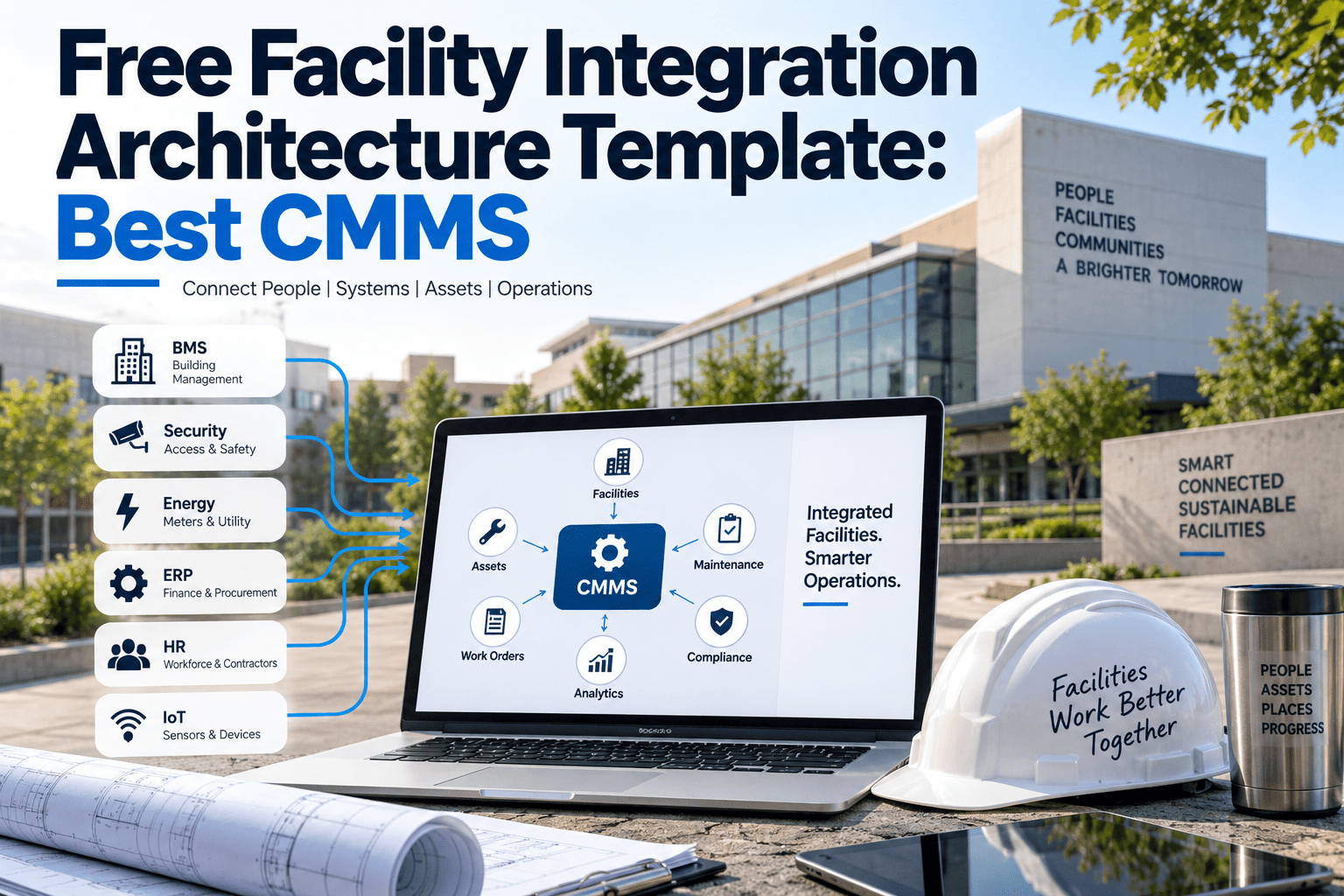
Turning the NFPA 25 Calendar Into Automatic Work Orders
The playbook only holds if the schedule actually reaches a technician's phone and the result actually reaches a manager's dashboard, at every property, every single week, without anyone needing to chase it down manually. Here is how that loop closes in practice, from asset registration to portfolio-level reporting.
Register Every Pump Once
Each fire pump, jockey pump, and controller across the portfolio is entered once with its make, model, rated capacity, and original acceptance curve. From that single record, the system already knows exactly which tests apply and how often.
Auto-Generate the Full Calendar
Weekly, monthly, annual, and 3-year tasks are created automatically for every pump the moment it is registered, assigned to the right technician or contractor at the right site, with no one at corporate needing to build a schedule by hand.
Capture Results in the Field
Technicians complete a standardized mobile form during the test itself — gauge readings, run time, start time, and photo evidence — so the record is created at the pump, not reconstructed later from memory or a paper clipboard.
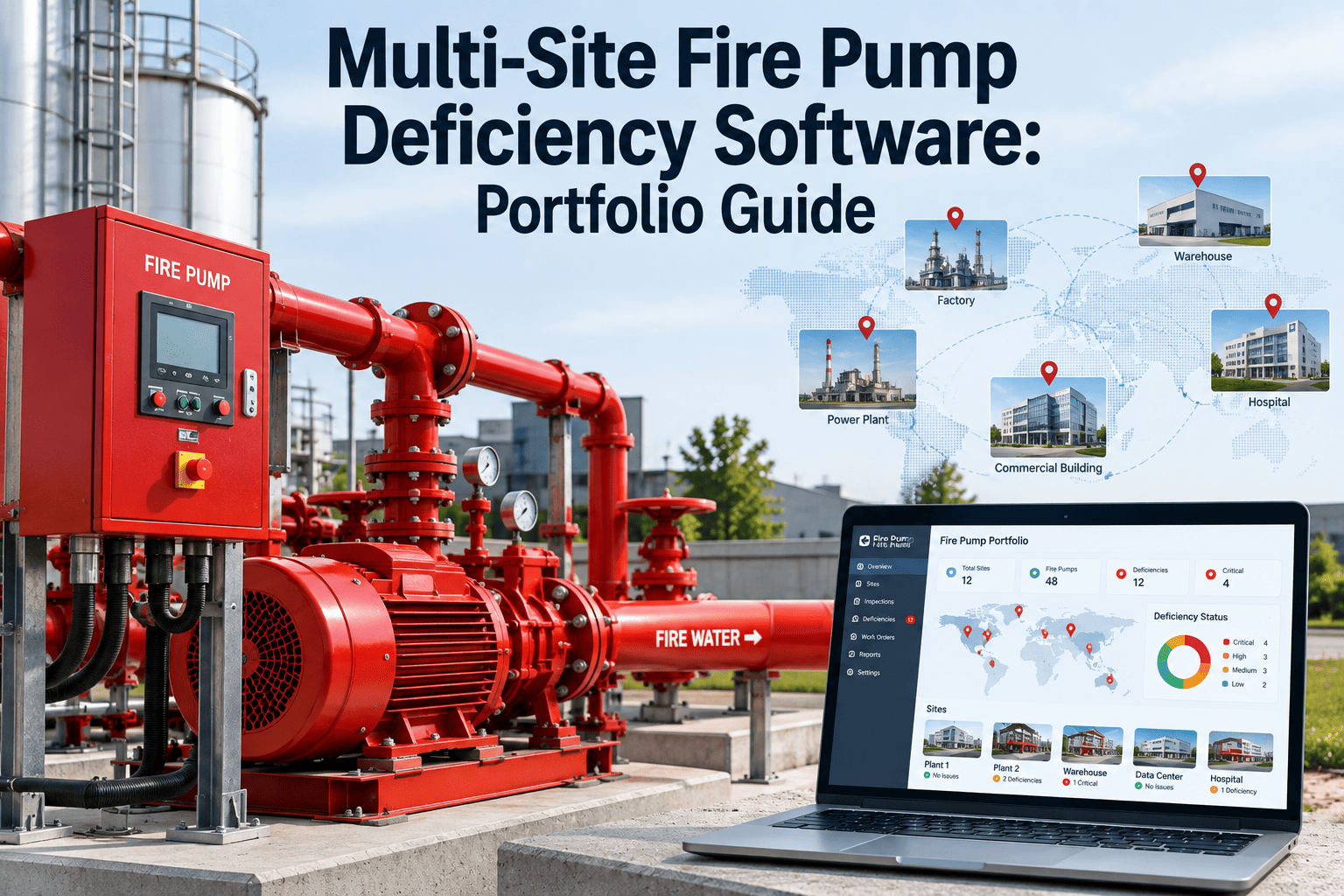
Roll Every Site Into One Dashboard
Every property's current status against the full calendar appears in one portfolio-level view, with overdue tests, flagged deficiencies, and flow curve degradation surfaced automatically instead of buried inside separate site-level reports.
Getting Started
Rolling the Playbook Out Across an Entire Portfolio
Bringing every property onto the same fire pump compliance standard does not need to happen overnight. Most portfolios move through the same four stages, whether they manage three buildings or thirty.
Audit the Current State
Before adding any new process, pull the existing test records from every site — however scattered they are — to establish which properties are current, which are behind, and which have no usable history at all.
Register Every Pump Centrally
Enter every fire pump, jockey pump, and controller into one registry with its acceptance curve, so the correct weekly, monthly, annual, and 3-year schedule can be generated automatically from day one, at every site simultaneously.
Standardize the Field Process
Roll out the same mobile testing form to every site's technicians and contractors, regardless of which company they work for, so every property's records look identical and comparable from the very first test cycle.
Review the Dashboard Monthly
Once every site is reporting into the same system, a short monthly review of the portfolio dashboard catches an overdue test or a flagged deficiency at any property within days, not at the next annual audit.
Frequently Asked Questions
How often does NFPA 25 require fire pumps to be tested?
Diesel-driven pumps need a no-flow churn test every week without exception, while electric pumps need the same no-flow test on a monthly basis. Every pump, regardless of driver type, also needs a full-flow annual test measured at shutoff, rated capacity, and 150% of rated capacity, plus a more detailed comprehensive test every three years.
Sign in to OxMaint to see this full calendar mapped automatically to your specific pumps and sites.
What happens if an annual flow test shows performance degradation?
If the results fall more than 5% below the pump's original acceptance curve, NFPA 25 requires a documented investigation before the next testing cycle begins. Left untracked across multiple properties, this threshold is easy to miss since it depends on comparing this year's numbers against several prior years of records held for every pump.
Can one CMMS actually manage fire pump compliance across many properties?
Yes — a centralized system generates the correct weekly, monthly, annual, and 3-year tasks for every pump at every site from one asset registry, captures field results through a mobile form, and rolls everything up into a single compliance dashboard.
Book a demo to see a live portfolio dashboard.
What is the most common fire pump violation auditors find?
A controller left in manual mode after a maintenance event is one of the most frequent and dangerous findings, since it means the pump cannot start automatically on pressure drop during a real fire event. Missed or undocumented weekly churn tests and overdue annual flow tests are the other two most common gaps auditors report.
Do jockey pumps need their own testing schedule?
Yes. The jockey pump maintains system pressure between fire pump cycles and needs its own weekly cycling check and monthly condition review, separate from the main fire pump's schedule, since it fails silently if it is left out of the playbook.
Stop Tracking Fire Pump Compliance Site by Site
OxMaint schedules, captures, and rolls up every NFPA 25 fire pump test across your entire portfolio into one dashboard — weekly churn tests, monthly runs, annual flow curves, and 3-year overhauls — so every property is audit-ready on the same day, not on a different timeline for each site.