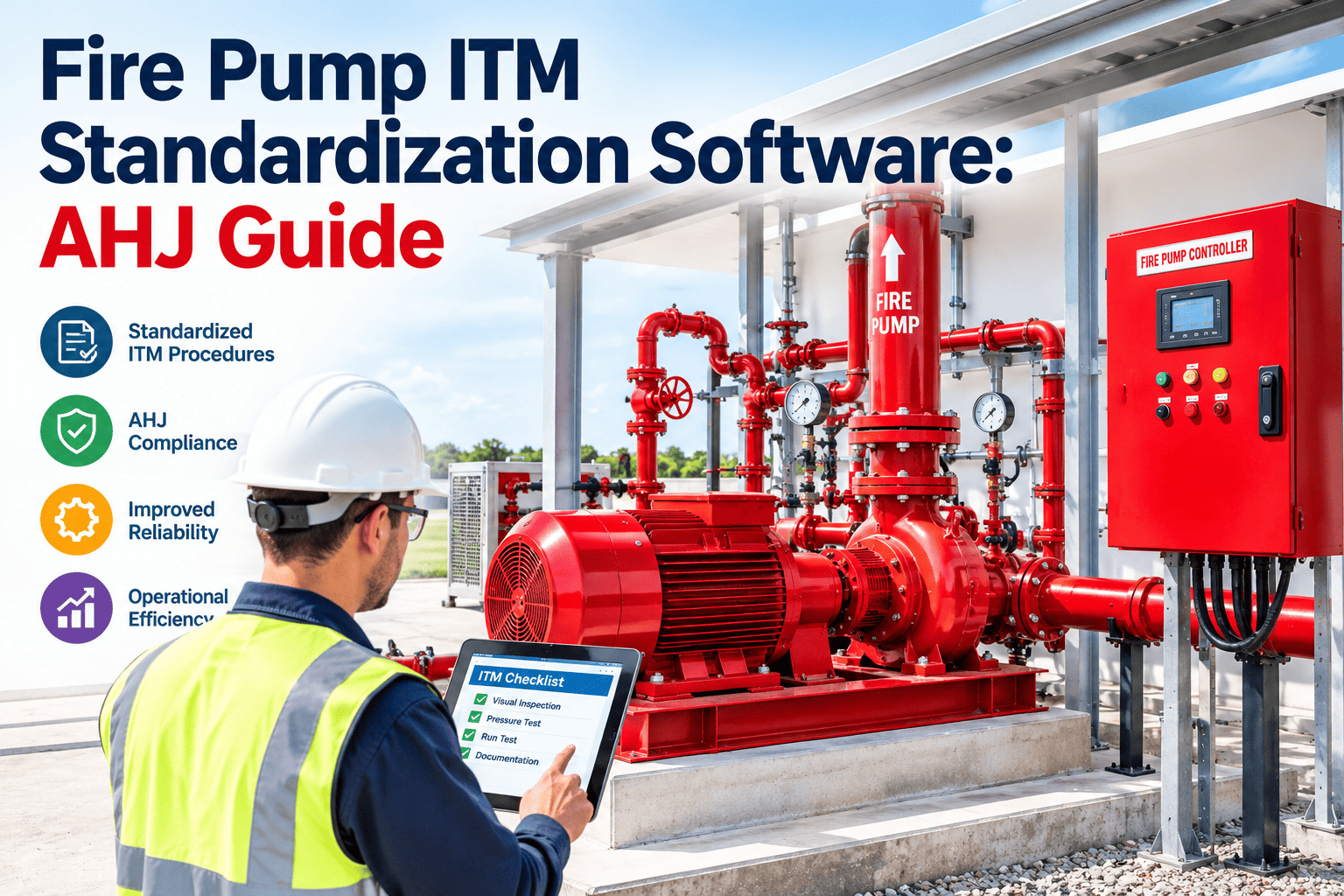
Fire Pump ITM Standardization Software: AHJ Guide

By Corin Hale on September 3, 2026

fire-pump-itm-standardization-software-ahj-guide

A 400-bed regional hospital in Ohio failed a routine AHJ fire pump inspection last spring — not because a pump had failed, but because three sister facilities recorded weekly churn test pressures on different paper logs, and the inspector could not reconcile which readings were accurate. The facility had passed its annual flow test with margin to spare, yet a single afternoon of paperwork inconsistency triggered a corrective action order and a follow-up visit six weeks later. Multiply that across a five-site health system running fire pumps under NFPA 25, and inconsistent inspection, testing, and maintenance records stop being a rare mishap and become a recurring liability. Facilities that standardize fire pump ITM on one digital system report fewer citations, faster AHJ sign-offs, and technicians who spend their shift on pumps instead of re-explaining spreadsheets to an inspector — OxMaint's fire pump ITM standardization platform was built to close exactly that gap.

Standardize Fire Pump ITM Across Every Site — Before the Next AHJ Visit
Weekly churn tests, monthly inspections, annual flow tests, and 5-year internal checks — one format, every facility, every time
63%
Of multi-site facilities cite inconsistent ITM records as their top reason for AHJ corrective action orders
41%
Average drop in repeat fire pump deficiencies within two quarters of standardizing ITM records digitally
3.5x
Faster AHJ walkthroughs when weekly, monthly, and annual fire pump records live in one searchable system

What Fire Pump ITM Standardization Actually Fixes

Inspection, testing, and maintenance for a fire pump is not one task — it is a weekly churn test, a monthly visual inspection, an annual flow test, and a five-year internal casing inspection, each with its own form, its own acceptable range, and its own AHJ expectation. When every building manages this on its own binder or its own spreadsheet, the same pump can be tested correctly but documented in five different formats across a portfolio, which is exactly what makes an AHJ pause. Standardizing the workflow inside OxMaint means every technician, at every site, fills out the same digital checklist in the same order, with the same pass or fail thresholds built in.

01
One Checklist, Every Site
Weekly churn, monthly visual, and annual flow test forms are identical across every building in the portfolio, so a regional fire marshal reviewing five sites sees one format, not five.
02
Built-In Pass/Fail Ranges
NFPA 25 acceptable pressure and flow ranges are pre-loaded per pump model, so a technician cannot record a passing result outside the tolerance without a flagged exception.
03
Automatic Test Scheduling
Weekly, monthly, annual, and five-year intervals are scheduled automatically from the last completed test, removing the manual tracking that causes missed churn tests.
04
Audit-Ready Export
Every completed test generates a timestamped, signed record that exports in the format most AHJs and insurance carriers already expect to see.

Where Fire Pump Records Fall Apart Without Standardization

Most fire pump deficiencies an AHJ writes up are not mechanical — they are documentation gaps that make a compliant pump look non-compliant on paper. A missed signature, a churn test logged three days late, or a discharge pressure written in the wrong units are enough to trigger a re-inspection. The table below compares how these gaps typically show up under manual logging versus a standardized digital ITM workflow.

ITM Task
Manual Logbook
Standardized in OxMaint
Typical Impact
Weekly churn test
Paper log, easy to miss a week
Auto-reminder, overdue flag
Fewer missed-week citations
Diesel driver run test
Run time noted inconsistently
Timer-linked digital entry
Consistent 30-minute record
Monthly visual check
Skipped when tech is short-staffed
Scheduled work order, cannot skip
Zero missed monthly checks
Annual flow test
Third-party report filed separately
Report attached to asset record
One source of truth per pump
5-year internal inspection
Tracked in a separate spreadsheet
Scheduled with the asset lifecycle
No lapsed inspection intervals
Deficiency corrective action
Emailed, sometimes lost
Logged as a tracked work order
Closed-loop deficiency tracking
Our five buildings were each doing fire pump ITM correctly, but every building described it differently on paper. Once we put the same checklist in front of every technician, our AHJ walkthroughs went from a half-day event to under ninety minutes, and we stopped getting written up for formatting.
Facilities Compliance Manager, Regional Healthcare Network, Five Buildings

The ITM Cycle, Standardized From Weekly Churn to Annual Flow Test

A fire pump does not sit still between annual flow tests. It is tested weekly, walked monthly, and certified annually, and each of those intervals produces a record an AHJ can request at any time. Standardizing the cycle means the same three phases repeat identically at every site, every week of the year.

Fire Pump ITM Cycle — Weekly to Annual, Standardized
Weekly & Monthly
Churn test recorded on the same digital form at every site, no exceptions
Suction and discharge pressure logged against pre-set acceptable ranges
Jockey pump cycling frequency checked against baseline
Monthly visual walk of pump house, gauges, and controller lights
Annual Certified Test
Flow test scheduled automatically from the prior year's completion date
Third-party test contractor results attached directly to the pump asset
Churn valve and relief valve settings verified against manufacturer spec
Deficiencies auto-converted into tracked corrective work orders
Every Five Years
Internal pump casing inspection scheduled alongside the annual cycle
Historical test trend reviewed before the inspection to flag wear patterns
Full ITM history exported as one continuous record for the AHJ
Next five-year interval scheduled the moment the current one closes

Fire Pump ITM Standardization by Facility Type

A hospital, a manufacturing plant, a high-rise, and a data center all run fire pumps under NFPA 25, but each has a different reason standardization matters most. Booking a walkthrough is the fastest way to see how the same platform adapts to each facility type without changing the underlying compliance logic.

Healthcare Facilities
Life Safety Continuity
  • Weekly churn logs tied to accreditation surveys
  • Deficiency escalation to facilities director in real time
  • Cross-campus record consistency for system audits
Manufacturing Plants
Insurance & Loss Control
  • Annual flow test results shared directly with insurers
  • Diesel driver run-time trends flagged before failure
  • Shift-based technicians using one shared checklist
High-Rise Buildings
Multi-Pump Coordination
  • Standpipe and sprinkler pump records kept separately
  • Booster pump churn tests scheduled independently
  • Building management sees one compliance dashboard
Data Centers
Zero-Tolerance Uptime
  • Redundant pump testing sequenced to avoid downtime
  • Instant deficiency alerts routed to on-call engineers
  • Full ITM history ready for client compliance audits
Fire Pump ITM Standardization
Every Site Should Pass the Same Way, Every Time
One checklist, one set of pass/fail ranges, one exportable record — across every fire pump in your portfolio.

Common Fire Pump ITM Failures Standardization Eliminates

Most fire pump write-ups trace back to one of four recurring gaps, and every one of them is a process problem, not a mechanical one. Standardizing the ITM workflow removes the human variability that causes each of these to repeat year after year, and the pattern shows up the same way whether the portfolio has three buildings or thirty.

Missed Weekly Churn Tests
Short-staffed weeks cause the test to slip without anyone noticing until the log is reviewed
Automatic overdue flags surface a missed week immediately, not at the next audit
Inconsistent Pressure Units
Different technicians record suction and discharge pressure in different formats across sites
Standardized digital fields lock the unit and range, removing transcription errors
Lost Annual Test Reports
Third-party flow test reports filed by email get separated from the asset record
Attaching the report directly to the pump asset keeps one continuous history
Unclosed Corrective Actions
Deficiencies noted on paper are easy to forget once the inspector leaves the site
Each deficiency becomes a tracked work order that cannot be closed without proof

How OxMaint Fits Into Your Existing Fire Pump Program

Standardizing fire pump ITM does not mean replacing the pump vendor, the fire protection contractor, or the annual test provider — it means giving all of them one shared place to put the record. OxMaint connects to the systems you already run so the switch to standardized ITM does not require new hardware or a new team. Most facilities keep their existing test contractor, their existing telemetry vendor, and their existing technicians; what changes is where the resulting record lands and how consistently it is captured from one week to the next.

This matters most at the point where responsibility changes hands — a new facilities manager inheriting a portfolio, a contractor rotation, or a technician covering a shift at an unfamiliar building. Without a standardized workflow, that handoff is where testing intervals slip and where a churn test gets logged in a format the next person cannot find later. With a shared digital checklist, anyone stepping into a fire pump room for the first time sees the exact same form, the exact same acceptable ranges, and the exact same history that the previous technician left behind, so continuity does not depend on one person's memory of how a particular site does things.

Mobile Checklists for Field Technicians
Technicians complete the weekly churn test, monthly visual walk, and annual test on a phone or tablet, with the same form appearing identically at every building in the portfolio, even offline in a pump room with no signal.
Building Automation and Sensor Data
Where sensors already monitor pump pressure or jockey pump cycling, that data feeds directly into the ITM record, cross-checking the technician's manual entry against live readings automatically.
Third-Party Test Contractor Uploads
Annual flow test contractors and five-year internal inspection firms upload their reports directly into the same asset record technicians use weekly, so nothing lives in a separate inbox.
Compliance Dashboard for Facility Directors
Portfolio-wide status shows which sites are current, which have an overdue test, and which have an open deficiency, so a regional director never learns of a gap from the AHJ first.
Exportable Records for Every Authority
Completed ITM history exports in the layout most fire marshals, insurance auditors, and accreditation surveyors already expect, cutting the time spent reformatting records before a visit.

Why AHJs Increasingly Expect Digital ITM Records

Fire marshals and third-party inspectors review far more properties today than they did a decade ago, and a growing share of them now ask for records before they arrive on site rather than after. A binder full of handwritten churn test entries slows a walkthrough down and invites more questions, while a digital export that shows every weekly, monthly, and annual entry in one continuous timeline moves the conversation from "prove this happened" to "confirm this looks right." Facilities that standardize early are increasingly treated as lower-risk properties during scheduling, which in practice means shorter visits and fewer follow-up requests.

The same shift is happening on the insurance side. Loss control engineers reviewing fire pump performance for renewal now routinely ask for the last twelve months of churn test data alongside the annual flow test report, and a standardized digital record answers that request in minutes instead of days spent tracking down which building has which binder. Booking a short walkthrough of how OxMaint assembles that history automatically is usually enough to see the time difference for a portfolio of any size.

63%
Fewer documentation-related AHJ deficiencies after standardizing fire pump ITM
3.5x
Faster AHJ walkthroughs across multi-site portfolios on one shared system
0
Missed weekly churn tests reported by facilities using automatic overdue flags
48 hrs
Typical setup time to bring a new site onto the standardized ITM workflow

None of this replaces the judgment of a qualified technician or a licensed test contractor — standardization simply removes the paperwork variability that turns a compliant pump into a documentation problem. Once the workflow is consistent, facility teams tend to spend their inspection days answering questions about the equipment itself rather than about which building's binder is missing a signature.


Frequently Asked Questions

Fire pump ITM covers weekly churn tests, monthly visual inspections, annual certified flow tests, and a five-year internal casing inspection. OxMaint schedules all four automatically from a single asset record.
Most write-ups trace back to inconsistent documentation, not failed equipment — different units, missed signatures, or late entries across sites. Standardized digital checklists remove that variability.
Yes — the same weekly, monthly, and annual checklist applies to every site, so a regional AHJ or corporate compliance team reviews one format instead of reconciling five. Book a walkthrough to see it across your portfolio.
Most sites are fully configured within 48 hours, with pump assets, test intervals, and technician access set up before the next scheduled churn test.
No — the certified annual test still requires a qualified contractor. Standardization simply attaches that report to the same continuous asset record used for weekly and monthly checks.
Fire Pump ITM Standardization
Stop Explaining Formatting Gaps to Your AHJ
Bring every fire pump, every site, and every technician onto one standardized ITM workflow — starting with your next scheduled churn test.

Share This Story, Choose Your Platform!