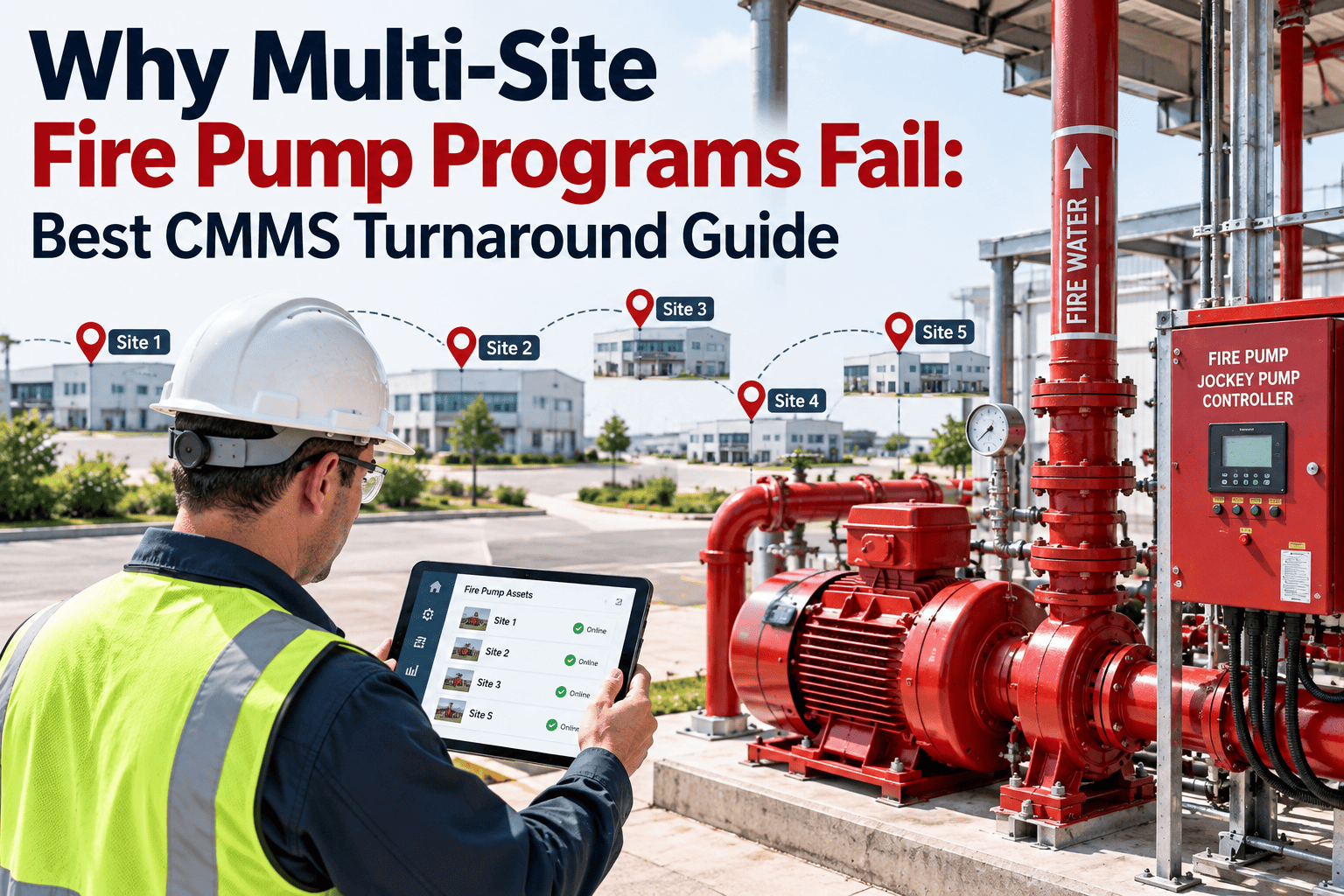
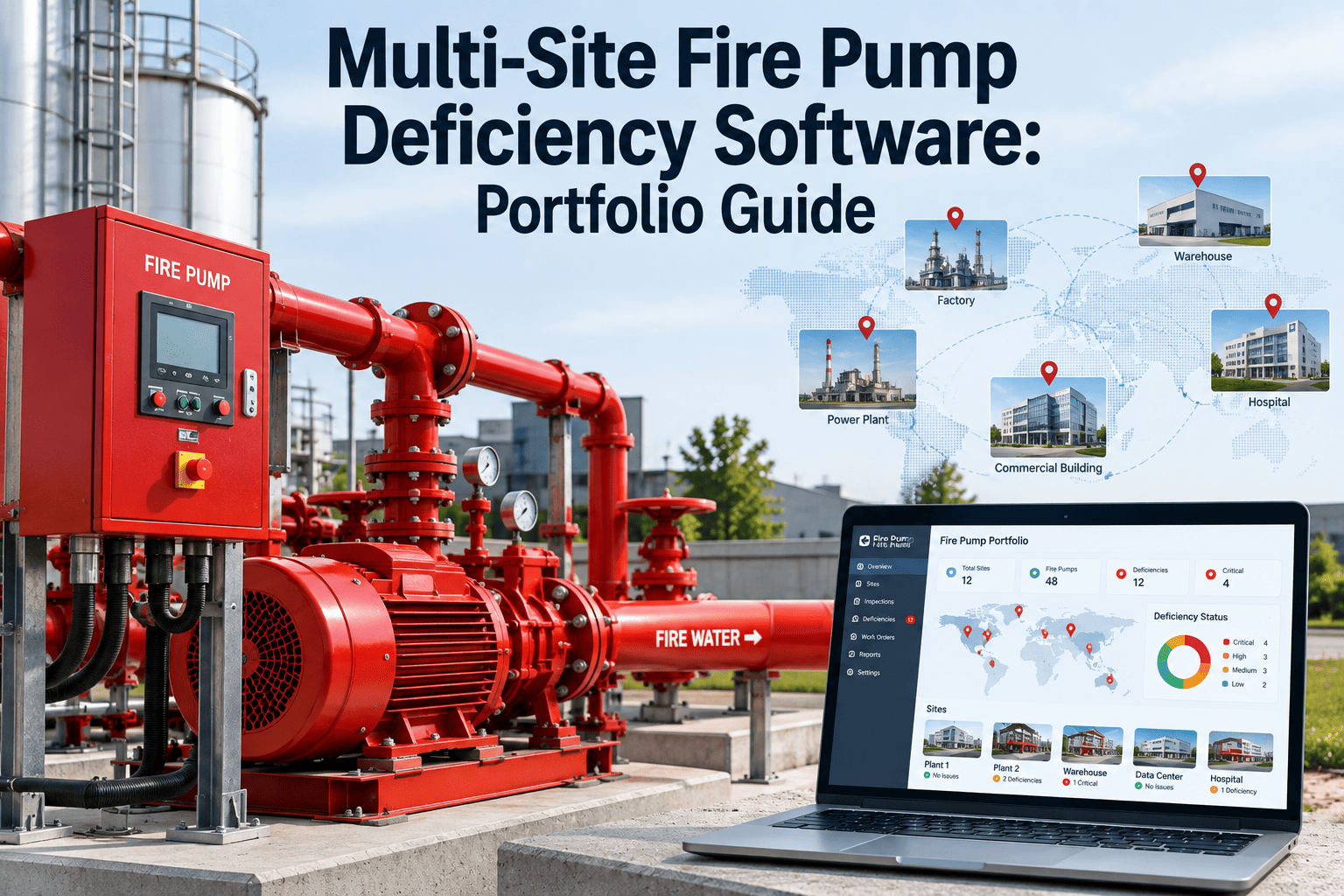
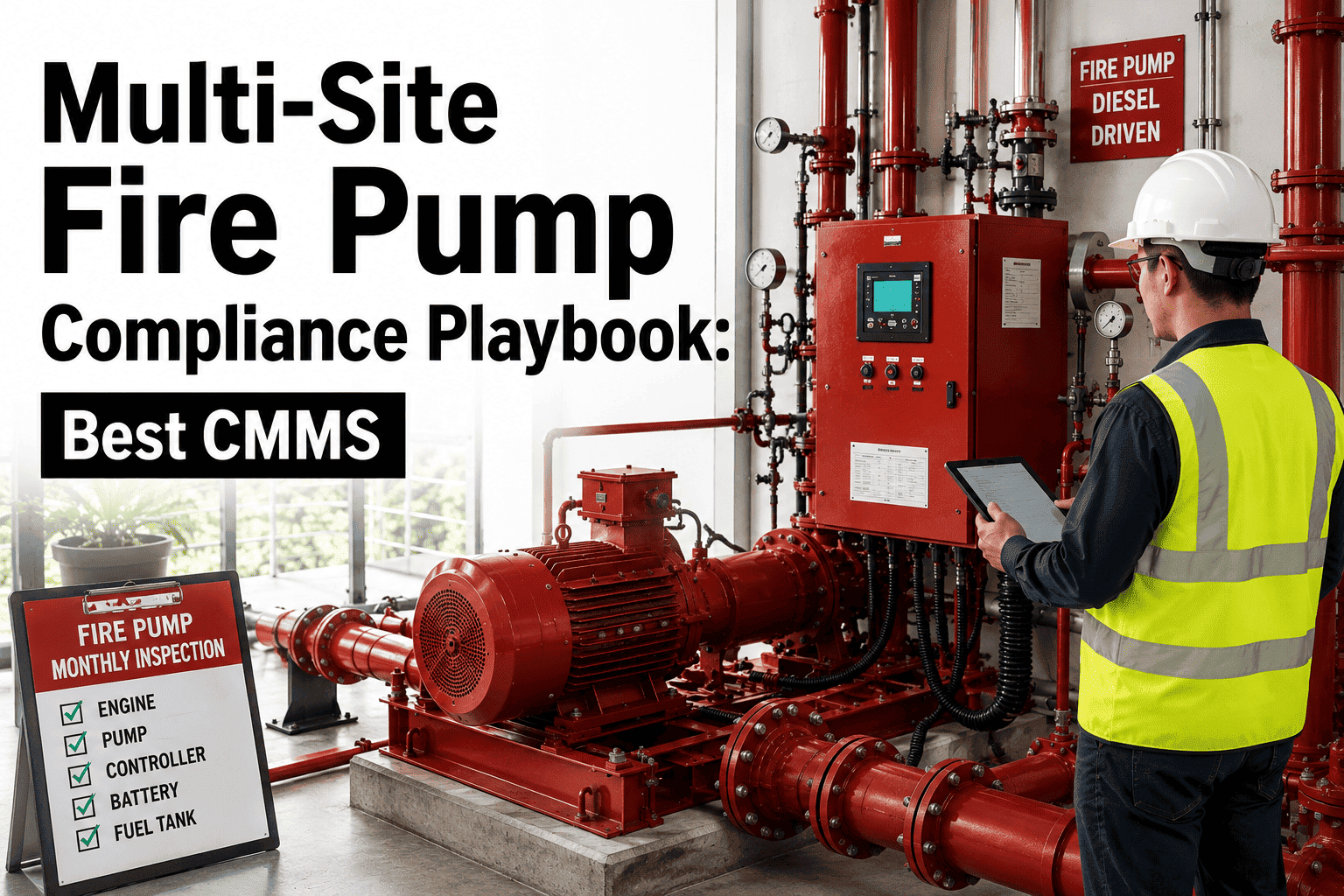
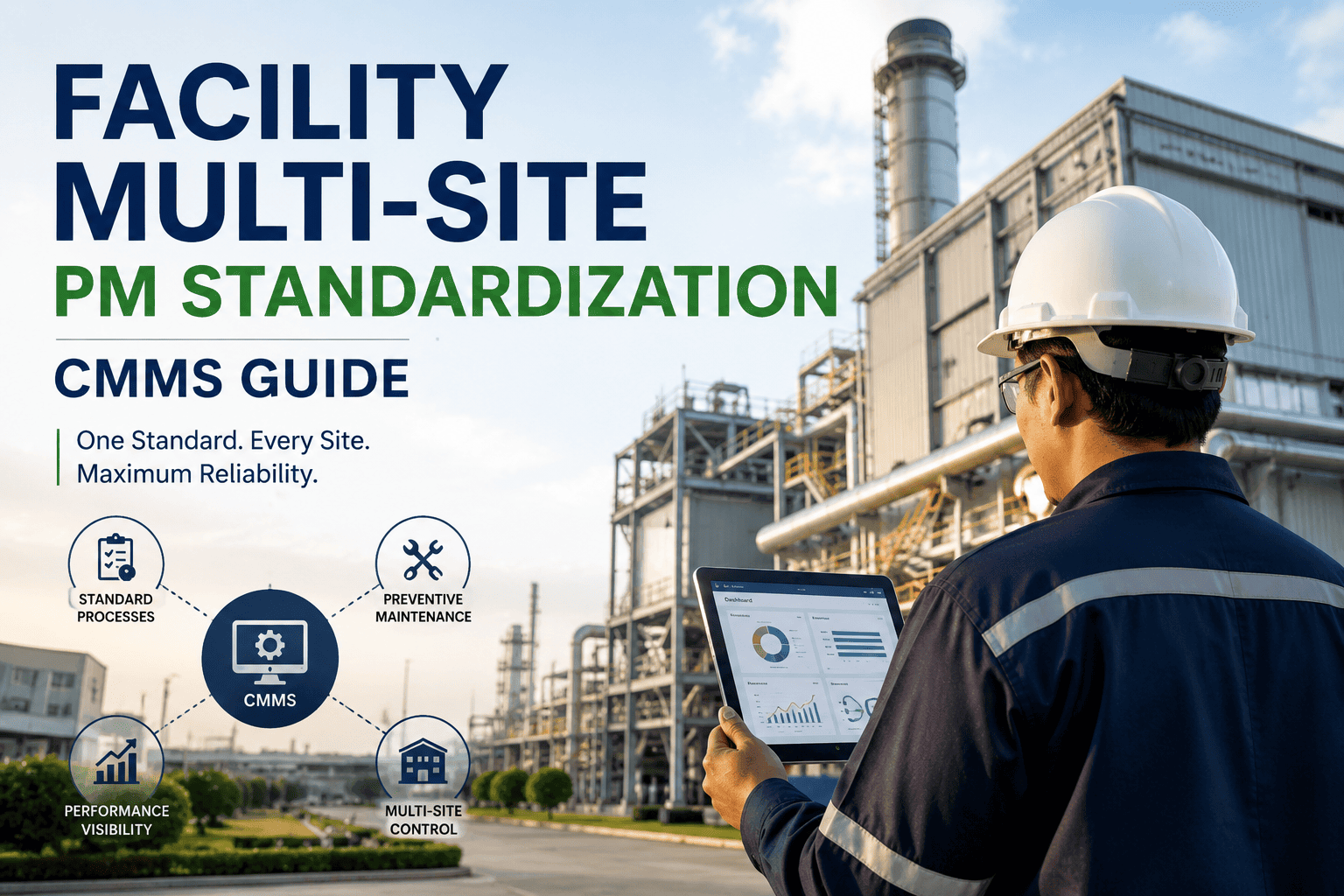
Ask a corporate facilities director how many different fire pump models sit across their portfolio and most cannot answer without pulling files from a dozen different property managers. One site runs a diesel-driven pump on a weekly churn schedule tracked in a paper logbook. Another runs an electric pump whose annual flow test was completed by a contractor whose report never made it back to head office. A third site has a pump nobody has run a no-flow test on in eleven weeks, and the person who used to track it left the company in the spring. This is not a hypothetical — it is the normal state of fire pump compliance across most multi-site REIT and corporate real estate portfolios, and it is exactly the gap an insurance auditor or AHJ inspector is trained to find. Sign in to OxMaint to see one standardized fire pump PM template applied across every property in your portfolio.
Portfolio Compliance · Fire Pump Standardization · 2026 Edition
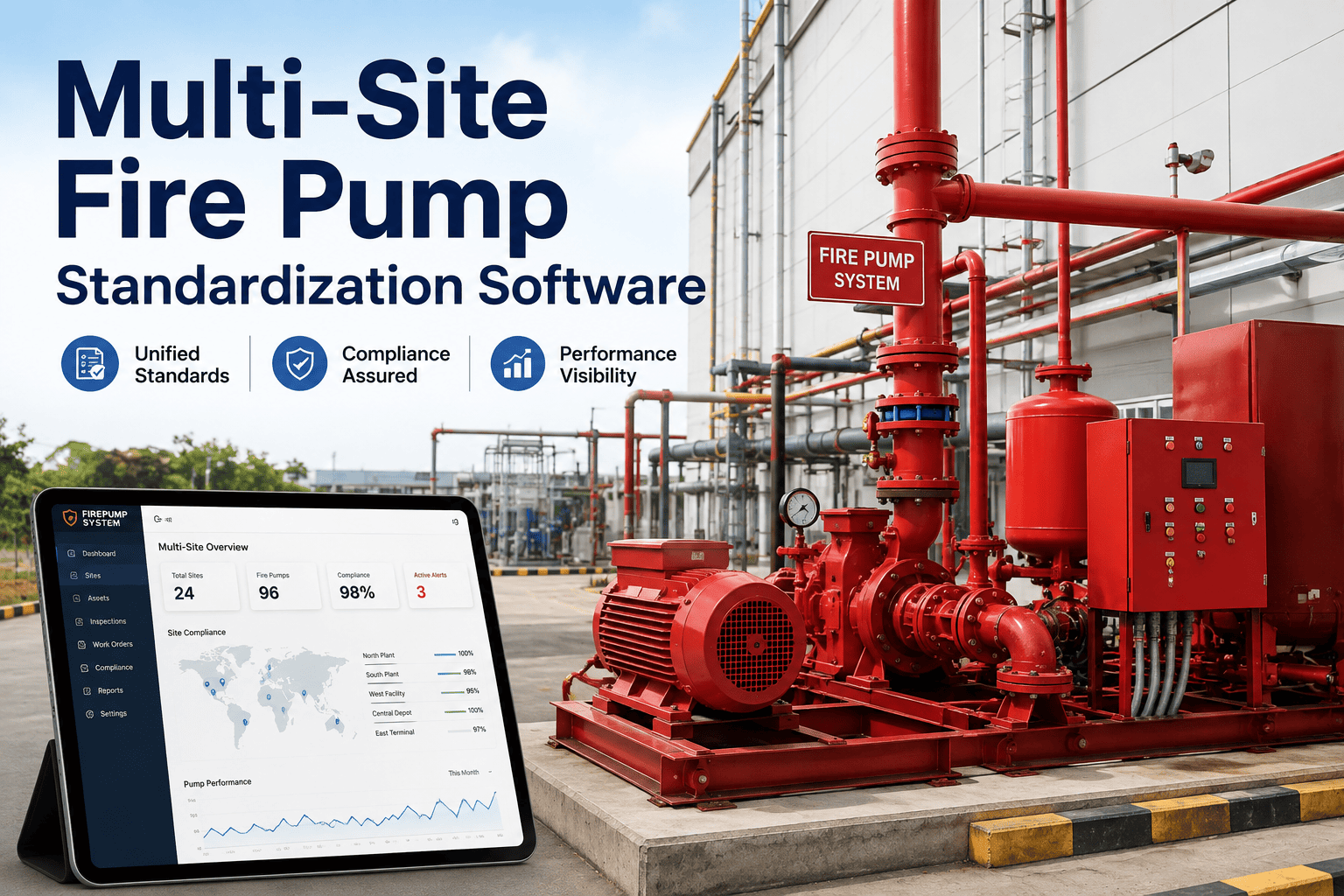
Multi-Site Fire Pump Standardization Software
One weekly churn test template, one annual flow test schedule, one documentation format — applied consistently to every fire pump in every building across your portfolio, regardless of pump make, model, or which local team runs the test.
52
Weekly churn tests every fire pump requires per year under NFPA 25, per site, per pump
10 min
Minimum required duration of a compliant no-flow churn test on every fire pump
1 yr
Minimum record retention period NFPA 25 requires for routine fire pump inspection logs
Life of system
Retention period required for annual flow test results and major maintenance records
The Portfolio Problem
Why Fire Pump Compliance Breaks Down Across Multiple Sites
A single-building facility team can track one pump on one clipboard. A portfolio of twenty, fifty, or two hundred properties cannot run on that same clipboard logic, and the gaps that form are exactly what insurers and fire marshals cite most often.
01
Every Site Runs a Different Template
One property manager built a spreadsheet in 2019. Another site still uses a laminated paper log. A third relies on the fire pump contractor's own field notes. None of the three formats match, and none of them roll up into a portfolio-level compliance view.
02
Mixed Pump Makes and Models
Electric-driven, diesel-driven, horizontal split case, vertical turbine — a growing portfolio inherits whatever the original developer installed. Each configuration has slightly different test procedures, and a standardized checklist has to account for all of them without becoming unusable.
03
No Portfolio-Wide Overdue Alert
A missed weekly churn test at one property is invisible to head office until an auditor asks for the log. Without a centralized alert, a gap can run for months before anyone above the site level even knows it exists.
04
Records Scattered Across Vendors
Annual flow tests are frequently performed by third-party fire protection contractors whose reports live in that contractor's own system, disconnected from the CMMS or the property's compliance file entirely.
Testing Intervals
The Fire Pump Testing Schedule Every Site Must Follow
Weekly
No-Flow Churn Test
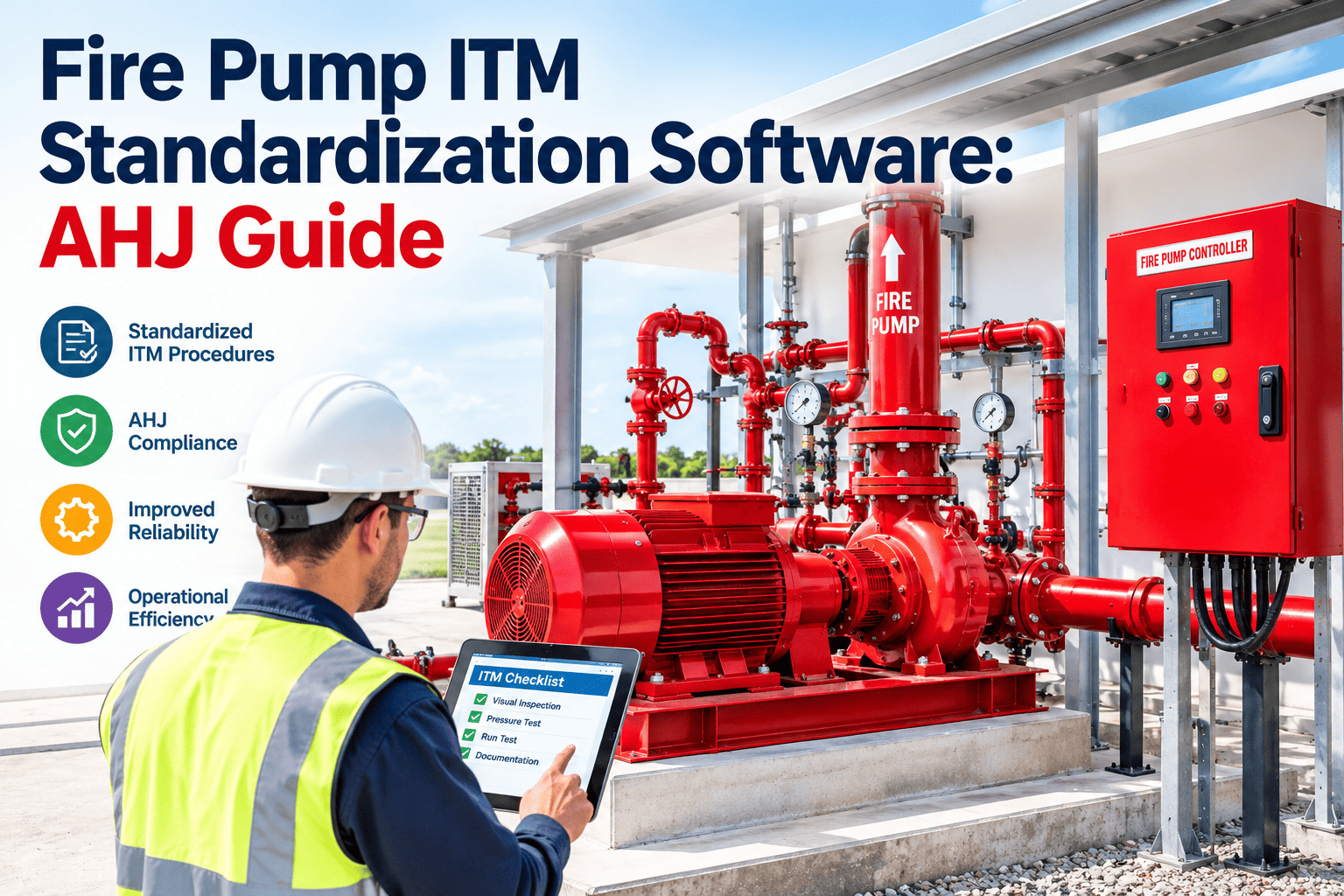
Run the pump for a minimum of ten minutes without flowing water, confirming automatic start, correct rotation, gauge readings within range, and no unusual noise or vibration.
Monthly
Diesel Pump Fuel and Battery Check
Diesel-driven pumps require additional monthly verification of fuel level, battery condition, and starting system readiness beyond the standard weekly churn test.
Annual
Full-Flow Performance Test
Every fire pump must demonstrate rated flow and pressure output through a full-capacity flow test, with results compared against the pump's original acceptance curve.
Ongoing
Impairment Documentation
Any time a pump or its supply is taken out of service, a formal impairment record is required regardless of how brief the shutdown — one of the most frequently cited gaps in multi-site portfolios.
Turn Twenty Different Spreadsheets Into One Compliance View
OxMaint applies a single standardized fire pump PM template across every property in your portfolio and rolls every site's test status into one dashboard.
Portfolio Risk
What an Untracked Fire Pump Actually Puts at Risk
Citation
AHJ enforcement action when a fire pump test cannot be produced on demand during an unannounced inspection
Premium Rise
Insurance carriers routinely adjust property premiums when fire protection test documentation has gaps
Policy Voidance
A fire loss claim can be challenged entirely if the insurer determines required testing was not performed or documented
Deal Risk
Missing fire pump compliance records are a recurring finding in property acquisition and lender due diligence reviews
Site-Level vs Portfolio-Level
Spreadsheet Tracking vs a Standardized CMMS Template
Each property manager builds and maintains their own log format
Head office has no visibility until a report is manually requested
Annual flow test reports sit in a contractor's files, not the portfolio record
Audit prep means calling every site individually and waiting on responses
One weekly churn test checklist deployed identically to every site
Portfolio dashboard shows every pump's test status in real time
Contractor flow test results uploaded directly into the same asset record
Full portfolio compliance export generated in minutes, not days
Rollout Requirements
What It Takes To Standardize Fire Pump PM Across a Portfolio
Standardization is a process change more than a technology change, and most portfolios can complete a phased rollout without disrupting existing site operations.
| Requirement |
Specification |
Notes |
Status |
| Master PM template |
Single weekly, monthly, and annual checklist covering all pump types |
Built once, deployed identically to every property in the portfolio |
OxMaint native |
| Asset register per site |
Pump make, model, drive type, and rated flow logged for every property |
Most sites already have this data in commissioning or O and M documents |
Often existing |
| Mobile access for site staff |
Technicians complete weekly churn tests from a phone or tablet on site |
Works offline in mechanical and pump rooms with poor signal coverage |
OxMaint native |
| Contractor upload access |
Annual flow test vendors upload results directly to the pump's asset record |
Removes the manual step of chasing paper reports from third parties |
Configured during rollout |
| Portfolio compliance dashboard |
Roll-up view of every site's test status, overdue items, and open impairments |
Gives head office real-time visibility without calling individual sites |
OxMaint native |
The biggest misconception in portfolio fire protection management is that standardization means forcing every building to have the same equipment. It does not. It means every building runs the same process on top of whatever equipment it has. A diesel pump in one building and an electric pump in another can both be tracked on the identical weekly checklist logic, with the equipment-specific steps built into the template rather than left to memory. Once that is in place, an audit request that used to take three days of phone calls to twenty property managers becomes a five-minute export, and a missed weekly test at any single site shows up on a dashboard the same day instead of surfacing during an inspection six months later.
DK
Daniel Krofchak, CFPS
Certified Fire Protection Specialist, 18 years advising REIT and corporate real estate portfolios on life-safety compliance programs, former portfolio compliance lead for a 140-property national commercial real estate group
Frequently Asked Questions
How does one software template work across sites with completely different fire pump equipment?
The core weekly and annual test structure stays identical across every site, while equipment-specific fields like drive type and rated flow are captured at the asset level.
Sign in to OxMaint to see the template applied to mixed pump types.
Can property-level teams still complete tests the way they do today?
Yes. Site staff complete the same weekly churn test in the field using a mobile checklist, and the only change is that the record now rolls up automatically into the portfolio compliance dashboard.
Book a demo to see the technician-side workflow.
How do third-party annual flow test contractors fit into a standardized system?
Contractors are given limited upload access to attach flow test results directly to the correct pump's asset record, eliminating the step of results sitting in a separate contractor system.
Sign up free to configure contractor access for your portfolio.
How fast can we prepare documentation when an insurer or AHJ requests a portfolio-wide audit?
Once every site is on the same template, a full compliance export across every property and every pump can be generated in minutes rather than the days it typically takes to collect records from individual sites.
What does a standardization rollout across an existing portfolio typically involve?
Most portfolios move site by site, starting with a pilot group of properties, confirming the template covers every pump configuration in use, then expanding to the full portfolio.
Book a demo to get a rollout plan for your properties.
One Template. Every Site. Every Pump. Every Audit Ready In Minutes.
OxMaint standardizes weekly churn tests, annual flow tests, and impairment documentation across your entire portfolio — so head office sees every property's fire pump compliance status in one place.