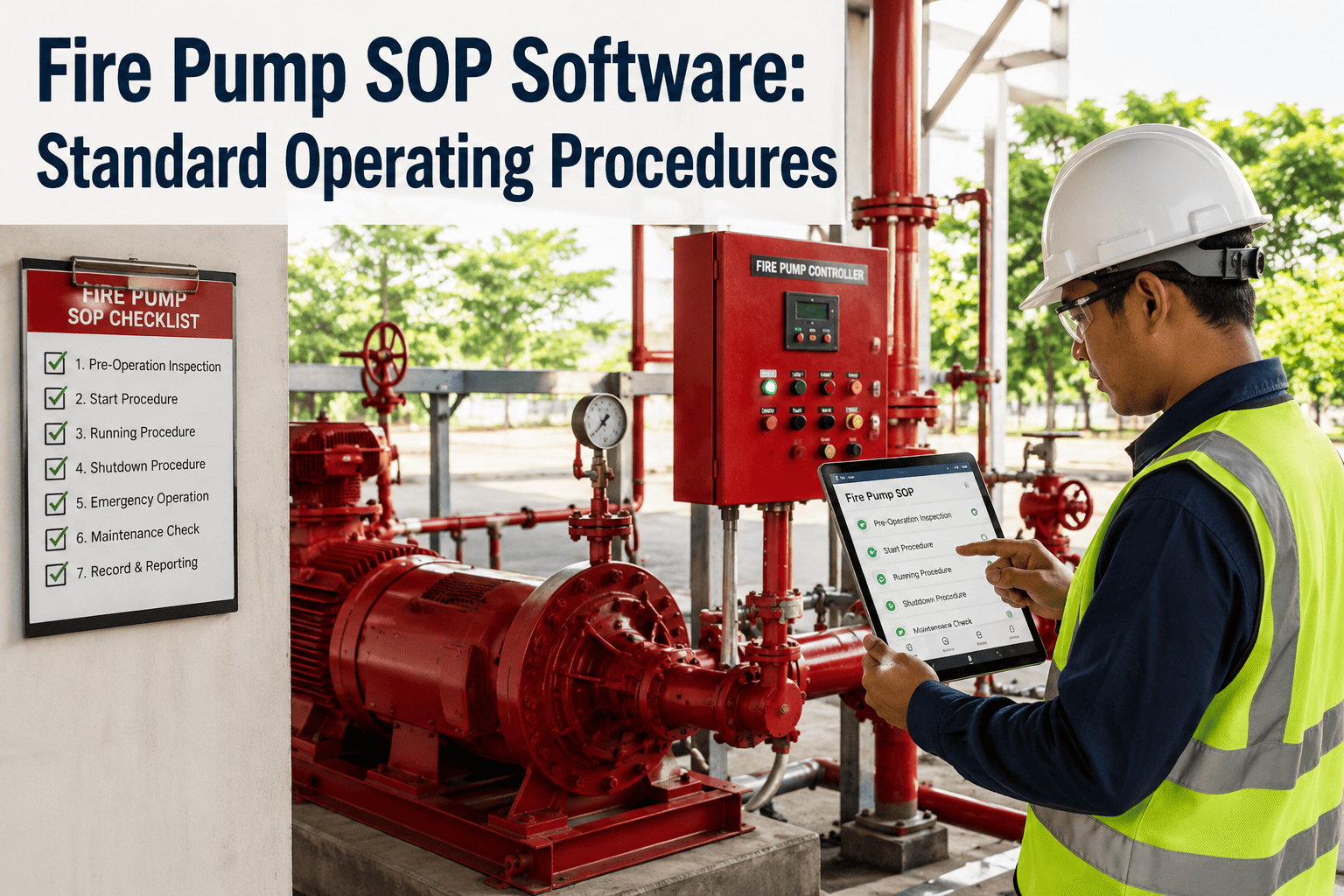
A fire pump that fails its monthly no-flow test because nobody logged the last inspection is not a paperwork problem — it is the difference between a controlled fire response and a catastrophic loss. NFPA 25 requires weekly, monthly, and annual fire pump procedures, each with its own readings, tolerances, and sign-offs, yet most facility teams still track these steps across binders, spreadsheets, and whatever a technician remembers from last quarter. When an authority having jurisdiction asks for three years of test records during an audit, teams scramble to reconstruct history that should already exist. See how a facility team runs fire pump SOPs on Oxmaint, free to start.
Each of these tests exists because a fire pump is a piece of equipment that sits idle for months and is then expected to perform flawlessly under the worst conditions a building will ever face. The weekly no-flow test confirms the driver still starts and holds pressure. The monthly starting test confirms the automatic controller and battery backup are ready to act without a human present. The annual flow and load tests confirm the pump can still deliver the capacity the fire protection design assumed it would, since impellers wear, diesel engines lose compression, and electrical components degrade even when nothing looks wrong on the surface. Skipping or half-completing any one of these steps does not usually cause an immediate problem — it just quietly erodes the margin the building is relying on the day a real fire starts.
Why Fire Pump Compliance Slips Through the Cracks
Fire pump procedures fail quietly, long before an inspector ever notices. A weekly test gets skipped because the assigned technician is out and no one is notified. A pressure reading gets written on a clipboard and never makes it into the permanent record. A controller alarm gets silenced and forgotten instead of triaged. None of these gaps show up until an insurance audit, a jurisdictional inspection, or worse, an actual fire event exposes them. The root cause is almost always the same: fire pump SOPs live as static documents instead of active workflows, so there is no system checking whether the procedure was actually followed, by whom, and with what result. Oxmaint turns the written SOP into a guided digital workflow that technicians cannot skip past, with every reading, photo, and signature captured the moment the test happens rather than reconstructed afterward.
The gap is often widest at multi-site facility portfolios, where a regional maintenance manager might be responsible for forty or fifty fire pumps across buildings they rarely visit in person. Without a system that surfaces missed tests and out-of-tolerance readings automatically, that manager only finds out about a problem when a technician happens to mention it, or when a corporate EHS audit flags it months later. Property managers, hospital facilities teams, data center operators, and manufacturing plants all describe the same pattern: the SOP itself was never the issue, since NFPA 25 spells out exactly what to do. The issue was always visibility into whether the procedure was actually being followed on the ground, at the frequency it required, with evidence that would satisfy an inspector.
A Skipped Weekly Test Is Invisible Until the Pump Doesn't Start
Oxmaint gives every technician the exact NFPA 25 sequence on their phone, captures readings and photo evidence automatically, and builds the compliance record without anyone touching a spreadsheet.
What a Fire Pump Test Record Actually Needs to Prove
A completed fire pump test is only useful if the record behind it can answer a handful of specific questions on demand: which pump was tested, by whom, at what time, under what conditions, and whether every reading fell inside the tolerance the original design and NFPA 25 require. A signature on a paper form answers almost none of that with confidence, because there is no way to confirm the reading was taken when it says it was, or that the technician was standing at the gauge rather than filling in a plausible number after the fact. Insurers, AHJs, and internal risk teams are increasingly explicit about wanting evidence, not attestations. That is why Oxmaint attaches a photo of the gauge, controller display, or flow meter to every reading, time-stamps it against GPS location where relevant, and locks the entry once the work order is submitted, so the record that goes into your compliance file is the same record a technician generated in the pump room, not a cleaned-up version assembled later. Facility teams that make this shift usually describe the same effect: the quality of the conversation with their AHJ or insurer changes from justifying gaps to simply handing over the report.
How Oxmaint Runs Fire Pump SOPs in the Field
Oxmaint does not replace your fire pump SOP — it turns it into the workflow every technician actually follows, on every shift, at every site.
Getting Your SOP Library Live
Fire pump SOP deployment on Oxmaint takes two weeks, not two quarters, because the procedures already exist — they just need a system that enforces them.
Fire Pump Standards Across Regions
Oxmaint builds jurisdiction-specific documentation into every fire pump test, so the record you generate already matches what your inspector expects to see.
Jurisdiction matters more than most facility teams expect, because the same fire pump behavior can be documented in different ways depending on which fire code, insurer standard, and local authority happens to apply to that building. A portfolio operating across two or three of these regions often ends up running two or three different paper-based reporting formats in parallel, which is exactly the kind of inconsistency that surfaces during a corporate audit or an insurance renewal. Configuring the reporting template once per jurisdiction inside Oxmaint means every site produces a record in the format its own regulator or insurer already expects, without the facility manager needing to remember which template applies to which building.
Oxmaint vs Other Facility CMMS Platforms
Swipe to view the full comparison table
| Capability | Oxmaint | MaintainX | UpKeep | Fiix (Rockwell) | Limble CMMS | IBM Maximo | Hippo (Eptura) |
|---|---|---|---|---|---|---|---|
| Fire Pump SOP Library | Pre-built to NFPA 25 | Generic checklists | Generic checklists | Custom config | Generic checklists | Full (complex) | Generic checklists |
| Photo Evidence Capture | Built into every step | Basic attachment | Basic attachment | Enterprise tier | Basic attachment | Configurable | Basic attachment |
| Controller Alarm Integration | Direct feed, auto work order | Not available | Limited | Rockwell ecosystem | Not available | Custom build | Not available |
| Offline Mobile Testing | Full offline with sync | Online only | Limited offline | Limited offline | Limited offline | Limited | Online only |
| AHJ Audit Export | One-click, jurisdiction-ready | General export | General export | Manufacturing focus | General export | Configurable | General export |
| Multi-Site Pump Dashboard | Built-in, real-time | Basic multi-site | Basic multi-site | Enterprise tier | Basic multi-site | Enterprise | Basic multi-site |
| Deploy Time | 7–14 days | 2–3 weeks | 2–4 weeks | 4–12 weeks | 1–2 weeks | 6–18 months | 2–6 weeks |
What Changes After Digitizing Fire Pump SOPs
These numbers reflect a simple shift in behavior rather than a new piece of equipment: technicians run the exact same weekly, monthly, and annual procedures they always have, but now the system notices immediately when a test is late, a reading falls outside tolerance, or a signature is missing, instead of that gap surfacing months later during an audit. Facility managers who move from spreadsheet tracking to a guided digital workflow consistently report that the biggest change is not the pumps themselves — it is how much less time their team spends chasing down missing records, and how much more confident they feel walking into a fire marshal's office or an insurance renewal meeting.
Your Insurer Will Ask for Three Years of Records. Can You Produce Them Today?
Digitize your fire pump SOPs, capture readings and photo evidence automatically, and generate audit-ready reports in one click, from one platform.
How Fire Pump Records Are Protected
A fire pump test record often becomes evidence in exactly the situations where its integrity matters most: an insurance claim after a loss, a liability review after an incident, or a jurisdictional audit that determines whether a facility keeps its occupancy certificate. Oxmaint treats every reading, photo, and signature in that record with the same security standard used for financial and health data, because the day that record is needed, there is no opportunity to go back and fix how it was stored.
Frequently Asked Questions
Does Oxmaint follow the exact NFPA 25 test sequence for fire pumps?
Can readings be captured automatically instead of written on paper?
What happens when a controller alarm or low-pressure signal fires?
Does the mobile app work in pump rooms without cell signal?
How fast can a multi-site facility portfolio get its SOP library live?
Every Untested Fire Pump Is a Bet You Are Not Allowed to Lose
Weekly, monthly, and annual SOPs. Photo-verified readings. Controller alerts. One-click compliance reports. All from one platform, live in 14 days.