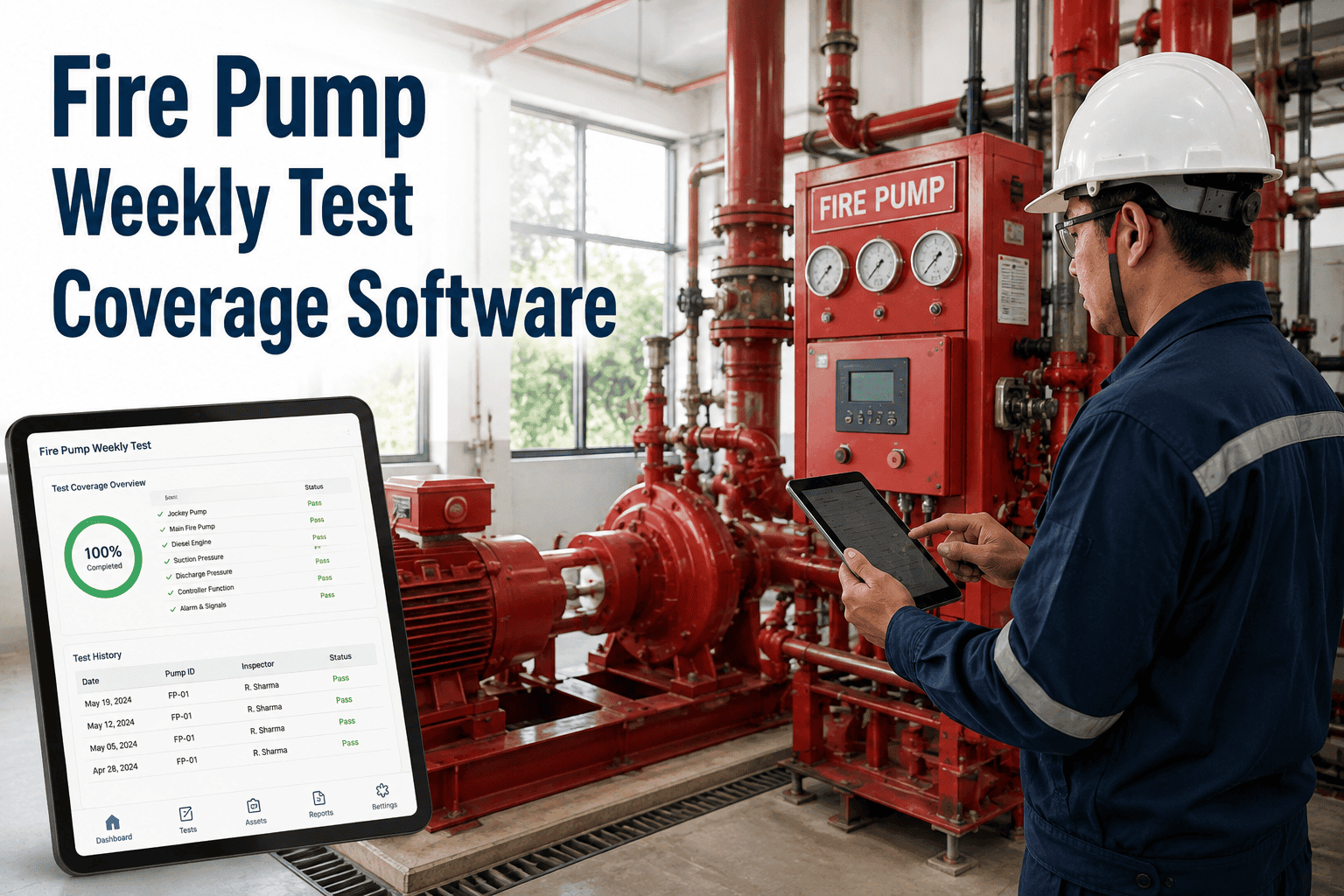
NFPA 25 requires a fire pump churn test every single week without exception, yet most facilities discover a missed week only when an authority having jurisdiction pulls the log book during an annual inspection. A missed weekly test is not a paperwork problem — it is the difference between a fire pump that starts on demand and one that has sat idle for months without anyone noticing the failure. Coverage rate, the percentage of required weekly tests actually completed and logged on time across every pump in a portfolio, is the single number that tells a facility director whether their fire protection program is compliant or exposed. This guide explains how a coverage rate KPI works, why manual log books consistently under-report missed tests, and read more on how OxMaint's fire pump testing module closes the gap before the next inspection cycle.
The Week Nobody Tested the Pump Is the Week It Would Have Failed
Weekly fire pump churn tests are the most frequently required, most frequently skipped, and most consequential recurring task in a fire protection program. This guide breaks down the coverage rate KPI, the failure points in manual tracking, and the CMMS structure that keeps every pump inside its testing window.
Fire pump deficiencies cited during third-party inspections trace back to a testing interval that was skipped or logged late, not to hardware failure.
Of facilities relying on paper or spreadsheet logs cannot produce an accurate coverage percentage when an AHJ requests it on the spot.
Average coverage rate improvement in the first quarter after a facility switches from paper logs to scheduled digital test reminders.
Typical cost range of an insurance premium increase or AHJ-mandated remediation plan triggered by a documented pattern of missed tests.
Why Weekly Coverage Slips Even at Well-Run Facilities
A weekly test sounds simple until it is spread across a rotating shift schedule, a multi-building portfolio, and a technician workload that already includes work orders for a dozen other systems. Coverage does not usually fail because nobody cares about fire pumps — it fails because the task has no owner for that specific week, no reminder that survives a shift change, and no record that distinguishes "not done" from "done but not logged." The four patterns below account for most of the coverage gaps facility teams discover during audit prep.
The Rotating Technician Gap
When the assigned technician is on leave, the weekly task has no automatic reassignment, so the week is simply skipped and nobody flags it until the log is reviewed months later.
The Multi-Building Blind Spot
A regional facilities manager overseeing twelve sites has no single view of which pumps are current and which are behind, so a lagging site stays lagging until the annual audit surfaces it.
The Paper Log That Travels
A physical log book left in the pump room gets damaged, misplaced, or simply not filled in consistently, and the gap in the paper trail becomes a gap in the actual testing record.
Suction and Discharge Readings Skipped
A technician runs the pump for the required minutes but skips recording suction pressure, discharge pressure, and churn flow, leaving a test that is compliant on time but incomplete on data.
The Coverage Rate KPI, Explained
Coverage rate is calculated as the number of weekly tests actually completed and logged within the required window, divided by the number of weekly tests that should have occurred, across the reporting period. A single pump tested 48 out of 52 required weeks in a year sits at a 92% coverage rate — a number that looks reasonable until an AHJ points out that NFPA 25 does not have a tolerance for missed weeks. The KPI becomes genuinely useful once it is tracked per pump, per building, and rolled up to a portfolio average, because that is the structure that reveals which specific site or which specific technician assignment is driving the gap.
Manual Logs vs. Digital Coverage Tracking
| Tracking Element | Paper or Spreadsheet Log | OxMaint Digital Coverage Tracking |
|---|---|---|
| Weekly test reminder | Relies on a technician remembering or a wall calendar | Automatic work order generated every week per pump, assigned to a technician |
| Missed week visibility | Discovered only during manual log review, often months later | Flagged the moment a test window closes without a completed work order |
| Portfolio-wide coverage rate | Requires manually compiling logs from every site | Live dashboard showing coverage percentage per pump and per site |
| Reading capture | Handwritten pressure and duration values, easy to skip a field | Structured digital checklist requiring suction, discharge, and duration fields |
| Audit package preparation | Days of manually transcribing and organizing paper records | Exportable compliance report generated on demand for any date range |
OxMaint turns the weekly churn test from a task someone might remember into a scheduled work order that cannot be quietly skipped — with a live coverage rate for every pump in the portfolio.
Closing the Coverage Gap in Four Steps
Register Every Pump and Its Required Interval
Load every fire pump in the portfolio into the asset register with its drive type, since electric and diesel pumps carry different minimum churn durations under NFPA 25. This is the reference point every future test is measured against.
Automate the Weekly Work Order
Configure a recurring work order that fires every seven days per pump, assigned to a named technician with a backup assignee so a leave day never becomes a skipped week.
Standardize the Digital Checklist
Require suction pressure, discharge pressure, churn duration, and pump start method on every completed work order so a test cannot be closed out with missing data fields.
Review the Coverage Dashboard Monthly
A monthly review of the portfolio coverage dashboard catches a lagging site or technician assignment weeks before it becomes a pattern an AHJ or insurer would flag.
I have sat across from an AHJ inspector who asked for the coverage rate on a specific pump for the past six months, and the facility team had no way to answer without pulling three different binders. That conversation is entirely avoidable. A weekly fire pump test is not a difficult task — it takes ten to thirty minutes depending on the drive type. What is difficult is proving, across fifty-two weeks and multiple buildings, that it actually happened every single time. The facilities that pass their annual inspection without a single citation are not the ones with the newest pumps. They are the ones who can produce a coverage report in under a minute because the system, not a person's memory, is tracking every week.
Frequently Asked Questions
How does OxMaint generate the weekly fire pump work order automatically?
Each fire pump asset is configured with a seven-day recurrence rule, so a new work order is created the moment the prior week's test window closes, assigned to the named technician. Start a free trial to configure recurrence rules for your own pump register.
Can OxMaint show coverage rate across multiple buildings in one view?
Yes, the portfolio dashboard rolls up coverage rate per pump into a per-building and per-portfolio percentage, so a regional manager can see a lagging site immediately rather than during annual review.
What happens if a technician misses a scheduled weekly test?
The work order remains open past its due date and is flagged on the coverage dashboard, which lowers the visible coverage percentage until the test is completed and logged.
Does the digital checklist capture the readings NFPA 25 requires?
The standard checklist template includes suction pressure, discharge pressure, test duration, and pump start method, matching the fields an AHJ typically requests during inspection review. Book a demo to see the checklist template in detail.
How far back can a facility pull historical coverage data?
Coverage reports can be generated for any date range once testing has been logged in the system, giving a facility a complete record to hand to an inspector or insurer on request.
Fifty-Two Weeks a Year. Zero Gaps in the Log. That Is What Coverage Rate Should Look Like.
OxMaint schedules every weekly fire pump test automatically, captures the readings NFPA 25 requires, and rolls every pump into a live coverage dashboard you can hand to an inspector without opening a single binder.