FM change management is the structured process that determines whether new facility technology gets embraced by the people who use it—or quietly abandoned within months of deployment. Studies consistently show that facility technology adoption fails more often than it succeeds, with up to 70% of digital transformation initiatives falling short of their objectives due to user resistance, inadequate training, and poor rollout strategy. The root cause is rarely the software itself; it is the absence of a disciplined facility change management program that prepares technicians, supervisors, and stakeholders for new ways of working. Overcoming FM technology adoption resistance requires a blend of clear communication, phased rollout milestones, and intuitive tools that demonstrably reduce daily workload rather than adding to it. You can Start Free Trial to see how a modern, AI-powered CMMS directly addresses these adoption barriers.
FM Change Management Strategy
Why does 70% of facility technology adoption fail—and how do you beat the odds?
Rolling out a new CMMS or EAM platform without a structured change management program guarantees friction. Technicians revert to spreadsheets, data quality collapses, and ROI evaporates. Bridging the gap between deployment and true FM digital adoption requires the right framework—and the right software.
The Cost of Inaction
The hidden cost of FM technology adoption resistance
When a facility management technology rollout stalls, the financial and operational impacts compound rapidly. The software licenses continue to bill, but the anticipated downtime reductions, asset lifecycle extensions, and labor efficiencies never materialize. A facility change management failure essentially locks an organization into paying for shelfware while reactive maintenance costs continue to climb.
Real-World Scenario
Consider a 180-asset manufacturing plant that deployed a new CMMS to digitize preventive maintenance. Without a dedicated FM change program, floor technicians found the mobile interface clunky and continued logging work on paper. Within six months, the facility experienced a 22% increase in unplanned downtime because PM schedules were missed in the digital void. The cost of that downtime—roughly $12,000 per line stoppage—quickly erased any anticipated software savings. Overcoming facility adoption resistance early is not just an HR exercise; it is a direct lever on equipment reliability and OEE.
4-Phase Framework
How to build a successful FM change management program
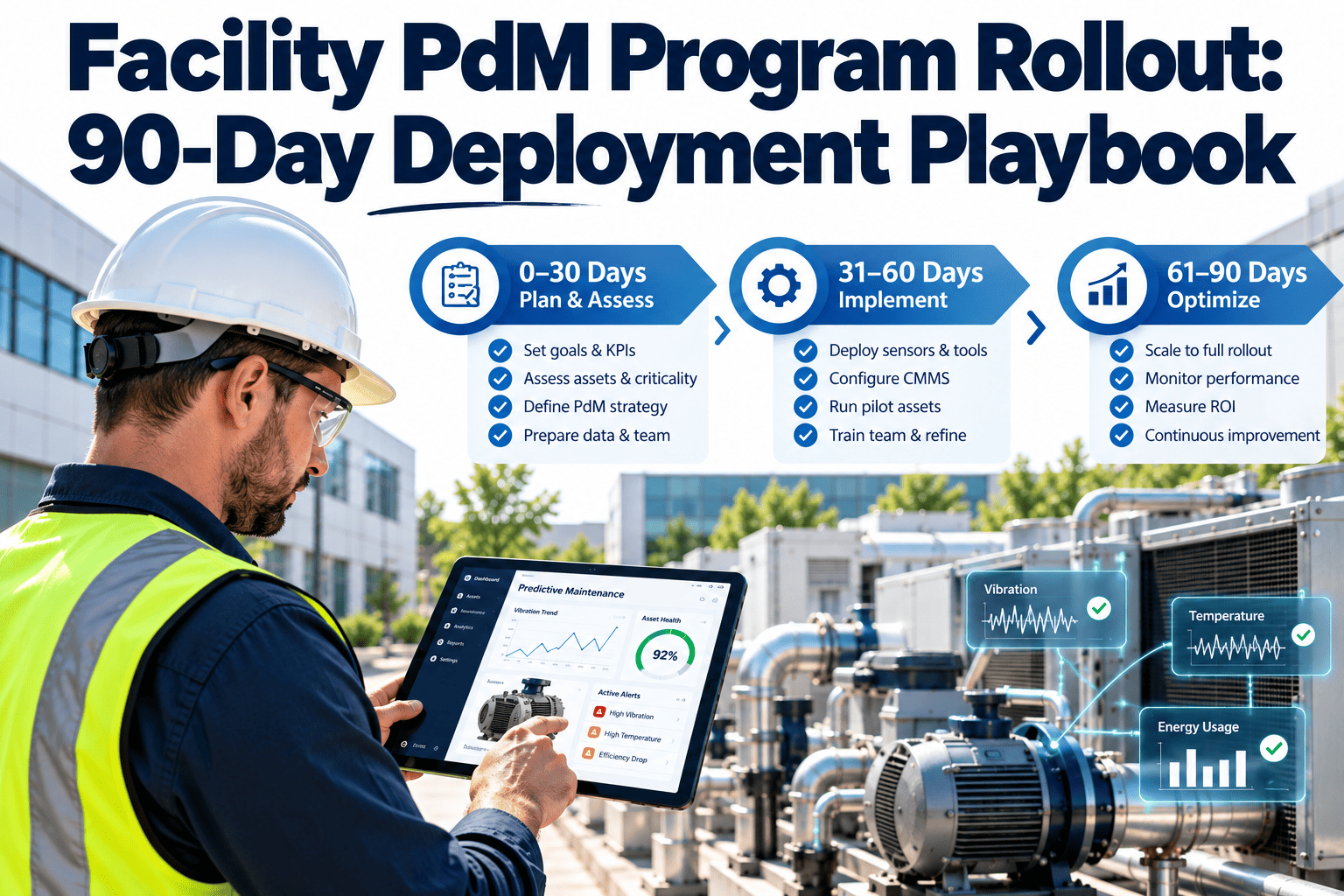
Driving facility management change requires more than an email announcement and a mandatory training session. A structured FM adoption change program moves users through awareness, buy-in, capability, and mastery. Here is a proven 4-phase timeline for ensuring your FM technology rollout achieves sustained user adoption.
Assess & Align (Weeks 1–3)
Identify key stakeholders, map current reactive workflows, and define measurable success metrics. Address FM technology adoption resistance head-on by holding one-on-one sessions with frontline technicians to understand their daily pain points with the legacy system.
Pilot & Prove (Weeks 4–8)
Launch the new platform with a single department or building. Focus heavily on quick wins—like eliminating paper work orders for a single asset class. Demonstrating a 30% time savings in this phase builds the internal advocacy needed for a full facility technology change management rollout.
Deploy & Enable (Weeks 9–14)
Execute the facility-wide rollout in waves. Provide role-based training, super-user support on the floor, and clear documentation. The goal of this FM rollout adoption phase is to ensure no technician is left without immediate help when they encounter the new system.
Reinforce & Optimize (Ongoing)
FM digital adoption is never truly "finished." Establish monthly reviews of system analytics to identify users who are disengaging. Continuously optimize forms, approval routing, and mobile layouts to permanently eliminate facility adoption resistance.
Overcoming Barriers
Common drivers of FM user adoption resistance
Understanding why technicians and managers resist new tools is the first step in dismantling those barriers. Resistance is rarely irrational; it is usually rooted in legitimate operational frustrations that must be engineered out of the rollout process.
| Resistance Driver | Technician Sentiment | Change Management Solution |
|---|---|---|
| Complex Interfaces | "The new app takes 10 clicks to close a work order." | Deploy a mobile-first CMMS with barcode scanning and 1-tap closure. |
| Fear of Micromanagement | "Leadership is just using this to track my location and speed." | Frame analytics around asset health and PM completion, not individual surveillance. |
| Poor Data Migration | "None of the asset history or spare parts transferred over." | Run parallel legacy systems for 30 days and audit data integrity before go-live. |
| Inadequate Training | "I was shown a 2-hour slideshow and told to figure it out." | Provide bite-sized, role-specific video tutorials and floor super-user support. |
Software as a Change Agent
How OxMaint accelerates facility management technology adoption
The easiest way to overcome facility adoption resistance is to deploy software that actually makes your team's day easier. If the new system is harder to use than a paper checklist, adoption will fail regardless of your change management strategy. OxMaint is engineered to drive rapid FM digital adoption by reducing friction at every touchpoint. Here is how OxMaint directly solves the most common adoption killers.
1-Tap Mobile Work Orders
Technicians can scan a QR code, view asset history, complete PM checklists, and close work orders from their phone in seconds. By eliminating paper forms and data entry, OxMaint cuts administrative time by up to 40%.
Transparent Asset Analytics
Dashboards shift the focus from individual tracking to asset reliability. Teams see how their PM completion rates directly reduce unplanned downtime by 30–50%, building intrinsic motivation to use the platform.
AI-Assisted Data Migration
OxMaint automates the heavy lifting of migrating legacy asset data, spreadsheets, and spare-parts inventory. This prevents the "empty database" frustration that derails most FM technology rollouts in week one.
Predictive Maintenance Guidance
Instead of just flagging failures, OxMaint provides AI-driven task recommendations. This elevates technicians from reactive firefighters to proactive reliability engineers, increasing engagement and software stickiness.
See OxMaint on your assets—book a 30-min demo
Stop fighting user resistance with outdated software. Discover how an intuitive, AI-powered CMMS gets your team onboarded and delivering ROI in weeks, not months.
Frequently Asked Questions
FM change management and technology adoption FAQs
Why does facility technology adoption fail so often?
Facility technology adoption fails primarily because organizations focus on the software deployment rather than the human element. When leadership skips structured FM change management, technicians are overwhelmed by complex interfaces, poor data migration, and inadequate training. They naturally revert to familiar legacy processes, causing the FM technology rollout to collapse.
How long does an FM technology rollout take?
A typical FM technology rollout takes between 8 to 14 weeks to reach full facility digital transformation adoption. This includes a 3-week assessment phase, a 4-week pilot program to secure quick wins, and a phased deployment. You can explore a platform designed for rapid onboarding when you Start Free Trial today.
What is the difference between change management and training in facility management?
Training teaches users which buttons to click, while facility change management addresses the behavioral and cultural shifts required to actually use the new system. A successful FM change program incorporates training as one component, alongside stakeholder alignment, communication, quick-win identification, and ongoing reinforcement to overcome facility adoption resistance.
How do you measure FM user adoption success?
FM user adoption is measured using specific platform analytics: login frequency, percentage of work orders closed via the mobile app versus paper, PM schedule adherence, and data completeness on asset records. A strong benchmark is achieving 85% active user engagement within 60 days of the facility management technology rollout.
How can a CMMS reduce FM technology adoption resistance?
A modern CMMS reduces adoption resistance by being easier to use than the old paper or spreadsheet methods. Features like 1-tap mobile work orders, QR code asset scanning, and automated data migration eliminate the friction that frustrates technicians. To see how an intuitive interface accelerates adoption, Book a Demo with our team.
Transform your facility management change trajectory today
Empower your maintenance and reliability teams with an AI-powered CMMS they will actually want to use. Drive seamless FM digital adoption, eliminate unplanned downtime, and take control of your asset lifecycle.
Free 14-day trial · No credit card required