Every facility has a bad week. A chiller compressor fails in July, a roof drain backs up before a storm, a main switchboard trips and takes a floor with it. The only question is whether the money to respond is already set aside or has to be argued for while the building is affected. A contingency reserve answers that question in advance. This guide explains how to size an emergency contingency for facility operations, how to fund it, who may spend it, and how to keep it from becoming a slush fund. It also shows how Oxmaint maintenance software supplies the repair history that makes sizing defensible.
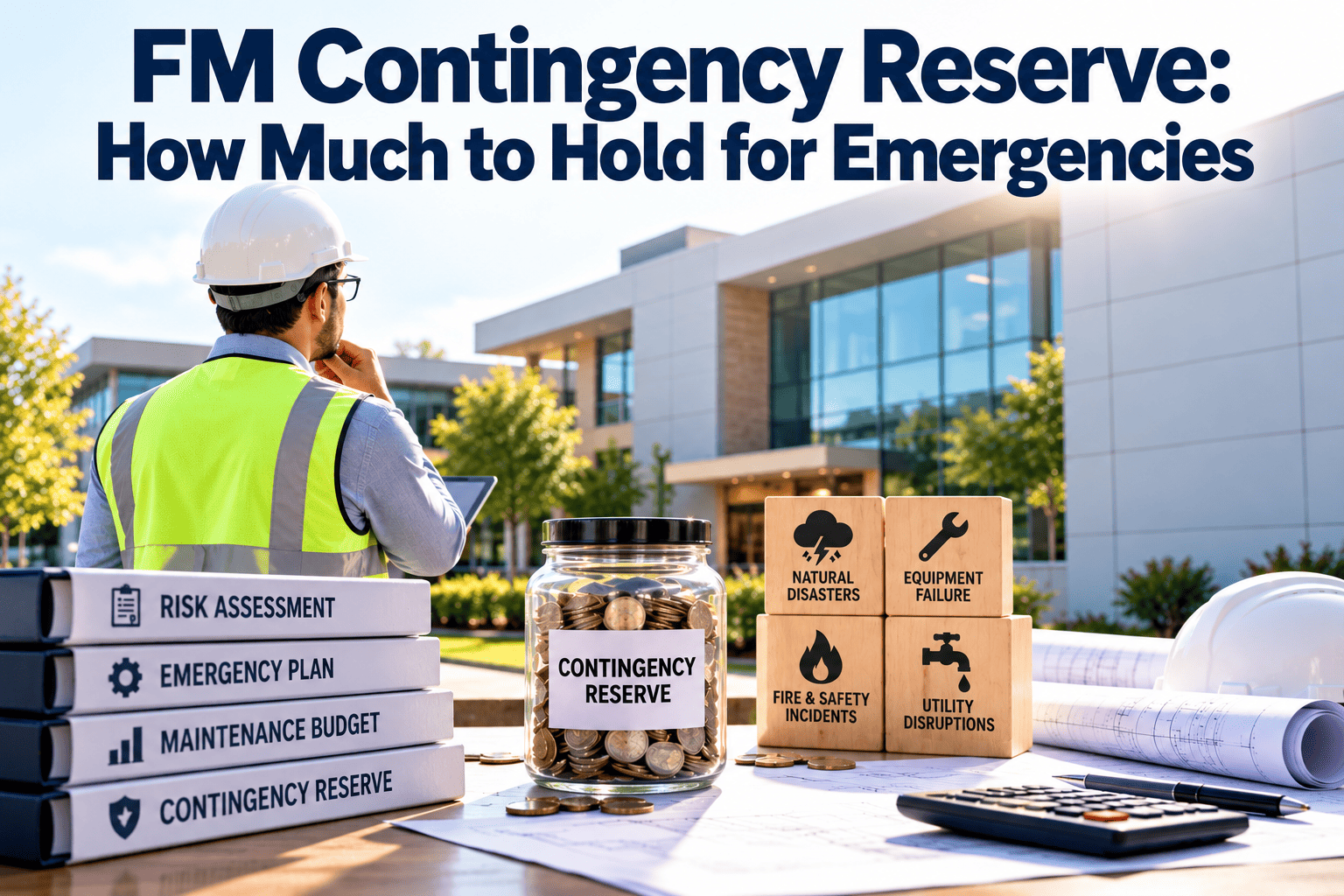
FM Contingency Reserve: How Much to Hold for Emergencies
Size the emergency fund from your own repair history, fund it deliberately, and spend it under clear rules. Protect planned work when the unexpected arrives.
Contingency, capital reserve, and emergency response are different pots
Mixing them up is the most common budgeting error. Each covers a different kind of uncertainty and needs its own rules.
| Fund | Purpose | Time horizon | Typical trigger |
|---|---|---|---|
| Operating contingency | Unplanned repairs and cost overruns within the current fiscal year | Within the year | A failure or event that was not in the plan |
| Capital reserve | Planned replacement of major systems such as chillers, roofs, and lifts | Multi-year | Equipment reaching the end of its useful life |
| Emergency or catastrophe fund | Major events such as floods, fires, or storm damage | Rare and severe | Declared incident that exceeds normal repair budgets |
| Insurance | Transfers the largest and rarest losses to a third party | Policy period | Covered loss above the deductible |
What published practice tells you about sizing
There is no single correct percentage. Public policies and industry guidance vary because they cover different things. Read the range as a reminder to size from your own data.
- Some institutions hold a small annual operating contingency, for example around 3 percent of operating expenditures, to cover shortfalls and unplanned spending.
- Some facility funds set an operating reserve between 5 and 10 percent of fixed annual costs.
- Some maintenance guidance suggests a contingency of 10 to 20 percent of the maintenance budget, calibrated to emergency history.
- Many facility teams begin with a band such as 8 to 12 percent of the operating budget, then adjust for history and risk.
A five-step method for sizing your contingency
Start with what has actually happened, then adjust for what could happen.
Pull two to three years of unplanned spend
Separate emergency and reactive work orders from planned work, using labor, parts, and contractor costs.Calculate the unplanned share
Divide unplanned spend by the total maintenance or operating budget for each year, then look at the average and the worst year.Adjust for risk
Raise or lower the figure using asset age, critical equipment, climate exposure, and redundancy.Set a base and a stretch
Fund the base in the budget and agree how a stretch amount would be sourced if the base runs out.Review every year
Compare actual use with the reserve and resize as your planned work share improves.A simple worked example
Risk factors that move the number
History is a starting point. Adjust for conditions that history may not capture.
| Factor | Raises the contingency | Lowers the contingency |
|---|---|---|
| Asset age | Many assets near or past typical service life | Recently replaced or well-maintained equipment |
| Critical equipment | Single points of failure with no backup | Redundant systems that can cover failures |
| Planned work share | Mostly reactive maintenance | High share of planned and condition-based work |
| Climate and exposure | Roofs, drainage, or plant exposed to storms or extreme heat | Sheltered buildings with proven drainage and protection |
| Insurance terms | High deductibles that the facility must fund itself | Low deductibles and broad cover |
| Tenant commitments | Strict service levels with penalties for outages | Flexible service agreements |
| Data quality | Little repair history, so uncertainty is high | Detailed history that narrows the range |
Funding models and their trade-offs
Where the money sits shapes how it gets used. Choose a model that matches how your portfolio is managed.
Ring-fenced line in each building budget
- Clear accountability for each site
- Risk of unused money at some sites and shortfalls at others
- Works for sites with separate owners or tenants
Central pooled reserve
- Spreads risk across the whole portfolio
- Smaller total reserve for the same protection
- Needs clear rules so one site does not drain it
Hybrid with a local first layer
- Sites fund small events from a local amount
- The central pool covers larger events
- Encourages local ownership with portfolio backup
Test the reserve against three scenarios
Stress-testing shows whether the number you chose is plausible. Use events your own portfolio has seen or could plausibly see.
| Scenario | What it looks like | What it tests | Pre-agreed response |
|---|---|---|---|
| Single critical failure | A chiller compressor, main pump, or switchboard fails in peak season | Whether one event fits within the base amount | Approve within tier rules and start the replenishment plan |
| Cluster of small failures | Many modest repairs in a short period, such as after a heat wave | Whether pacing triggers fire before the reserve is gone | Review causes, defer non-critical work, and prioritize critical assets |
| Weather or utility event | Roof leaks, drainage failure, or power disruption across several buildings | Whether the pooled reserve and insurance work together | Declare an incident, document damage early, and notify insurers |
Mistakes that drain a reserve
Most reserves fail through habit rather than a single bad decision.
- Treating the reserve as extra budget for projects that were not planned.
- Never recording why money was drawn, so no pattern can be seen.
- Sizing from a single good year and leaving the fund too thin.
- Using the capital reserve to cover routine breakdowns without a transfer record.
- Allowing the same asset to draw on the reserve repeatedly without a root cause review.
- Letting the reserve stay at its low point after a big event with no replenishment plan.
Size your reserve from real repair history
Record every emergency repair, cost, and cause so your contingency is based on evidence.
Drawdown rules: who can spend, and on what
A reserve with no rules gets spent on whatever is urgent to whoever is loudest. Agree the rules before the first emergency.
What qualifies, and what does not
- Qualifies: failures of critical systems, safety hazards, storm damage, and tenant-affecting outages.
- Does not qualify: scope additions, deferred planned work, and items that should be in the capital plan.
- Every drawdown records the asset, cause, amount, approver, and whether the event was foreseeable.
- Foreseeable items that keep drawing from the reserve should move into the planned budget.
From event to replenishment
Each drawdown follows the same path, so the record builds itself and the reserve gets restored.
- EventFailure, incident, or hazard is reported
- ClassifySafety, critical system, or other
- AuthorizeApproval at the right tier
- RepairWork order, labor, parts, contractors
- RecordCost and cause linked to the asset
- ReplenishPlan how the reserve is restored
Pacing the reserve through the year
Watch how fast the reserve is being used. Agree in advance what happens at each trigger.
| Status | Example trigger | Action |
|---|---|---|
| Green | Reserve use tracks at or below the planned pace | Continue normal approvals |
| Amber | Reserve use is running well ahead of the planned pace | Review recent drawdowns and look for repeat causes |
| Red | The reserve is on track to run out before year-end | Defer non-critical work, seek additional funding, or reduce preventive work on non-critical assets |
Shrinking the need for contingency
The best way to reduce the reserve you need is to cause fewer emergencies. Maintenance strategy and reserve size are linked.
- Move work from reactive to planned by fixing the failure modes that appear in the reserve records.
- Use condition monitoring on critical rotating equipment to catch problems early.
- Keep critical spares for long-lead items so repairs are not delayed by procurement.
- Inspect roofs, drainage, and plant exposed to weather before the season that stresses them.
- Confirm backup systems and emergency contracts work before they are needed.
- Review every drawdown for a root cause and a preventive action.
Presenting the reserve to executives and finance
A reserve request is easier to approve when it is framed as a decision, not a plea.
- Show unplanned spend for the last two to three years and the share of the total budget it represents.
- Show the largest single events and what they cost, using real work orders.
- Explain the rules for spending and replenishing, so leaders can see the reserve is governed.
- Present options, such as a smaller reserve with higher risk or a larger one with lower risk, and state the trade-off.
- Link the reserve to a plan for reducing emergencies, so approval is not permanent growth in the fund.
- Commit to reporting use and results at fixed intervals.
Replenishing after a drawdown
A reserve that is spent and never restored protects nothing next time. Decide the method before the event.
| Method | How it works | Watch for |
|---|---|---|
| Next-year budget top-up | Restore the reserve in the following budget cycle | A gap during the current year if another event occurs |
| In-year reallocation | Move money from underspent lines during the year | Starving planned work that protects reliability |
| Monthly contribution | Rebuild gradually from operating funds | Slow recovery after large events |
| Insurance recovery | Reimburse covered losses above the deductible | Delays in payment and proof-of-loss documentation |
How Oxmaint supports a contingency reserve
Sizing and governing a reserve depends on records of what failed, what it cost, and who approved it.
Work order cost history
Separate planned and reactive spend by asset and failure cause to size the reserve from evidence.Corrective maintenance tracking
Record emergency work orders with time, parts, contractors, and approvals.Asset register and condition
Flag aging or critical assets that raise the risk of costly failures.Preventive maintenance
Schedule the inspections and tasks that reduce the number of emergencies.Spare parts inventory
Hold critical spares so repairs avoid expensive rush purchasing.Reports and dashboards
Track planned versus reactive spend and repeat failures through the year.KPIs for contingency management
Measure the reserve and the behavior that drives it.
Reserve used
Amount drawn divided by amount funded, tracked monthlyUnplanned spend share
Unplanned spend divided by total maintenance spendForeseeable drawdowns
Drawdowns later judged foreseeable divided by all drawdownsRepeat failures
Assets drawing on the reserve more than once in a yearTime to approve
Hours from request to approval, by tierReplenishment on time
Reserve restored within the agreed period after useFM contingency reserve FAQs
What percentage should an FM contingency be?
Published practice ranges widely. Many teams start around 8 to 12 percent of the operating budget, then adjust using unplanned spend history and risk.
Is contingency the same as a capital reserve?
No. Contingency covers unplanned costs within the year, while a capital reserve funds long-term replacement. Keep them separate.
What if the reserve runs out early?
Defer non-critical work, seek approval for more funding, or reduce preventive work on non-critical assets. Book a demo to plan the rules.
Who should be allowed to draw on it?
Use approval tiers by amount and type, with every drawdown recorded against an asset and a cause.
How does Oxmaint help?
It records unplanned work, costs, and asset history, so the reserve is sized from evidence. Sign up free to start collecting it.
Hold the right reserve and spend it by the rules
Give your team one record of repairs, costs, and approvals so emergencies are funded without raiding planned work.