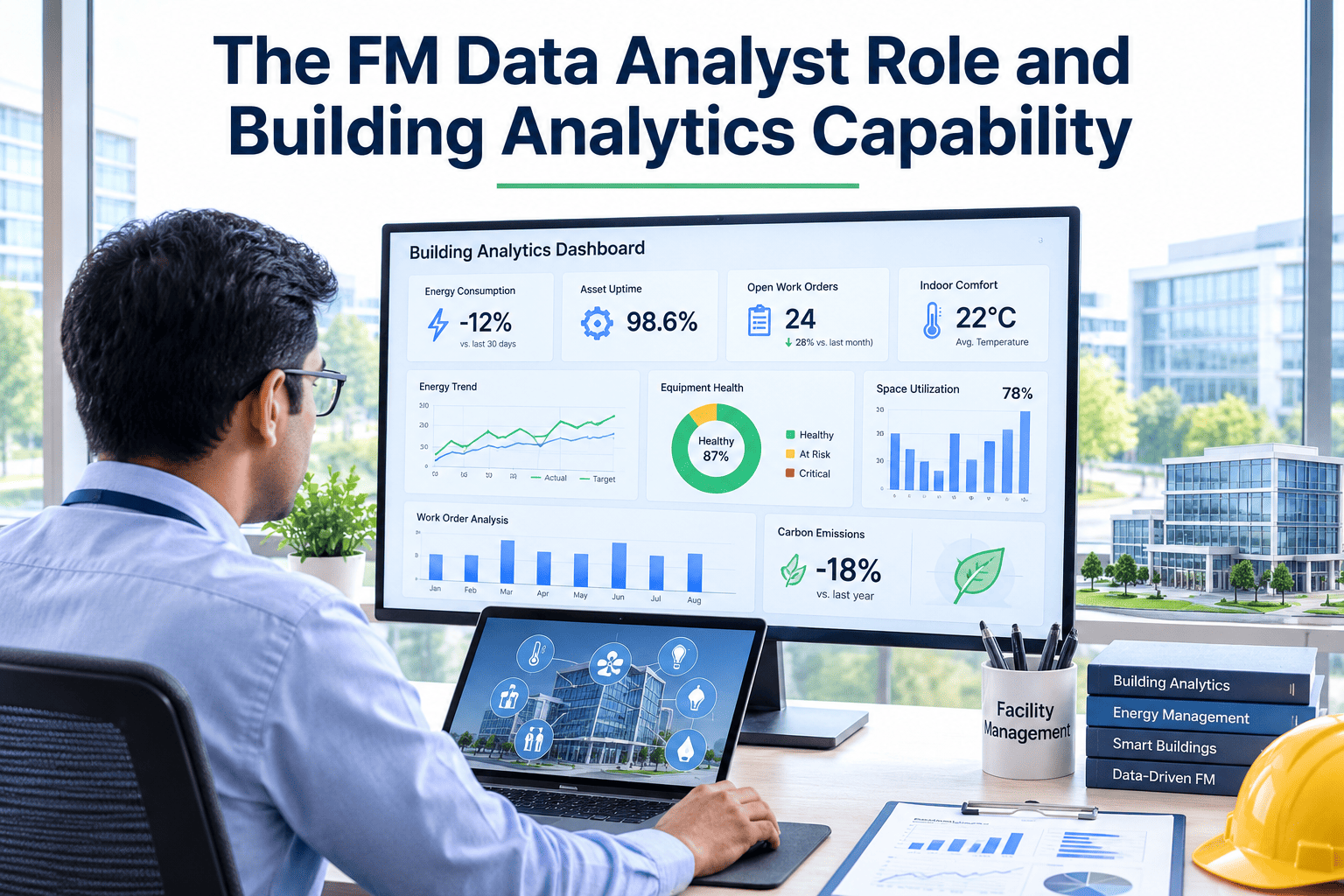
Facility management job postings increasingly list "data analyst" or "FM analytics lead" alongside the usual maintenance and operations titles — a role that barely existed in FM organizational charts a decade ago. The shift is straightforward: portfolios generate more work order, sensor, and cost data than any single facilities manager can interpret manually, and the teams that hire someone to make sense of it move ahead of the ones that don't. This guide covers the FM data analyst role and how to build that analytics capability from scratch, whether you are hiring the first dedicated analyst or growing the skill inside an existing team using tools like Oxmaint's reporting layer.
Analytics & Reporting
Team Capability
FM Careers
What Changes When FM Builds an Analytics Capability
Before
Reports built manually, once a quarter, from exported spreadsheets nobody trusts fully.
Analytics Capability
Dashboards updated continuously, decisions backed by real work order and asset data.
After
Budget requests, staffing, and vendor decisions defended with numbers, not instinct.
Role Definition
What an FM Data Analyst Actually Delivers
PM compliance reporting
Tracks completion rates by technician, asset class, and site, and flags where scheduled work is quietly slipping.
Cost and downtime analysis
Connects work order labor and parts cost to asset age and failure frequency to justify repair-versus-replace calls.
Vendor and contractor scorecards
Builds response-time and first-time-fix benchmarks that turn subjective vendor complaints into renewal decisions.
Capital planning support
Supplies the failure-history and remaining-life data that planning and finance teams need to prioritize capital requests.
Give Your Analyst Data Worth Analyzing
Oxmaint captures clean, structured work order and asset data automatically, so your analytics capability starts from a reliable base instead of a data-cleanup project.
Skills & Tool Stack
What the Role Requires — and What It Runs On
| Capability | Typical Tool | What It Enables |
|---|---|---|
| Work order and asset data | CMMS reporting module | Source of truth for PM compliance, downtime, and cost |
| Spreadsheet modeling | Excel or Sheets, pivot-level fluency | Ad hoc analysis and budget scenario modeling |
| Dashboarding | BI tool or native CMMS dashboards | Recurring reporting without manual rebuilding each cycle |
| Basic statistics | Trend lines, MTBF/MTTR calculation | Separating real failure patterns from normal variation |
| Stakeholder communication | Presentation and narrative framing | Turning a chart into a budget or staffing decision |
Building the Capability
Four Stages of Growing FM Analytics Maturity
1
Clean data capture
Standardize how technicians log work orders so the data is analyzable before anyone tries to analyze it.
2
Ad hoc reporting
One person, often part-time, starts pulling recurring reports for leadership from CMMS exports.
3
Dedicated analyst role
A named owner builds standing dashboards and starts feeding capital and staffing decisions with data.
4
Embedded analytics
Every FM decision — vendor renewal, PM frequency, headcount — routes through the analytics function by default.
Start With Dashboards Your Team Already Trusts
See how Oxmaint's built-in reporting gives a new or growing analytics function a working starting point on day one.
Frequently Asked Questions
FM Data Analyst Role — Common Questions
Does a facility team need a full-time data analyst to build this capability?
No — many teams start with a part-time or rotating owner who pulls recurring reports from the CMMS, and only hire dedicated headcount once the reporting workload justifies it. Start a free trial to see what standing dashboards look like before committing to a hire.
What background suits someone moving into an FM analyst role?
Maintenance planners and reliability technicians often transition well, since they already understand asset behavior — the analytics tools are learnable, but domain knowledge of equipment failure patterns is harder to teach.
What is the biggest blocker to building FM analytics capability?
Inconsistent data entry, not missing skills. If technicians log work orders differently across sites, no analyst can produce a trustworthy report from that data. Book a demo to see how structured CMMS forms fix this at the source.
Can a CMMS replace a dedicated BI tool for FM reporting?
For most facility teams, yes — native CMMS dashboards cover PM compliance, downtime, and cost reporting without needing a separate BI license, unless the portfolio spans systems beyond maintenance.
How is FM analytics maturity typically measured?
By how decisions get made — whether vendor renewals, PM frequency changes, and capital requests are backed by reported data or by anecdote. Start a free trial to establish a reporting baseline for your own portfolio.
Turn Maintenance Data Into a Real Capability
Oxmaint gives your team clean data capture and built-in reporting, so building an FM analytics function doesn't start from zero.